NATO Without the U.S.: The Fastest Path to a Deterrence Failure
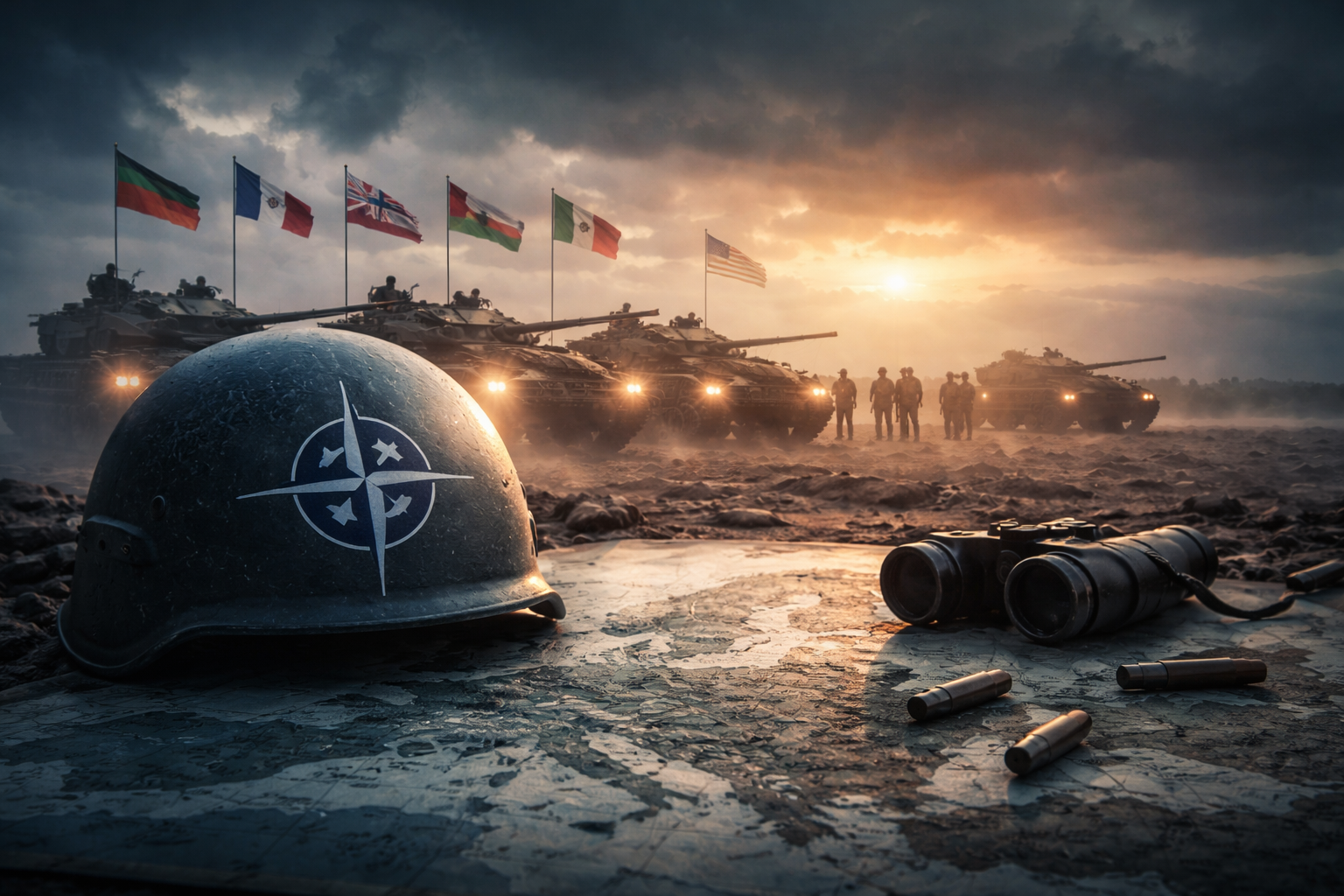
Post-America NATO: What Changes If the U.S. Steps Back
The Alliance Without Its Anchor
A NATO war without the United States would not begin with a treaty argument. It would begin with a race: to move forces, protect skies, and keep supply flowing while the attacker tries to win fast.
That race feels less hypothetical, as European leaders openly debate a stronger, more self-reliant security posture alongside NATO.
The brutal truth is that NATO is designed around U.S. leadership and U.S. “strategic enablers”—the high-end systems that make everyone else’s forces work together at speed. Without those enablers, Europe can still fight, but it fights slower, with more friction, and with less margin for error.
The hinge is not whether Europe has brave soldiers or big budgets. The question is whether Europe can replace the U.S. as the alliance’s operational operating system—command, intelligence, and logistics—before the shooting starts.
The story turns on whether Europe can turn “allies” into one warfighting machine fast enough.
Key Points
NATO has thirty-two members, mostly in Europe, which is a lot of manpower, industry, and geography.
The U.S. is still the heavyweight in defense resources across NATO members, and it also provides many of the capabilities that tie allied forces together in real combat.
“Without the U.S.” can mean several realities: the U.S. stays in NATO politically but is delayed, limited, or focused elsewhere when an Article 5 crisis erupts.
Europe’s biggest near-term vulnerabilities are not slogans like “strategic autonomy,” but specific gaps: air-and-missile defense, deep strike, intelligence, electronic warfare, and munitions resupply.
The U.S. holds a central position in NATO's nuclear deterrence; its removal alters the escalation calculations, even if Britain and France continue to be nuclear powers.
The most important signal is not speeches about spending. It is whether Europe reorganizes command roles, procurement, and industrial production around a wartime plan, not national preference.
Article 5 is NATO’s collective defense promise: an attack on one ally is treated as an attack on all. In practice, that promise becomes real only if forces can mobilize quickly, fight under a single plan, and sustain losses.
Europe has strategic depth, but it also means a patchwork of militaries with different equipment, readiness, and stockpiles.
The United States remains central in two ways. First, it is a major share of NATO members’ total military spending, according to SIPRI’s 2024 estimate. Second, it provides a large portion of the enabling capabilities that modern war depends on: long-range intelligence, secure networks, electronic attack, air refueling, strategic lift, and large-scale resupply.
NATO’s command design reflects that reality. The alliance’s operational command is headed by SACEUR, Supreme Allied Commander Europe, a role traditionally held by a U.S. commander who is also dual-hatted as the commander of U.S. European Command.
The strategic nuclear forces of the alliance, particularly those of the United States, serve as the "supreme guarantee" in NATO's nuclear posture. Additionally, NATO relies on forward-deployed U.S. nuclear weapons in Europe and allied dual-capable aircraft.
The boundary risk: why “day one” can decide the war
A U.S.-absent NATO fight is most dangerous when it starts fast and close to NATO territory. The attacker aims to establish a decisive victory before the arrival of reinforcements and before the alliance can reach a consensus on a cohesive operational response.
European frontline states want speed and certainty. Rear-area states often want deliberation and risk control. That mismatch matters more when the U.S. is not the default coordinator and amplifier.
The simplest scenario split is timing: a U.S. that is absent versus a U.S. that is merely late. In the “late” scenario, Europe must maintain its position until U.S. support arrives, while in the "absent" scenario, Europe must assert its strength through its own depth, stockpiles, and command.
The competing models: Europe’s mass vs America’s enablers
One model says Europe can do this: Europe is wealthy, populous, and already fields serious militaries. Over time, it can build what it lacks.
The other model says Europe struggles in the first phase of a major war because it fights as a collection of national forces that expect the U.S. to supply key missions and connective tissue.
Both models can be true depending on the time horizon. Over years, budgets and procurement can change. The alliance battles with its existing fielded, trained, networked, and stocked forces over days and weeks.
That is why the real question is not, “Can Europe spend more?” It is, “Can Europe produce combat power fast enough, under one plan, with one logistical rhythm?”
The core constraint: the invisible war of enablers and resupply
High-end combat is not only tanks and troops. It is the ability to find targets, suppress enemy air defenses, keep aircraft fueled, move heavy equipment, protect networks, and replace munitions at scale.
RUSI’s blunt point is that most non-U.S. NATO members rely heavily on the U.S. to conduct critical missions in a major fight, including suppression/destruction of enemy air defenses, command-and-control networks, and rapid resupply of munitions and consumables.
When those enablers are thin, European forces can still fight—but they fight at shorter ranges, with less air freedom, and with more caution. That slows tempo, raises losses, and increases the odds that an attacker’s early gamble pays off.
This is also where industry becomes strategy. NATO's updated Defence Production Action Plan explicitly aims to scale industrial capacity by aggregating demand, improving standardization, and placing more multiyear multinational procurement contracts. In a U.S.-led war, “who can replenish” becomes as important as “who can deploy.”
The hinge: who runs NATO’s command-and-logistics operating system
The most fragile point in a U.S.-free NATO fight is not courage. It is orchestration.
NATO’s operational leadership has long been built around an American SACEUR, tied into U.S. European Command through the dual-hat. If the U.S. is not fighting, Europe has to replace more than just firepower. It has to replace the default integrator: the authority that can fuse intelligence, assign missions, prioritize air defense, and drive sustainment across borders.
NATO is already shifting some responsibilities. In February 2026, NATO announced a new distribution of senior officer roles in which European allies will lead all three Joint Force Commands at the operational level, while the U.S. continues to lead key theater component commands and maintains the role of SACEUR. That is burden-sharing—but it still keeps the core “operating system” anchored to U.S. command.
In a true U.S.-absent fight, Europe would need a wartime command spine that can do what the U.S. usually makes look easy: turn 30-plus national inputs into one coherent output.
The measurable signals: what readiness looks like when it’s real
You can tell whether Europe is closing the U.S. gap by looking at three signals that are hard to fake.
First: command reality. Are Europeans taking on operational leadership roles with the staff depth, authorities, and rehearsed procedures that crisis demands? NATO’s 2026 command redistribution shows movement, but it also underlines what remains U.S.-led.
Second: procurement that matches a war plan. NATO’s production plan emphasizes aggregated demand and standardization for a reason: fractured buying produces fractured readiness.
Third: investment commitments that translate into outputs. NATO says allies committed in 2025 to a 5% of GDP investment target by 2035, split between core defense requirements and broader security-related spending, with annual plans to show a credible path. The signal is not the percentage. It is whether annual plans and contracts produce deployable units and stockpiles, not paper compliance.
The forward risk: deterrence credibility and escalation control
The hardest part of a NATO fight without the U.S. is not only winning. It is controlling escalation.
NATO’s own language says the strategic nuclear forces of the alliance—particularly those of the United States—are the “supreme guarantee” of allied security, and NATO also relies on U.S. forward-deployed nuclear weapons in Europe. Remove that center of gravity, and adversaries will test the edges: with long-range strikes, coercive threats, and attempts to split allies politically.
Britain and France remain nuclear powers, and NATO notes their independent forces contribute to overall deterrence. But the question in a U.S.-absent war is whether those forces translate into a credible, alliance-wide escalation posture that adversaries believe will be used if needed.
That belief is shaped by peacetime decisions: command arrangements, consultation mechanisms, and whether Europe has enough conventional strength to avoid being pushed into a nuclear corner.
What Most Coverage Misses
The hinge is that Europe does not just need “more defense.” It needs a single wartime operating system that makes national forces fight as one.
That changes incentives because it forces governments to spend against shared capability targets, shared logistics plans, and shared stockpiles—rather than spreading money across nationally preferred programs that look good at home but do not add up in war.
You will know this hinge is being pulled if, over the next year, you see two things: multinational, multiyear contracts for prioritized munitions and enablers, and deeper European operational command roles matched by large, rehearsed staffs and authorities that work in crisis.
What Happens Next
In the short term, the decisive actions are mechanical: who assumes operational control, how quickly air-and-missile defense is reinforced, and whether allies can move forces and supplies across borders without delay. The main consequence is speed, because the side that sets the tempo early can force the other into riskier choices.
In the medium term (weeks to months), watch whether NATO’s industrial agenda becomes binding reality: aggregated demand, standardization, and multiyear procurement that increases stockpiles and surge capacity. That is the only way to make “sustainment” more than a talking point.
In the long term, years, the key test is whether the 2035 investment commitment produces output: ready formations, integrated air-and-missile defense, resilient networks, and the command depth to run major operations without U.S. leadership.
Real-World Impact
A frontline NATO government would shift daily life toward readiness: larger reserve call-ups, more military convoys on public roads, and tighter rules around critical infrastructure—because the first job is keeping the homeland functional under pressure.
A European manufacturer would see the defense economy collide with normal business. Long-term orders are good for revenue, but bottlenecks in skilled labor, components, and testing capacity can spill into civilian supply chains and hiring.
A shipping and logistics firm would love the friction: rerouted routes, higher insurance, and priority lift for military cargo. The cost shows up as delays and higher prices, not just headlines.
A household far from the front would still feel it through budgets. Defense spending and resilience projects compete with other public priorities, and governments will have to explain trade-offs in plain language.
The European Deterrence Test Has a Clock
A NATO fight without the U.S. is not a single scenario. It is a spectrum: the U.S. delayed, distracted, limited, or was absent. The closer you move toward “absent,” the more Europe’s bottleneck becomes integration—turning money and national forces into shared combat power that arrives on time.
The fork in the road is simple: Europe either builds the command-and-sustainment machine that makes collective defense real, or it keeps buying defense in national fragments and hopes the crisis arrives later.
Watch the signposts that cannot be faked: who holds operational command roles, whether multinational procurement becomes the default, and whether stockpiles and readiness measurably rise against NATO’s own capability targets.
The historical significance is that the alliance is being forced to prove, in peacetime, whether its deterrence is a promise or a system.
