NATO’s “European-Led” Pivot: The Burden-Sharing Stress Test
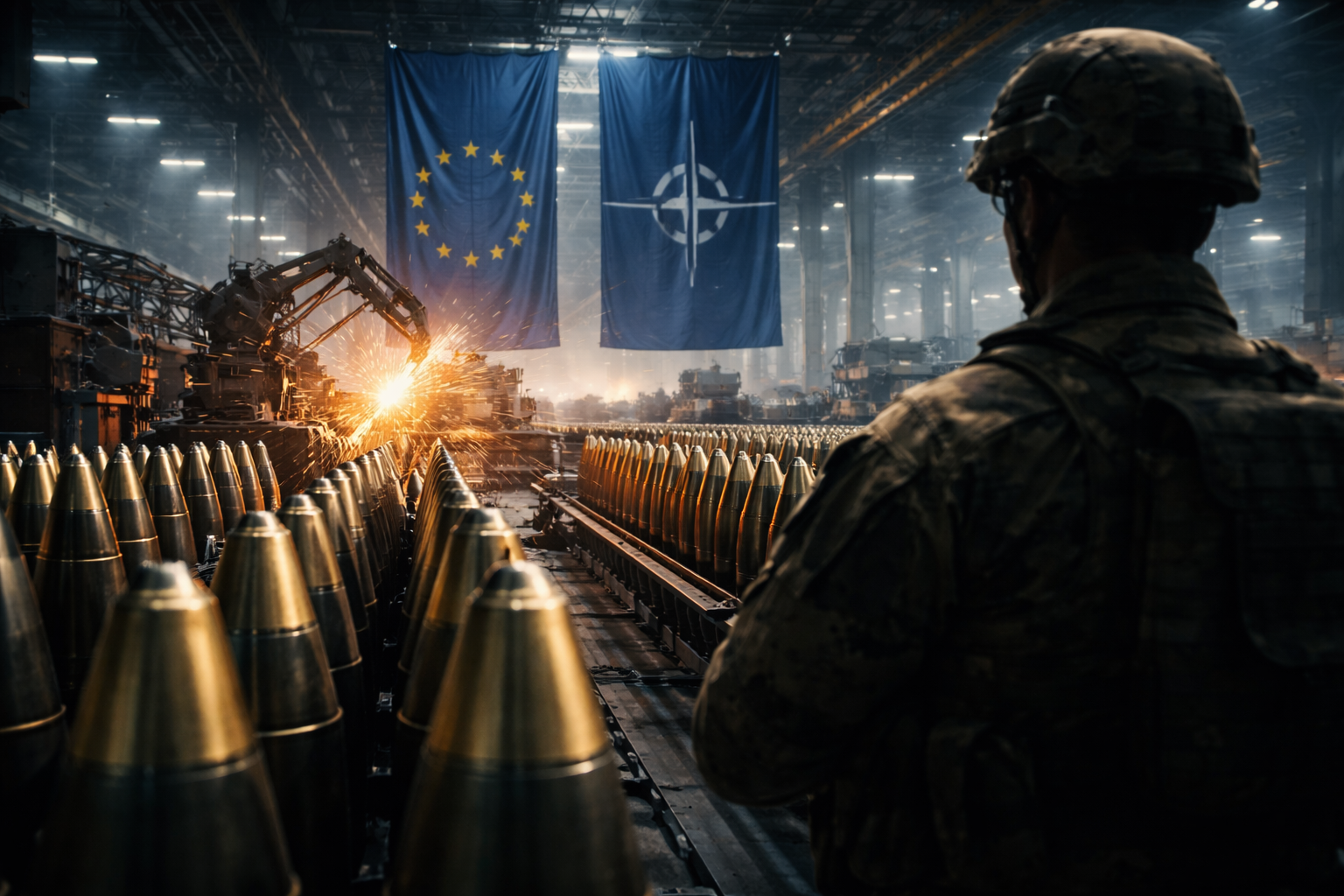
European-Led NATO: the spend-readiness-production test
NATO Signals a European-Led Future—Here’s What Could Break First
NATO’s newest line sounds reassuring: Europe will lead more, and America will stay anchored.
The message was sharpened at the Munich Security Conference, where NATO’s Secretary General described a gradual shift towards a more European-led posture, coordinated with the United States through NATO’s defense planning.
On paper, it presents a straightforward compromise: Europeans allocate more resources and assume greater responsibility, while the US maintains its nuclear and conventional defenses.
In practice, “European-led” only becomes real when it shows up in force readiness, ammunition stocks, and industrial output—the unglamorous bits that decide whether deterrence holds.
The story turns on whether Europe can convert rising budgets into deployable mass faster than threats can exploit the gap.
Key Points
NATO leadership is signaling a more European-led alliance over time while insisting the United States remains firmly anchored in NATO’s structure and deterrence.
“European-led” is not one thing: it can mean who supplies forces, who commands operations, and who can sustain a long fight with stocks and production.
NATO’s defense planning process is positioned as the mechanism that translates political intent into specific capability targets and timelines.
A credible shift requires measurable movement in three areas: spending, readiness, and production—not just pledges.
The major constraint is substitution speed: some high-end capabilities and enabling functions are difficult for Europe to replace quickly at scale.
The next test will not be a speech; it will be a crisis that forces rapid deployment, resupply, and industrial surge.
Background
NATO has spent the last decade pushing members to spend more, but Russia’s war in Ukraine and a tougher security environment have raised the bar from “more money” to “warfighting readiness.”
At the 2025 Hague summit, allies agreed to a new 5% investment commitment by 2035, structured as 3.5% for core defense requirements and 1.5% for defense- and security-related spending, with annual national plans to show a credible path. That matters because it ties money to capability targets rather than vibes.
NATO’s Defence Planning Process (often shortened to NDPP) is the internal engine: it assigns capability targets to allies and assesses whether plans and forces add up to what NATO’s regional defense plans require.
At the same time, NATO has been shifting from smaller crisis response to layered readiness, including a tiered model intended to make large forces available at shorter notice.
That’s the context for the new rhetoric. The question is whether the machinery can now force delivery.
Analysis
What “European-led” actually means inside NATO
There are three overlapping meanings, and only one of them is mostly rhetorical.
1) Force provision (who brings the mass).
"European-led" can mean European allies provide a larger share of the combat brigades, air sorties, maritime presence, logistics, and sustainment needed for NATO’s plans—especially on Europe’s eastern flank.
2) Operational leadership (who commands and plans).
It can also mean Europeans increasingly hold key operational leadership roles, run more day-to-day command functions, and generate more of the headquarters staff and enabling units needed to execute plans.
3) Strategic guarantee (who underwrites escalation).
Lastly, the term "anchored US" refers to the elements that Europe cannot swiftly replace, such as nuclear deterrence, specific high-end enablers, and the capacity to rapidly deploy global assets into Europe.
In other words, “European-led” does not mean "US-absent." This implies that Europe assumes a more significant role, while the US continues to serve as the decisive backstop in specific domains.
Three measurable indicators that turn rhetoric into reality
To convert speeches into something you can track, use three indicators that are hard to fake.
Indicator 1—Spend that is tied to capability targets (not just a GDP number).
The useful measurement is not “Did spending rise?” But “Are national plans credibly resourcing NATO capability targets on a schedule that closes specific shortfalls?”
A practical proxy is whether allies publish multi-year investment plans that map spending to deliverables (air defense batteries, munitions contracts, ready brigades, logistics units) and whether NATO assessments treat those plans as credible.
Indicator 2—Readiness that is proven by time-to-move, not PowerPoint.
NATO’s readiness model is explicitly time-based. The real test is how much combat power Europe can generate inside the shortest readiness tiers and actually deploy with sustainment.
Measurement proxies include the number of units at the highest readiness, exercise performance (movement, integration, and ammunition expenditure rates), and how quickly forces can be reinforced across borders with functioning logistics and permissions.
Indicator 3—Production that is measured in throughput and lead time.
Deterrence fails when stocks run down faster than factories can refill them. The trackable reality is contracted production capacity, delivery lead times, and standardization that allows shells, missiles, spares, and drones to be shared across allies.
If procurement stays fragmented, Europe can spend more and still end up with incompatible kit and slow replenishment.
These three indicators work together: spending funds readiness; readiness burns munitions; production determines whether preparedness is sustainable.
Command, procurement, and credibility: where the friction lives
The most important fights in a “European-led” transition are bureaucratic, not cinematic.
Procurement.
Europe has long struggled with fragmented buying: too many variants, too many national priorities, too little pooled demand. That drives up unit costs, stretches lead times, and makes wartime interchangeability harder.
Stockpiles.
Ammunition and missile stocks are the silent credibility layer. You can announce new brigades, but if stocks and resupply plans are thin, a long fight becomes a strategic gamble.
Industrial capacity.
Industrial surge is not magic; it’s contracts, skilled labor, supply chains, test ranges, explosives production, and predictable demand. The ramp happens, or it doesn’t.
Planning discipline.
This is why NATO keeps pointing back to defense planning: it’s the tool designed to stop “announce and forget” politics.
Call the bluff: capabilities Europe still can’t substitute quickly
If someone says, “Europe can take over,” the honest follow-up is, “Take over what, at what scale, and by when?” The substitution problem is steepest in five areas.
1) Nuclear deterrence and escalation management.
Europe has nuclear capabilities, but the US role in extended deterrence remains foundational. Replacing that political-military guarantee quickly is not realistic.
2) Integrated air and missile defense at scale.
Europe is improving, but the coverage problem is hard: sensors, interceptors, command networks, stock depth, and sustained resupply. Building layered defense quickly is expensive and production-limited.
3) Intelligence, surveillance, reconnaissance (ISR), plus space-enabled targeting.
High-end ISR and space support (tracking, communications, timing, and targeting) are major force multipliers. Europe has pieces of this, but the US remains disproportionately important.
4) Strategic lift, aerial refueling, and rapid sustainment logistics.
Moving heavy forces and sustaining them at pace is an enabler, not a headline. Shortfalls here turn “we have forces” into “we can’t get them there in time.”
5) High-end suppression of enemy air defenses and deep strike ecosystems.
Modern war rewards the side that can find, jam, and disable systems at range. Electronic warfare, specialized munitions, and integrated kill chains are hard to build quickly and harder to scale.
None of this means Europe is weak. It means “European-led” is not a moral statement; it is a production and readiness timetable.
What Most Coverage Misses
The hinge is simple: the transition lives or dies on standardized, pooled procurement that turns European spending into interchangeable munitions and sustainment.
Here’s the mechanism. Defense spending rises fastest on paper, but warfighting power rises fastest when allies buy compatible kits, sign multi-year contracts, and create predictable demand that industry can scale against. In the absence of this, Europe's ability to lead politically and maintain operational dependence during a crisis hinges on its ability to manage stocks and resupply.
Two signposts would confirm such an outcome in the coming weeks and months:
First, a visible shift towards aggregated demand and multi-year production contracting (especially for munitions and air defense).
Second, readiness reporting shows that more European forces are moving into the highest readiness tiers with sustainment, not just nominal force counts.
What Happens Next
In the short term, the alliance will keep walking the tightrope: reassuring publics and markets that the US remains committed while pushing Europe to accelerate delivery.
Over the next weeks, watch for concrete implementation signals: national investment plans tied to NATO capability targets, procurement announcements that pool demand, and readiness measures that show faster reinforcement and integration.
Over the next years, the balance shifts if (and only if) the three indicators move together: spending that buys capability, readiness that can deploy, and production that sustains a long fight—because deterrence collapses when the adversary believes NATO cannot endure.
The most affected actors are frontline allies and defense industries: the former need fast reinforcement; the latter must scale output without wasting money on fragmented designs.
Real-World Impact
A defense ministry planner will feel this as a trade-off between “national bespoke” programs and pooled buys that deliver faster, even if they offend domestic politics.
A manufacturer will feel it as contract predictability: multi-year orders that justify new lines, training, and supplier investment.
A serving unit will feel it as readiness pressure: more demanding exercises, higher stock requirements, and scrutiny on deploy-by timelines.
A taxpayer will feel it as budget reprioritization: more defense spending competing with other public priorities, justified by deterrence credibility.
The Deterrence Test Europe Can’t Postpone
The safest version of “European-led NATO” is not a decoupling story. It is a throughput story: how fast Europe can generate mass, move it, and keep it supplied while the US remains the strategic anchor.
If the alliance gets procurement and production right, “European-led” becomes a stabilizer. Failure to do so exposes the phrase to a credibility risk that can be investigated by adversaries.
The next crisis will not ask what leaders intended. It will ask what can be deployed, what can shoot, and what can be replaced. The historical significance of this moment is that NATO is trying to rebalance deterrence while the threat environment is still live.
