

Numbers Stations: The Spy Messages Anyone Can Hear
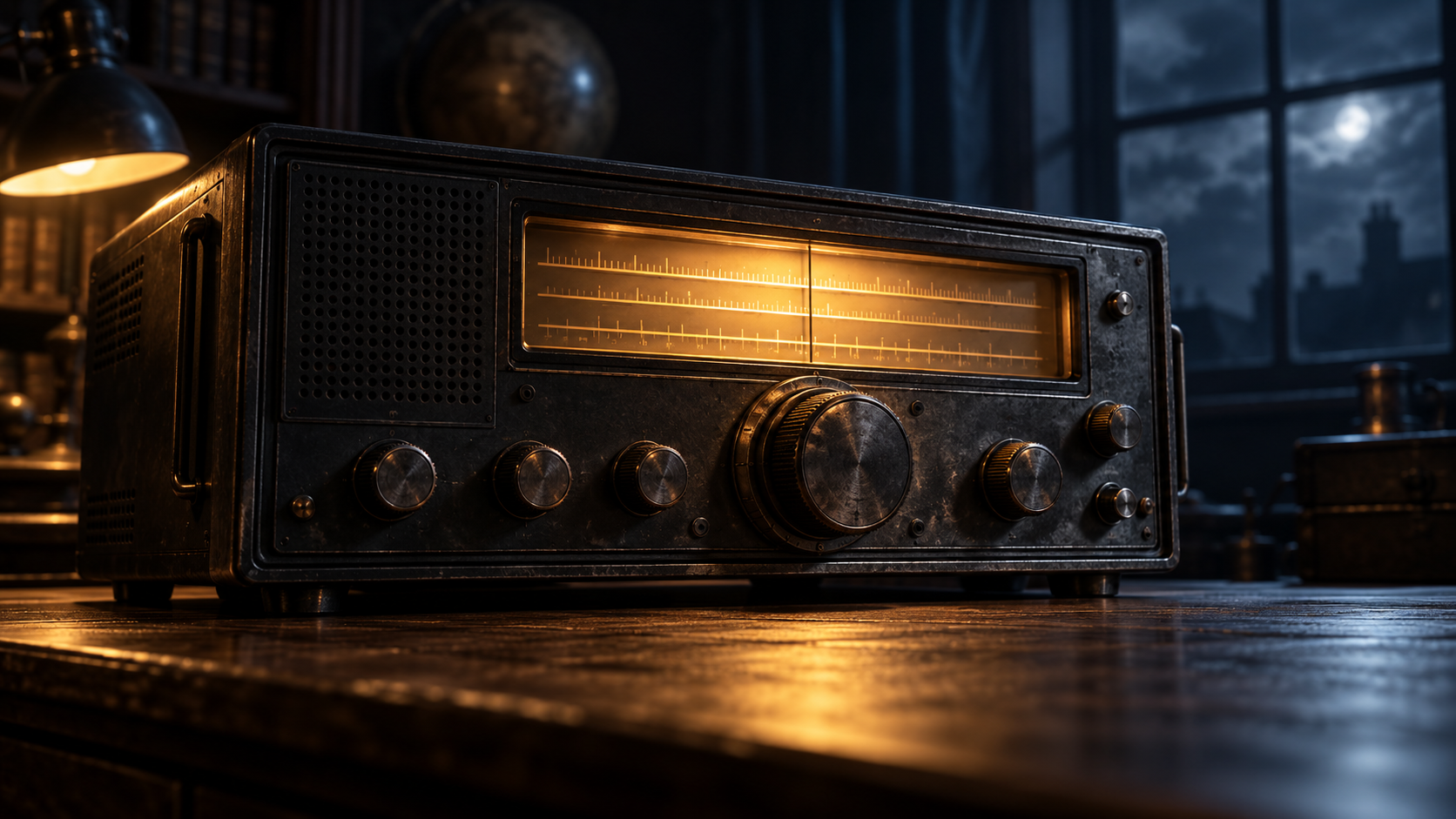
The Messages Hidden In Plain Hearing
How A Public Broadcast Keeps A Secret
Numbers stations turn an apparent contradiction into a communication system: a message can be broadcast publicly while its meaning remains private.
A voice reads groups of numbers over shortwave radio. There may be a recognisable introduction, a repeated pattern or a pause before another sequence. Anybody with suitable receiving equipment can hear the transmission. Hearing it does not necessarily bring them any closer to understanding it.
Numbers stations are associated with sending encrypted instructions to intelligence agents. This use is supported by public espionage records, although the operator, recipient and encryption method of a particular unidentified broadcast may remain uncertain. The intrigue lies in that boundary between what can be recorded and what can be established.
The central idea is simple: secrecy does not always require hiding the existence of a message. Sometimes the valuable secrets are its meaning and the identity of the person listening.
A Public Signal With A Private Audience
The monitoring organisation Priyom describes numbers transmissions using voices, Morse code and digital modes. Many carry groups of numbers or letters. Listeners document their patterns and classify them, but those classifications are an aid to observation rather than an official directory supplied by intelligence agencies.
Imagine a hypothetical message broadcast to a large area. Thousands of radios could receive it, but only one listener possesses the information needed to interpret it. A second listener can make a perfect recording without gaining that information.
This is the first distinction to keep in mind: access to the signal is different from access to its meaning. We encounter the same broad principle whenever encrypted information travels through infrastructure other people can inspect.
The unusual feature here is the audience relationship. A radio receiver does not need to introduce itself to the broadcaster to hear an ordinary one-way transmission. The intended recipient can listen among an unknown number of other listeners.
Why Receiving Is Different From Replying
A conventional online conversation often creates records of requests, accounts or connections. A passive radio reception does not involve the same exchange with the transmitter. That difference helps explain the appeal of one-way broadcasting for covert instructions.
It does not make a listener invulnerable. Equipment can be discovered, movements observed and other parts of an operation compromised. A communication method reduces particular exposures; it does not erase the world around the person using it.
There is also a trade-off. The absence of a reply means the sender does not automatically know whether the intended recipient heard and understood the message. Any acknowledgement requires another arrangement, and that arrangement introduces its own practical questions.
This gives the technology a more realistic shape. Its attraction is not that an old radio is mysteriously superior to every modern device. It is that a specific design can avoid a particular kind of connection record while accepting other limitations.
The One-Time Pad
The CIA Museum describes one-time pads as matching sets used to encode and decode agent communications. The key material must be random, kept secret and used only once. A used sheet is destroyed.
The important word is “once”. The mathematical security of the ideal system depends on demanding conditions, including sufficient genuinely random key material shared securely by sender and recipient. Reusing material or exposing the key changes the problem.
The physical object can look unimpressive: rows of digits on a small sheet. Yet the secrecy comes from information the outsider lacks, rather than the visual complexity of the device. A very elaborate-looking machine is not automatically more secure than a correctly used simple system.
Priyom cautions that the encryption methods of most individual numbers stations are not publicly known. One-time pads explain an established communication technique; they should not be asserted as the confirmed method of every signal somebody records.
Why Guessing A Message Is Not Decrypting It
Suppose a listener hears a transmission shortly before an international incident. It is easy to propose that the numbers referred to the incident. The proposal might sound convincing because the event supplies a dramatic interpretation.
But a story that fits afterwards is different from a demonstrated decoding. A successful claim would need a reproducible method and independent evidence that the interpretation corresponds to the actual message. Otherwise, many incompatible stories could be attached to the same recording.
This distinction is especially useful when an online account claims that a broadcast “predicted” an attack or contained a secret warning. Ask what was recorded before the event, what the proposed method was and whether it could have produced a different answer.
The absence of a public translation is itself limited evidence. It tells us that the meaning has not been established in the material available to us. It does not identify the intended operation or demonstrate that the transmission concerns the largest current headline.
The Ana Montes Case Provides A Documented Connection
The FBI’s historical account of Ana Montes supplies a concrete link between espionage and coded shortwave instructions. Montes worked at the US Defense Intelligence Agency and passed information to Cuba. According to the Bureau, she received instructions in code over shortwave radio and transferred information to a handler.
She pleaded guilty in 2002 and received a 25-year prison sentence. The case is relevant because the radio connection comes from a documented investigation rather than an inference based solely on a strange sound.
It also illustrates a limit of focusing exclusively on encryption. The FBI describes an investigation using surveillance and searches. A person can be identified through an operation’s wider activities even if outsiders cannot simply read every broadcast addressed to them.
A secure channel and a secure operation are therefore different achievements. The first concerns a particular means of communication. The second includes people, access, records, behaviour and the possibility that someone close to the activity notices a discrepancy.
The Lincolnshire Poacher
Some stations acquired nicknames from their introductions. The Lincolnshire Poacher is a familiar example, named for the tune associated with its broadcasts. Priyom identifies it as E03 and records it as inactive, last reported in July 2008.
Its documented format included an introduction and repeated groups of digits. Such repetition gives a listener recognisable structure even when the underlying content remains unavailable. The format can become familiar while the meaning stays opaque.
There is a reason these recordings attract people who have little interest in radio engineering. A human-sounding voice usually promises communication we can join. Here, the voice continues in an orderly fashion while excluding us from its purpose.
That is an interpretation of the listening experience, not evidence of who sat behind the microphone. The atmosphere of a recording can explain its cultural appeal without supplying missing operational facts.
The Buzzer Is A Different Kind Of Case
The station popularly called UVB-76, or the Buzzer, is often grouped with numbers stations in online discussions. Priyom instead describes a Russian military radio network using a persistent channel marker and voice messages.
That classification matters. An unfamiliar military transmission is not automatically a clandestine message to an individual spy. Similar-sounding recordings can belong to different systems with different users and purposes.
The popular “doomsday radio” label adds another unsupported step if it is treated as a verified description of a nuclear mechanism. A change in audible traffic, a pause or an odd interruption does not by itself establish a launch order or a coming war.
For the broader strategic context, Taylor Tailored’s account of the Cold War explores the relationship between military capability, intelligence and uncertainty. Those relationships require more evidence than an ominous noise.
What A Recording Can Establish
A recording can preserve an audible sequence at a stated time, provided its provenance is reliable. Multiple independent receivers may help corroborate that a transmission occurred. Records of frequency, timing and reception conditions can make later comparison more useful.
Even then, several questions remain separate. Was the original recording altered? Did it capture the claimed station? Does a listener’s label accurately identify the network? Is an apparent pattern meaningful, or merely memorable?
The same caution applies to a recording uploaded years after it was made. Upload date is not transmission date. A caption can contain a confident interpretation that the audio itself cannot establish.
For a podcast, this is an opportunity to teach the listener how evidence accumulates. The story can move from hearing a signal, to documenting a format, to comparing historical records. It need not jump from a striking sound to an invented secret mission.
Why An Old Method Can Remain Useful
Technologies survive when they fit a task, not simply because they are new. A one-way broadcast can remain interesting wherever the sender wants to reach someone without requiring that recipient to establish a return connection through the same channel.
But “still useful” is a design argument, not a measurement of how many agencies currently rely on it. Public monitoring can document transmissions. It cannot produce a complete census of classified communications or show why a particular service selected one method over another.
There are practical constraints too. The recipient must be able to receive the message and know how to interpret it. Shared secret material has to reach the right people. Schedules and formats need coordination. A system’s elegance on paper does not remove its operational workload.
Historical deception also depends on what an observer is led to infer. The Operation Mincemeat evidence provides a different example of why observing information, accepting its apparent origin and understanding its purpose are distinct steps.
The Mystery Worth Keeping
Numbers stations do not need an invented catastrophe to be interesting. Their documented purpose already contains a striking idea: information can be placed in public while remaining useful only to a hidden audience.
The unknown details are real limits. We may have a recording without a recipient, a format without a translation or an attributed station without publicly available operational records. Keeping those gaps visible makes the subject more credible and leaves room for future evidence.
The next time a sequence of numbers is presented as a revelation, ask which part has actually been established. Hearing is the beginning of the investigation. Understanding requires something more.
