

Putin’s Parade Without Power: The Victory Day Spectacle Ukraine Just Forced Off Script
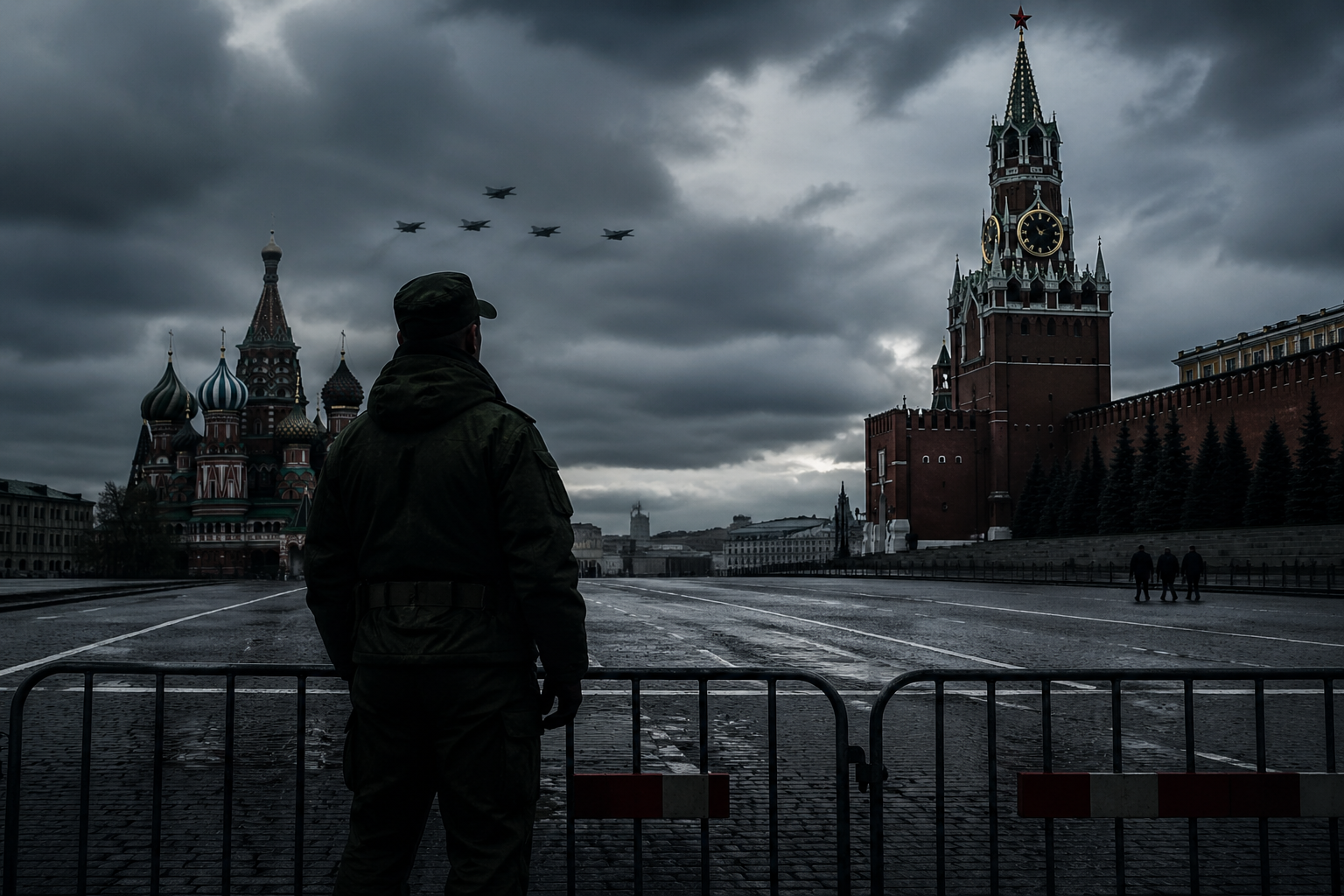
Putin’s Parade Without Power: The Victory Day Spectacle Ukraine Just Forced Off Script
No Tanks On Red Square: The Moment Russia’s War Reality Broke Its Greatest Symbol
There are years when a military parade is just theater.
And then there are years when what’s missing tells you more than what’s there.
In 2026, Russia’s Victory Day parade — one of the most choreographed displays of state power in the world — will take place without tanks, missile systems, or heavy military hardware. For the first time in nearly two decades, Red Square will host a parade stripped of the very symbols designed to project strength.
That decision isn’t cosmetic. It’s strategic. And it reveals something deeper about the war in Ukraine than any speech ever could.
What Has Actually Changed
Victory Day, held every year on May 9, commemorates the Soviet Union’s defeat of Nazi Germany in World War II. It is Russia’s most important secular holiday—and under Vladimir Putin, it has become a centerpiece of national identity and political messaging.
Traditionally, the parade showcases the following:
Main battle tanks
Intercontinental missile systems
Armoured vehicles
Thousands of troops in coordinated formation
But in 2026, those defining elements are gone.
Instead, the event will feature:
Marching personnel
Limited ceremonial units
Aerial flyovers
The official explanation points to the “current operational situation” and security concerns tied to Ukrainian attacks.
Unofficially, the picture is clearer: Ukraine’s long-range strike capability has forced Russia to rethink what it can safely display — even in the heart of Moscow.
Why This Matters Now
Military parades are not about celebration. They are about signaling.
For years, Russia used Victory Day to project three messages:
Military superiority
Strategic confidence
Historical continuity between WWII victory and modern power
Removing hardware disrupts all three.
This is not just about avoiding risk. It is about acknowledging vulnerability.
Ukraine’s expanding use of long-range drones has shifted the geography of the war. What was once a distant front is now capable of reaching deep into Russian territory, including industrial infrastructure and symbolic targets.
The parade itself—and the preparations leading up to it—present an unusually exposed target. Equipment must be assembled, parked, rehearsed, and staged in predictable locations. That predictability is exactly what modern drone warfare exploits.
So Russia has made a calculation:
It is safer to remove the spectacle than risk it being destroyed on live display.
The Strategic Reality Behind The Symbol
There are two overlapping truths behind this decision.
1. The Reach Of Modern War Has Changed
Ukraine’s strikes are no longer limited to battlefield positions.
They now target:
Energy infrastructure
Military production sites
Rear-area logistics
Strategic assets inside Russia
This shift matters because it alters the psychological map of the war.
When Moscow itself becomes part of the threat envelope, the idea of “safe space” disappears.
And when there is no safe space, even symbolic events must adapt.
2. Optics Are No Longer Fully Controlled
Victory Day has long been carefully managed political theater.
Every tank, every formation, every camera angle serves a narrative:
Russia is strong, unified, and in control.
But removing military hardware introduces an unavoidable contradiction.
The state is still telling a story of strength —
while simultaneously behaving as if it is exposed.
That tension is visible.
And once visible, it cannot be unseen.
What Most People Will Miss
The immediate reaction to this news is simple:
Russia scaled back a parade because of drone threats.
But the deeper implication is more important.
Ukraine has achieved something rare in modern warfare:
It has forced its opponent to change behavior not just on the battlefield but also in its most symbolic domestic ritual.
That is strategic pressure at a different level.
Not destruction. Not occupation.
Influence.
The ability to shape what the other side feels safe doing — even in its own capital.
That kind of pressure compounds over time.
It affects:
Public perception
Leadership confidence
International signalling
Internal narratives about control
And it does so without needing a decisive battlefield breakthrough.
A Pattern, Not A One-Off
This is not the first time Victory Day has been scaled back.
Since the invasion of Ukraine in 2022, parades have gradually reduced in scale, foreign attendance has declined, and regional events have been cancelled due to security concerns.
But 2026 marks a step change.
Removing military hardware entirely crosses a psychological threshold.
It turns a display of power into a managed risk event.
The Wider War Context
On the battlefield, the war remains slow, grinding, and unresolved.
Russia continues to pursue incremental territorial gains.
Ukraine continues to adapt, innovate, and extend its strike capabilities.
At the same time:
Drone warfare is intensifying on both sides
Infrastructure is increasingly targeted
Strategic depth is shrinking
The parade decision sits inside that broader reality.
It is not an isolated event.
It is a visible symptom of a longer shift.
The Message Beyond Moscow
Internationally, the signal is just as significant.
For allies, observers, and adversaries, Victory Day has always been a window into Russia’s self-image.
This year, that image looks different.
Not collapsed.
Not defeated.
But constrained.
And in geopolitics, constraint matters.
Because it shapes what leaders believe they can risk next.
The Quiet Power Of Absence
There will still be marching soldiers.
There will still be aircraft overhead.
There will still be speeches about history and sacrifice.
But there will be no tanks rolling across Red Square.
And that absence will carry more weight than any speech delivered that day.
Because it reflects something real:
The war is no longer contained.
It has reached far enough — and become unpredictable enough — to reshape even Russia’s most controlled moment of national power.
That is not just a military development.
It is a symbolic turning point.
