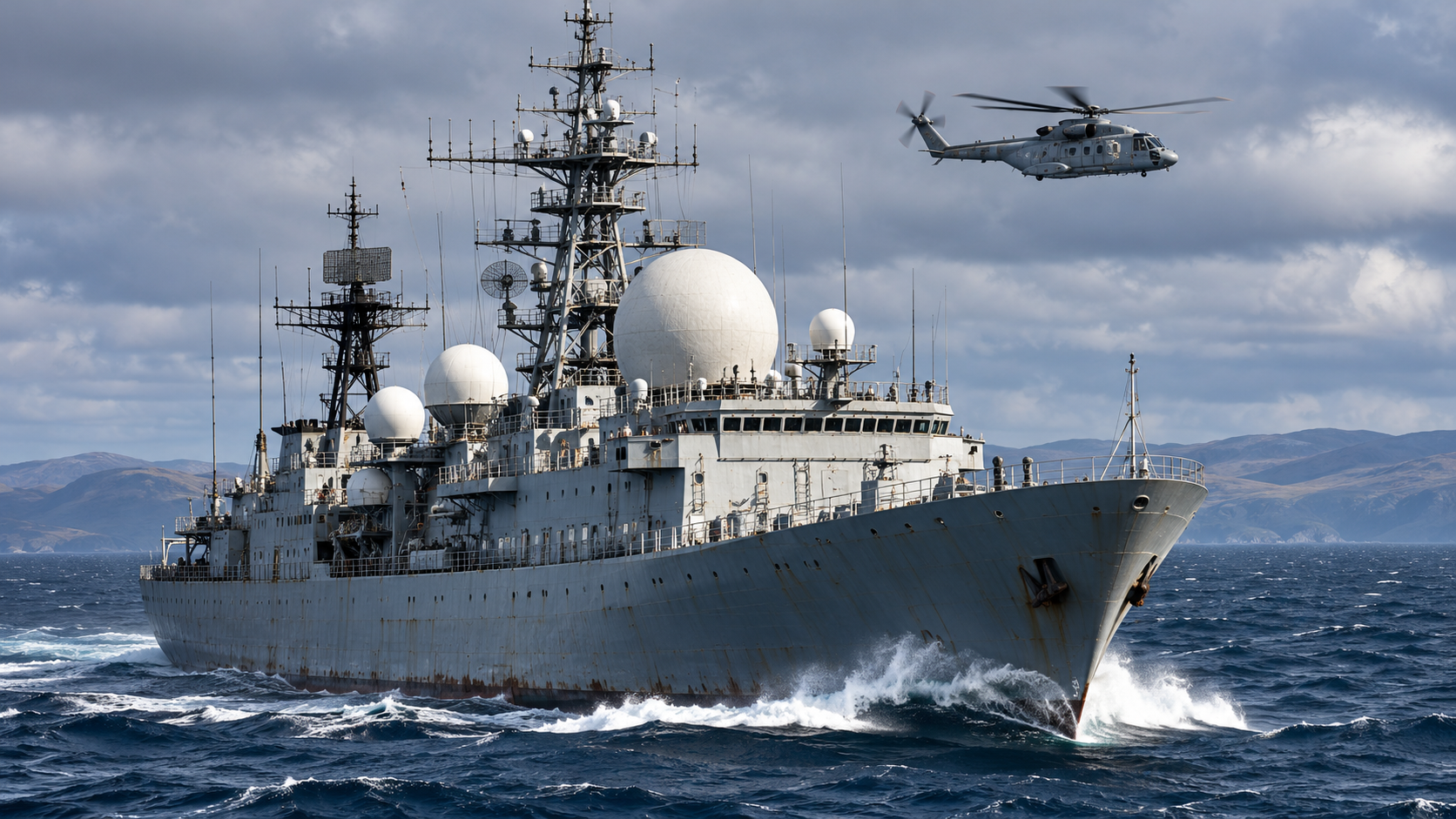
What Was Russia’s Spy Ship Watching Off Scotland?
The Spy Ship Beyond the Coast
British surveillance operations reveal overlapping pressures from Russian intelligence gathering and naval protection for cargo movements.
The Royal Navy has disclosed three operations involving Russian vessels around Britain, including a spy ship watching NATO exercises and warships escorting cargo through the English Channel.
The announcement concerns activity in late September and October. Its significance lies in the different demands arriving together: watching an intelligence vessel, following armed escorts and keeping British forces available to respond.
The public account describes surveillance operations, rather than a battle or a newly discovered attack on Britain. Understanding that distinction makes the underlying security problem clearer.
Which Russian Ships Were Involved?
Merlin helicopters tracked the intelligence-gathering ship Viktor Leonov around the Outer Hebrides between 29 September and 8 October. The Royal Navy says it was monitoring NATO vessels participating in Exercise Strike Warrior.
Separately, HMS Dauntless and HMS Tyne monitored the frigate Neustrashimy from 1 to 14 October as it escorted sanctioned cargo ships through the Channel.
Tyne then followed the landing ship Aleksandr Shabalin between 11 and 14 October. It was accompanying cargo vessel Energy-2 and tug Proton towards the Baltic, with a British Wildcat helicopter supporting surveillance.
These were distinct assignments. Combining them into a single “Russian fleet approaching Britain” would obscure what each vessel was doing.
Why A NATO Exercise Attracts Attention
Strike Warrior provided a substantial military activity to observe. An earlier Royal Navy account described eight warships and 19 aircraft participating, with more than 2,000 personnel from six nations.
The exercise rehearsed crisis response in the High North and North Atlantic. Its activities included amphibious landings, boarding, reconnaissance and anti-submarine warfare.
One documented sequence involved commandos deploying from a German submarine near Cape Wrath and directing naval gunfire from positions ashore. Such training brings different countries’ forces together under realistic operational demands.
That helps explain its intelligence value. Observing how forces assemble and coordinate could reveal more than simply identifying which ships are present. It could offer clues about procedures, timing and the practical relationship between different units.
This is an analytical explanation of why an observer might be interested. The public material does not disclose what Viktor Leonov actually collected, how useful it was or whether British countermeasures restricted it.
An exercise can demonstrate capability to an adversary while also giving that adversary an opportunity to study it.
What Operation Iceblast Adds To The Story
The helicopter deployment also tested Britain’s ability to sustain operations away from its usual bases.
In its 14 October account of Operation Iceblast, the Royal Navy described four Merlin aircraft and around 90 personnel moving from Cornwall to Prestwick. Their work included supporting NATO training and tracking the new submarine HMS Agamemnon during dive trials.
The operational challenge extends beyond flying an aircraft north. Crews need maintenance support, supplies and functioning command arrangements at the location from which they operate.
The Navy explicitly described Iceblast as a test of those arrangements. That makes the deployment useful evidence of exercised readiness, although one successful detachment cannot establish how much spare capacity exists across the fleet.
The practical question is whether a force can keep producing useful surveillance when demands overlap, aircraft need servicing and personnel require relief. Numbers of aircraft alone cannot answer it.
Why Russia Is Providing Armed Escorts
The cargo escorts belong to a different contest: pressure on shipping associated with Russia’s war economy.
In August, the Royal Navy linked increased escort activity to Britain’s June interception of the sanctioned tanker Smyrtos. First Sea Lord General Sir Gwyn Jenkins said subsequent changes in shipping routes were imposing costs and delays, while escort requirements were diverting Russian warships from other duties.
There is a plausible mechanism behind that assessment. If a merchant voyage requires military protection, keeping cargo moving also consumes naval time and availability. The burden includes whatever alternative work that warship cannot perform.
However, an escort is evidence of resources being committed, not a calculation of sanctions’ overall effectiveness. Establishing the economic result would require information about delivered volumes, prices, delays and the ability to use alternative routes.
Russia continuing to move cargo and Russia facing additional costs can both be true. The presence of an escort does not settle which effect matters more.
Britain also incurs a cost when it follows those movements. This is a competition in sustained availability as well as a contest over individual ships.
Does This Mean An Attack On Undersea Cables?
The latest announcement does not establish that.
Britain has previously described specific concerns involving another Russian vessel, Yantar. In January 2025, the Ministry of Defence said it had been observed loitering over critical undersea infrastructure and described a British submarine surfacing nearby during an earlier encounter.
That statement also connected British surveillance efforts with protection of offshore infrastructure and NATO’s Baltic Sentry activity.
Those concerns provide background, but they should not be transferred automatically to Viktor Leonov. Different ships, locations and reported behaviour require separate evidence.
The distinction matters when reading about undersea cable security. Monitoring a military exercise, surveying infrastructure and physically damaging a cable are different activities. Evidence of one does not establish the others.
For this announcement, the supported description of Viktor Leonov’s activity remains observation of NATO training.
What Would Signal A More Serious Escalation?
The useful indicators would be changes in behaviour and consequences: a dangerous encounter causing damage, confirmed interference with infrastructure, an attempted boarding meeting armed resistance, or a demonstrable change in military posture.
Those are possible developments to watch, not events established by this disclosure.
The wider question of how a confrontation could escalate depends on subsequent decisions and evidence. A photograph of opposing warships close together cannot supply either.
For now, the most revealing feature is the range of work demanded of British forces. Training, intelligence surveillance and shipping-related operations overlap geographically and compete for attention.
Future announcements will be more informative if they show whether these tasks can be sustained, how effectively allies share them and whether Russian escort commitments continue. Counting interceptions is easier than measuring the endurance behind them.
Sources
Royal Navy — Royal Navy intercepts Russian intelligence vessel and warships across three intensive operations — The 2 November announcement identifying the vessels, operational dates and British surveillance forces. royalnavy.mod.uk
Royal Navy — Commandos hitch ride on submarine as biggest workout in 15 years ramps up — Strike Warrior’s scale, purpose and documented training activities. royalnavy.mod.uk
Royal Navy — Merlin helicopters test rapid deployment to Scotland to safeguard submarine force — Operation Iceblast’s personnel, aircraft, submarine-support work and logistical objectives. royalnavy.mod.uk
Royal Navy — Royal Navy monitors Russian warships and shadow fleet activity in UK waters during 72-hour operation — Earlier escort operations and the First Sea Lord’s assessment of their implications for Russian resources. royalnavy.mod.uk
Ministry of Defence — Royal Navy tracking Russian spy vessel in the Channel to keep UK safe — The separate January 2025 account concerning Yantar and undersea infrastructure. GOV.UK
Next Reads
NATO Caught Russian Submarines Rehearsing A Secret Attack On Critical Undersea Cables — Related coverage of undersea infrastructure concerns, distinct from the surface operations described here.
NATO Explained: What Article 5 Really Means And How The Alliance Would Respond To War — Background on collective defence, allied coordination and national decisions.
Could NATO Article 5 Start World War III? The Escalation Timeline Explained — An examination of the decisions separating a confrontation from a wider conflict.
