Taiwan Plans 210,000-Drone War Shield in $6.6bn Race to Stop China
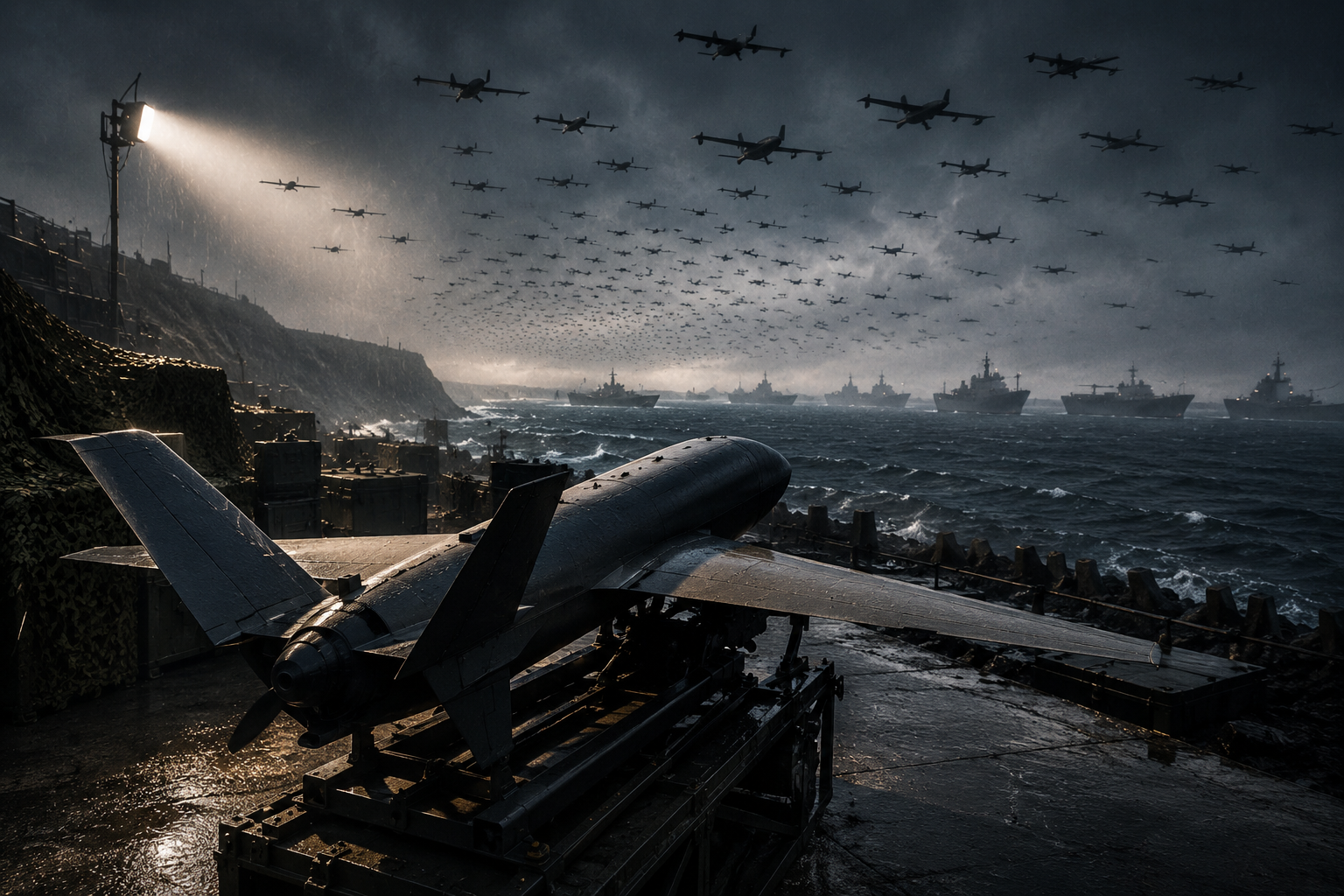
Taiwan Bets on a Vast Drone Army as Beijing Turns Up the Pressure
Taiwan’s Unmanned Arsenal
Taiwan is pushing ahead with an extraordinary plan to acquire more than 210,000 unmanned military systems in a multibillion-dollar attempt to make the island dramatically harder for China to attack. At the heart of the proposal is a simple calculation: Taiwan cannot match Beijing platform for platform, but it could make any invasion, blockade or coastal assault vastly more complicated by flooding the battlespace with cheaper, expendable weapons.
President Lai Ching-te’s government is seeking authorisation for up to NT$210 billion — around US$6.6 billion — for the programme through the end of 2031. The proposed arsenal includes 208,200 coastal attack drones, 1,446 coastal surveillance and reconnaissance drones and 1,320 small one-way attack unmanned surface vessels, producing a planned total of 210,966 air and sea systems.
Taiwan Is Preparing for a Different Kind of War
The scale is striking because the overwhelming majority of the proposed fleet would not consist of large, exquisite aircraft comparable with conventional fighters. Taiwan wants huge quantities of comparatively expendable attack drones that could be dispersed, concealed and launched against forces approaching its coastline.
That reflects one of the clearest lessons Taiwan has drawn from recent wars. Lai has repeatedly pointed to the battlefield importance of drones in Ukraine and the Middle East, arguing that unmanned technology has become a central part of asymmetric warfare rather than a supporting capability. Taiwan’s government says such systems can strengthen deterrence while exploiting the island’s strengths in electronics, semiconductors, communications technology and advanced manufacturing.
Vice President Hsiao Bi-khim has gone further, describing drones as capable of performing reconnaissance, attack and logistics missions. She said the systems sought under the special legislation were particularly suited to Taiwan’s island-defence and multi-domain-denial requirements.
The strategic logic is uncomfortable but clear. China possesses vastly greater conventional military resources. Taiwan’s answer is increasingly focused on creating layers of relatively cheap threats capable of surviving an opening attack and imposing enormous costs on ships, landing forces and military infrastructure.
More Than 208,000 Attack Drones
The numbers reveal where Taipei believes the greatest value lies.
Of the 210,966 systems originally specified under the plan, 208,200 are coastal attack drones. Another 1,446 are intended for coastal reconnaissance, while 1,320 are small unmanned surface vessels designed for one-way attack missions.
That means roughly 98.7 per cent of the proposed platforms are attack drones.
Taiwan is effectively exploring warfare by mass. A defender able to deploy thousands of low-cost unmanned systems from dispersed positions presents a different targeting problem from one dependent primarily on a relatively small number of expensive aircraft, ships and fixed bases.
The programme would also sit alongside other drone purchases rather than replacing them. Taiwan has separately been planning tens of thousands of military-specification drones across short-range multirotor, medium-range, long-range fixed-wing and other categories. Drone battalions have been established in the army’s northern, central and southern corps, while units are also being developed for Taiwan’s outlying-island commands.
If the build-up reaches the scale envisaged, drones would cease to be specialist equipment and become a pervasive element of Taiwan’s defensive forces.
Why China Makes the Timing So Important
Taiwan’s urgency cannot be separated from the military balance across the Taiwan Strait.
Beijing claims Taiwan as part of China and has not renounced the use of force to bring the island under its control. Taipei, meanwhile, has accused China of intensifying military coercion and grey-zone activity while expanding the capabilities of the People’s Liberation Army.
Lai has said Taiwan will neither provoke Beijing nor yield to its pressure, while arguing that stronger defences are required to preserve the existing peace. His administration wants defence expenditure, measured according to NATO methodology, to rise to 5 per cent of GDP by 2030.
Taiwan’s proposed 2027 defence budget alone would reach about NT$1.12 trillion, representing an increase of roughly 18 per cent and taking spending beyond 3 per cent of GDP. Drones, missiles, submarines and wider asymmetric capabilities are becoming increasingly prominent within that modernisation effort.
Beijing views Lai very differently. Chinese authorities accuse his administration of pursuing separatism and routinely condemn measures that deepen Taiwan’s military preparedness or ties with foreign partners. The drone programme therefore lands in an already highly charged strategic environment.
The Ukraine Lesson Taiwan Cannot Ignore
Modern warfare has radically increased the strategic importance of cheap unmanned weapons.
Ukraine demonstrated that relatively inexpensive drones could locate targets, correct artillery fire, attack armoured vehicles, strike logistics infrastructure and carry explosives directly into targets. The technology has continued evolving at extraordinary speed as both sides adapt electronic warfare, navigation, autonomy and counter-drone systems.
Taiwan is not Ukraine. Geography fundamentally changes the problem. Any major Chinese assault would have to cross the Taiwan Strait, placing ships, ports, aircraft, helicopters and landing forces at the heart of many potential scenarios.
That is precisely why coastal reconnaissance and attack systems could matter. A distributed network of sensors and strike drones could help find an approaching force and then create additional waves of threats that an attacker would have to detect, jam or destroy.
The drones would not make Taiwan invulnerable and could not independently stop the Chinese military. Their value would lie in forcing Beijing to solve many more problems simultaneously — and raising the potential price of trying.
Taiwan Wants to Cut China Out of the Supply Chain
There is another battle hidden inside the spending plan: manufacturing.
Taiwan does not simply want hundreds of thousands of drones. It wants a domestic industrial base capable of building them without dependence on Chinese components.
Lai has spoken of creating secure “non-red” supply chains alongside the United States and other democratic partners. His government wants Taiwan to become an Asian centre for the global drone industry, combining its semiconductor industry with strengths in electronics, communications, machine tools and precision manufacturing.
That has strategic implications beyond procurement. A military that expects to lose large numbers of drones during combat also needs the ability to replace them quickly. Production capacity therefore becomes part of deterrence.
The government has separately backed a six-year NT$44.2 billion industrial development programme running from 2025 to 2030 to strengthen Taiwan’s wider drone ecosystem.
Hsiao has argued that guaranteed large-scale military orders could give manufacturers enough certainty to automate production, cut unit costs and eventually become more competitive in international markets.
Taiwan is therefore attempting something broader than buying weapons. It is trying to create an industrial machine capable of producing them at wartime scale.
But Taiwan’s Biggest Immediate Battle Is Political
The arsenal is not yet a fait accompli.
Lai is trying to get the special procurement legislation through a legislature in which opposition parties hold the balance of power. The government favours a dedicated special budget overseen by the Ministry of National Defense, arguing that predictable multiyear procurement is essential for both military planning and manufacturers.
The opposition Kuomintang and Taiwan People’s Party have put forward alternative approaches. Among the proposals is funding drone development through ordinary annual budgets rather than granting the government the same multiyear special-budget structure. A KMT proposal has included an annual ceiling of NT$40 billion.
Defence Minister Wellington Koo has warned that the cap could clash directly with military requirements. The government is already planning expenditure of about NT$42.1 billion for the programme in 2027 alone, making a NT$40 billion ceiling restrictive before the build-up reaches full speed.
The parties also disagree over institutional control. Lai’s side argues that because the drones are being acquired to meet operational requirements, the defence ministry must remain the authority determining what the armed forces need. Opposition proposals have given a greater role to the Ministry of Economic Affairs, reflecting their emphasis on industrial policy, oversight and regular budget scrutiny.
The disagreement matters because mass drone warfare depends on predictable scale. Manufacturers cannot build production lines efficiently if order volumes repeatedly change, while militaries cannot restructure doctrine around weapons that may arrive late or in fewer numbers than expected.
An ‘Unmanned Shield’ Around Taiwan
The strategic ambition is becoming increasingly obvious.
Taiwan wants to turn its geography into a weapon. Reconnaissance systems could identify approaching forces. Attack drones could threaten landing craft, vehicles and other targets. Unmanned boats could add another layer of danger at sea. Conventional missiles, artillery, mines, aircraft and naval forces would remain behind them.
Taiwanese national-security officials have previously described the concept as an “unmanned shield.”
The phrase captures what Taipei is trying to build: not one wonder weapon capable of defeating China, but thousands upon thousands of relatively inexpensive systems capable of creating uncertainty everywhere.
An attacker would have to worry not merely about Taiwan’s most advanced missiles or aircraft, but about small launch teams, concealed drones, distributed sensors and unmanned vessels emerging from numerous directions.
That is asymmetric warfare at industrial scale.
The Bigger Message to Beijing
The programme also carries a political signal.
Hsiao has warned against allowing Beijing to conclude that Taiwan lacks the determination to defend itself, drawing a comparison with the danger of an aggressor believing a war can be won quickly.
Deterrence ultimately depends on precisely that calculation. Taiwan does not have to convince China that it can overpower the People’s Liberation Army in conventional terms. It has to convince Chinese leaders that attempting to conquer the island could become prolonged, costly and unpredictable enough to outweigh the benefits.
More than 200,000 attack drones fit that strategy almost perfectly.
Each individual aircraft may be comparatively small. Collectively, they could create an immense targeting and defence problem.
The legislation now moving through Taiwan’s political system will therefore determine far more than how many drones a ministry can purchase. It could decide whether Taiwan manages to convert one of the defining lessons of modern warfare into a mass-produced defensive capability before the strategic environment around the island becomes even more dangerous.
For Beijing, the calculation is straightforward but uncomfortable: Taiwan is trying to make an invasion less like a single decisive military operation and more like a fight against a vast, dispersed and constantly replenished swarm.
