Taiwan’s trade warning to the world: Alignment now has consequences
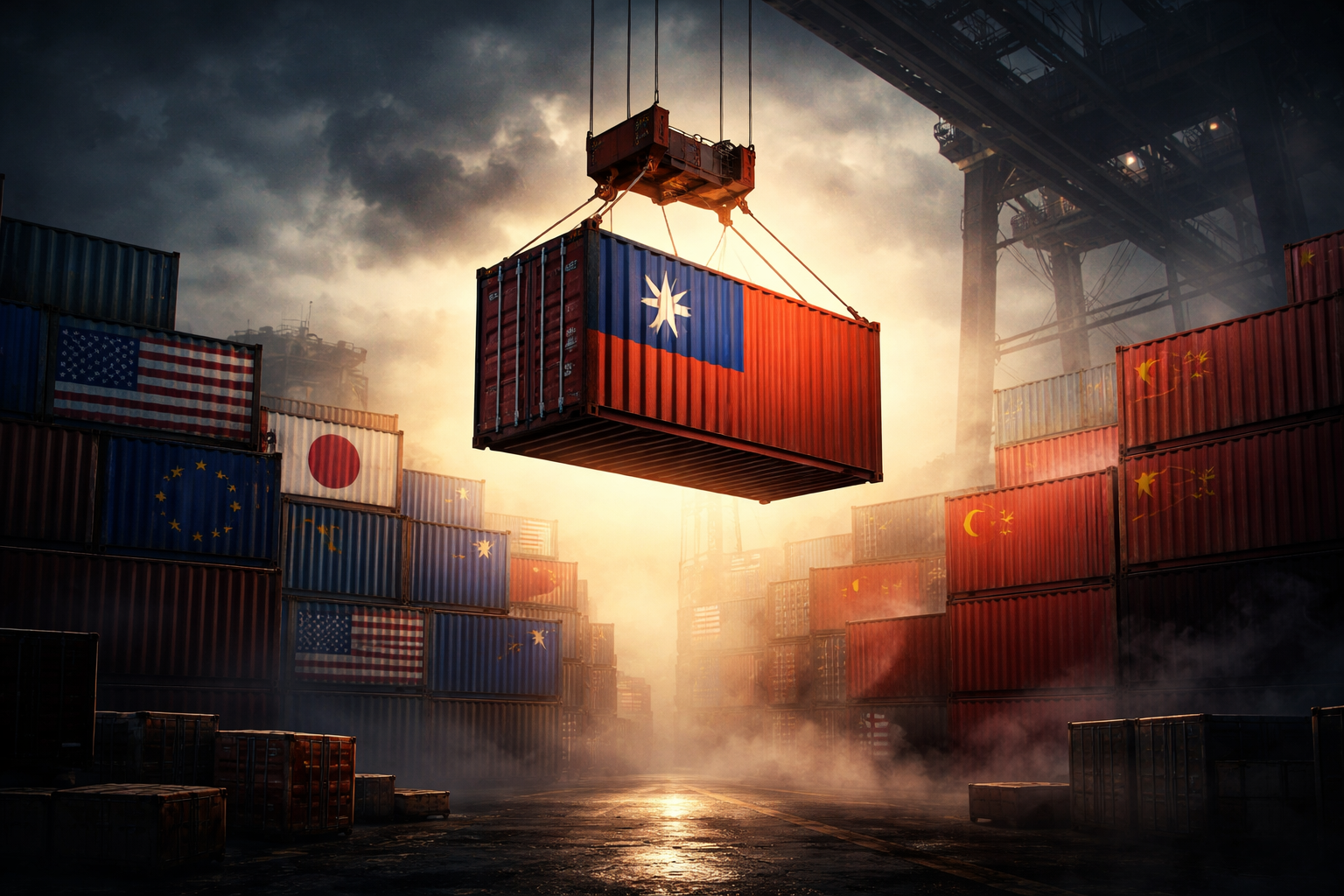
Taiwan’s “democracies first” trade stance is a strategic signal. Here’s what it means for chips, security, and EU/UK options.
Taiwan draws a line in trade: “democracies first” has consequences.
Taiwan’s president publicly urged the island to deepen trade and economic cooperation with fellow democracies rather than China. The phrasing matters because it is not just about exports and tariffs. It is a signal about alignment, risk, and who Taiwan expects to stand with it when pressure arrives.
The immediate story looks like rhetoric wrapped around supply chains. The deeper story is that “trade with democracies” is a way of redrawing the map of dependence—quietly, contract by contract—before any crisis forces a sudden, messy scramble.
The story turns on whether Taiwan’s words harden into policy tools that change corporate behavior faster than governments can negotiate new deals.
Key Points
Taiwan's leadership has positioned trade as a strategic signal, focusing on democratic partners rather than China.
In practice, alignment language reshapes supply chains through procurement rules, investment screening, standards, and “trusted supplier” frameworks.
The front line is semiconductors and the wider “AI stack”: chips, advanced packaging, critical minerals, undersea cables, satellites, and industrial software.
Retaliation risk is real, but it rarely arrives as one dramatic ban; it often arrives as friction—customs delays, informal boycotts, licensing headaches, and selective coercion.
Beyond formal recognition battles, Europe and the UK have options such as targeted industrial partnerships, investment facilitation, resilience standards, and coordinated coercion response.
Watch for next-step proof: new talks, signed frameworks, investment announcements, and any Chinese counter-moves that test the credibility of “democracies first.”
Background
Taiwan sits at the intersection of three realities. First, it is a trading economy that depends on global access. Second, it is central to the world’s advanced semiconductor supply chain, which increasingly underpins AI, defense systems, and critical infrastructure. Third, it faces sustained political and economic pressure from China, which claims Taiwan and objects to foreign governments treating it like a sovereign equal.
For years, Taiwan’s policy language has balanced pragmatism with ambiguity: diversify markets, attract investment, stay indispensable, and avoid giving rivals a clean pretext to escalate. What is different now is the explicitness of the framing. “Democracies” is not a geography. It is a club. And clubs come with expectations.
In that sense, Taiwan is not merely pitching itself as a factory. It is pitching itself as a strategic node that wants to be embedded inside “trusted” networks—networks that increasingly treat economics and security as one combined system.
Analysis
What was said, and why the phrasing matters
When a leader says “trade with democracies,” the immediate reading is moral and political: values alignment. Markets, however, translate that into something more mechanical: counterparty risk. If a supplier sits inside a “trusted partner” frame, buyers assume fewer shocks—fewer sudden sanctions, fewer export-control traps, fewer reputational landmines, and fewer compliance surprises.
That translation matters because it shifts behavior without waiting for a treaty. A procurement manager does not need Parliament to vote on a new doctrine to start preferring suppliers that reduce future disruption.
The phrase also quietly invites reciprocity. If Taiwan signals it will prioritize democracies, democratic partners will ask what prioritization means in practice: faster approvals, fewer barriers to investment, shared standards, and coordinated responses when coercion appears.
Why trade language is strategic language
Trade alignment language does three jobs at once.
It reassures partners that Taiwan is not playing both sides for short-term advantage. Adversaries receive a warning that Taiwan will respond to economic pressure through coordination, not isolation. Additionally, it communicates to the domestic industry that the government is prepared to incur a short-term cost in order to mitigate vulnerability.
The biggest moves in geopolitics often occur before the headline event. If you anticipate a future shock, you don't wait for it to diversify. You preposition. Alignment language is a form of pre-positioning because it nudges private capital to behave as if a separation is already underway, even if policymakers insist they are only “de-risking.”
Priority partners and the logic behind them
The most logical “democracies first” partners are those that can either (a) absorb Taiwan’s exports, (b) supply critical inputs Taiwan needs, or (c) provide security and resilience support that reduces vulnerability to coercion.
The United States sits at the center of this logic because it combines market pull, technology partnerships, and security guarantees. Japan and parts of Europe matter because they are critical for advanced manufacturing ecosystems, high-end tools, materials, and standards-setting. Australia and Canada matter because critical minerals and resource resilience are increasingly inseparable from semiconductor and defense supply chains.
There is also a quiet, practical rationale: partner diversification reduces single-point failures. Should one market face political constraints, Taiwan must maintain access to other avenues. “Democracies first” is, in part, a narrative wrapper for a diversification plan.
Sector implications: chips and the broader critical-tech stack
Semiconductors are the obvious front line, but the real exposure is wider than foundries.
Chips depend on advanced packaging, specialized chemicals, ultrapure gases, precision components, and engineering talent. The AI boom adds new choke points: high-bandwidth memory, advanced substrates, data-center power equipment, and the software and firmware layers that make hardware usable at scale. Then there is connectivity: undersea cables and satellite links that keep an economy functioning under stress.
A “democracies first” stance nudges the ecosystem toward a few predictable outcomes. There is a need for increased collaboration in research and development, as well as the harmonization of standards. More supply chain mapping and stress testing. There is increasing pressure to categorize suppliers based on trust and resilience, rather than solely on price. There will also be increased investment screening on both sides, as partners aim to prevent sensitive capabilities from falling into adversarial hands.
For companies, the practical question becomes blunt: if cross-strait risk rises, do you want your critical inputs anchored in jurisdictions that will coordinate—or jurisdictions that may be compelled to comply with coercion?
Retaliation and pressure channels
Economic pressure rarely arrives as a clean, announced policy that everyone can price in. It often arrives as selective friction designed to create domestic political arguments: “This stance is costing you jobs.”
The pressure toolkit is familiar: customs slowdowns, informal consumer boycotts, targeted regulatory inspections, licensing delays, constraints on tourism or student flows, pressure on third-country firms to choose sides, and signaling campaigns that raise the perceived risk of partnering with Taiwan.
The subtle version is often more effective than the loud version because it keeps escalation deniable while still imposing costs. That creates a policy challenge for Taiwan’s partners: if they only respond to dramatic, explicit sanctions, coercion will simply stay below the threshold that triggers action.
EU/UK positioning options
Europe and the UK face a classic tension: they want resilience and access to Taiwan’s capabilities, but they also want to avoid turning economic policy into a sovereignty referendum.
There are workable middle paths.
Europe can deepen industrial cooperation through standards, R&D partnerships, secure supply-chain initiatives, and investment facilitation, while tightening its ability to respond to economic coercion. That approach treats Taiwan less as a diplomatic symbol and more as a practical contributor to Europe’s economic security goals.
The UK has similar tools, plus a post-Brexit appetite for Indo-Pacific trade links. The UK can build “quiet depth” without theatrical politics: targeted tech collaboration, resilience dialogues, supply-chain financing support, and sector-specific agreements that improve certainty for businesses while staying within existing diplomatic constraints.
The question for both is whether they will avoid "choosing Taiwan over China" in speeches. It is whether they will build enough practical redundancy—inputs, inventory, alternative routes—that coercion stops working as a pressure lever.
What Most Coverage Misses
The hinge is that “democracies first” can reshape behavior through private-sector compliance cascades long before governments sign anything.
The mechanism is simple: once alignment is framed as a risk-management issue, the most conservative actors move first—insurers, lenders, auditors, and big procurement teams. They start asking for supply chain provenance, contingency plans, and “trusted partner” assurances. That pushes suppliers to reconfigure just to stay bankable and insurable, even if official policy remains vague.
What would confirm the change in the coming weeks is not another speech. It is paperwork: new procurement clauses, new financing terms, updated supplier codes of conduct, and policy frameworks that quietly define “trusted” categories in operational language.
What Changes Now
The short-term change is informational: Taiwan has made its preference structure clearer. That reduces ambiguity for partners, and it increases reputational cost for anyone perceived as undercutting Taiwan under pressure.
Over the next 24–72 hours and into the coming weeks, the key decisions will be about follow-through: whether trade talks, investment facilitation, and resilience frameworks turn the rhetoric into repeatable processes. The main consequence is that firms start planning as if supply security is part of geopolitics, because uncertainty itself is a cost.
Over months and years, the stakes are structural. If “democracies first” becomes embedded in procurement and investment rules, it creates parallel economic circuits that are harder to unwind. That can stabilize Taiwan’s position inside trusted networks, but it can also intensify competition over choke points, especially around advanced chips, AI infrastructure, and critical minerals.
Real-World Impact
A European data center operator quietly rewrites its supplier list, not because it expects a war, but because it cannot justify a single-source risk to insurers anymore.
A UK manufacturer finds that “chip availability” is no longer just a price question; it becomes a delivery-certainty question tied to geopolitics, driving higher inventory buffers and higher costs.
A Taiwanese mid-sized exporter is pushed to open new sales channels in partner markets faster than planned because a single large customer wants redundancy and “political resilience” in its supply chain.
A multinational splits its Taiwan strategy into two tracks: one for sensitive tech with strict partner-country controls and one for lower-risk products that can still move through broader markets.
The fork in the supply chain road
Taiwan’s “democracies first” framing is designed to make one outcome more likely: a gradual, managed shift toward trusted networks rather than a sudden decoupling triggered by crisis.
The next phase will be revealed by actions that are boring but decisive: signed frameworks, investment announcements, procurement rules, resilience standards, and the way partners respond to coercion that stays just below the headline threshold. If those elements align, the shift will occur gradually and steadily, making it difficult to reverse. If they do not, the world will keep drifting until a shock forces a sharp, expensive reordering.
History tends to remember the loud moments, but supply chains are rebuilt in silence—and the present is one of those moments.
