The Destroyer Decision That Exposes UK’s Defence Gamble: Britain Has Chosen Drone Warships
Why Britain’s Scrapped Destroyer Plan Is Bigger Than One Warship
The Warship Decision That Turns Strategy Into Political Risk
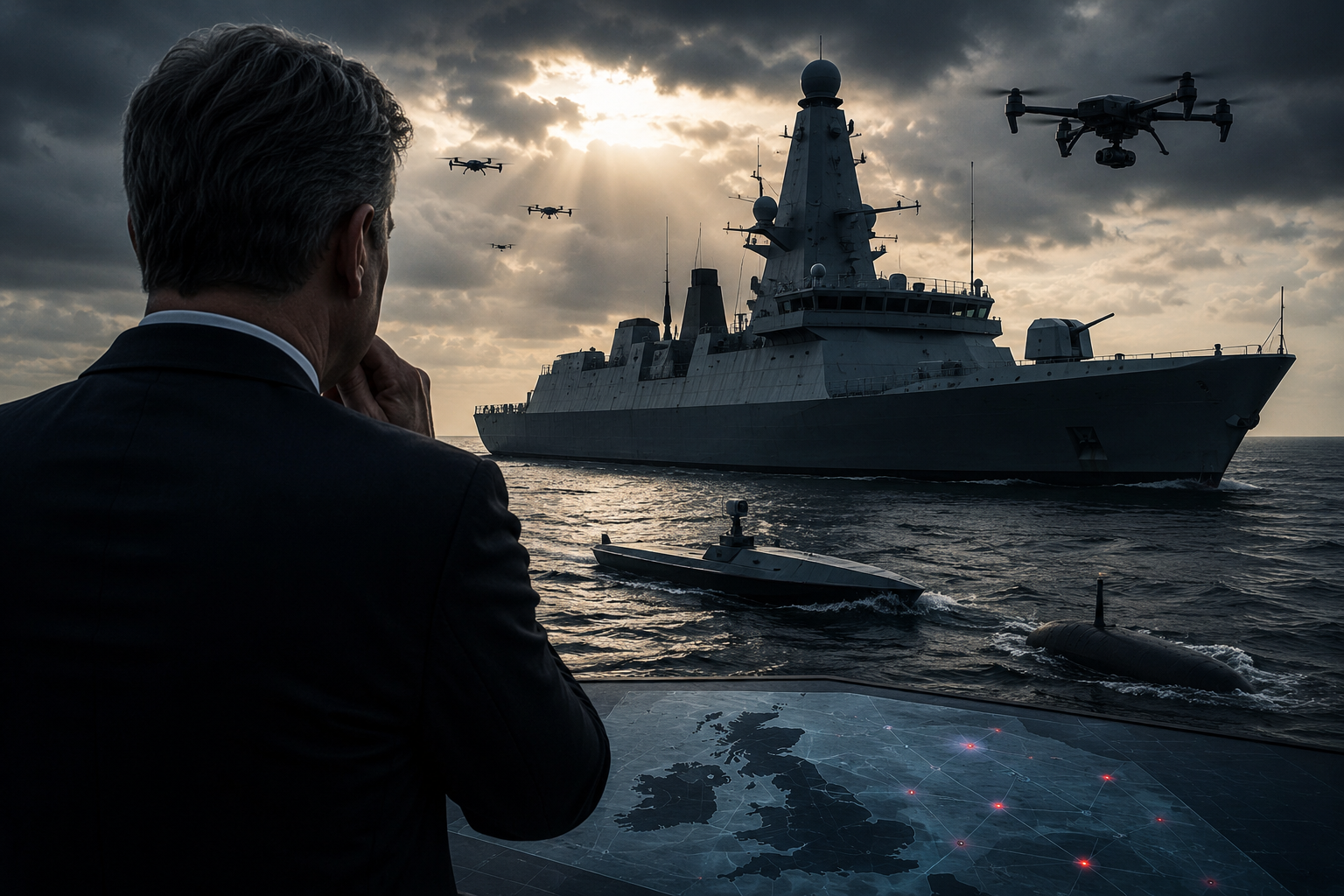
Britain Has Rewritten Its Naval Future Before The Blueprint LandsBritain has scrapped earlier plans for a new Type 83 destroyer and will instead procure at least six Common Combat Vessels as part of the system replacing the Royal Navy’s current Type 45 destroyers. Official statements say the new ships will act as hybrid warships, coordinating uncrewed systems in the air, on the surface and under the sea, with delivery expected from the early 2030s.
That is why this matters now. This is not just a technical procurement adjustment buried inside a defence document. It is a visible choice by Labour to move away from a traditional high-end destroyer replacement toward a cheaper, more distributed, drone-heavy model before the wider Defence Investment Plan has fully landed in public view.
The government’s argument is straightforward: modern warfare is changing too quickly for Britain to pour everything into a small number of large, expensive ships. The political problem is just as straightforward: if the new model works, Labour can claim it has modernised defence for the drone age; if it fails, it will look like a government dressed up a funding squeeze as military innovation.
Why This Has Happened
The immediate reason is money, pace and threat. The Type 45 destroyers are ageing, the Royal Navy needs a future air-defence system, and the Ministry of Defence is trying to match new threats without simply repeating the last generation of naval design. The official language is about resilience, reach and firepower without a proportional rise in crew or cost.
The deeper reason is that Britain is trying to build a navy for an era of drones, missiles, submarines, cyber pressure and attacks on undersea infrastructure. The Strategic Defence Review already pointed toward a “New Hybrid Navy”, with crewed ships, uncrewed vessels and autonomous systems operating together in the North Atlantic and beyond.
That makes the decision tactical in military terms, but political in presentation. Labour can say it is adapting to the battlefield of the future, not clinging to the symbols of the past. Yet the timing makes it look defensive: the government is making a major capability shift while trying to prove that its defence plan is affordable, credible and ready for a more dangerous world.
The Tactical Case Is Real
There is a serious defence logic behind the move. A destroyer is powerful, but it is also expensive, crew-intensive and vulnerable if too much capability is concentrated in too few platforms. A hybrid vessel that controls drones and uncrewed systems could spread risk, extend surveillance, increase persistence and make the fleet harder to disable in one strike.
The Royal Navy has been signalling this direction for some time. Senior naval leadership has warned that Russian surface and sub-surface activity is a persistent challenge around the UK, critical infrastructure and the wider North Atlantic. The same speech argued that standing still is not an option and that autonomous and uncrewed vessels are needed to keep pace with the growing threat.
So yes, there is a tactical case. Ukraine, the Red Sea, the Gulf and the wider drone revolution have all shown that expensive legacy platforms can be pressured by cheaper, faster, more numerous systems. A future fleet that cannot control drones, sensors and autonomous platforms will be fighting tomorrow’s war with yesterday’s assumptions.
The Political Problem Is Labour’s Credibility Gap
The problem for Labour is not that the hybrid navy idea is automatically wrong. The problem is that cancelling or replacing a major warship plan before the public has fully absorbed the defence blueprint invites the obvious suspicion: is this modernisation, or is this a cut wearing modern language?
That suspicion will be difficult to dismiss because the old Type 83 plan carried a clear public meaning. It sounded like a direct successor to the Type 45 destroyers. It suggested continuity, seriousness and high-end naval power. Replacing that with Common Combat Vessels may be strategically defensible, but politically it sounds like Britain is trading a destroyer for something smaller, cheaper and less proven.
Labour will argue that this is about capability, not prestige. Its critics will argue that the government is lowering ambition while talking about innovation. That is the fight now: not whether drones matter, because they clearly do, but whether drones are being added to British strength or used to explain away the shrinking of traditional strength.
The Risk Is A Capability Gap Hidden Behind New Language
The key danger is not that Common Combat Vessels are a bad idea. The danger is that Britain ends up in an awkward middle place: too late to sustain the old model properly, but too early to prove the new one can replace it. The Type 45 destroyers remain the current backbone of Royal Navy area air defence, and the replacement system must arrive before age, maintenance and threat pressure collide.
Official plans say the Common Combat Vessel will replace the current Type 45 fleet, with delivery expected from the early 2030s. The new ships are due to work with Type 26 and Type 31 frigates, as well as planned uncrewed missile, sensing and underwater platforms.
That is ambitious, but ambition is not the same as delivery. Britain has a long record of defence programmes becoming more expensive, slower and smaller than first promised. Labour is now betting that a complex network of crewed ships, drones, sensors and autonomous systems can be delivered at speed, integrated properly and trusted in the kind of crisis where failure is not theoretical.
Why The Timing Looks Tactical
The timing matters because this decision is emerging around the Defence Investment Plan, the document meant to translate broad strategic promises into funded priorities. The Strategic Defence Review said the plan would ensure defence choices were deliverable and affordable, while linking technology, frontline kit and industrial growth.
That makes the destroyer decision look like a pre-emptive signal. Labour is trying to show NATO, industry and the public that it understands the future of war: drones, autonomy, digital targeting, undersea infrastructure, missile defence and industrial resilience. It is also trying to show that it can make hard choices rather than simply publish another expensive wish list.
But there is a darker reading. If the government announces a futuristic replacement before the full financial pain is clear, it can frame a cancellation as transformation. That is the anti-Labour line that will cut through: Britain did not get a stronger navy; Britain got a cheaper story about a stronger navy.
Ordinary People Should Care Because This Is About National Insurance, Not Naval Romance
For most people, destroyer procurement sounds distant. It feels like a specialist defence argument about hulls, missiles and naval acronyms. But the real issue is much closer to ordinary life: Britain’s sea lanes, undersea cables, energy routes, NATO commitments and nuclear deterrent all depend on whether the country can defend itself at sea.
Modern conflict does not need to begin with an invasion. It can begin with a damaged cable, a disrupted port, a drone swarm, a cyber attack, a missile threat or a submarine operating where it should not be. The government’s own naval framing links the new Atlantic programmes to Russian activity, critical underwater infrastructure and NATO deterrence.
That means this is not just a debate about whether Britain has the right ships. It is a debate about whether the state can still protect the invisible systems that keep daily life functioning. If Labour gets this wrong, the cost will not be felt first in a defence committee; it will be felt in vulnerability, delay, dependence and the quiet loss of national control.
The Labour Gamble Is Now Exposed
The strongest defence of Labour is that the world has changed, and the Royal Navy has to change with it. A drone-heavy, hybrid fleet may be exactly where serious naval power is heading. The worst criticism of Labour is that it is using the language of the future to soften the reality of constraint.
Both can be true at the same time. The Type 83 may have been too expensive, too traditional or too underdeveloped for the war Britain now has to prepare for. But the replacement must be judged by what it can actually do, not by how modern it sounds in a press release.
This is the trap Labour has built for itself. By scrapping the destroyer plan and promising a smarter hybrid future, it has made the test brutally simple: either Britain gets a more adaptable navy for a more dangerous world, or the country discovers too late that a capability gap was hidden inside the language of innovation.
