The Falklands Showdown Returns
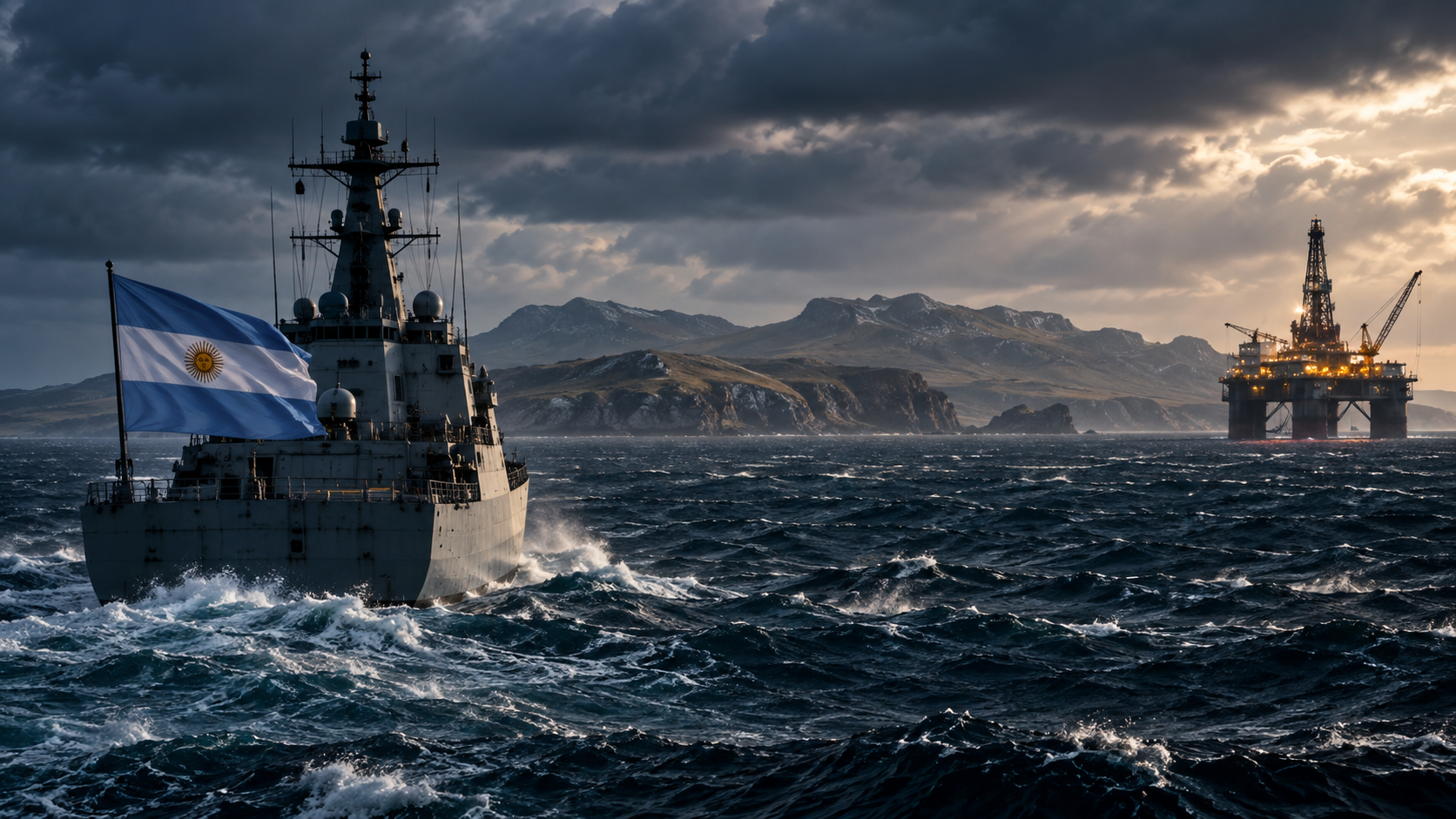
Argentina Turns Up the Pressure
Argentina Escalates Falklands Dispute as Milei Targets British-Backed Oil Project
Javier Milei has dramatically intensified Argentina’s confrontation with Britain over the Falkland Islands, announcing tougher sanctions against companies involved in offshore oil development, additional defence spending and a new naval base in Tierra del Fuego. The Argentine president has also placed the South Atlantic at the centre of a wider national-security strategy as the dispute shifts beyond diplomatic rhetoric into economic and strategic pressure.
The immediate flashpoint is the huge Sea Lion oil development north of the islands, which is moving towards drilling and production despite Argentina rejecting British authority over the surrounding waters. Milei portrayed the project as an urgent threat to Argentine interests and promised to use diplomatic, economic, judicial and legal tools to obstruct companies that participate without Buenos Aires's permission.
Milei Moves From Words to Concrete Pressure
In a televised national address on 3 September, Milei repeated Argentina's longstanding assertion that the islands — known as the Malvinas in Argentina — belong to Argentina and directly rejected the Falkland Islanders' claim to self-determination. His government argues that Britain's control of the territory since 1833 constitutes an occupation and that the sovereignty dispute remains unresolved.
What makes the latest intervention more significant is the package accompanying that rhetoric. Milei said Argentina would accelerate sanctions under Law 26.659 against companies involved in unauthorised hydrocarbon activity and strengthen its ability to identify and penalise businesses, shareholders, directors and suppliers connected to projects around the islands.
Companies participating directly or indirectly could be prohibited from operating or contracting in Argentina. Milei also wants legislation extending sanctions to suppliers and potentially to other commercial activities involving natural resources around the islands.
That creates a clear economic choice for international companies: participate in Falklands development and potentially lose access to the much larger Argentine market, or remain inside Buenos Aires's regulatory orbit.
It is an attempt to make the sovereignty dispute commercially expensive rather than merely politically controversial.
Sea Lion Oil Has Changed the Stakes
The confrontation is increasingly about resources as much as flags.
Sea Lion lies roughly 220 kilometres north of the Falkland Islands and has moved decisively from planning towards development. Operator Navitas Petroleum and partner Rockhopper Exploration reached a final investment decision on its first phase in December 2025, with development drilling expected to begin in early 2027 and first oil targeted for the first quarter of 2028.
Rockhopper has reported 110 million barrels of proved and probable reserves net to its interest in the project, alongside another 211 million barrels of contingent resources. Plans are already being developed to accelerate later stages using another floating production vessel, potentially turning Sea Lion into a much larger long-term oil development.
For Argentina, that raises an obvious strategic problem. Once billions of dollars have been committed, infrastructure installed and oil begins flowing, the economic status quo surrounding the Falklands becomes harder to reverse.
Milei explicitly presented the situation in those terms. He argued that allowing large-scale petroleum production would give Britain a stronger incentive to consolidate its presence around the islands and exploit resources that Argentina regards as its own.
Britain and the Falkland Islands authorities reject that premise. London maintains that sovereignty is not open for negotiation unless the islanders themselves wish it to be, while the population overwhelmingly voted in a 2013 referendum to remain a British Overseas Territory.
The two sides are therefore operating from positions that are fundamentally incompatible.
Argentina Is Building a New Naval Base
Milei's most strategically significant announcement concerns defence.
He said additional resources would be provided to Argentina's Ministry of Defence, with construction of an integrated naval base in Tierra del Fuego given priority alongside improved telecommunications capabilities. Milei described the project as central to making Argentina a major logistical power in the South Atlantic.
Its importance stretches beyond the Falklands.
Tierra del Fuego sits at Argentina's southern extremity, facing crucial routes into the South Atlantic and towards Antarctica. Milei explicitly linked control and influence in the South Atlantic with Argentina's future geopolitical position, arguing that competition over resources and Antarctica will become increasingly important.
He also called for Argentina to become economically influential, politically relevant and "militarily respectable" if it is to advance its sovereignty claims effectively.
That language represents a harder strategic posture than simply repeating Argentina's historic diplomatic claim.
It does not, however, amount to a threat to invade the islands.
Milei's announced tools are sanctions, diplomacy, legislation, economic pressure and increased Argentine defence capacity. His government has continued to describe its sovereignty campaign as peaceful.
That distinction matters. Argentina's military capabilities and the circumstances surrounding the islands are radically different from those that produced the 1982 Falklands War.
But building greater military and logistical capability in southern Argentina still alters the strategic environment over the longer term.
Trump Has Given Milei an Opening
The timing is especially uncomfortable for Britain because Milei believes the international environment is shifting in Argentina's favour.
Donald Trump has publicly questioned whether Washington would support Britain in another Falklands confrontation and has suggested the United States could reconsider its position towards the sovereignty dispute. Milei seized directly on those remarks, arguing that Argentina's increasingly close relationship with Washington was producing diplomatic opportunities.
For Buenos Aires, even uncertainty in Washington is valuable.
The United States does not need to endorse Argentine sovereignty for Milei to benefit politically. Merely weakening Britain's assumption of automatic American diplomatic backing changes the calculation and gives Argentina greater reason to internationalise the dispute.
Milei described Argentina as an increasingly important Western partner with strategic resources and an important geographical position. He contrasted that with what he portrayed as Britain's long-term economic, demographic and political decline.
Those claims were designed partly for a domestic audience, but the message to London was obvious: Argentina believes time could increasingly work in its favour.
Whether Washington actually changes policy is another matter. Trump's comments have created uncertainty, but uncertainty is not the same as formal US recognition of Argentina's sovereignty claim.
A New National-Security Strategy
The Falklands announcements are also part of something much bigger inside Argentina.
Milei wants Congress to create a National Security Council bringing together foreign affairs, defence, intelligence and economic policy. The proposed framework would address critical infrastructure alongside maritime and aerospace protection and give Argentina stronger economic and diplomatic tools against state and non-state actors considered threats to national security.
That tells Britain something important about where the Falklands issue is heading.
Milei is attempting to move the islands from the category of historical territorial grievance into Argentina's permanent national-security architecture.
He explicitly described protection of the South Atlantic as a national-security issue and said additional advances around the Falklands would be regarded as violations of Argentina's security interests.
The strategy connects the islands to energy, Antarctica, maritime power, defence investment and Argentina's future position in the international system.
That makes the current dispute potentially more durable than another burst of nationalist rhetoric.
Britain Still Holds the Stronger Immediate Position
None of this means Argentina is close to taking control of the Falklands.
Britain continues to administer and defend the islands, whose inhabitants have repeatedly expressed a clear preference to remain linked to the United Kingdom. Britain also maintains that the principle of self-determination is decisive and has reiterated that its commitment to the islanders is unwavering.
There is also no evidence that Milei is preparing an Argentine military operation against the territory.
The more immediate threat to British interests is therefore economic, diplomatic and strategic.
Argentina can attempt to punish companies operating around the Falklands, discourage potential investors, mobilise diplomatic support and build greater military and logistical capacity in the region without firing a shot.
Sea Lion makes that battle increasingly important because commercial development is creating facts on the ground — and beneath the seabed.
The Falklands Dispute Is Entering a Different Phase
For decades, Argentina's sovereignty claim survived largely as a diplomatic constant. Milei is now trying to turn it into an active strategy.
Oil development gives Buenos Aires something tangible to confront. Trump's uncertainty gives Milei a possible diplomatic opening. Argentina's defence rebuilding gives him the opportunity to talk about South Atlantic power in terms previous governments struggled to make credible.
Britain still possesses the islands and retains overwhelming control of the immediate situation. The islanders' preference is also emphatically clear.
But the strategic problem is becoming harder to dismiss.
If Sea Lion begins producing oil in 2028 while Argentina simultaneously expands its naval infrastructure, sanctions companies involved with the islands and pushes Washington and other governments for diplomatic support, the Falklands dispute will increasingly sit at the intersection of energy, military power and competition for influence across the South Atlantic.
This is not 1982 again. There is no announced Argentine invasion plan and no evidence that another Falklands war is imminent.
What Milei has done is more calculated: raise the economic cost, strengthen Argentina's position in the South Atlantic and signal that Buenos Aires intends to make British control of the islands a more persistent international problem. The next question is whether Britain treats that as political theatre — or the beginning of a much longer strategic challenge.
