

The Next World War May Start With A Communications Blackout
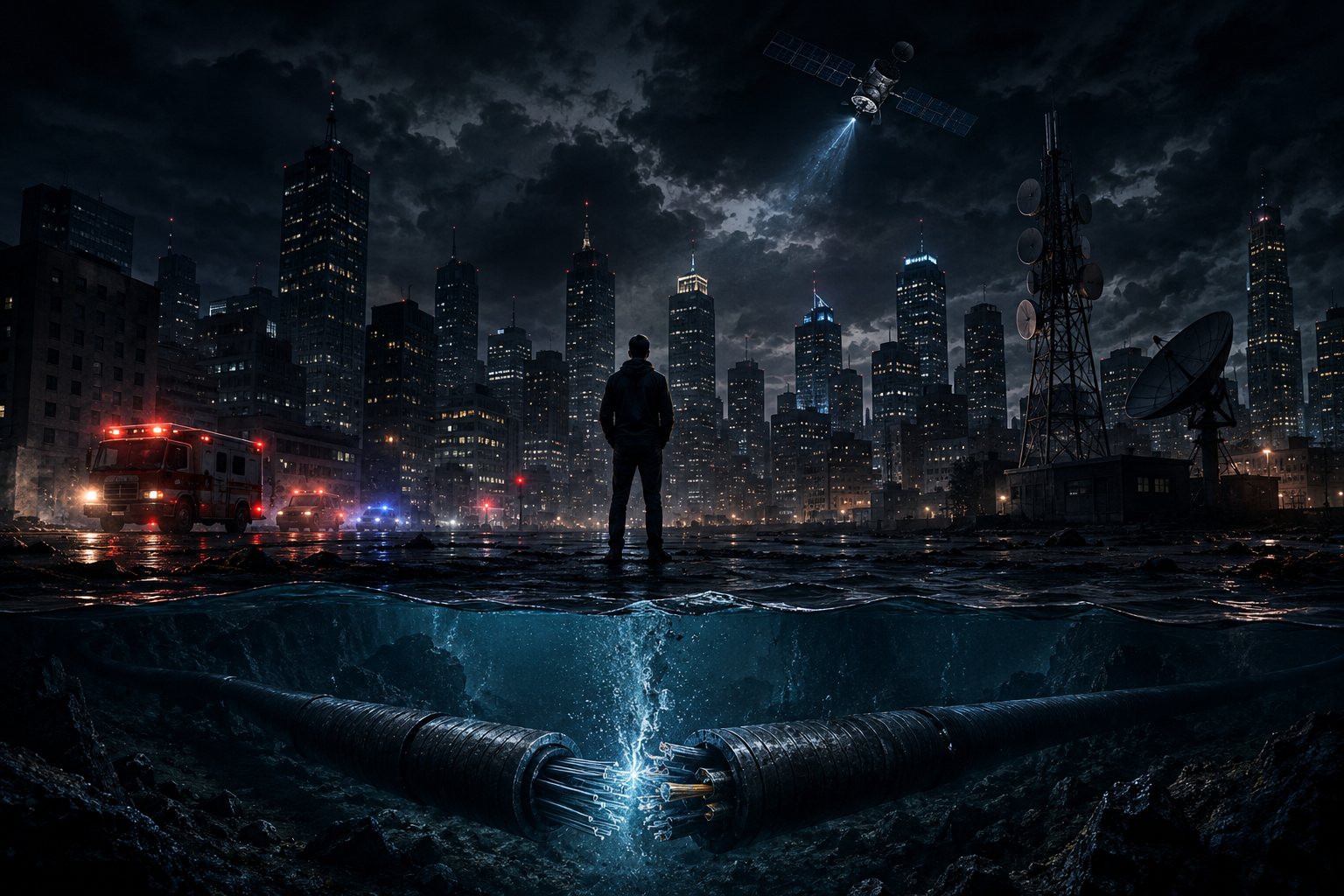
When The Internet Goes Dark Before The Missiles Fly
Why The First Strike Of The Next World War May Be Silence
The War Before The WarThe next world war may not begin with a mushroom cloud, a border crossing, or a televised declaration from a nervous leader. It may begin with a phone that cannot connect, a payment that will not process, a map that suddenly lies, and a public that has no idea whether the blackout is a fault, an accident, a cyberattack, or the first move in something much larger.
That uncertainty is the point. A communications blackout is not just an inconvenience. It is a psychological weapon, a military tool, an economic shock and a political test all at once. If a hostile state can make a society blind before it makes it bleed, it can shape the opening hours of a crisis before anyone agrees what has happened.
The dangerous part is not that every system would fail at once. The dangerous part is that modern civilization has become so dependent on invisible infrastructure that even partial failure can produce disproportionate fear. People do not need every network to collapse before panic begins. They only need enough signals to fail at the same time.
That is why the first strike of a future great-power conflict may be silence.
The Hidden Nervous System Beneath Modern Life
Modern countries look solid because their physical surfaces still appear normal. The roads are there. The hospitals are there. The banks are there. The government buildings are there. The supermarkets are there. But beneath that visible world sits a nervous system of cables, satellites, data centers, payment rails, GPS timing, telecoms networks, cloud platforms and emergency communications.
Most people only notice that nervous system when it stops working. The International Telecommunication Union says submarine cables carry roughly 99% of the world’s internet traffic and enable financial transactions, cloud computing and government communications. It also says there are more than 500 active and planned submarine cable systems worldwide, connecting continents, markets and households.
That fact changes the way war should be imagined. The internet is often described as weightless, wireless and everywhere, but much of global connectivity still depends on physical fiber-optic cables lying across the seabed. These cables are not abstract. They have routes, landing stations, repair vessels, choke points and private operators. They are part of the real geography of power.
The same is true of satellites. They provide communications, surveillance, weather monitoring, navigation and timing. They support military coordination, civilian transport, logistics, emergency response and financial systems. A state does not need to destroy every satellite to create disruption. Jamming, spoofing, cyber intrusion, degraded signals or localized denial can be enough to turn confidence into confusion.
Why Undersea Cables Are A Perfect Grey-Zone Target
Undersea cables are strategically awkward because they are vital, exposed and difficult to defend continuously. They stretch across oceans, pass through chokepoints and are often owned or operated by private companies rather than militaries. A damaged cable can be an accident, sabotage, negligence, deniable state action or something that sits deliberately in the fog between them.
That ambiguity is useful to an attacker. A missile launch is obvious. A tank column is visible. A cable fault is slower to understand. It can take time to locate the break, identify the cause, coordinate repair and decide whether the incident crosses the threshold of armed attack. In that gap, pressure builds.
The ITU has warned that cable disruptions affect economies, access to information, public services and the daily lives of billions of people. It has also noted that between 150 and 200 faults are reported globally each year, which matters because the system already lives with ordinary failures before hostile intent is even considered.
That is what makes the undersea cable problem so dangerous. A hostile power can hide inside the normal noise of global infrastructure. Ships drag anchors. Earthquakes happen. Fishing activity damages cables. Technical faults occur. The question in a crisis is not simply whether a cable has been cut, but whether anyone can prove why quickly enough to respond with confidence.
Satellites Make War Faster, But Also More Fragile
Satellites have become one of the great accelerators of modern power. They make armies faster, weapons more precise, logistics more visible and commanders better informed. They also make civilian life smoother in ways most people barely notice. Navigation apps, aircraft routes, shipping movements, telecoms synchronization, financial timing and emergency systems all depend, directly or indirectly, on signals that can be disrupted.
NATO’s own space policy warns that threats such as signal jamming and cyberattacks can affect space systems, and that harmful effects in space can be difficult to attribute. It also notes that many threats to allied space systems originate in the cyber domain and are likely to increase.
That means the space layer of modern life is not just a futuristic battlefield. It is already part of the operating system of the present. A contested satellite environment would not only affect soldiers on a front line. It could affect pilots, ports, broadcasters, weather forecasting, financial systems, delivery networks and government decision-making.
The deeper risk is synchronization failure. Modern life depends on timing as much as communication. If timing signals are disrupted, systems can become inaccurate before they become visibly broken. That is a darker kind of fragility: the world still appears to function, but the invisible order underneath it is losing precision.
GPS Failure Would Feel Like The World Losing Its Sense Of Direction
GPS is commonly understood as a map tool. That is a dangerously small way to think about it. Positioning, navigation and timing services support critical infrastructure, and the Cybersecurity and Infrastructure Security Agency says PNT is necessary for the functioning of national critical infrastructure.
A serious GPS disruption would not only make drivers miss turns. It could affect aviation, maritime navigation, rail operations, mobile communications, energy systems, emergency response, logistics and timing-sensitive financial operations. CISA’s GPS interference guidance lists critical infrastructure operations that use GPS, including marine, terrestrial and aviation services, communications network synchronization and other timing-dependent functions.
The public would experience this in fragments before understanding the whole. A delivery does not arrive. A ship cannot trust its position. A plane is rerouted. A mobile network becomes unstable. Emergency services lose precision. A trading or settlement system faces timing risk. Each incident may look local, technical or temporary, until the pattern becomes too large to dismiss.
That is why GPS interference is so powerful as a first-strike tool. It attacks confidence in coordination. It does not need to produce spectacular images. It simply makes a society ask whether it can still locate itself, time itself and move itself safely.
Banking Systems Would Become The Panic Layer
If communications go dark, banking becomes the emotional accelerant. Most people can tolerate inconvenience for a while. They become far less calm when money stops moving. A payment failure turns an abstract infrastructure crisis into a personal threat within seconds.
Modern financial systems are designed with resilience in mind, but they are also deeply networked, fast and dependent on trusted data. The Bank for International Settlements has warned that cyberattacks can be stealthy, propagate rapidly and cause significant service disruption to the broader financial system. Its guidance emphasizes the need for financial market infrastructures to detect, respond, contain and recover quickly from cyberattacks.
The nightmare is not simply that someone cannot buy a coffee. It is that nobody knows whether balances are accurate, whether payments are delayed or lost, whether ATMs will work, whether salaries will clear, whether markets can open normally, whether a bank outage is isolated or systemic, and whether official reassurance can be trusted if communications channels are already degraded.
Public panic does not require full financial collapse. It requires uncertainty plus personal exposure. If cards fail, banking apps freeze, cash machines empty, rumor spreads and official statements arrive slowly, the public will not wait for a technical post-mortem. People will act on fear first.
Emergency Services Would Face The Worst Kind Of Confusion
Emergency services exist to create order inside panic. A communications blackout attacks that order at the worst possible moment. Police, ambulance crews, fire services, hospitals, coastguards, military responders and local authorities all rely on communications, location data, dispatch systems, interoperable networks and verified information.
If those systems are degraded, the first problem is operational. Calls may not route properly. Locations may be wrong or incomplete. Crews may be sent inefficiently. Hospitals may struggle to coordinate capacity. Command centers may not share the same picture. Backup systems may work, but not with the same speed, coverage or confidence.
The second problem is psychological. In a blackout, every ordinary emergency becomes politically charged. A crash, a fire, a hospital delay or a police incident may be interpreted through the wider fear that the country is under attack. Rumor fills the space left by missing information.
This is where disinformation becomes especially dangerous. A hostile actor does not need to invent panic from nothing. It only needs to amplify the uncertainty already created by real disruption. Fake evacuation orders, false claims about attacks, forged government messages, manipulated videos and rumors about banking failure could all turn technical disruption into public disorder.
Disinformation Would Become The Soundtrack Of Silence
Silence does not stay silent for long. When trusted systems fail, people search for explanations. If official channels are slow, contradictory or unreachable, unofficial channels take over. That is where disinformation becomes not a side issue, but part of the attack.
A communications blackout creates the perfect emotional conditions for false information: fear, uncertainty, isolation, urgency and low trust. People will share screenshots, voice notes, rumors and fragments because doing something feels safer than waiting. The more frightening the claim, the faster it can travel through whatever channels remain.
The attacker’s goal may not be to make the public believe one specific lie. It may be to make the public believe nothing can be trusted. That is a more corrosive objective. If people cannot tell whether the government is telling the truth, whether the outage is local or national, whether banks are safe, whether emergency services are functioning, or whether military escalation has begun, the country has already lost part of its decision-making capacity.
This is also where modern societies are more fragile than they look. They are not held together only by infrastructure. They are held together by shared confidence that systems are still working, authorities still know what is happening, and tomorrow will still behave broadly like yesterday. A blackout attacks that confidence directly.
Military Confusion May Be The Real Target
The civilian effects of a communications blackout would be frightening, but the military logic may be even more important. A state preparing visible escalation has a strong incentive to blind, delay and confuse its opponent first. Disrupting communications, satellite feeds, GPS signals, command networks, logistics systems and public information could buy time at the exact moment when time matters most.
In the opening hours of a crisis, leaders need clarity. They need to know what has happened, who did it, whether it is continuing, whether it is limited or expanding, whether allies are affected, whether forces are ready, whether the public is safe and whether retaliation would be lawful, proportionate and strategically wise. A blackout makes every one of those questions harder.
This is why the line between cyberattack, sabotage, hybrid warfare and armed conflict is becoming more dangerous. A hostile state may try to stay below the threshold of formal war while still shaping the battlefield. It may create enough disruption to weaken response, but not enough certainty to trigger immediate collective action.
That grey zone is not a loophole in modern conflict. It may become the opening chapter.
The Fragility Is Not The Technology, But The Dependency
The obvious conclusion is that technology has made society vulnerable. The sharper conclusion is that dependency has outpaced resilience. Modern countries have optimized for speed, convenience, efficiency and integration. Those strengths become weaknesses when the system is placed under deliberate stress.
A cash-light economy is efficient until digital payments fail. Cloud computing is powerful until access is disrupted. GPS is miraculous until spoofing makes the signal untrustworthy. Satellite communications are essential until jamming degrades them. Undersea cables are invisible until a severed route exposes how much of the world depends on a few physical pathways.
This does not mean collapse is inevitable. It means resilience must be treated as a strategic asset, not a technical afterthought. NATO has already moved to strengthen coordination around critical undersea infrastructure, including a Maritime Centre for the Security of Critical Undersea Infrastructure and a Critical Undersea Network to improve information-sharing and coordination for undersea cables and pipelines.
The direction of travel is clear. Governments, militaries, regulators and private companies are increasingly treating cables, satellites, cloud systems, GPS timing and financial infrastructure as part of national security. The old separation between civilian infrastructure and battlefield infrastructure is breaking down.
The First Strike May Be Designed To Look Like A Failure
The most dangerous communications blackout would not necessarily look like an attack at first. It might look like several unrelated failures: cable faults, satellite interference, banking disruption, GPS anomalies, emergency service pressure, cloud outages and a flood of contradictory claims online.
That is exactly why it would be effective. The attacker would not be trying only to break machines. It would be trying to break interpretation. Is this a malfunction? Is it sabotage? Is it cyberwar? Is it the prelude to a missile strike? Is it domestic failure? Is it foreign action? Is it coordinated? Is it over?
Modern war may begin in that uncertainty. Not because silence is more dramatic than fire, but because silence gives the attacker room to move before the defender can name the moment. The first casualties may be confidence, coordination and truth. By the time the public sees the war, the opening strike may already have happened beneath the ocean, above the atmosphere, inside the payment system and inside the mind.
