Trump Puts Reliability First In Dramatic Aircraft-Carrier Technology Reversal
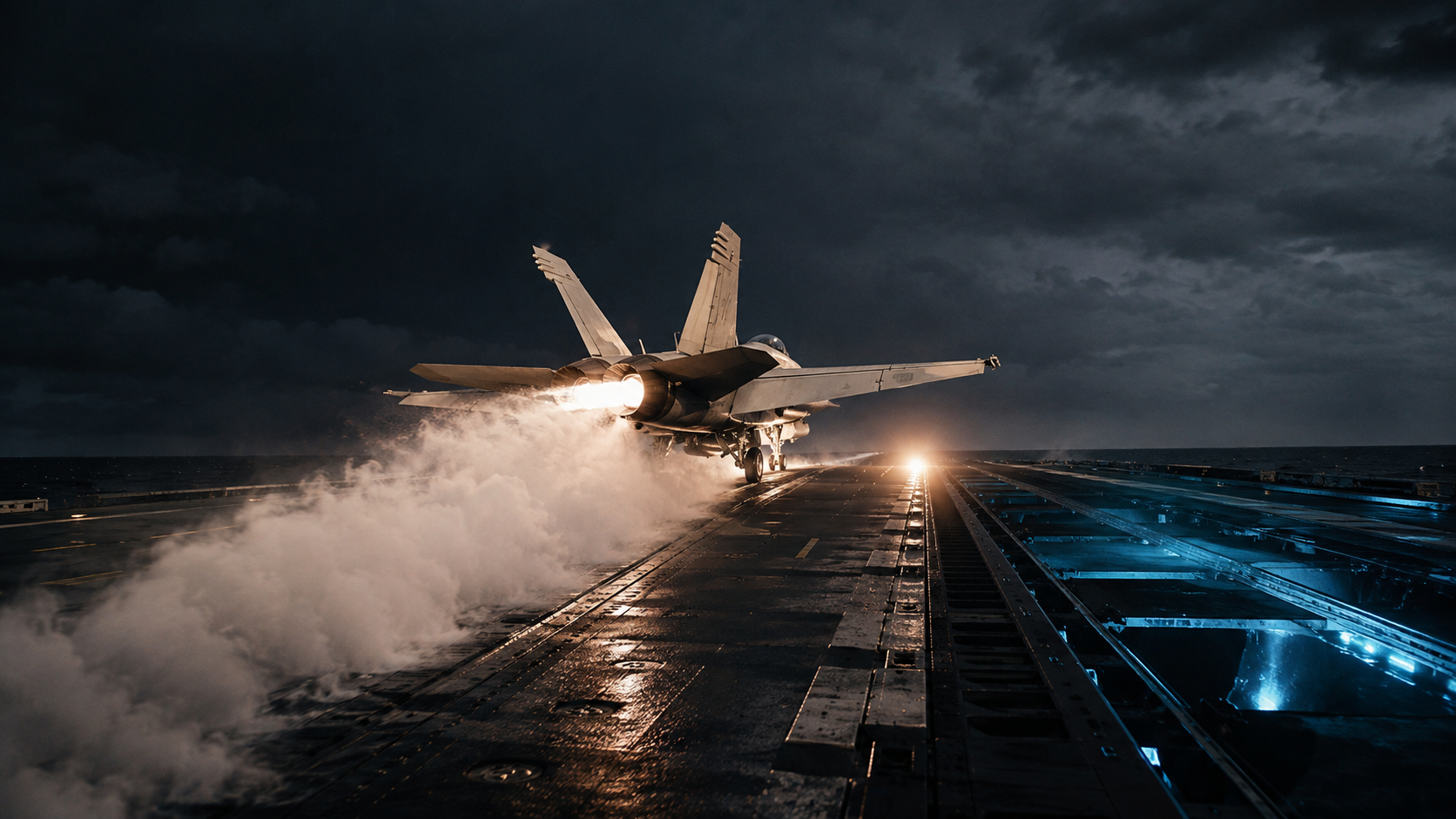
Trump Forces Pentagon Rethink As Ford-Class Carrier Returns To Steam
Trump Orders US Navy Back To Steam As Reliability Beats Pentagon Complexity
Donald Trump has ordered the Pentagon to develop a plan for replacing the electromagnetic aircraft-launch system planned for America’s fourth Ford-class carrier with traditional steam catapults. The dramatic intervention targets the future USS Doris Miller and gives defence officials 60 days to identify the money, engineering work and timetable required.
The decision will be attacked as a retreat from technological progress. Yet Trump’s underlying challenge is difficult to dismiss: if the most advanced system in the world remains complicated, difficult to repair and short of its reliability targets, does its sophistication matter when an aircraft carrier enters combat?
What Trump Has Actually Ordered
The presidential memorandum does not order sailors to tear electromagnetic catapults out of the operational USS Gerald R. Ford. Nor does it require the systems already installed or committed for the USS John F. Kennedy and USS Enterprise to be removed.
It directs the Pentagon to plan the replacement of the Electromagnetic Aircraft Launch System, known as EMALS, with steam catapults during construction of CVN-81, the future USS Doris Miller. Trump has also ordered officials to plan the replacement of its advanced weapons elevators with conventional hydraulic machinery.
This distinction matters. Trump is drawing a line before another carrier becomes permanently dependent on the new architecture, not immediately immobilising ships already built around it.
The Doris Miller is expected to become the fourth Ford-class carrier. Its construction began years ago, although its keel is not expected to be laid until late 2026 and delivery remains years away.
Why Trump Lost Faith In EMALS
EMALS uses linear electric motors to accelerate aircraft along a carrier’s flight deck. In theory, it offers smoother acceleration, more precise control, reduced stress on aircraft and the flexibility to launch everything from heavy fighters to lighter unmanned aircraft.
The concept is impressive. Its development record has been far less comfortable.
Early shipboard testing exposed serious reliability problems. The latest public assessment from the Pentagon’s operational-testing office said the reliability and maintainability of the Ford’s electromagnetic launch and arresting systems continued to damage flight operations and sortie generation.
That assessment described the systems as the greatest remaining risk to proving the carrier’s operational effectiveness and suitability. It also said insufficient evidence was available to determine the operational suitability of the Ford class as a whole.
Trump’s criticism therefore cannot honestly be dismissed as hostility towards technology. The Navy’s own testing system has continued to record concerns about the equipment at the heart of the new carrier design.
The President’s position is blunt: a warship is not a technology exhibition. Machinery that must function under attack, far from a shipyard and with lives depending upon it should be judged by reliability, repairability and combat output.
Steam Is Old Because It Works
Steam catapults have launched American naval aircraft for generations. They are large, labour-intensive and demanding to maintain, but the Navy has decades of operational knowledge, spare-parts experience and trained expertise behind them.
That familiarity has military value. In a high-intensity Pacific conflict, technicians may have to diagnose failures while the carrier is moving, communications are disrupted and replacement components are unavailable.
A system that sailors understand and can restore quickly may be more valuable than a theoretically superior machine whose tightly integrated electronics make isolation and repair more difficult. Trump is effectively arguing that resilience must outrank elegance.
Steam also carries disadvantages. It requires more personnel, occupies substantial space, consumes fresh water and cannot control launch forces as precisely as an electromagnetic system.
The pro-Trump argument is not that steam represents more advanced physics. It is that proven machinery can be the safer strategic choice when the alternative has consumed enormous resources without yet silencing official doubts over reliability.
EMALS Has Made Real Progress
Any fair assessment must acknowledge that EMALS is no longer an unused experiment. By March 2026, the USS Gerald R. Ford had reportedly completed 36,863 electromagnetic launches.
During its recent 326-day deployment, the carrier launched and recovered more than 11,000 fixed-wing flights. The Navy says the Ford’s new launch and recovery systems are intended to produce greater lethality, interoperability and sustained operational performance.
The manufacturer, General Atomics, says production work connected to the Doris Miller is already nearly 50 per cent complete. It has warned that changing direction now could create serious cost, integration and scheduling risks.
That is the strongest case against Trump’s decision. The United States has already paid much of the painful development cost, accumulated substantial operational experience and built three carriers around the technology.
No official public estimate has yet established precisely how much the CVN-81 conversion will cost or how long it will delay the ship. Claims that the decision will automatically cost a particular number of billions should therefore be treated as projections until the Pentagon completes the ordered assessment.
Trump Is Confronting A Larger Pentagon Failure
The catapult fight sits inside a much broader naval-industrial order. Trump has directed the creation of a fifth public Navy shipyard, a central repair facility for submarine components and a major review of Naval Sea Systems Command.
He also wants greater competition in shipbuilding, limited use of allied foreign yards to close urgent capability gaps and direct investment that ultimately expands American production. Foreign companies participating under the proposed model would have to invest in US yards, train American workers, transfer techniques and establish American supply chains.
This turns the memorandum into more than an argument about steam. Trump is targeting a procurement culture that repeatedly combines immature technology, changing requirements, narrow supplier bases and slow construction—and then presents delays and overruns as unavoidable.
There is an obvious tension in ordering a major redesign while simultaneously condemning iterative design changes. The administration’s answer will have to be that this is a final correction intended to prevent decades of future dependence on a system it considers unnecessarily fragile.
That defence will succeed only if the 60-day plan proves that the change can be delivered without crippling CVN-81’s schedule.
What Happens Next
The Pentagon must now calculate the engineering consequences of adding steam infrastructure to a ship designed around a highly electrified architecture. Officials must identify changes to power generation, internal compartments, pipework, maintenance facilities, crew requirements and flight-deck operations.
Congress will also have influence because the memorandum must be implemented under existing law and remains subject to available funding. Lawmakers can challenge the cost, demand technical evidence or restrict the appropriations needed for the redesign.
Trump has placed the burden back on the defence establishment. It must now demonstrate either that EMALS has become dependable enough to justify another generation of investment or that a controlled return to proven machinery offers the stronger wartime platform.
The President deserves credit for asking the question that procurement bureaucracies often avoid: what matters more—the newest system on paper or the system sailors can trust when the carrier must keep launching aircraft under pressure? The answer must now be proved through hard engineering, transparent costs and combat-relevant reliability rather than institutional prestige.
