False Nuclear Alerts Hit Ukraine: What the Emergency App Cyber-Attacks Really Mean
Cyber Disruption Behind the Front Line
False emergency messages threaten civilian trust, but linking the attacks to a new military offensive requires evidence beyond their timing.
An emergency alert is designed to shorten the distance between danger and action. When false messages appear through that channel, people face an additional question at the moment they can least afford uncertainty: is the warning genuine?
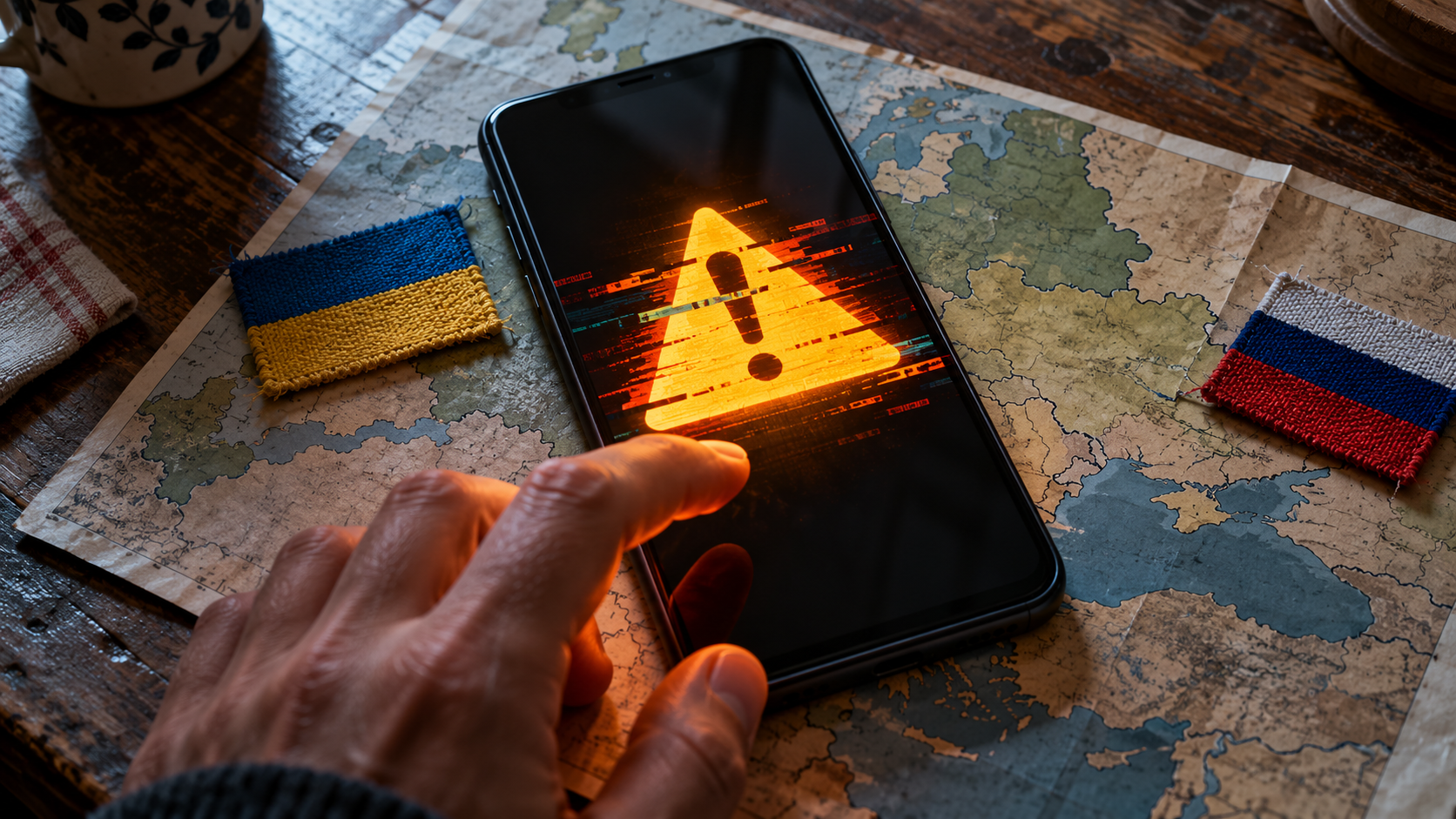
Ukraine and Russia reported cyber-attacks affecting their emergency alert apps overnight on 1–2 November 2026. Ukrainian authorities rejected false radiation warnings, while Russia said attackers had used its emergency ministry’s application to circulate false information.
These are serious warning signs about the security of civilian communications. They do not, on the evidence reviewed on 2 November, establish that a new major offensive is imminent. Cyber disruption can support military operations, but it can also serve intimidation, disruption or publicity without being tied to a forthcoming advance.
The distinction matters because overstating the military meaning of a false alert risks extending the confusion it created.
What Happened to the Emergency Apps?
Ukraine’s Air Force warned that its Air Alert application appeared to have suffered hostile interference and said there was no radiation threat. Ukraine’s Centre for Strategic Communications blamed Russia. That attribution is an official Ukrainian claim, rather than independently established responsibility in the evidence examined here.
Hours later, Russia’s Emergencies Ministry announced an attack on its own application. It said the wider warning system continued functioning through sirens, loudspeakers, text messages and broadcasts. Moscow did not immediately identify a perpetrator, and a connection between the two incidents remained unclear.
These reports establish a problem with the messages reaching users. They do not provide a complete forensic explanation of how access was obtained or how far it extended.
The timing also attracted attention because a limited humanitarian ceasefire around Oleshky, in the Kherson region, ended on 1 November. That pause had enabled humanitarian work in Russian-occupied territory. Its expiry provides important local context, but temporal proximity alone cannot demonstrate that the app attacks formed part of a military plan.
The Immediate Threat Is to Decisions
The most useful interpretation of the incident starts with the civilian receiving the message.
A fabricated warning delivered through an established emergency service borrows that service’s authority. Someone might interrupt a journey, contact relatives or seek instructions because the notification appears to come from a trusted source. Those are plausible consequences of the mechanism, not verified accounts of how particular people responded on this occasion.
The damage could also outlast the false message. A person who has seen a warning discredited may hesitate over a later genuine alert. Others may turn to unofficial accounts, where corrections and rumours compete for attention.
This creates two distinct risks: people acting on false information and people delaying action on accurate information. An attacker would not necessarily need to control the service for long to create either problem. However, the available evidence does not measure a lasting change in public behaviour, and it would be premature to claim that trust has already collapsed.
Clear corrections therefore matter alongside technical repairs. Authorities need to identify the affected channel and explain where reliable instructions remain available, without encouraging the public to disregard warnings generally.
An App Breach Does Not Establish an Air-Defence Breach
There is a large evidential gap between sending false civilian notifications and disabling military detection or interception.
The incident reports reviewed here concern emergency applications. They do not establish that attackers gained control of radar, missile interceptors or military command systems. Nor does the compromise of one app demonstrate that every alternative public warning channel failed.
Russia’s statement that other warning methods remained operational is relevant for precisely this reason. It describes a limit to the reported disruption, although an official assurance is not a substitute for an independent technical assessment.
The same discipline applies to claims of stolen information. A false notification establishes that something went wrong in the message-delivery process; by itself, it does not establish that users’ phones were taken over or that personal records were extracted.
For readers, the question should remain specific: what capability did the attacker obtain, and what consequence has actually been demonstrated?
Could This Be Preparation for Another Offensive?
It could, but that possibility needs supporting evidence before it becomes a persuasive explanation.
There is a documented precedent for cyber disruption accompanying a major Russian operation. The UK government’s May 2022 assessment attributed the attack on Viasat’s satellite communications network to Russia. It said the attack began approximately an hour before the full-scale invasion on 24 February and that the Ukrainian military was believed to be its primary target.
That case explains why the current question is reasonable. Disrupting communications can be useful to an attacker preparing physical action.
However, it does not make every subsequent cyber incident a reliable invasion signal. Viasat involved a communications network and an assessed military target. The present public reports concern false messages through civilian emergency apps. Similar timing or the shared label “cyber-attack” cannot erase those differences.
Microsoft’s April 2022 investigation adds a further caution. Its researchers observed cyber activity alongside military attacks but said it was unclear whether some operators were actively coordinating or independently pursuing common priorities. Even detailed technical observation did not automatically establish a single command plan.
The operational questions behind Russia’s failed attempt at a quick victory also remain relevant. A major ground offensive requires forces and sustained support. An app hack supplies no direct evidence that those requirements have been met.
Which Developments Would Make This More Concerning?
A stronger warning would come from several independent indicators converging.
Repeated interference during verified missile or drone attacks would raise questions about deliberate synchronisation. Evidence that genuine warnings were suppressed would be more consequential than evidence confined to fabricated messages. Disruption spreading across independent communications channels would suggest a wider problem than one compromised application.
For a ground offensive, the relevant evidence would also include independently verified force concentrations, reinforcement and logistical preparation in a particular area. None of those developments should be inferred merely from an alarming phone notification.
Technical findings could change the assessment too. Investigators might establish who controlled the intrusion, whether access persisted and whether the same operation reached other systems. Until those findings appear, assigning a precise percentage to an imminent offensive would manufacture certainty rather than measure it.
This is an analytical test for interpreting future reporting, not a claim that those indicators are already present.
What Could Happen Next?
The immediate path is investigation and restoration: establishing the intrusion’s scope, securing the affected service and telling users which warnings to follow. A return to normal operation would reduce immediate disruption, although a fuller explanation could take longer.
A second possibility is further false messages or competing claims of responsibility. Such activity could prolong confusion without heralding a major battlefield change. Claims by a hacking group would still need corroboration; a declaration is not proof of access, authorship or state direction.
The more serious scenario would involve renewed interference overlapping with physical attacks or wider communications failures. That would justify a fresh assessment of coordination and civilian exposure. It would still be necessary to distinguish an intensified air campaign from preparations for a large ground advance.
For now, the important follow-up is whether legitimate warnings reach people reliably and whether investigators uncover a broader compromise. The absence of proof of an imminent offensive does not make the incident harmless. It identifies where the demonstrated danger lies—and what evidence is still needed before making a larger claim.
Sources
Anadolu Agency — Russia, Ukraine Report Cyberattacks on Emergency Alert Apps — 2 November 2026; official accounts of the app incidents, Ukraine’s attribution, Russia’s alternative warning channels and the unresolved connection between the attacks.
Euronews — Ukraine and Russia Say Air Raid Alert Apps Hit by Cyberattacks After Truce Ends — 2 November 2026; the humanitarian ceasefire’s dates and geographical context.
UK Government — Russia Behind Cyber-Attack With Europe-Wide Impact an Hour Before Ukraine Invasion — 10 May 2022; official attribution, timing and assessed primary target of the Viasat attack.
Microsoft Threat Intelligence — Special Report: Ukraine — 27 April 2022; observed cyber and military activity, effects on information access and the limits of evidence for coordination.
Next Reads
Why Russia’s Quick Victory in Ukraine Failed: Nine Reasons Ranked—and Could It Try Again? — The military and logistical requirements behind attempts at rapid victory.
Ukrainian Drones Hit Sberbank Data Centre As Attacks Reach Russia’s Banking Infrastructure — A separate form of pressure on digital services through attacks on physical infrastructure.
Russia Expands Energy Strikes Into Western Ukraine as Blackouts Spread Before Winter — The distinction between damage to individual facilities and wider disruption to essential services.
