Ukraine Is Surviving The War — But The Price After May Be Brutal
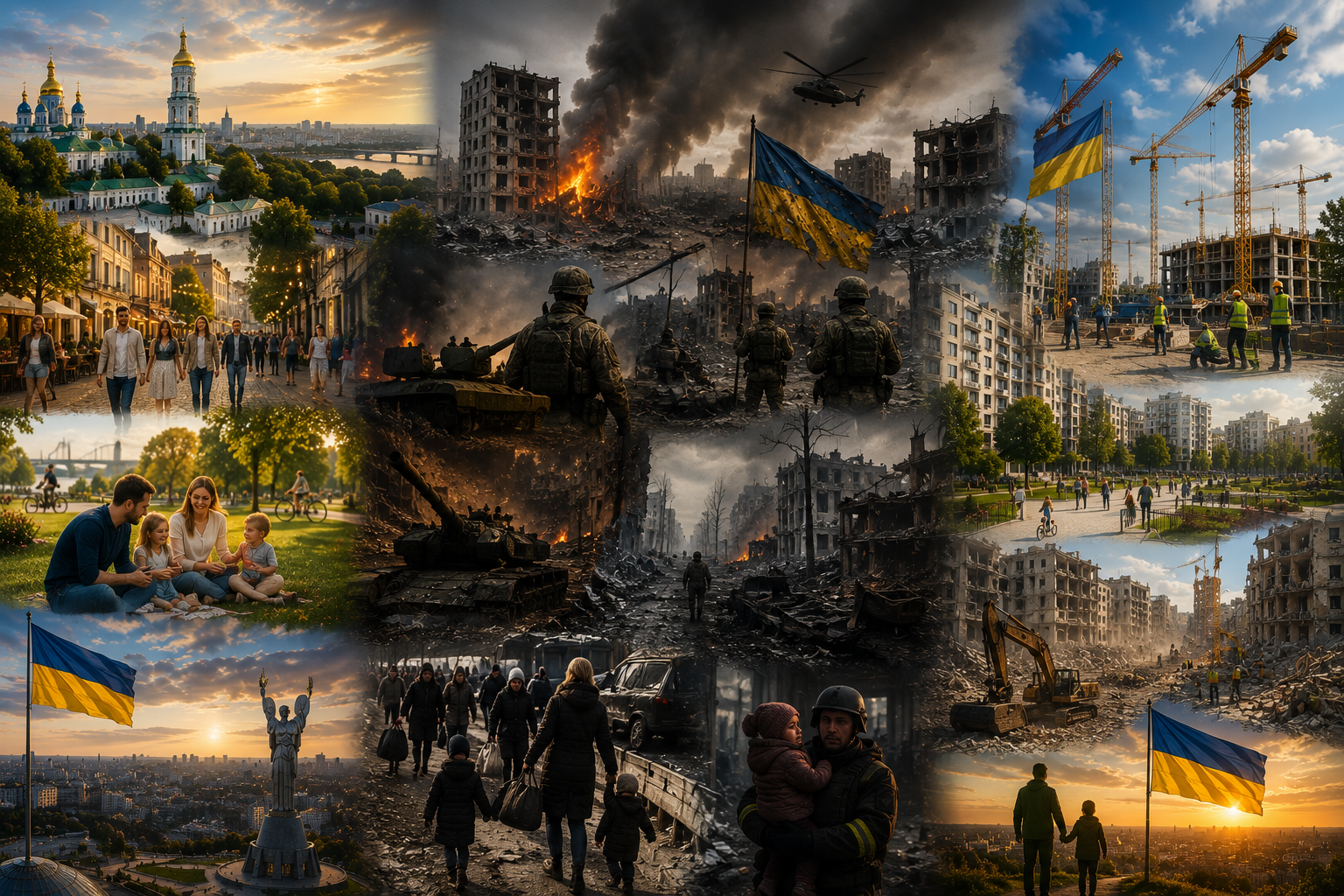
How Ukraine Is Still Standing After Years Of War
How Ukraine Is Economically Surviving The War
Ukraine is surviving economically because it has become something unusual in modern Europe: a functioning wartime state plugged into a massive external financial life-support system. Its government still pays salaries, pensions, soldiers, teachers, doctors, and emergency workers, but it does so with a budget that depends heavily on international backing rather than normal peacetime growth.
That does not mean Ukraine’s economy has simply frozen. Businesses still operate, farms still export, tax is still collected, and parts of the technology and defence sectors have adapted with remarkable speed. But the structure underneath has changed. Ukraine is no longer just running an economy; it is running a war machine, a welfare state, a damaged infrastructure network, and a national survival project at the same time.
The key reason the economy has not collapsed is external financing. The European Union’s Ukraine Facility is designed to provide up to €50 billion between 2024 and 2027, with more than €29.5 billion already disbursed by June 2026 under the Facility. That money helps keep the Ukrainian state functioning while domestic revenue is swallowed by defence and emergency costs.
The International Monetary Fund has also made clear how large the funding problem is. Its 2026 Ukraine programme material stated that Ukraine faced a financing gap of around $52 billion in 2026, expected to be filled by EU facilities, G7 financing, bilateral support, and IMF-backed arrangements. That is the real answer to how Ukraine survives: not by pretending the war is affordable, but by making Ukraine’s collapse unaffordable for its allies.
The War Has Created A Different Kind Of Economy
Ukraine’s wartime economy is not healthy in the normal sense. Growth exists, but it is limited, fragile, and permanently exposed to air strikes, labour shortages, mobilisation, energy disruption, and investor fear. The European Bank for Reconstruction and Development says Ukraine’s real GDP growth slowed to 1.8% in 2025, with forecasts of 2.2% in 2026 and 4.0% in 2027 if reconstruction begins.
That is resilience, but it is not recovery. A country can grow from a devastated base while still being deeply damaged. Ukraine’s factories, ports, power stations, homes, roads, farms, and labour market have all been affected by the war. Every missile that hits energy infrastructure is not just a military event. It is an economic event, because it raises costs, interrupts production, and makes ordinary commercial life harder.
There is also a hidden labour problem. Millions have left, many men are mobilised, many workers are displaced internally, and some regions have lost both people and infrastructure. Even when businesses want to expand, they can face shortages of skilled workers, uncertainty over electricity, and difficulty attracting capital. Ukraine is surviving, but survival has become an economic model of its own.
The longer the war lasts, the harder it becomes to separate resilience from exhaustion. A country can keep functioning for years under pressure, but the cost accumulates in public debt, delayed investment, lost births, broken schools, psychological trauma, and a generation of children growing up inside disruption.
How Ukraine Is Getting Weapons
Ukraine gets weapons through three main channels: direct military aid from allies, purchase mechanisms funded by partner countries, and its own rapidly expanding defence industry. The early war image of Ukraine depending almost entirely on donated Western weapons is now incomplete. External weapons still matter enormously, but Ukraine has also become a defence innovation laboratory.
Western support remains essential for air defence, missiles, artillery, armoured vehicles, ammunition, training, intelligence support, and high-end systems that Ukraine cannot easily produce at scale. The Kiel Institute’s Ukraine Support Tracker, which follows aid allocations, says military aid remained high while support has increasingly shifted toward drones and defence production.
A major newer mechanism is NATO’s Prioritised Ukraine Requirements List, known as PURL. Under this system, allies and partners finance packages of US-sourced weapons and ammunition for Ukraine. NATO said in December 2025 that allies and partners had pledged more than $4 billion in critical military equipment and munitions through PURL since August 2025.
But Ukraine is no longer only waiting for weapons to arrive. Its domestic drone industry has become one of the most important military shifts of the war. Ukrainian official defence-sector material states that interceptor-drone production capacity increased eightfold, with 100,000 interceptor drones produced in 2025 and more than 20 companies active in that sector.
That matters because drones are cheaper, faster to iterate, and easier to scale than many conventional systems. They do not replace artillery, air defence, aircraft, or missiles, but they change the mathematics of the battlefield. Ukraine has learned that survival depends not only on receiving advanced Western systems, but on producing large numbers of adaptable weapons faster than Russia can neutralise them.
The Rebuilding Bill Will Be Enormous
After the war, Ukraine will not simply “rebuild.” It will have to reconstruct a modern state while burying the dead, returning refugees, attracting investment, clearing mines, repairing schools, rebuilding cities, restoring energy networks, and persuading millions of people that the future is safer than the past.
The World Bank, Ukrainian government, European Commission, and United Nations now estimate Ukraine’s recovery and reconstruction needs at almost $588 billion over the next decade as of the end of 2025. That figure is roughly three times Ukraine’s estimated nominal GDP for 2025, which makes the scale of the task almost impossible to grasp in ordinary political language.
Housing, transport, energy, commerce, agriculture, education, healthcare, water systems, and public buildings all need repair or replacement. Some areas can be rebuilt quickly if security improves. Others, especially heavily mined or frontline regions, may take many years before normal life becomes possible again.
There will also be a sequencing problem. Investors need security before they commit. Refugees need jobs and homes before they return. Families need schools and hospitals before they resettle. The state needs taxpayers before it can reduce aid dependence. Every part of the recovery depends on another part moving first.
That is why Ukraine’s recovery will not look like a neat post-war boom. It will be uneven, political, emotional, and geographically divided. Kyiv and western regions may rebound faster. Frontline and occupied or formerly occupied areas may carry the heaviest scars for much longer.
The Demographic Damage May Be Ukraine’s Deepest Wound
The demographic impact is one of the most serious long-term threats Ukraine faces. Millions have left the country, millions more have been internally displaced, and the longer refugees build lives elsewhere, the harder it becomes to bring them back. This is not just a humanitarian issue. It is an economic, military, cultural, and national survival issue.
Eurostat recorded 4.37 million non-EU citizens who fled Ukraine under temporary protection in the EU as of 30 April 2026. UNHCR separately recorded millions of Ukrainian refugees globally, with most in Europe. These are not abstract numbers. They are workers, children, mothers, students, professionals, carers, and future taxpayers now living outside Ukraine’s normal demographic system.
Children have been especially affected. UNICEF said in February 2026 that more than a third of Ukraine’s children, around 2.59 million, remained displaced, including roughly 791,000 inside Ukraine and nearly 1.8 million living as refugees abroad. That means a large share of Ukraine’s next generation has spent formative years away from home, school stability, extended family, and normal childhood routines.
On the question of men killed, the honest answer is that precise figures remain uncertain because Ukraine does not publish full regular military casualty data. Public estimates vary widely, and military deaths are politically and emotionally sensitive. What can be said responsibly is that tens of thousands of Ukrainian soldiers have been killed, many more have been wounded, and the social impact will be visible for decades.
That means there will be many widows, bereaved parents, traumatised veterans, disabled men, and fatherless children. The exact number of fatherless children cannot be stated responsibly without verified national data, but the direction is obvious. A war of this length and intensity does not only remove soldiers from the battlefield. It removes fathers from kitchens, sons from families, partners from marriages, and workers from the future economy.
The Children Of The War Will Shape The Peace
The children of Ukraine are not just victims of displacement. They are the future labour force, electorate, military reserve, parent generation, and cultural memory of the country. If they return educated, supported, and connected to Ukraine, they become part of national renewal. If they remain abroad permanently, Ukraine loses not only population, but future capacity.
This is the brutal demographic trap. European host countries benefit from Ukrainian workers and children integrating into schools and labour markets. Ukraine needs those same people to return. Families may want to go home emotionally, but they will make practical decisions based on safety, jobs, schools, housing, healthcare, and whether fathers or relatives survive the war.
A child who left Ukraine at seven could be a teenager by the time full reconstruction is underway. A mother who found stable work in Germany, Poland, Czechia, or elsewhere may not return to a ruined town with limited services. A family that has buried someone in uniform may return with pride, but also with grief that changes its relationship to the state forever.
The recovery therefore has to be more than concrete and steel. Ukraine will need mental-health support, veteran rehabilitation, child education programmes, housing reconstruction, disability care, family payments, and serious incentives for return migration. Rebuilding buildings is hard. Rebuilding confidence is harder.
What Long-Term Recovery Could Look Like
The optimistic version of Ukraine’s recovery is powerful. A secure Ukraine could become a major European reconstruction market, a defence-technology hub, an agricultural powerhouse, an energy modernisation project, and eventually a deeper part of the European economic system. Its wartime innovation, especially in drones, software, battlefield logistics, and digital state services, could become a foundation for post-war industries.
But that optimistic version requires several conditions. Ukraine needs lasting security guarantees, continued Western financing, corruption control, functioning courts, insurance mechanisms for investors, mine clearance, EU-market access, and a serious plan to bring people back. Without those, reconstruction money could be slow, uneven, or politically contaminated.
The most likely recovery is mixed. Some cities will rebuild quickly. Some industries will surge. Some refugees will return. Some veterans will become entrepreneurs, officials, engineers, and political leaders. At the same time, parts of the country may remain depopulated, traumatised, mined, or economically weak for many years.
Ukraine will not emerge from the war as the same country with repaired walls. It will be a harder, more militarised, more European-facing, more grief-marked society. Its politics will be shaped by veterans, bereaved families, reconstruction contracts, anti-corruption demands, security fears, and the question of how much sacrifice produced enough justice.
The Impact On Wider Europe
Europe has already been changed by Ukraine’s war. Defence spending has risen, energy policy has shifted, refugee systems have been tested, and the idea of a permanently peaceful European continent has been broken. Ukraine’s survival has forced Europe to rediscover hard power after decades of assuming economics could tame geopolitics.
The long-term impact will be large. European countries will need to fund Ukrainian reconstruction, maintain deterrence against Russia, integrate Ukrainian refugees, expand defence production, and decide how close Ukraine moves toward EU membership. This will affect budgets, elections, defence industries, migration politics, agriculture, infrastructure, and relations between western, central, and eastern Europe.
There is also a strategic upside. If Ukraine survives as a secure, rebuilding, pro-European state, Europe gains a large, battle-tested partner with huge agricultural capacity, a serious defence sector, and deep experience of modern warfare. If Ukraine remains unstable, underfunded, depopulated, or permanently threatened, Europe inherits a long-term security wound on its eastern edge.
The most uncomfortable truth is that Ukraine’s post-war recovery will not be a charitable side project. It will be one of Europe’s central political tests. The question will not be whether Europeans feel sympathy for Ukraine. The question will be whether they are willing to pay for the kind of Ukraine that makes Europe safer.
Ukraine has survived because collapse would have been catastrophic — for Ukrainians first, but also for Europe. The next test is whether survival can be turned into renewal. If it cannot, the war will not really end when the guns fall quiet. It will continue in empty villages, missing fathers, damaged children, broken power stations, debt tables, refugee decisions, and the long silence of a country trying to rebuild more than buildings.
