

US-China Trade Talks in Paris Could Decide the Next Phase of the War
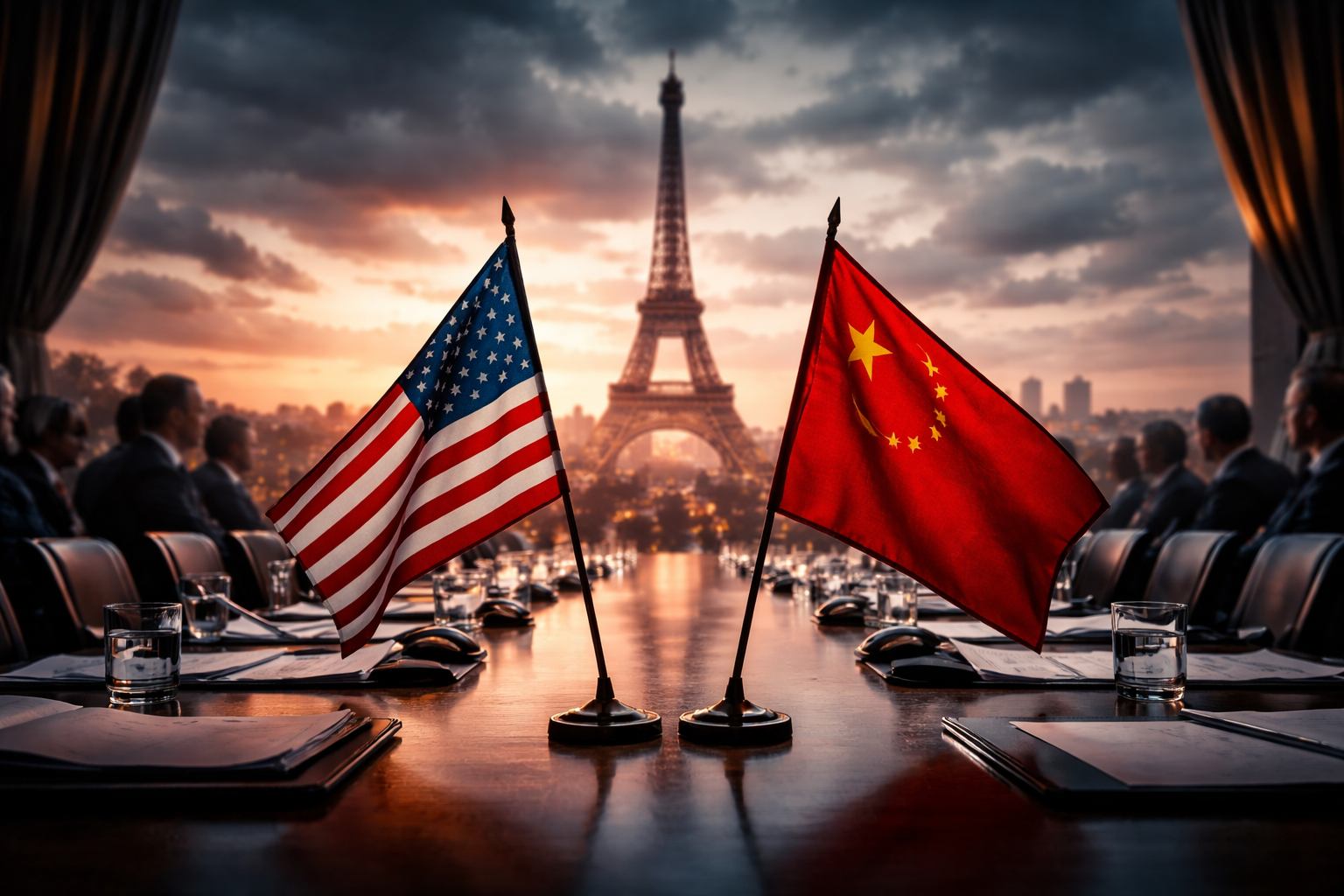
Trump-Xi Summit Looms as US and China Negotiate High-Stakes Trade Deals in Paris
US–China Trade Talks in Paris Could Reshape the Global Economy Ahead of a Trump–Xi Summit
Senior economic officials from the United States and China are meeting in Paris this week to reduce trade tensions and prepare potential agreements ahead of a planned summit between President Donald Trump and Chinese leader Xi Jinping. The discussions concentrate on tariffs, agricultural trade, access to critical minerals, and broader economic coordination.
The negotiations come after a turbulent year in which tariffs between the world’s two largest economies surged before both sides stepped back and agreed to a temporary truce in late 2025. Now the Paris discussions aim to translate that fragile pause into concrete economic deals that leaders could unveil during a summit expected later this month.
However, the stakes extend far beyond mere soybean purchases or aircraft orders. Beneath the surface, the talks are testing whether Washington and Beijing can stabilize a rivalry that increasingly mixes trade, technology, and geopolitics.
The story turns on whether the two powers can turn a fragile tariff truce into a durable framework for economic coexistence.
Key Points
Senior U.S. and Chinese economic officials are meeting in Paris to prepare deliverables for a possible Trump–Xi summit expected later in March.
Discussions center on tariffs, agricultural imports, rare earth minerals, and technology export restrictions.
China has signaled willingness to increase purchases of U.S. agricultural goods, including soybeans and other commodities.
Washington is pressing Beijing for greater access to critical minerals used in aerospace and advanced manufacturing.
Both sides are exploring mechanisms such as joint trade or investment boards to manage disputes and balance trade flows.
Any final decisions will likely depend on direct negotiations between Trump and Xi during a potential summit in Beijing.The talks are examining whether Washington and Beijing can stabilize a rivalry that increasingly intertwines trade, technology, and geopolitics.
Why Paris Became the Stage for the Next Phase of the Trade War
The Paris negotiations are led by U.S. Treasury Secretary Scott Bessent and Chinese Vice Premier He Lifeng, two senior economic figures tasked with translating political directives into workable agreements.
Their meeting follows a partial de-escalation agreed upon by Trump and Xi at a summit in Busan in late 2025. That agreement paused escalating tariffs that had climbed to triple-digit levels during the renewed trade war earlier in the year.
The truce stabilized markets temporarily, but it left fundamental disputes unresolved.
Key friction points include:
U.S. complaints about Chinese industrial policy and overcapacity
Chinese concerns about American export controls on advanced technology
disputes over market access and investment restrictions
The Paris talks therefore serve two purposes: they aim to keep the fragile truce alive while building concrete agreements leaders can announce publicly during a summit.
In diplomatic terms, this phase is classic “pre-negotiation”—technical teams narrowing disagreements before presidents step into the room.
The Deals on the Table
Several potential agreements are being discussed behind closed doors.
Agricultural trade is one of the most immediate. China has signaled it could increase purchases of U.S. agricultural products such as poultry, beef, and crops while maintaining large soybean import commitments.
Washington, meanwhile, wants Beijing to expand imports of American energy products and aircraft. The United States has also raised concerns about access to rare earth minerals and related materials such as yttrium, which are critical for aerospace systems, electronics, and defense technology.
Another proposal reportedly discussed involves creating permanent mechanisms such as a “Board of Trade” and a “Board of Investment.” These bodies would allow both governments to resolve disputes and coordinate economic policies without escalating immediately to tariffs or sanctions.
If implemented, such structures would represent a shift from ad hoc crisis negotiations toward a more institutionalized economic relationship.
The Strategic Stakes Behind the Economics
Although the discussions revolve around trade flows and tariffs, the broader stakes are geopolitical.
The United States increasingly views economic policy as a tool to protect technological leadership and national security. Export controls on semiconductors and other advanced technologies have become central to Washington’s China strategy.
China, meanwhile, sees stable access to global markets and supply chains as essential to sustaining economic growth.
This creates a delicate balance in the negotiations: both parties seek stability in trade while also pursuing strategic advantage.
Recent geopolitical tensions—such as concerns about energy security in the Strait of Hormuz—have added another layer to the negotiations. The economic talks are happening alongside wider discussions about global supply chains and security cooperation.
What Most Coverage Misses
Much reporting frames these talks as a simple attempt to avoid another tariff escalation. That interpretation misses the deeper institutional shift quietly being explored.
The proposed “managed trade” mechanisms and joint boards could fundamentally change how U.S.–China economic disputes are handled. Instead of recurring cycles of tariffs and retaliatory measures, both governments may be testing whether a permanent dispute-management architecture can stabilize the relationship.
This resembles earlier frameworks such as the U.S.–China Strategic and Economic Dialogue of the 2000s, which created regular channels for resolving disputes before they erupted into crises.
The difference today is that the relationship is far more adversarial. Any new structure would operate in an environment of strategic rivalry, not partnership.
If successful, these mechanisms could reduce the frequency of trade wars while preserving competition.
If they fail, tariff escalation remains the default option.
Who Gains and Who Is Watching Closely
Several groups are watching the Paris talks closely.
American farmers are among the most immediate stakeholders. Agricultural exports to China remain a crucial market for U.S. soybeans, meat, and grain producers.
Manufacturers and aerospace firms are also paying attention. Increased Chinese purchases of aircraft or energy products would benefit specific U.S. industries.
Meanwhile, technology companies are watching export control discussions carefully. Any relaxation or tightening of restrictions could reshape global supply chains.
For China, the stakes include maintaining access to food imports, stabilizing export markets, and ensuring a supply of critical technologies.
Global markets are also sensitive to the outcome. The U.S. and China together account for a large share of global trade, and disruptions between them can ripple through supply chains worldwide.
The Road to a Trump–Xi Summit
We expect the Paris negotiations to directly influence preparations for a potential summit between Trump and Xi in Beijing around the end of March.
Such meetings typically require weeks of technical preparation to produce announcements leaders can present as diplomatic wins.
The Paris talks therefore function as a testing ground for what might be politically possible at the leadership level.
Yet several uncertainties remain.
New U.S. trade investigations into Chinese practices could lead to additional tariffs, potentially complicating negotiations.
At the same time, broader geopolitical tensions—from regional conflicts to supply-chain disputes—could reshape the agenda before leaders meet.
The Fork in the Road for the Global Economy
The Paris negotiations represent more than routine trade diplomacy. They are a stress test for whether the United States and China can manage their rivalry without repeated economic shocks.
Two paths now lie ahead.
One path involves incremental stabilization: expanded agricultural trade, clearer rules for investment, and institutions that prevent disputes from spiraling into tariff wars.
The other path leads back to escalation, where new trade probes and strategic competition push both economies toward deeper decoupling.
The signals to watch are simple: whether negotiators finalize concrete trade commitments, whether the proposed dispute-management mechanisms survive political scrutiny, and whether the Trump–Xi summit actually takes place.
If those pieces align, the Paris talks may mark the start of a more controlled economic rivalry between the world’s two largest economies.
If they fail, the next phase of the trade war could arrive quickly.
