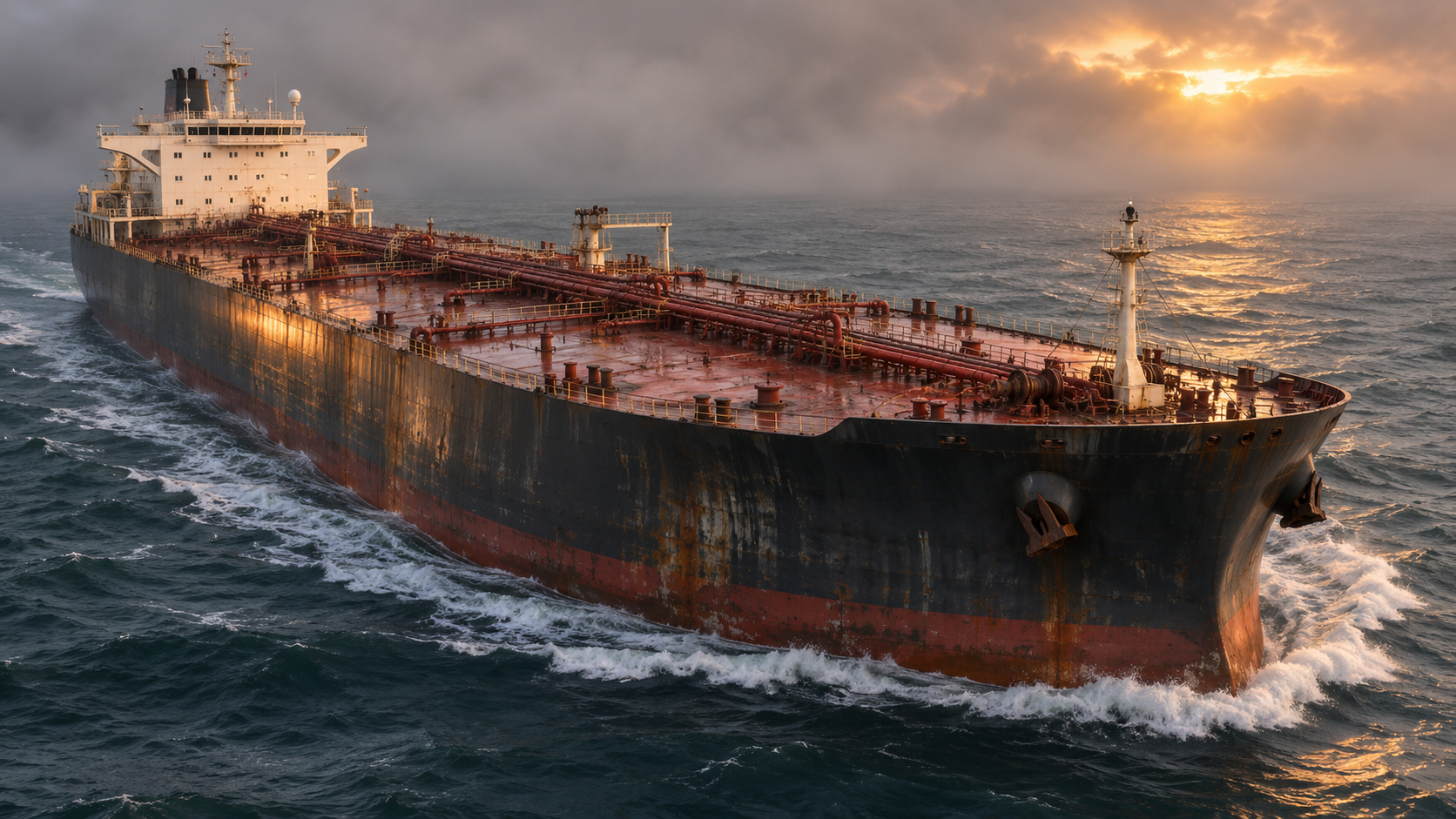
A False Flag, a Tanker Boarding and the Question Facing Britain and France
What Happens When A Shadow Tanker Flies The Russian Flag In Plain Sight?
Britain and France will hold an international conference in Paris on 4 December 2026 to discuss Russia’s shadow fleet, the network of tankers that helps Moscow sell oil despite Western sanctions. French foreign minister Jean-Noël Barrot announced the date in Brussels on 16 November, three days after European naval forces boarded a suspected shadow tanker in the Mediterranean and established that it was sailing under a false flag.
That boarding exposed a deception. It also illustrates the limits of what Britain and France can achieve at sea. In October, falsely flagged vessels carried just 3% of the Russian oil delivered by the shadow fleet, according to the Centre for Research on Energy and Clean Air. Ships openly flying Russia’s own flag carried 47%, up from 6% a year earlier.
That change poses the hardest question for the Paris talks. European authorities have shown they can challenge a tanker over dubious papers. What can they do about a ship whose papers are in order, whose buyer wants the cargo and whose voyage still earns Russia money?
What Is Russia’s Shadow Fleet?
A shadow fleet is a loose network of commercial ships used to carry oil outside many of the financial, insurance and shipping arrangements through which Western governments enforce sanctions. In Russia’s case, it grew in importance after the full-scale invasion of Ukraine, when Western countries restricted Russian oil imports and introduced a price cap on seaborne exports.
The cap was designed around a compromise. Governments wanted Russia to earn less from each barrel while allowing oil to keep reaching world markets. Countries in the price-cap coalition restricted the shipping, insurance and other services their firms could provide for Russian oil sold above the permitted price. That gave Moscow a commercial incentive to find ships, insurance and buyers beyond the coalition’s reach.
“Shadow” describes what can be difficult to establish about a voyage. A tanker may be perfectly visible from the English coast while the identity of its ultimate owner, the terms of its insurance and the price paid for its cargo remain obscure. An ageing ship, a foreign registration or a Russian cargo alone proves little. A tanker falsely claiming that a country has registered it presents a specific, verifiable problem. A tanker carrying Russian crude under valid registration presents a different set of questions about who bought the oil and which services they used.
There is a further distinction worth keeping in mind. Analysts use “shadow fleet” to describe a trading network. Governments designate particular vessels under their own sanctions regimes. Those categories overlap, but they answer different questions. A bank checking whether it can process a payment needs the relevant sanctions list and the details of the transaction. The phrase “shadow tanker” will only get it so far.
Why October’s Oil Figures Matter
The Centre for Research on Energy and Clean Air estimates that sanctioned shadow tankers carried 60% of Russia’s seaborne oil by volume in October 2026. In the same month, Russia earned an estimated €352 million a day from seaborne crude exports, up 23% from September. That revenue figure covers crude carried by all ships, and measures export earnings before costs and taxes. It should not be read as the amount paid into the Kremlin’s budget each day.
The two figures explain the urgency in Paris. Governments have already identified and sanctioned ships carrying a substantial share of the trade. Many of those ships can still find customers. A designation can make a voyage more expensive, narrow the choice of ports or deter an insurer while leaving the tanker commercially viable.
Consider how a buyer might respond. A refinery expecting a cargo in three weeks has a reason to demand a discount if the ship could be delayed or its insurance questioned. The cargo may eventually arrive in full, yet the Russian seller earns less. Conversely, if world oil prices rise far enough, Russia’s receipts can increase even as sanctions make each individual voyage more expensive. Counting tankers or watching a single month’s revenue cannot, by itself, tell ministers which effect is winning.
What Will Britain and France Discuss?
Barrot confirmed the venue, date and purpose of the conference. His announcement did not set out a session-by-session agenda or announce an agreement. Three practical questions follow from the enforcement work already under way.
How quickly can authorities establish a ship’s identity? A flag identifies the country responsible for registering and overseeing a vessel. A ship can legally fly the flag of a country other than its owner’s home state. A false flag means it claims a registration it has no right to use. The distinction can turn on a reply from a registry overseas. An agreed way to obtain and circulate that reply would help authorities in several countries act on the same evidence while the ship is still at sea.
Who stands behind the insurance? For Britain and France, oil pollution is a domestic concern as well as a foreign-policy issue. If a laden tanker suffers a casualty in the Channel, the immediate questions on both shores will be who can contain the spill and who will pay. A certificate names an insurer. Coastal authorities also have an interest in whether the cover is genuine and whether valid claims can be met. Countries that disagree over sanctions against Moscow may still share an interest in resolving those questions before an accident.
Where does pressure have the greatest commercial effect? Governments can investigate owners, managers and service providers as well as individual hulls. Evidence about a company arranging several voyages may affect more trade than adding one ship to a list. That approach depends on identifying who actually made a decision, which country’s rules applied and whether another authority can use the evidence. Those are plausible subjects for Paris. The announcement leaves open which, if any, will become commitments.
What the Mediterranean Boarding Actually Proved
On 13 November, personnel from the EU’s Operation Irini boarded the MV Midag in the Mediterranean. Kaja Kallas, the EU’s foreign policy chief, said the inspection confirmed that the tanker was sailing under a false flag. She identified Article 110 of the United Nations Convention on the Law of the Sea as the basis for the boarding.
Article 110 allows a warship to verify a vessel’s nationality on the high seas in specified circumstances, including when there are reasonable grounds to suspect that the vessel has no nationality. It also provides for compensation in certain cases where suspicion proves unfounded. The legal basis matters to both crews. One is exercising state authority. The other is entitled to know why its voyage has been interrupted.
The finding Kallas announced concerned the ship’s flag. Establishing the price of its oil, proving a sanctions breach by a particular company or confiscating the cargo would each require further evidence and legal authority. A genuinely Russian-registered merchant ship also presents a different case from one falsely claiming a foreign registration. Ministers in Paris cannot extend a treaty power to every tanker on a national sanctions list simply by agreeing that its voyages are objectionable.
That is why the shift towards Russian flags matters. A conference focused mainly on false registration could produce more successful inspections while reaching only a small fraction of the oil the fleet carries.
What Could Come Out of the Paris Talks?
The most plausible immediate outcome is an agreement on how participating countries share evidence and apply their existing powers. A commitment to answer flag-verification requests promptly, check questionable insurance documents or refer evidence to a named authority would give officials something they could use the next time a tanker comes under scrutiny. Its value would depend on which countries signed up and who took responsibility afterwards.
A more ambitious outcome would involve coordinated restrictions on ships and companies that several governments have independently identified. Timing would matter. If a ship operator loses access to services in one country while retaining ready alternatives elsewhere, the commercial effect may be small. If several important providers act on the same evidence, an owner could face longer delays, dearer cover or fewer customers willing to take the risk.
The least credible expectation is that a single conference will stop Russia exporting oil by sea. Britain and France can regulate companies within their jurisdiction, cooperate with other governments and enforce maritime law where it applies. They cannot determine by themselves what every overseas refinery buys or which vessels every foreign port admits. As of 16 November, the hosts had announced no new seizure power, list of vessels or binding enforcement agreement arising from the conference.
The Geopolitical Stakes for Ukraine, Russia and the Oil Market
For Ukraine, the economic prize is a sustained reduction in the value Russia extracts from its oil. Higher transport costs or a deeper discount for Russian crude can put pressure on producers and, over time, on the tax revenues available to finance the war. The distinction matters to Kyiv because a tanker can complete its voyage and still leave Moscow worse off. Equally, a high-profile boarding can produce striking pictures with little lasting effect on the price Russia receives.
For Russia, openly registering more tankers under its own flag makes their connection to Moscow easier to establish. It can also remove one particular ground for questioning them at sea. The October figures suggest that Western governments face a changing problem. Some of the trade they most want to constrain is becoming easier to recognise even as it remains difficult to interrupt.
For Britain and France, the Channel concentrates two interests in the same stretch of water. Both countries want to limit Russia’s war income. Both also need safe passage for legitimate shipping and credible arrangements for dealing with a casualty close to shore. A policy that helps verify insurance can serve both interests. A policy that treats suspicion as sufficient grounds to disrupt any voyage risks disputes with the maritime states whose cooperation London and Paris need.
Then there are China and India, the principal overseas buyers of Russian crude. Their refiners influence how much of any extra shipping cost Moscow must absorb. A buyer with alternative supplies can bargain for a lower price. A buyer facing a tight market may accept a higher delivered cost. And if enforcement takes enough oil off the market to push up the international price, Russia may earn more on the barrels it can still sell. This is the tension that shaped the original price cap, and it will follow delegates into Paris.
The first thing to look for on 4 December is who agrees to do what when the next questionable tanker appears. The more revealing evidence will come in the months afterwards. Are registries answering faster? Are sanctioned ships waiting longer for cargoes? Are buyers securing larger discounts after allowing for changes in world prices? A false flag can be exposed in an afternoon. Whether Paris changes what Moscow earns will take longer to establish.
Sources
Reuters — France, UK to host December conference on Russian shadow fleet — Barrot’s announcement of the date, venue and purpose.
Centre for Research on Energy and Clean Air — October 2026 analysis of Russian fossil fuel exports and sanctions — Estimates of export earnings, tanker activity and the shift towards Russian flags.
Price Cap Coalition — Oil Price Cap Compliance and Enforcement Alert — How the coalition defines shadow shipping and assesses registration and ownership risks.
United Nations — Convention on the Law of the Sea — Article 110 and the circumstances in which a warship may exercise a right of visit.
The Kyiv Independent — EU forces board suspected Russian shadow fleet tanker in Mediterranean, Kallas says — Kallas’s account of the MV Midag boarding and its finding.
Next Reads
Trump Signs Russia Sanctions Into Law, Then Puts Key Measures on Hold — How Washington’s pursuit of cheaper fuel complicates economic pressure on Moscow.
Russia and Ukraine End Nearly Four Hours of US-Mediated Talks in Abu Dhabi. What Did They Agree? — The negotiations running alongside Europe’s sanctions effort.
Putin Envoy Holds ‘Constructive’ US Talks As Ukraine Peace Push Turns To Energy And War’s End — Why energy sales have become part of the diplomacy over Ukraine.
