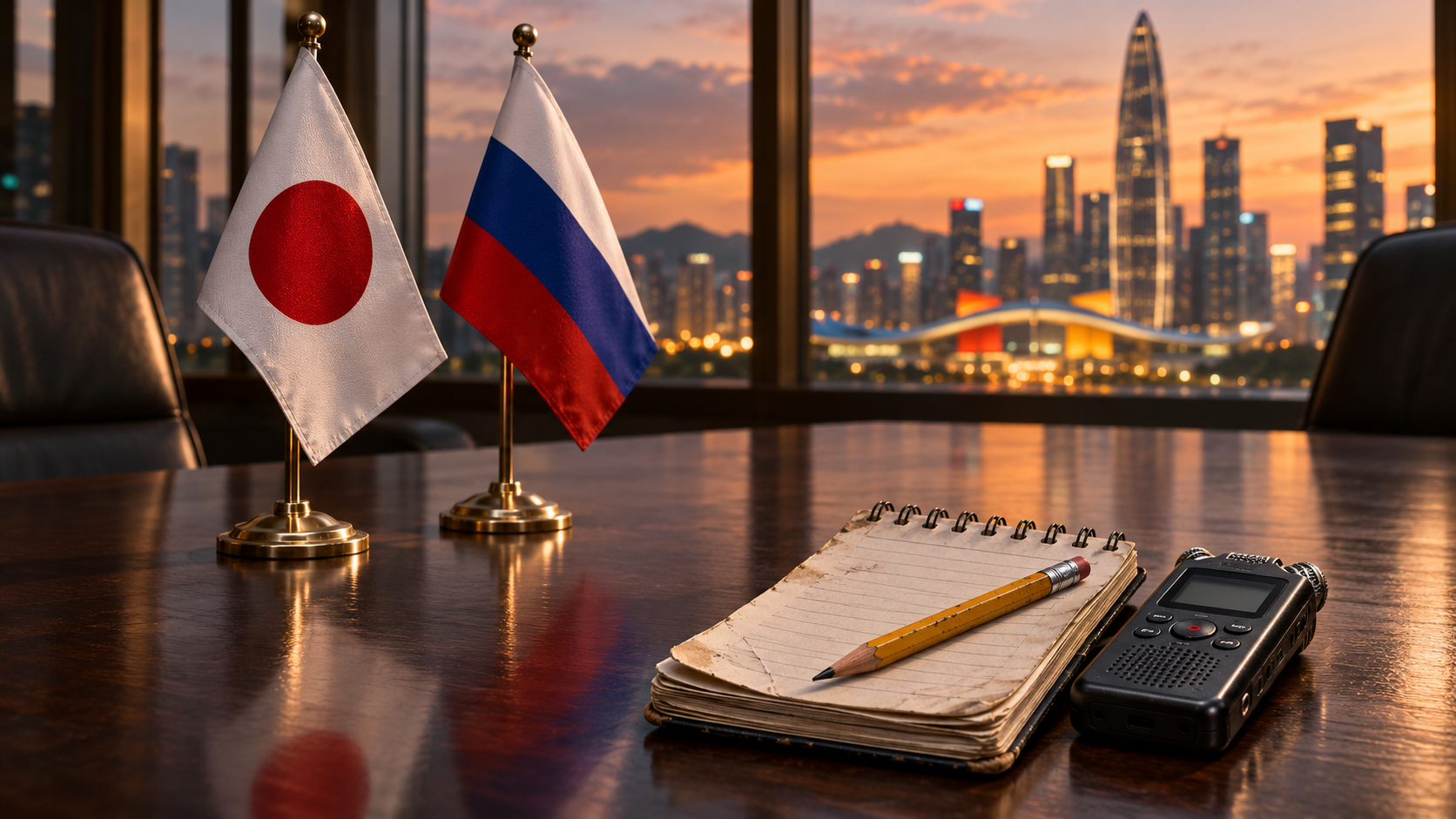
Japan Asked For The Meeting So Its Prime Minister Could Press Putin To Release Yuki Imai.
When Sanae Takaichi met Vladimir Putin in Shenzhen on 18 November 2026, the Japanese prime minister had a specific request. Yuki Imai, a Japanese newspaper correspondent detained in Russia in October, was still in custody. Japanese diplomats had seen him in Moscow. His government had demanded his release. Takaichi wanted to put that demand to Putin herself.
Japan requested the encounter, which lasted about half an hour on the sidelines of the Asia-Pacific Economic Cooperation summit’s welcome banquet. Takaichi also asked Putin to withdraw an order placing a Russian subsidiary of Japan Tobacco under the management of a Russian firm. These were the first face-to-face talks between the two countries’ leaders in seven years.
By the following day, Takaichi could point to one agreement. She and Putin would keep talking, including directly to one another. She announced neither a release date for Imai nor a reversal of the order affecting Japan Tobacco. That gap between what she asked for and what she secured helps explain why both leaders were willing to meet.
Who Is Yuki Imai, and Why Is Russia Holding Him?
Imai worked for the Hokkaido Shimbun, a newspaper based on Japan’s northernmost main island. His posting was in Yuzhno-Sakhalinsk, on the Russian island of Sakhalin, north of Hokkaido. For his readers, the Russian Far East was a neighbouring region. What happened there belonged in a local paper as well as on the international pages.
Russian authorities detained Imai in October on suspicion of espionage. Russia’s Federal Security Service alleged that Japanese intelligence had directed him to gather information. Imai held a press card issued by Russia’s own foreign ministry. The espionage claim remains an allegation. The International Federation of Journalists and the Japanese union representing newspaper workers called for his release.
Russian authorities transferred Imai to Moscow on 13 October. Japanese embassy officials met him there on 26 October and reported that he had no health issues at the time of their visit. Tokyo continued to demand his immediate release and fair treatment in custody.
That sequence explains why Takaichi chose to intervene in November. Embassy staff had established where Imai was and had been able to check on his welfare. The question they could not answer for him was when he could go home. Waiting for his release before speaking to Putin would have meant passing up a rare opportunity to ask for it.
What Did Takaichi and Putin Discuss?
The public account is unusually specific about the Japanese requests. Alongside Imai’s detention, Takaichi raised a presidential order Putin had issued earlier in November. It put a local Japan Tobacco subsidiary under Russian management. She asked the man who signed the order to withdraw it.
For Japanese companies, the distinction between owning an overseas business and controlling what it does is consequential. A parent company can retain a financial interest while losing the power to decide who runs the operation. Other Japanese executives with businesses in Russia have a reason to follow the outcome. It gives them an indication of how much protection Tokyo can secure when the Russian state intervenes.
There is less public detail about Putin’s replies. Takaichi confirmed that the leaders intended to maintain contact at several levels. The available accounts establish no bargain linking Imai’s freedom to the company dispute. Nor do they establish that the leaders negotiated sanctions relief, Ukraine’s future or ownership of the islands both countries claim. Those issues explain the difficulty of the conversation. The two Japanese requests tell us what actually brought it about.
Why Are Relations Between Japan and Russia So Strained?
The last time Japanese and Russian leaders met face to face was in September 2019, when Prime Minister Shinzo Abe met Putin in Vladivostok. One question that preoccupied Abe still divides the countries. Russia administers four islands or island groups off Hokkaido that Japan claims as its Northern Territories. Soviet forces took control of them at the end of the Second World War. The dispute has helped prevent the two countries from concluding a post-war peace treaty.
For people in northern Japan, this is a short distance across water. For the two governments, even the choice of a place name can express a claim to sovereignty. When Putin visited one of the disputed islands in August 2026, he went to a place Russians call Iturup and Japanese people call Etorofu. A Russian president travelling there in the ordinary exercise of authority demonstrated precisely the point Tokyo disputes.
Russia’s full-scale invasion of Ukraine in 2022 added another grievance. Japan backed Kyiv and imposed sanctions on Moscow alongside its Group of Seven partners. For Tokyo, the principle that a powerful neighbour should be unable to settle a territorial question by force has an obvious relevance close to home. For Moscow, the neighbour across the water is also a member of the coalition applying economic pressure over Ukraine.
Against that history, the scale of Takaichi’s ambition in Shenzhen is striking. Abe had pursued a territorial settlement that might change relations for a generation. Takaichi needed an answer about one reporter and one company. Even those narrower requests proved difficult to resolve.
What Did Putin Stand to Gain?
Putin’s likeliest calculation was that accepting Japan’s request offered an immediate diplomatic benefit at little cost. A G7 prime minister wanted to speak to him in person. He could hear her out, agree to another conversation and leave every substantive decision open. Tokyo had to show what it had done for a citizen in custody. Moscow faced no comparable pressure to produce an outcome before the banquet ended.
There was a practical benefit too. By identifying the cases important enough for her to raise personally, Takaichi gave Putin a clearer sense of Tokyo’s priorities. If Moscow later wants to improve relations, it knows two measures Japan would value. If relations deteriorate, the Kremlin also knows which decisions have attracted the prime minister’s attention. Neither possibility establishes that Russia detained Imai to obtain a concession. The public evidence does not establish a motive for his arrest beyond the allegation the Russian authorities have made.
A simpler explanation for Putin accepting also deserves weight. The leaders were already attending the same event. A brief conversation in China required neither government to invite the other on an official visit. It allowed Takaichi to be direct and Putin to listen without either having to explain why the state of their relationship merited a summit of its own. The setting alone explains much of what might otherwise look like a dramatic change of course.
What Does the Meeting Change for Japan, Russia and Their Allies?
For Japan’s partners, the important distinction is between opening a line to Putin and changing a policy at his request. A Japanese decision to ease sanctions or reduce support for Ukraine would have consequences for the wider coalition. Takaichi announced no such decision. What Shenzhen demonstrated was that a G7 government could maintain its position on Ukraine while approaching Moscow over a national in Russian custody. Other governments whose citizens face trouble abroad have an interest in preserving that option.
China gained something more modest. Its summit gave two estranged neighbours a place to speak. Hosting that encounter adds to Beijing’s diplomatic standing, although Japan’s account says Tokyo requested the conversation. There is no public indication that China negotiated on Imai’s behalf or secured a commitment about his future.
The most revealing test now belongs to the person with the least control over what happens next. If Putin and Takaichi speak again, both governments can say they have kept their word. If Russian authorities release Yuki Imai, he can go home. As of 19 November, Japan had secured the opportunity to ask again. Imai was still waiting for the answer.
Sources
Jiji Press — PM Takaichi Demands Release of Journalist during Talks with Putin — Japan’s request for the meeting, the two issues Takaichi raised and her account of the outcome.
Japan’s Ministry of Foreign Affairs — Detention of a Japanese National in Russia — The transfer to Moscow, the embassy visit on 26 October and Tokyo’s demand for release.
International Federation of Journalists — Reporter Arrested by Russian Security Services for Alleged Espionage — Imai’s posting, accreditation, the Russian allegation and the journalists’ organisations’ response.
Associated Press — Japan’s Prime Minister Takaichi Says Russia and Japan Will Keep Talking as Ties Remain Chilled — The seven-year gap between encounters and the recent dispute over Putin’s island visit.
Next Reads
Trump and Putin Shake Hands Before Xi Talks on Nuclear Weapons, Iran and Ukraine — The other encounters that made Shenzhen an important diplomatic venue.
Will Britain Get a Seat at the Next Ukraine Peace Talks? Washington and Putin Disagree — Why a government can influence one part of a negotiation while remaining outside another.
Russia Opens Door to New Three-Way Ukraine Peace Talks as Trump Pushes Moscow and Kyiv Back to the Table — An earlier example of what Moscow can signal by agreeing to talk while leaving the outcome open.
