One country hosts the climate summit while another leads the talks.
The Country Welcoming Delegates To Antalya Is Sharing A Job Usually Seen As One.
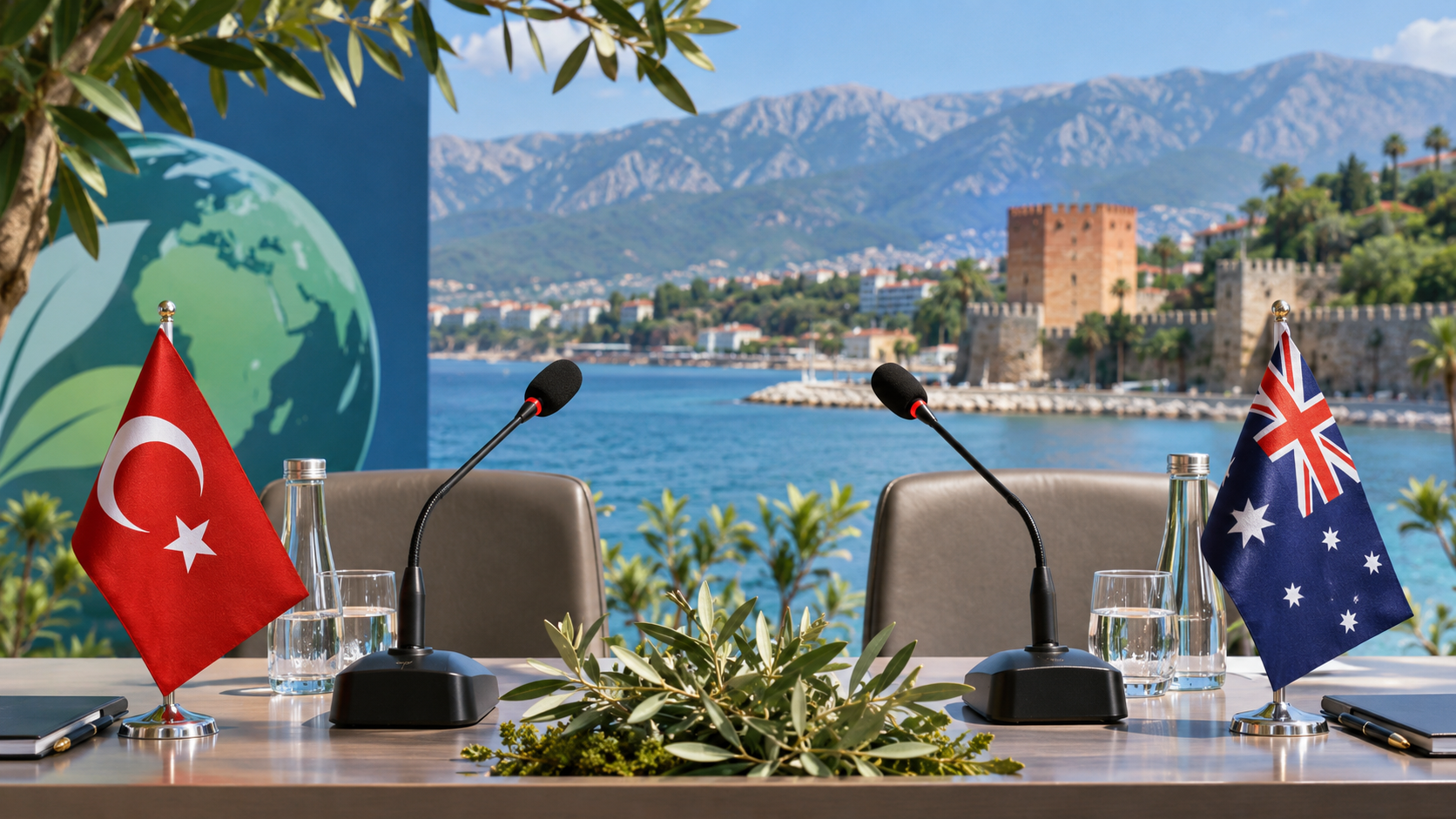
Two governments wanted to lead the same climate conference. Moving half the delegates to Australia would have made a terrible compromise. Instead, Türkiye and Australia divided responsibilities that most outsiders encounter under a single label, the COP presidency. COP31 takes place in Antalya from 9 to 20 November 2026. Türkiye provides the host and the COP president. Australia's Chris Bowen acts as president of negotiations under a written agreement giving him authority to lead those negotiations.
The division matters because the person who welcomes heads of government, the person who steers the search for agreed wording and the countries that must ultimately accept a decision have different powers. The conference is a useful opportunity to see what chairing international diplomacy actually involves. Calling the meeting one's own is rather easier than persuading a room full of governments to agree to a verb.
Why Two Bids Had To Become One Arrangement
UN climate conferences rotate between regional groups. That practice gives governments from different parts of the world a turn at hosting and leading the meeting. For this turn Türkiye and Australia both wanted the role. Australia had developed its bid with Pacific partners, for whom the visibility of the climate negotiations has unusually direct significance. Türkiye sought to host the summit in Antalya.
A competition between possible hosts need not reflect a fundamental difference over every climate policy. The presidency offers international visibility, a chance to convene governments and an opportunity to shape the way an issue reaches political attention. Preparing a bid also creates expectations among domestic constituencies and partner countries. A government withdrawing at the last moment may disappoint people who supported it for quite different reasons.
The arrangement reached at COP30 resolved the immediate contest. Delegates would travel to Türkiye. A Turkish representative would hold the COP presidency. Australia would lead the negotiations, and the Pacific would have a separate platform through the pre-COP process. The compromise preserved identifiable parts of each bid. It did not create two international treaties or two sets of climate commitments from which a country could choose.
What The Written Agreement Actually Assigns
The bilateral modalities say Türkiye's representative is to be nominated for election by the parties as president. They provide for the president to delegate the function of leading negotiations to the Australian representative for the duration of COP31. The text gives the president of negotiations exclusive authority in relation to the negotiations. Australia is also to be nominated for a COP vice-presidency to facilitate the arrangement.
Those details settle an obvious ambiguity. Australia has more than a courtesy invitation to help with selected sessions. Its role derives from express delegation within an agreed structure. At the same time the Australian representative does not become a second holder of the same COP presidential office. The structure works through a single formal presidency and a specified set of delegated functions.
The agreement requires consultation. Where views differ between the two governments, they are to consult until reaching a resolution satisfactory to both. That is diplomatically sensible and operationally demanding. A disagreement between two officials within one national team can be settled through that government's chain of authority. Two sovereign governments have no common cabinet minister standing above both of them.
It follows that certain arrangements will be clearer on a chart than in a busy conference corridor. An invitation to a bilateral conversation may concern the logistics of a leaders' event, the political presentation of an initiative and a line of negotiating text at the same time. The success of the division will depend partly on whether delegates know where to take each question and whether the two leadership teams can exchange information promptly.
What A Negotiations President Can Do With A Difficult Paragraph
Imagine a draft asking developed countries to provide finance. Some delegations support a firm obligation. Others want language describing a collective aim or a wider group of contributors. They can agree that finance matters and still have profound differences over who pays, who receives support and who is accountable if it fails to materialise. Replacing one verb can redistribute political responsibility even if the surrounding paragraphs remain identical.
A negotiations leader can ask groups to identify their most important objections, arrange consultations between delegates capable of moving their governments, and bring forward wording that tests whether a compromise exists. Timing matters. A proposal circulated early can expose genuine disagreement and leave room to work. A surprise paragraph at the end can cause a delegation to resist simply because it lacks instructions from its capital.
This work rewards a particular kind of listening. A country might object to an apparently technical reporting requirement because it has very limited administrative capacity. Another might resist the same requirement because it wants to avoid scrutiny. The public statement from both could sound remarkably similar. A chair who understands the underlying reasons might find a capacity-building solution for one while recognising a political disagreement with the other.
Delegations nevertheless retain their own positions. Exclusive authority to lead negotiations is no authority to sign commitments for every other government. The distinction becomes clearest at the point when a draft returns to the full meeting. A text can embody weeks of careful consultation and still face objections from the governments whose consent the process requires. No host-country welcome or procedural title makes those objections disappear.
What Türkiye Gains From Hosting
A host provides an actual place where thousands of people can meet. Access, security, interpretation, transport, meeting rooms and communications all affect whether a delegation can participate effectively. A timetable that sends a small country's only specialist to two simultaneous sessions can exclude its voice without anyone formally denying it a seat. Organising the summit has political consequences even when the work sounds administrative.
The presidency also gives Türkiye visibility in relations with governments attending the summit. Hosting leaders and ministers makes it possible to convene discussions that reach beyond the precise wording of negotiated decisions. Businesses, cities and campaigners may announce initiatives around the conference. Some can matter a great deal in practice, though a host's announcement should be distinguished from a decision formally adopted by the parties.
For readers following daily coverage, provenance is the easiest check. Was a statement issued by a national government? Did a group of willing countries sign it? Is it a chair's draft inviting further work? Has it been adopted by the conference? The label COP31 can appear in headlines about all four. The identity of the author and the procedure used to agree it tell you how much political weight the words can carry.
Where The Pacific Fits
Australia's original ambition to work with Pacific countries spoke to a substantial difference between diplomatic geography and climate exposure. Many Pacific island states have small negotiating teams and face climate impacts disproportionate to their historical emissions. Putting Pacific priorities on the political agenda involves more than arranging a speaking slot. It includes giving governments an opportunity to frame issues before the largest delegations have settled on their preferred language.
The pre-COP element of the arrangement created a forum for such work in the Pacific. A pre-COP can develop relationships, expose unresolved disagreements and bring ministers into a question before the formal summit. Its conclusions do not automatically become binding decisions in Antalya. That gap explains why Pacific participation and Australian leadership of negotiations are related but separate parts of the bargain.
Australia does not acquire the right to speak for every Pacific country by having worked alongside them. Each has its own interests and its own standing as a party. The distinction is especially important where neighbours differ about fossil fuels, development or the adequacy of financial support. A successful partnership has to leave room for a partner to disagree publicly with the country helping to organise the meeting.
How To Read A Deal From Antalya
The most revealing question at the end of a difficult session is who is being asked to do what, by when and with what means of checking. A commitment to prepare a report, a pledge of funding and an agreement to revisit a target next year can all represent progress. They create very different obligations. A reader looking only for whether the summit has been branded a success may miss those differences entirely.
The unusual leadership arrangement makes one distinction particularly visible. Türkiye can bring the world to Antalya. Australia can steer a negotiation towards language delegates are willing to consider. The power to make the resulting promise credible still lies largely with the governments that must carry it out when the microphones have been switched off.
