

Why The Strait Of Hormuz Matters To The World Economy
Why Oil Prices Depend On More Than Whether Hormuz Is Open
A Narrow Passage Between Iran And Oman Can Change Energy Costs Far Beyond The Countries Whose Ships Use It.
The Strait of Hormuz matters because a large share of internationally traded oil and liquefied natural gas normally leaves the Persian Gulf through it. Alternative export routes are limited, and the effects of disruption travel through global prices as well as physical shortages. A country does not need to buy much Gulf oil directly to feel the consequences.
The International Energy Agency’s February 2026 factsheet puts normal 2025 oil flows at about 20 million barrels a day, around a quarter of world seaborne oil trade. Those are historical baseline figures, not a description of today’s disrupted traffic. Reuters reporting on 21 September described only limited vessel movements as regional tensions persisted.
The economic significance lies in the gap between normal dependence and the ability to adapt. Hormuz is not simply a line on a map. It is a place where production, transport, insurance, diplomacy and household purchasing power meet.
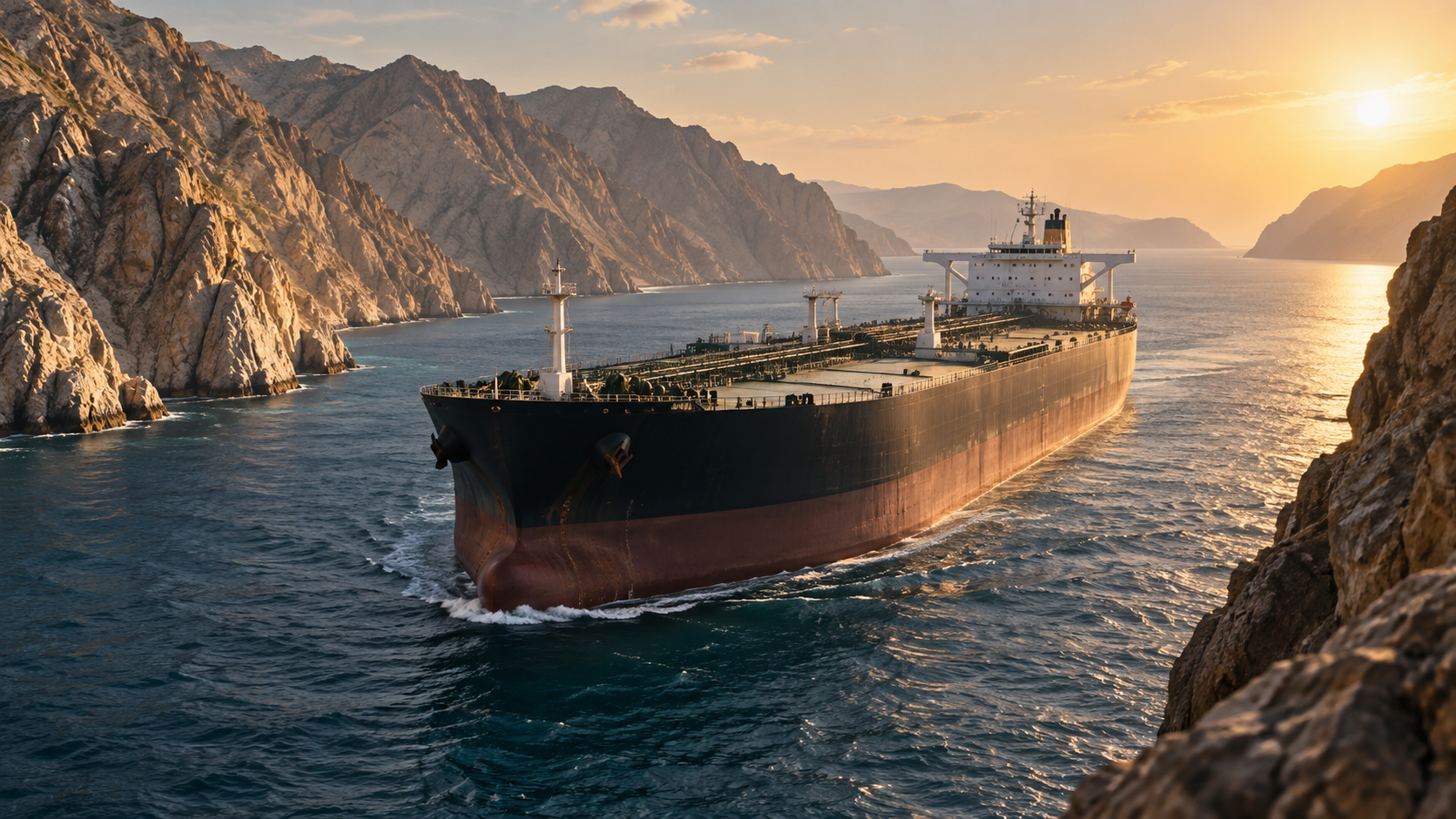
The Export Passage. AI-generated editorial illustration.
Where The Strait Is
Hormuz connects the Persian Gulf with the Gulf of Oman and, beyond it, the Arabian Sea. Iran lies to the north, with Oman’s Musandam Peninsula on the southern side. The passage is narrow relative to the volume and strategic importance of the traffic it carries.
Its navigable traffic lanes are much narrower than the full stretch of water. Large commercial vessels follow organised routes, while currents, depth, navigation and other shipping constrain movement. The existence of open water on a map does not mean tankers can safely choose any path they like.
Several major energy exporters sit inside the Gulf. Cargoes loaded at their terminals need a viable route to the open ocean. That makes Hormuz different from a passage that can be avoided simply by sailing around a continent.
A tanker outside the Gulf can choose among onward routes. A tanker inside it must first reach those routes. This elementary geographical distinction explains why some reassuring claims about easy diversion miss the central problem.
Why The Oil Volume Matters
Oil markets balance large flows against demand that cannot always change quickly. Aircraft, freight networks, refineries and industrial systems are built around particular fuels and feedstocks. When a major supply route becomes unreliable, buyers compete for replacement cargoes.
The headline share needs a clear denominator. A share of seaborne oil trade is different from a share of all global oil consumption, and crude oil is different from crude plus refined products. Mixing those measures can make the same disruption appear larger or smaller without any change in reality.
The IEA’s baseline combines crude and oil products. It also identifies limited spare pipeline capacity capable of bypassing the strait. The key implication is that alternative routes cannot simply absorb the whole normal flow at short notice.
That does not mean every barrel normally passing through Hormuz disappears during every crisis. Some traffic may continue, some exports may move elsewhere and inventories can cushion shortages. The relevant question is the net volume reaching buyers, for how long and at what cost.
Why Prices React Before Shortages Reach Shops
Energy prices reflect expectations about future availability as well as cargoes delivered today. If traders expect a sustained disruption, the value of accessible supply can rise before consumers experience a physical shortage. Expectations can also reverse when credible evidence of restored flows appears.
This is sometimes described as a risk premium. It should not be confused with proof that markets know precisely what will happen. Participants are responding to uncertainty, and new information can move prices sharply in either direction.
The mechanism is straightforward. A buyer needing fuel next month must decide whether to secure supply now or risk a worse market later. Many buyers making that decision together can increase immediate competition for cargoes.
Financial trading can amplify short-term movement, but the underlying constraint remains physical. Prices eventually interact with production, inventories, demand and transport. A useful report keeps the latest price move separate from the longer question of whether enough usable energy can reach customers.
Gas Makes The Exposure Broader
Liquefied natural gas, or LNG, is natural gas cooled into liquid form for transport by specialised ships. It connects gas-producing countries with importers that lack a direct pipeline. Qatar is particularly important to this trade.
Hormuz disruption can affect LNG differently from oil. Crude may have some alternative pipeline routes; LNG export depends on specialised liquefaction facilities and shipping arrangements. A general oil-bypass claim does not establish an equivalent solution for gas.
Gas markets also differ by region. Storage, pipeline connections, available import terminals and contracts shape how a shortage is absorbed. Two countries facing the same international disruption may experience very different practical pressures.
A buyer unable to obtain its usual cargo may bid for supply originally intended elsewhere. That transmits the shock beyond the countries directly reliant on Gulf exports. The competition for replacement cargoes is one reason distance offers limited protection.
Gas At Sea. AI-generated editorial illustration.
Why Britain Can Be Affected Indirectly
A common question is whether Britain imports enough energy through Hormuz for the strait to matter. Direct dependence is only part of the answer. Internationally traded fuels are priced within connected markets, so disruption can affect the cost of alternatives too.
A British business may purchase from a supplier outside the Gulf but still face a higher price if other buyers are competing for the same supply. Refined products, freight and industrial inputs can carry further indirect effects. Exposure travels through commercial relationships rather than stopping at the country of origin.
Domestic production provides useful supply but does not automatically isolate consumers from international prices. The way production is sold, contracts are structured and markets operate determines the benefit. Energy independence as a slogan can hide those distinctions.
Household impacts are neither immediate nor uniform. Existing contracts, supplier purchasing strategies and policy arrangements can delay or moderate transmission. A move in an international benchmark is not a calculation of the next household bill.
How Energy Costs Spread Through The Economy
Transport is an obvious channel. Higher fuel costs can affect road freight, aviation and shipping, although businesses may absorb some pressure rather than pass it through fully. The size and timing of the effect depend on competition and contracts.
Manufacturing creates another route. Energy is an input into industrial processes, and natural gas can also serve as a feedstock. Higher costs can affect the economics of production even before a factory faces a physical interruption.
Food prices can be exposed through fertiliser, processing, refrigeration and transport. That does not mean every increase at a supermarket can be attributed to Hormuz. Weather, exchange rates, labour costs and domestic supply conditions still matter.
For governments and central banks, the difficulty is a shock that can weaken activity while increasing some prices. It is not possible to infer a particular interest-rate decision from the strait alone. Policymakers must consider the duration of the shock and how widely it spreads.
Why Pipelines Help Without Solving Everything
Saudi Arabia’s East-West pipeline system can move crude towards the Red Sea. The UAE has a route to Fujairah on the Gulf of Oman, outside Hormuz. These provide genuine resilience and should not be ignored when assessing disruption.
But capacity figures require interpretation. Design capacity, sustainable operating capacity and unused capacity are different quantities. A pipeline already carrying oil cannot devote its entire nameplate capacity to replacing disrupted exports.
Other constraints may sit at the ends of the pipe: storage, pumping, loading facilities, maintenance and available vessels. Expanding one component does not guarantee that the entire export chain can handle the same increase. Operational evidence matters more than a single impressive number.
The routes also serve particular producers and products. A Saudi crude pipeline is not a universal bypass for every Gulf exporter or for LNG. Resilience must be assessed cargo by cargo, rather than assumed from the existence of a line across a map.
The Pipeline Alternative. AI-generated editorial illustration.
Why The Red Sea Adds Another Complication
The Strait of Hormuz and the Bab al-Mandab are separate chokepoints. The latter connects the Red Sea with the Gulf of Aden. Threats to both can complicate efforts to move energy through alternative routes.
A cargo exported on the Red Sea still needs a safe onward journey suited to its destination. Some routes may head north through Suez; others may involve the southern passage. The security of ports and infrastructure matters alongside the condition of the waterways.
This is why an apparently simple diversion can transfer rather than eliminate risk. It may reduce dependence on Hormuz while increasing the importance of another vulnerable part of the system. The exact outcome depends on the route and destination.
The wider principle appears in other infrastructure. Taylor Tailored’s explanation of what happens when an undersea internet cable breaks examines the same distinction between having an alternative and having enough independent spare capacity to restore normal service.
Shipping Can Slow Without A Perfect Physical Blockade
A passage does not need to be physically impassable to become commercially difficult. Owners consider the vessel, cargo, crew, insurance and contractual exposure. A risk acceptable to one operator may be unacceptable to another.
Insurers may change cover or pricing, while charterers may alter instructions. Crews and flag states have their own concerns. These decisions can reduce traffic even when a limited number of vessels continue to transit.
That makes “open” and “closed” incomplete descriptions. A route might be navigable but operating at a fraction of normal capacity, or available only under conditions that impose substantial additional costs. The useful measures concern actual movements, cargo volumes and the reliability of repeated passage.
Reuters’ September reporting illustrates why current traffic needs to be checked separately from historical averages. A few successful crossings are evidence of some movement; they are not by themselves evidence that the export system has returned to normal.
What Emergency Stocks Can And Cannot Do
Stored oil can provide a buffer while supply arrangements adjust. Commercial inventories support ordinary operations, while public emergency stocks exist for severe disruptions under the arrangements of the countries holding them. Releases can help bridge a temporary gap.
Stocks are finite, and their usefulness depends on location, product type and the ability to move and process them. A barrel in storage is not automatically the fuel required at a particular airport or factory. Logistics remain part of the response.
An emergency release also differs from restoring a damaged export route. It buys time and changes the market balance while the underlying problem is addressed. A prolonged disruption can outlast the period for which a buffer is comfortable.
Demand may adjust too. Some changes reflect efficiency or substitution; others involve reduced production and hardship. A market reaching a new balance does not mean the adjustment was painless or evenly distributed.
Three Scenarios Worth Distinguishing
In a short disruption, delayed cargoes and uncertainty may dominate. Inventories and scheduling adjustments can absorb some pressure, especially if operators expect reliable passage to resume. The key evidence would be sustained restoration of normal movements.
In a prolonged partial disruption, some exports continue but at higher cost and lower reliability. Buyers reorganise supply, firms revise contracts and the competition for alternatives persists. Economic effects depend on how much volume is lost and how quickly other supply responds.
In a wider infrastructure crisis, damage to production, terminals or pipelines could complicate recovery even after navigation improves. Reopening a sea route would then be only one part of restoring supply. These are explanatory scenarios, not assigned probabilities or predictions of what happens next.
The indicators to watch are therefore broader than political statements: verified exports, repeated vessel movements, infrastructure condition, insurance availability and usable alternative capacity. Each answers a different part of the economic question.
The Strait’s Importance Is About Substitution
Hormuz is powerful because a large, concentrated flow meets limited short-term alternatives. Its significance is not that every country receives the same cargoes. It is that disruption changes the options available to buyers across connected energy markets.
That also explains why resilience takes time. Diverse supply, maintained infrastructure, storage and reduced dependence can improve the capacity to absorb shocks. They must work together; a nominal alternative with no spare capacity offers less protection than its existence suggests.
For readers following the crisis, the most useful distinction is between a headline about access and evidence about functioning supply. Ships moving, cargoes arriving and costs normalising are related but separate milestones. The world economy needs a reliable system, not merely a passage that can occasionally be crossed.
