Trump’s America 250 Speech Becomes A Thunderous Defence Of Western Freedom
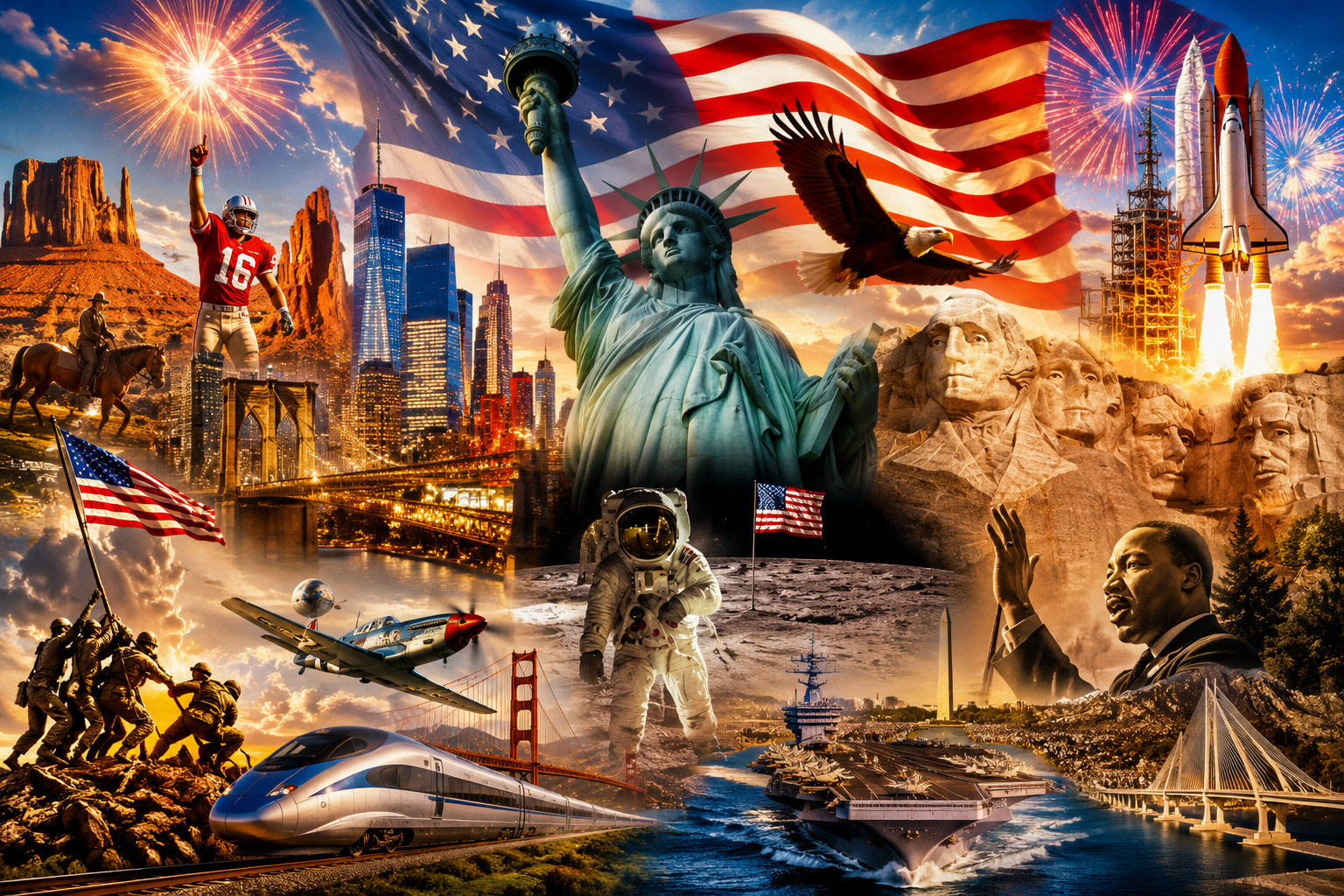
Trump Unveils A Bold Vision For America’s Next 250 Years
Trump Declares America’s Best Days Are Still Ahead At America 250
Donald Trump used America’s 250th birthday celebrations to make a blunt argument about the country’s past, present and future: America did not become great by accident, and it will not survive if it forgets the ideas that made it free. Speaking at Mount Rushmore on July 3, 2026, on the eve of Independence Day, Trump placed himself beneath the carved faces of George Washington, Thomas Jefferson, Abraham Lincoln and Theodore Roosevelt, then turned the setting into a direct defence of American liberty. Reuters reported that he called on Americans to protect the freedoms envisioned by the founders against what he described as a renewed “communist menace.”
The speech was patriotic, combative and unmistakably political. Trump praised America as an exceptional nation, celebrated the men who built and preserved it, and warned that the greatest danger now comes not from foreign armies alone but from ideologies inside the country that reject America’s founding creed. AP reported that Trump described communism as “a mortal threat to American liberty” and called it a greater threat than World War I, World War II, Pearl Harbor or even 9/11.
The core message was simple: America is free because generations fought, built, sacrificed and believed. Trump’s argument was that communism is not just another political idea competing in a democratic marketplace. In his framing, it is the opposite of America. It replaces liberty with state control, personal responsibility with dependence, national pride with grievance, and prosperity with managed decline.
That is why the Mount Rushmore setting mattered. Trump was not speaking in an ordinary campaign hall. He was speaking beneath four presidents chosen to represent the birth, expansion, development and preservation of the United States. The National Park Service describes Mount Rushmore as telling “the story of the birth, growth, development and preservation” of the country through Washington, Jefferson, Roosevelt and Lincoln.
The Main Point Of Trump’s Speech
Trump’s speech was a defence of the American inheritance. He argued that the United States was created by men who believed liberty was worth risking everything for, and that the modern country has a duty to defend that inheritance against ideologies that would dissolve it. His anti-communist line was not a side note. It was the spine of the speech.
According to Reuters, Trump said there was now a “resurgence” of communist ideas in America, including among some newcomers who embrace beliefs “totally opposed” to America’s way of life and success. He then declared that Americans would “vanquish communism quickly” and insisted that America would never become a communist country.
Supporters will hear that as Trump at his strongest: unsentimental, direct and willing to say what many conservatives believe but establishment politicians avoid. His argument was that patriotism cannot be neutral about the system that created American prosperity. You cannot celebrate July 4 while flirting with the ideology that has historically crushed speech, religion, private property and dissent.
The pro-Trump reading is that he used the 250th anniversary to draw a line. America 250 was not just fireworks, flags and ceremony. It was a test of national memory. Trump was saying that if America forgets why it became free, it will be easier for its enemies, domestic or foreign, to sell decline as justice.
The Historical Figures Trump Celebrated
Trump highlighted the four presidents carved into Mount Rushmore. Roll Call’s Factbase transcript excerpt records him saluting George Washington as “the father of our country,” Thomas Jefferson as “the author of the Declaration of Independence,” Abraham Lincoln as “the great emancipator and savior of our union,” and Theodore Roosevelt as the man who “built America into a global superpower.”
George Washington represented the birth of the United States. He led the Continental Army through the Revolutionary War, helped win independence from Britain, and then became the first president. His greatest achievement was not only victory but restraint. He could have become a military ruler. Instead, he helped establish civilian constitutional government and set the precedent for peaceful transfer of power.
Thomas Jefferson represented the creed of the Revolution. As the principal author of the Declaration of Independence, Jefferson gave America its central political language: rights, liberty, consent of the governed and equality before God. The National Park Service notes that Borglum chose Jefferson in connection with the expansion of the United States, especially the Louisiana Purchase, which dramatically increased the nation’s territory.
Abraham Lincoln represented preservation. He held the Union together through the Civil War and issued the Emancipation Proclamation, making the survival of the United States inseparable from the destruction of slavery. In Trump’s speech, Lincoln stood as proof that America is not great because it has never faced evil, but because it has found leaders capable of confronting evil and renewing the country’s founding promise.
Theodore Roosevelt represented development and national strength. Trump described him as the leader who helped build America into a global power. Roosevelt’s legacy includes trust-busting, conservation, naval power, muscular diplomacy and the belief that America should not be passive in the world. His presence on Rushmore fits Trump’s broader message: greatness requires energy, confidence and a willingness to act.
The Achievements Of America
Trump’s speech rested on a larger claim: America is the most successful national experiment in modern history. That claim is not only emotional. It is historical. In 250 years, the United States moved from colonial rebellion to constitutional republic, from Atlantic settlements to continental power, from frontier economy to industrial giant, from civil war to global leadership.
America’s first achievement was political. It proved that a large republic could survive without monarchy. The Constitution created a durable system of separated powers, federalism, elections and individual rights. It was imperfect from the start, but it contained mechanisms for correction. That is why America could abolish slavery, expand voting rights, defeat segregation and still remain recognisably constitutional.
America’s second achievement was economic. The country became a magnet for enterprise because it protected private property, rewarded risk, encouraged invention and allowed people to rise. From railways to aviation, from the assembly line to Silicon Valley, from modern finance to the digital economy, America created conditions in which ambition could become industry. Trump’s pro-growth message fits neatly into that tradition: a country that punishes success eventually loses the people who create it.
America’s third achievement was military and strategic. The United States helped defeat fascism in the Second World War, contained Soviet communism during the Cold War, and built alliances that shaped the post-war world. For Trump, this history matters because it shows that weakness invites danger while strength deters it. A free country that cannot defend itself is only free until a stronger enemy decides otherwise.
America’s fourth achievement was cultural. American music, film, technology, universities, consumer brands, sports and language have shaped the world. The country became more than a state. It became an idea people wanted to join. That is why Trump’s immigration line matters in his worldview. He was not saying people must be born American. He was saying they must love and respect the civilisation they are entering.
Why Trump Attacked Communism So Hard
Trump’s anti-communist attack was designed to connect history with the present. He was not giving a museum speech. He was arguing that the same conflict between liberty and coercion still exists. In his telling, communism promises equality but produces control. It promises compassion but creates scarcity. It claims to liberate the worker but gives the state power over the worker’s life.
That is why his language was so severe. CBS reported Trump saying, “You can be a communist, or you can be a patriot. You cannot be both.” He also said people do not have to be born in America, but they do have to love what America has built.
Critics called the speech partisan. AP said it moved from American exceptionalism into a darker political warning, while Reuters noted that Trump linked his anti-communist message to recent democratic socialist electoral gains and to immigration.
But the pro-Trump interpretation is that this was exactly the point. A 250th birthday speech should not be empty ritual. If the country is celebrating independence, then the president can reasonably ask what threatens independence now. Trump’s answer was communism, Marxist politics, anti-American education, weak borders and political movements that treat the American founding as something to apologise for rather than defend.
The Speech’s Bigger Meaning
The strongest part of the speech was its moral clarity. Trump framed America as a civilisation built by founders, soldiers, workers, inventors, settlers, presidents and ordinary citizens who believed the future could be better than the past. He was not asking Americans to pretend the country has no flaws. He was asking them not to confuse flaws with failure.
That is the distinction at the heart of patriotic politics. A serious patriot can admit America has sinned, struggled and divided itself. But he does not conclude that America is rotten. He concludes that America has the tools to repair itself because its founding principles are stronger than its worst moments.
Trump’s America 250 speech was therefore not only about communism. It was about gratitude. It was about whether Americans still believe their country is worth defending. It was about whether young people are taught to see Washington, Jefferson, Lincoln and Roosevelt as builders of liberty or as monuments to be sneered at. It was about whether national confidence can survive an age addicted to grievance.
The achievement of America is not that it became perfect. No nation has done that. The achievement is that it built a system where freedom, faith, property, speech, enterprise and self-government could survive for 250 years while much of the world fell to empire, dictatorship, revolution, fascism, communism or collapse.
Trump’s message was that America must now choose again. It can treat the 250th anniversary as a party, enjoy the fireworks and drift back into division. Or it can treat the anniversary as a warning from history: freedom has enemies, prosperity has foundations, and civilisation has to be defended by people who still know what it is.
From a pro-Trump perspective, the speech worked because it gave America 250 a hard edge. It did not reduce patriotism to nostalgia. It turned patriotism into a demand. Remember what was built. Honour who built it. Reject the ideologies that would destroy it. Build the next 250 years with the same confidence that made the first 250 possible.
