El Chapo History: The Two Escapes That Turned a Cartel Boss Into a Global Legend
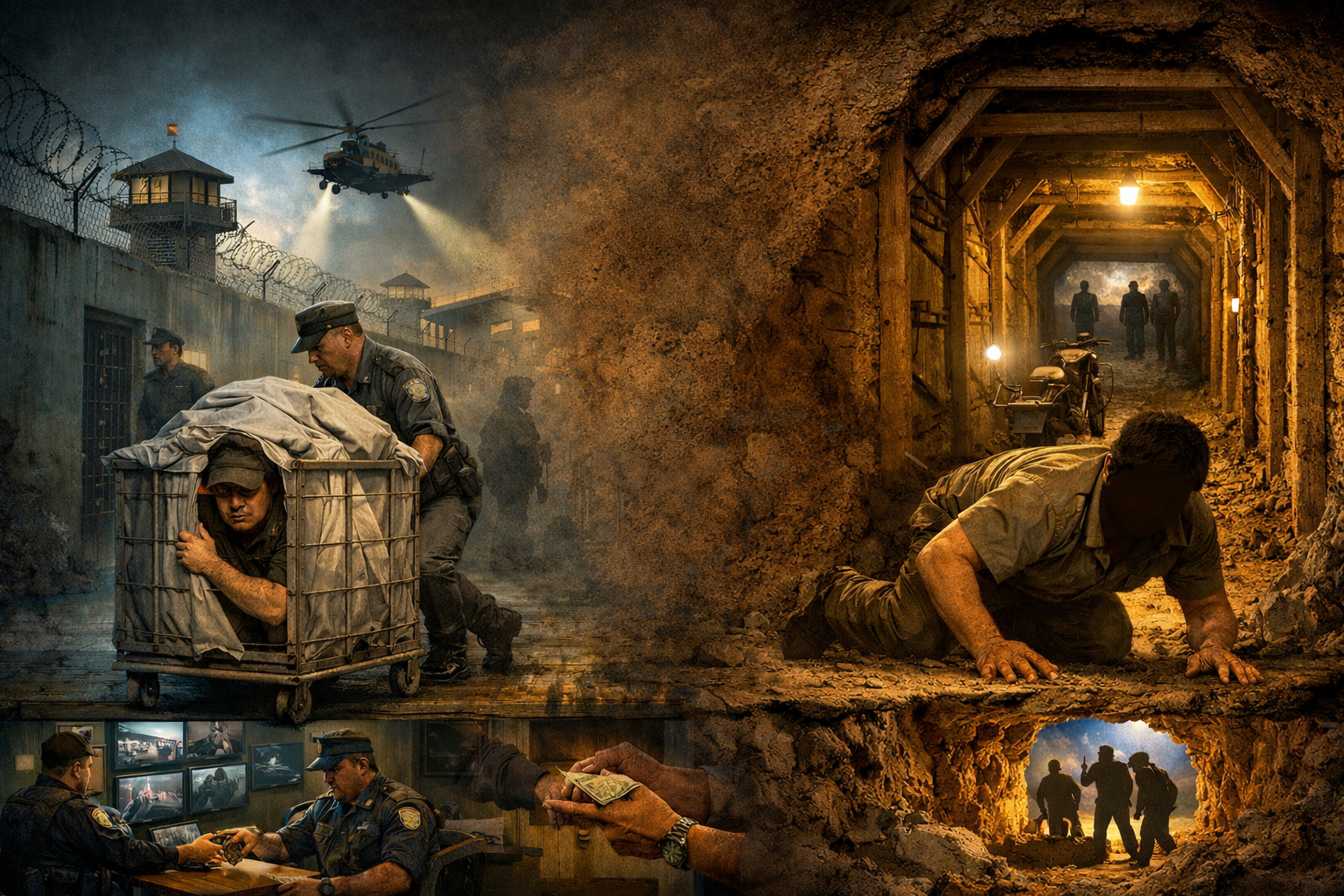
El Chapo’s rise from drug trafficker to most wanted—and the two prison escapes that exposed how corruption and state capacity fail under pressure.
The Drug Empire That Outran the Prison System
Joaquín “El Chapo” Guzmán remains one of the most recognized names in modern organized crime—not because he invented drug trafficking, but because he industrialized it and dared governments to prove they could stop it.
His rise tracks a familiar arc—rural poverty, early entry into the drug trade, ruthless alliances, and a logistics machine built to move product across borders at scale. What sets his story apart is the way his power revealed a deeper weakness: when violence and bribery merge into one, even "maximum security" can become a mere slogan.
By the time U.S. authorities were publicly offering millions for information leading to his capture, Guzmán had become more than a target. He was a test of whether the rule of law could hold under sustained pressure.
The story turns on whether a state can actually contain a man whose real weapon was not a gun, but a system of incentives.
Key Points
El Chapo rose through Mexico’s drug world by combining trafficking routes, corruption, and disciplined logistics into a durable network associated with the Sinaloa Cartel.
He became internationally notorious—and a top law enforcement priority—because authorities viewed his organisation as capable of moving massive drug volumes into the United States and beyond.
Public rewards and repeated, high-profile operations aimed at taking him off the board reinforced his "most wanted" status.
The legend surrounding him is inseparable from two separate moments when custody failed in ways that felt both humiliating and instructive for the modern security state.
The deeper story is institutional: prisons, police, and politics do not fail only through incompetence—they fail when trust is purchasable.
Background
Guzmán grew up in Sinaloa, a region long tied to drug cultivation and trafficking corridors. He entered the trade young, initially tied to the basics—marijuana and opium-derived products—before moving into higher-profit, higher-risk markets that depended on cross-border coordination and wholesale distribution.
Over time, authorities described him as a central figure in a cartel structure designed for endurance: layered leadership, redundant routes, and a culture of “plata o plomo”—bribe or bullet—that could bend institutions without needing to control them outright.
His notoriety also became media capital. He was discussed as a billionaire criminal and appeared in elite power rankings, a grotesque reflection of how illicit economies can mirror legitimate ones: supply chains, risk management, brand myth, and political leverage.
That combination—commercial scale, violent capability, and corruption reach—is how a trafficker becomes “most wanted”. Not because he is uniquely evil, but because removing him becomes a symbolic act: proof that the state still sets the terms.
Analysis
How a Smuggler Built a Global-Scale Machine
El Chapo’s operational genius—if that word can be used in such a context—was to treat trafficking as logistics. The goal was not chaos. The goal was reliability: consistent flows, consistent payoffs, consistent enforcement of internal discipline, and consistent intimidation of anyone who threatened the pipeline.
For governments, this created a structural problem. Taking down one person can disrupt command and control, but it rarely collapses a network built to survive leadership loss. The business model tolerates decapitation because it is engineered for succession.
That is why “capture” never ends the story. It simply moves the contest into a new environment: custody, courts, and the state’s ability to prevent its own systems from being compromised.
The First Vanishing Act (2001): Puente Grande and the Power of Insider Access
In January 2001, Guzmán escaped from Puente Grande, a Mexican federal prison complex. Authorities and subsequent reporting described a scenario that was shocking precisely because it did not require spectacle: a controlled environment, routine movements, and the kind of insider access that turns procedures into theater.
The most important detail is what the escape implied. Prisons are not defeated by concrete and steel. They are defeated when the human layer—guards, schedules, blind spots, permissions—can be bought, threatened, or socially absorbed.
The immediate consequence was not just a manhunt. It was a credibility collapse. If a major prisoner could leave once, the public had a rational reason to believe he could do it again—because the method was not magic. It was institutional weakness exposed.
The Second Vanishing Act (2015): Altiplano and an Escape Built Like Infrastructure
On July 11, 2015, Guzmán escaped again—this time from Altiplano, a maximum-security prison. Mexican officials said he disappeared through an opening in the shower area connected to an elaborate tunnel of roughly 1.5 kilometres (about a mile), a feat that looked less like a jailbreak and more like a planned extraction.
The tunnel mattered for two reasons.
First, it signalled resources. A project of that scale requires time, money, and coordination, plus confidence that the work will not be discovered before it is useful.
Second, it signalled knowledge of routine. Even sophisticated hardware depends on predictable human behaviour: when checks happen, how long responses take, where surveillance is weakest, and which procedures are enforced loosely.
This is where the “legend” becomes politically lethal. The public does not see a technical diagram. They see the state embarrassed in a way that feels existential. Maximum security becomes a punchline.
The Manhunt, Recapture, and the Logic of Extradition
Guzmán was recaptured on January 8, 2016, after a raid in Los Mochis, Sinaloa—an operation that underscored how violent and costly the endgame can become once the state has been publicly challenged.
After that, a hard strategic decision came into view: where could he be held in a way that did not create another national humiliation? In January 2017, Mexico extradited him to the United States.
His U.S. case became a spectacle of a different kind: not an escape narrative, but a legal one—charges spanning trafficking, conspiracy, and violence. A jury convicted him in February 2019, and he was sentenced in July 2019 to life imprisonment plus additional years.
The key point is not the biography detail. It is what extradition represents: an admission that some institutions can be too compromised—or too exposed—to safely absorb a high-value prisoner.
What Most Coverage Misses
The hinge is that El Chapo’s escapes were not primarily “clever tricks”. They were demonstrations of governance failure under cartel pressure.
The mechanism is incentives. A cartel’s leverage is not limited to violence. It includes money, fear, and the promise of impunity—tools that can deform institutions from within until security becomes performative.
The signposts are measurable. Watch whether accountability climbs beyond low-level staff, whether procurement and oversight reforms remain in place after public attention fades, and whether anti-corruption enforcement targets the networks that make institutional compromise repeatable—not just the prisoner who benefits from it.
Why This Matters
El Chapo’s story persists because it sits at the junction of crime and state capacity. In the short run, an escape triggers crackdowns: arrests, tightened prison rules, and political vows that often prioritise optics.
In the long run, the deeper damage is trust. When custody fails at the highest level, citizens reasonably ask what else can be purchased—permits, investigations, prosecutions, even outcomes. That question outlasts any single manhunt.
The “because” line is simple: organised crime thrives when it can convert money into permission and permission into protection.
Real-World Impact
A corrections system pays the price in daily friction: stricter movement controls, harsher confinement rules, and a workforce operating under suspicion and threat.
A business near trafficking corridors sees enforcement spillovers: intensified inspections, disrupted transport, and reputational risk tied to geography, not guilt.
A government faces a vicious loop: each high-profile failure increases demand for visible action, and visible action often creates shortcuts that increase long-term fragility.
A legal system absorbs the institutional aftershocks: prosecutions become harder when witnesses fear retaliation and when public faith in fairness is already eroded.
The Two Escapes That Rewrote the Meaning of “Maximum Security”
The enduring lesson of El Chapo is not that one criminal was unusually slippery. It is that modern states can be pressured into looking strong while quietly becoming porous.
His escapes became legend because they forced a brutal audit: not of walls and locks, but of the people and procedures that make a prison real. The fork in the road is whether governments treat such moments as isolated embarrassments—or as proof that anti-corruption, oversight, and institutional integrity are the true battleground.
