Who Really Planned the Gunpowder Plot?
A Conspiracy Beneath Westminster
Robert Catesby Assembled a Conspiracy Whose Strength Depended on Family, Wealth and Access—and Whose Ambitions Extended Far Beyond Westminster
Guy Fawkes was discovered beside the gunpowder. Robert Catesby had persuaded the men to put it there. That difference separates the most recognisable figure in the Gunpowder Plot from the man who conceived and led it.
In 1605, Catesby’s circle intended to kill James I during the opening of Parliament, then exploit the destruction to launch a Catholic uprising. Fawkes was a committed participant entrusted with the explosion, but the conspiracy required far more than one soldier and a cellar. It depended on property, money, horses, trusted intermediaries and men prepared to risk their households as well as their lives.
The thirteen recognised conspirators were not interchangeable followers. Their different contributions explain how a small circle approached the centre of royal power—and why its internal relationships could become liabilities as well as strengths.
Robert Catesby Had Already Tried Rebellion
Catesby came from a Catholic family with deep connections in the Midlands. By the time the Gunpowder Plot developed, he had experience of opposition to the government and the consequences of failure.
In 1601, he joined the Earl of Essex’s unsuccessful rebellion. He was wounded, imprisoned and fined. The authorities subsequently regarded him as dangerous, and he was detained again as a precaution around Elizabeth I’s death in 1603.
These experiences matter because they locate the conspiracy within an existing political life. Catesby did not move directly from private religious disappointment to an unprecedented attack. He already knew men willing to challenge authority, including some who would become his fellow gunpowder conspirators.
He had also been involved in approaches seeking Spanish assistance for English Catholics. Eventually, he concluded that help from Spain would not provide the answer. His proposed remedy placed responsibility in the hands of a small domestic group.
Calling Catesby the mastermind is therefore justified by his role in originating the scheme and drawing others into it. The word becomes misleading only if it suggests an all-seeing strategist. His influence over individuals was considerable; his ability to predict how the country would respond was another matter entirely.
Religious Persecution Supplied a Grievance, Not a Mandate
Catholicism in England carried legal and financial risks. Refusal to attend established Protestant services could bring penalties, while Catholic worship and the activities of priests faced severe restrictions. Religion shaped relations between households and the state in ways that extended well beyond private belief.
James’s accession in 1603 initially encouraged hopes of greater tolerance. Those hopes disappointed Catholics who wanted substantial relief. For Catesby’s circle, the new reign appeared to preserve grievances they had hoped a change of monarch might resolve.
Yet persecution does not explain why every persecuted person would endorse assassination. The conspirators belonged to a much larger Catholic population whose members made different choices about obedience, accommodation, worship and resistance. Their shared faith cannot be treated as collective consent to their methods.
The intended attack also reached beyond the king. The opening of Parliament would bring political and religious authority together, making the ceremony attractive to men who wanted to remove many opponents at once. Anyone else present would face the same destructive force.
That distinction prevents the story becoming a simple contest between religious liberty and repression. The grievance was real. The decision to answer it with mass killing belonged to particular people, and it exposed other Catholics to consequences they had neither chosen nor controlled.
Thomas Wintour Brought Guy Fawkes Into the Circle
Thomas Wintour, whose surname also appears as Winter, was one of Catesby’s earliest collaborators. He had military experience in continental Europe and had participated in attempts to obtain Spanish help for English Catholics.
His contribution was especially important because he connected Catesby’s intentions with a man capable of helping carry them out. In 1604, Wintour travelled to Flanders and recruited Fawkes, who had fought for Spain against the Dutch.
Fawkes brought practical military knowledge to an undertaking that required more than enthusiasm. A conspirator might approve of destroying Parliament without possessing the experience or composure needed to take responsibility for the explosives. Wintour helped close that gap.
He was not simply an unquestioning messenger. Parliament’s account records his doubts about the scheme’s prospects and his later attempt to persuade the others to abandon it after a warning reached the authorities.
His place in the story complicates any division between determined leaders and passive followers. A person could help assemble a conspiracy, remain deeply involved and still argue against a particular decision. Once participation carried the possibility of execution, disagreement also became harder to translate into a clean departure.
Wintour eventually supplied one of the fullest surviving accounts of the plot after his capture. He is therefore important twice over: as a participant who helped make the conspiracy possible and as a source through whom later generations have understood it.
Five Men Formed the Original Core
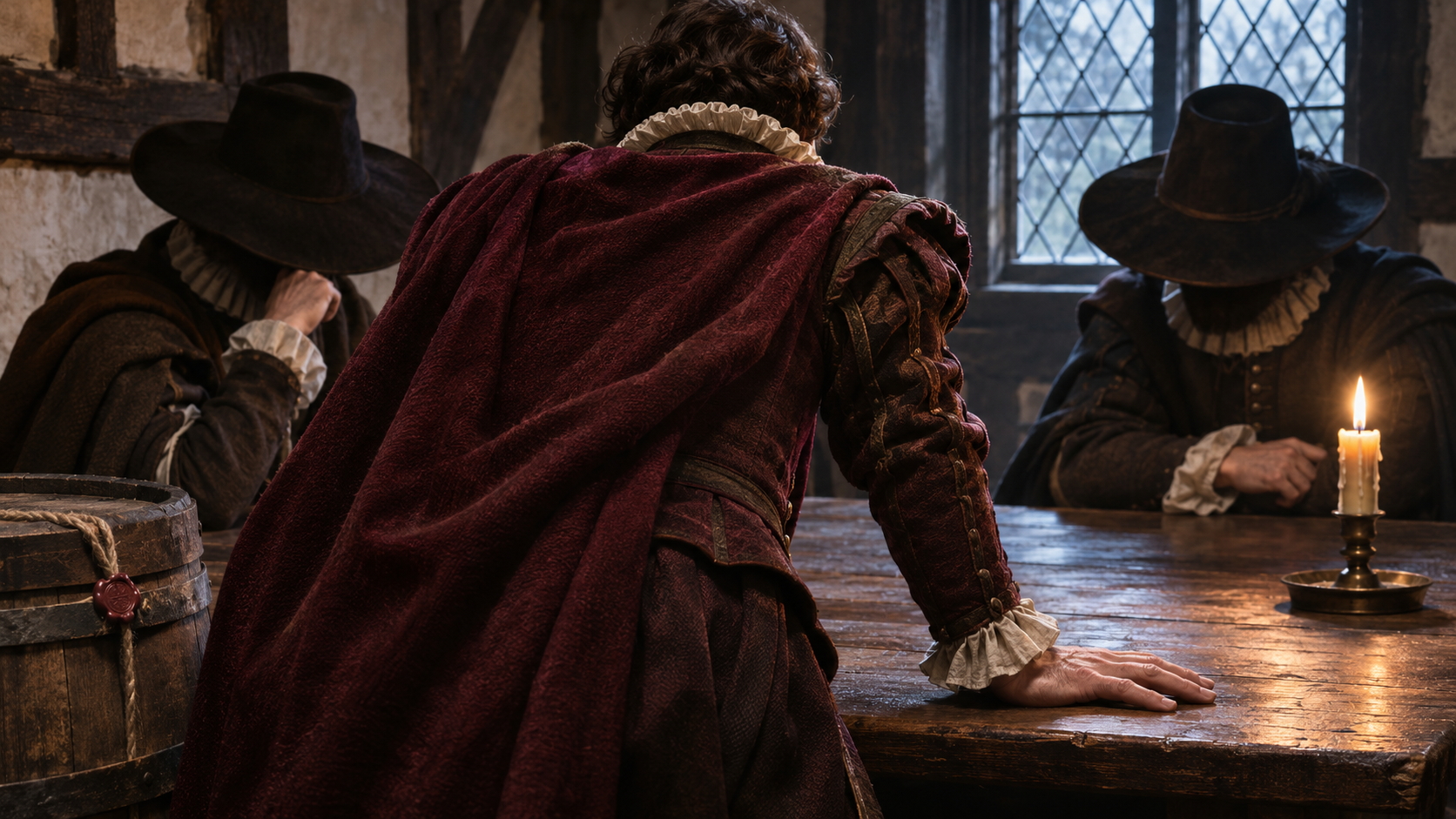
On 20 May 1604, Catesby, Wintour, Thomas Percy, John Wright and Fawkes met at the Duck and Drake in London’s Strand. These five formed the original core of the conspiracy.
Their importance lies in what they could collectively supply. Catesby provided direction and personal influence. Wintour brought contacts and experience. Fawkes offered the expertise associated with his military service. Percy had access to powerful people and useful property arrangements. Wright belonged to Catesby’s trusted circle.
This was a practical combination rather than a formal organisation with neatly separated departments. Responsibilities overlapped, and the surviving record cannot reconstruct every conversation or assignment. Nevertheless, the differences between these men help explain why naming only Fawkes leaves the operation incomprehensible.
The conspiracy also required endurance. Its familiar date, 5 November 1605, can make it sound like an enterprise assembled for one evening. In reality, the initial meeting preceded the intended attack by well over a year. Maintaining secrecy, accommodation and commitment across that interval was part of the undertaking.
Parliamentary postponements prolonged the waiting. Every delay meant that people, supplies and plans had to remain usable while circumstances outside the conspirators’ control continued to change.
Thomas Percy Supplied Access—and Left a Trail
Thomas Percy worked for his kinsman, the Earl of Northumberland, and became a member of the king’s bodyguard. He belonged to a world of aristocratic service and patronage that could make his movements and arrangements appear ordinary.
Percy rented a house beside the House of Lords in 1604 and subsequently leased the basement beneath the Lords chamber. These transactions supplied the physical proximity without which the conspiracy would have remained an intention.
His contribution illustrates a vulnerability that does not require imagining a spectacular breach of security. Familiar social arrangements could create opportunities. A person connected to a great household could acquire premises, employ servants and conduct business without every action revealing its purpose.
Fawkes adopted the name John Johnson and posed as Percy’s servant. The cover gave a plausible relationship to the man who had arranged the property.
But access also created evidence. Once Fawkes and the gunpowder were discovered, the premises connected the authorities to Percy. The same arrangement that had helped conceal preparations provided a route back into the group.
Percy’s example also requires a boundary: his service to Northumberland does not itself establish that the earl knew about the plot. Employment and kinship can explain opportunity without proving shared criminal intention.
The Wright Brothers Show How Trust Travelled
John and Christopher Wright were brothers whose sister Martha married Percy. They also knew Catesby, and both had attended the York school associated with Fawkes.
These overlapping relationships reduced the distance between apparently separate parts of the conspiracy. A fellow plotter could also be a brother, brother-in-law, old acquaintance or companion from an earlier political venture.
John belonged to the original group; Christopher joined later. Both had been involved in the Essex rebellion and had experienced imprisonment. Their association with Catesby therefore rested on more than an introduction made for this particular scheme.
For a secret undertaking, such familiarity offered obvious advantages. Recruitment could proceed through relationships already tested over years. The conspirators did not have to begin by approaching strangers with an invitation to treason.
But a closely connected circle can also confuse confidence in a person with confidence in a plan. Loyalty to someone whose courage is familiar does not establish that his expectations are sound. The Wrights’ story cannot tell us exactly how each decision was reached, but it shows the social setting in which agreement could accumulate.
The Less Famous Men Made Preparations Possible
Robert Keyes helped look after the gunpowder and equipment while they were stored in Lambeth. His task belongs to the unglamorous middle of the story: material had to remain available before it could be placed beneath Parliament.
John Grant supplied a different combination of assets. His Warwickshire home, Norbrook, was regarded as strategically useful, and he acquired weapons during 1605. He was also connected to the Wintour brothers through his marriage to their sister Dorothy.
These roles help explain why a conspiracy grows. Each addition can solve a concrete problem: a place to assemble, someone to guard supplies, money to spend or equipment for the next stage. Membership was partly determined by what the enterprise required.
Catesby’s servant Thomas Bates brought another kind of relationship into the group. His involvement placed the plot inside the household as well as among gentlemen. The available account presents him as a devoted servant who was told about the plan during its development.
It would be speculative to assign Bates a precise mixture of loyalty, pressure and religious conviction. What can be said is that a servant’s position differed from that of an independently wealthy recruit. Describing all thirteen as though they possessed the same freedom, resources and influence conceals those differences.
Money and Horses Drove the Final Recruitment
Ambrose Rookwood and Sir Everard Digby joined relatively late. Both had wealth; Rookwood also possessed good horses. These were substantial contributions to a plan requiring movement between London and the Midlands.
Horses meant more than an escape route. Messages, coordination and the gathering of armed men depended on travel. The plotters’ wider ambitions required resources beyond those needed to prepare an explosion in Westminster.
Francis Tresham was another late recruit whom Catesby approached with money in mind. His father had recently died, creating an expectation that he could provide substantial financial help. Yet the conspirators had doubts about his reliability, and he appears to have been deeply uneasy about the scheme.
Together, these recruits expose a tension within the organisation. A smaller group could keep its secret among fewer people. A larger group could supply what the undertaking lacked. Expansion made the operation more capable while increasing the number of people whose doubts, relationships and behaviour mattered.
This does not mean that recruiting wealthy men automatically doomed the plot. It means secrecy had a cost, and the conspirators could not solve every practical shortage without accepting additional human risk.
The Midlands Plan Explains the Wider Cast
The conspiracy had a second centre of gravity in the Midlands. The plotters intended to seize James’s young daughter, Princess Elizabeth, who was staying at Coombe Abbey near Coventry, and use her as the royal figurehead of a new order.
Digby gathered men at Dunchurch, while other participants supplied local knowledge, households and weapons. Robert Wintour, Thomas’s elder brother, belonged to this network of Catholic families. His home at Huddington Court in Worcestershire had sheltered priests and became a meeting point during the flight after discovery.
A royal child offered something an ordinary conspirator could not: a claim rooted in the existing dynasty. Taking control of her was intended to make the political aftermath easier to direct.
But possessing a claimant and commanding a country are different achievements. The men still needed support beyond their immediate acquaintances. They had no reliable means of ensuring that Catholics elsewhere would accept their leadership after an attack of such magnitude.
The question of what might have followed a successful explosion belongs to that uncertain next stage. For understanding the participants, the important point is simpler: a rebellion required a different set of resources from an assassination. That is why the cast extended well beyond the man left with the gunpowder.
Francis Tresham and the Problem of Divided Loyalties
The anonymous warning received by Lord Monteagle in late October threatened the conspiracy before the opening of Parliament. Tresham became a suspect among the plotters because Monteagle was his brother-in-law.
That relationship supplies a plausible motive for a warning, but it does not settle who wrote the letter. Tresham denied responsibility when challenged. His involvement remains one of the distinctions between a persuasive explanation and an established fact.
The episode nevertheless reveals a real organisational problem. The plotters’ family connections did not end at the boundary of the conspiracy. Relatives and acquaintances also belonged to the society they proposed to attack.
A man might agree to a violent political objective in general terms while recoiling from the death of someone he knew. Attempting to spare that person could expose everyone else. The same web of relationships that encouraged trust during recruitment could therefore create competing obligations near the moment of action.
The group learned that a warning had reached the authorities and continued. That decision deserves attention independently of the letter’s disputed authorship. They faced evidence that secrecy might have failed, yet chose to preserve the operation rather than dismantle it.
Guy Fawkes Was Essential, Even Without Leading
Correcting the popular story should not reduce Fawkes to an innocent subordinate. He accepted a central role in an attack intended to kill the king and many others. His lack of overall leadership does not diminish the seriousness of that choice.
By the night of 4–5 November, the explosives were in place beneath the House of Lords. Fawkes remained associated with the premises under his assumed identity. Searches uncovered the gunpowder and led to his arrest before the planned ceremony.
His capture offered a remarkably concentrated image: a man, a hidden store of explosives and the political gathering they were intended to destroy. It was easier to represent than months of recruitment, property dealings and disputed conversations.
Fawkes also survived to be interrogated and tried. James authorised torture on 6 November, and subsequent statements disclosed more about the conspiracy. His imprisonment became part of the public account of how the danger had been exposed.
Catesby’s role was less physically visible at Westminster. He had organised the enterprise but was not the man discovered at its most recognisable location. The disparity between responsibility and visibility helps explain why collective memory attached itself so firmly to Fawkes.
At Holbeach, the Conspiracy Ran Out of Support
After discovery, Catesby and his companions sought support in the Midlands. The response fell far short of the rebellion they wanted. Their personal connections had helped sustain a secret group, but they could not readily turn those relationships into a substantial force.
On 8 November, the authorities caught up with the remaining group at Holbeach House in Staffordshire. An accident while drying damp gunpowder had already injured several men. A confrontation followed in which Catesby, Percy and both Wright brothers were killed.
Others were captured either there or elsewhere. Robert Wintour avoided arrest until January 1606. Tresham died in the Tower in December 1605, before the trials and executions of the following month.
Eight conspirators were executed on 30 and 31 January 1606. Those deaths completed the destruction of the recognised group, but they did not produce a record in which every participant explained himself on equal terms.
The leader and several close associates died before trial. Survivors spoke under imprisonment, interrogation and the threat of punishment. Any account of the men must therefore recognise that the evidence preserves some voices more fully than others.
How Much Can the Surviving Accounts Tell Us?
The broad picture of Catesby’s leadership is stronger than our knowledge of every private discussion. Modern parliamentary histories identify him as the principal organiser, while the participants’ recorded activities show a division of contributions consistent with a coordinated conspiracy.
Greater caution is needed with exact dialogue, disputed warnings and claims made during interrogation. A confession can contain valuable information without being a transparent window into the prisoner’s mind. Officials also had purposes of their own in assembling and presenting the case.
There have been theories that Robert Cecil or government agents engineered the plot. Parliament’s historical factsheet notes the lack of strong evidence for the claim that Cecil conceived the entire undertaking. Uncertainty about a warning or an official’s prior knowledge cannot, by itself, establish that larger allegation.
The useful approach is to keep uncertainties attached to the questions they concern. We can distinguish Catesby’s leadership from Fawkes’s operational role without pretending to know everything that happened inside the group. Likewise, recognising the political uses of the plot’s discovery does not require denying the intended violence.
Why Bonfire Night Remembers One Man
Commemoration turned a complicated conspiracy into an event that could be repeated annually. Thanksgiving observances followed the plot’s failure, and later traditions made Fawkes’s effigy a familiar object. A recognisable individual could stand for a danger that involved many people.
That shorthand has proved durable. It supplies a name for the night, a figure for the bonfire and a face that can acquire meanings far removed from the religious objectives of 1605.
Recovering the other participants restores a different scale of responsibility. The attack depended on people who could introduce a soldier, secure premises, protect supplies, contribute money and organise movement. Each made a choice that allowed the next stage to proceed.
Remembering Catesby therefore changes more than the answer to a historical quiz. It restores the decisions that came before the arrest: whom to trust, whose doubts to override and whose resources to draw into a project that could destroy them all. The gunpowder was discovered in one place. The conspiracy had been built across many lives.
Sources
UK Parliament — People Behind the Gunpowder Plot — Overview and linked individual biographies, consulted for all thirteen conspirators’ roles, relationships and fates.
UK Parliament — The Plot — Preparations beneath Parliament and the planned uprising and seizure of Princess Elizabeth.
UK Parliament — Discovery and Flight — The warning, searches, flight to the Midlands and confrontation at Holbeach.
House of Commons Information Office — The Gunpowder Plot, Factsheet G8 — Trials, execution dates, commemoration and the evidential limits of theories about government orchestration.
Historic Royal Palaces — Guy Fawkes and the Gunpowder Plot — Fawkes’s imprisonment, interrogation and later prominence in public memory.
Next Reads
What If the Gunpowder Plot Had Succeeded? The Explosion Was Only the Beginning — The political problems the conspirators would have faced even after a successful attack.
The Greatest Unsolved Historical Mysteries Ranked — Other cases where missing evidence and the survival of competing narratives complicate historical judgement.
What If the Great Fire of London Had Burned the Entire City: A Capital on the Move in 1666 — A clearly speculative examination of how destruction in London could disrupt government and authority.
