What If the 1918 Spanish Influenza Had Been Even Deadlier?
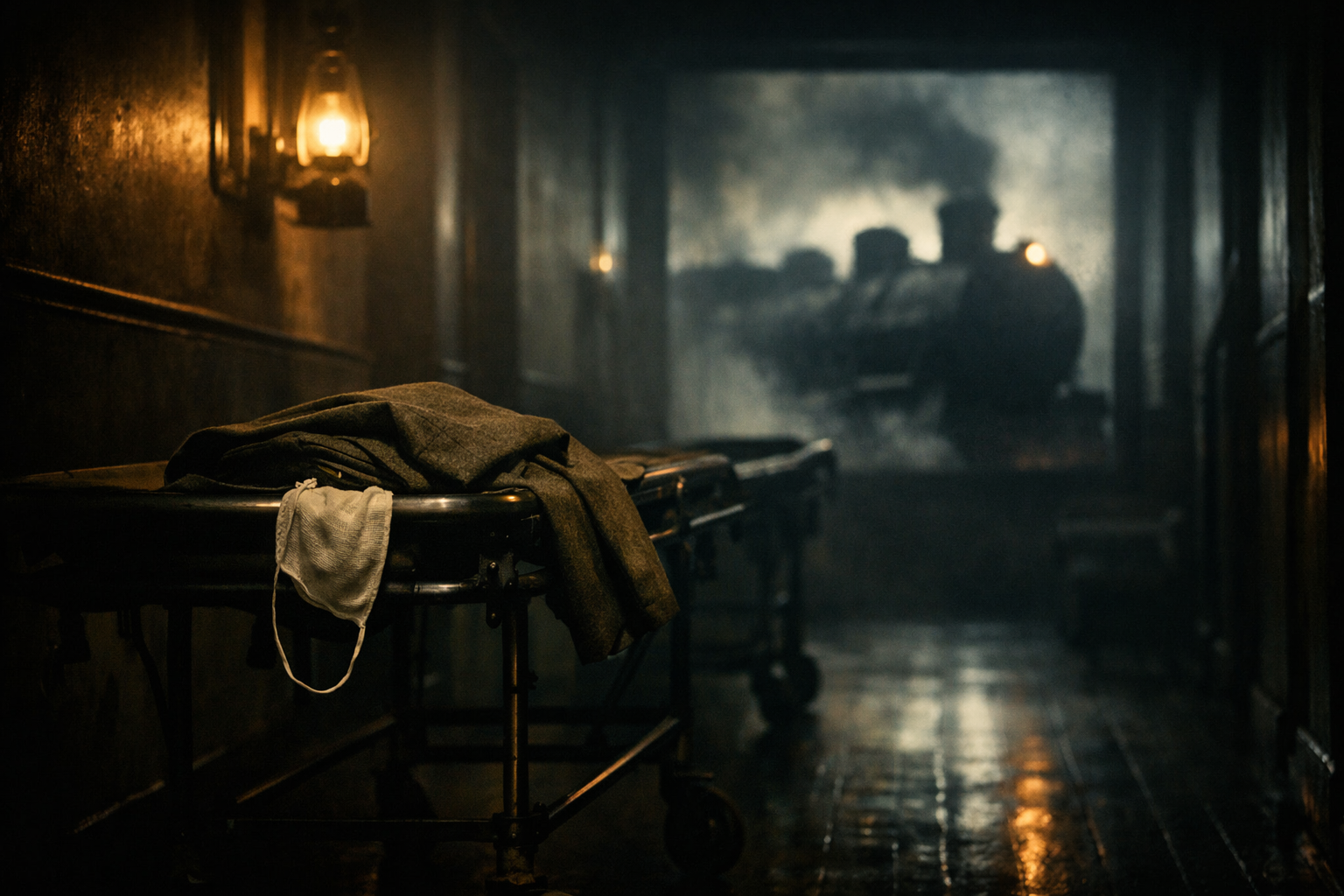
In real history, the 1918 Spanish Influenza hit a world already exhausted by war. In this scenario, it hits harder at the worst possible moment: late summer 1918, as troop trains and ships move in endless loops between ports, camps, and front lines.
The divergence is simple and brutal. In the final week of August 1918, the virus that fuels the second wave shifts toward deeper-lung infection more often than it did in real history. It spreads much the same way. It just kills more of the people who catch it, faster, and with less warning.
That matters because 1918 is not a world with ventilators, antibiotics, or spare hospital capacity. It is a world of coal smoke, crowded tenements, underfed conscripts, and rail schedules that cannot slip without consequences. A deadlier strain does not just raise the body count. It attacks the machinery of the state: staffing, transport, food, policing, and trust.
The alternate timeline is not a single neat outcome. It is a set of pressured choices under poor information, made by officials who are tired, constrained, and often wrong.
The story turns on whether governments choose speed or survival when movement itself becomes the weapon.
Key Points
The divergence: in late August 1918, the second-wave virus becomes markedly more lethal while remaining broadly as contagious as in real history.
In the first month, hospitals, morgues, and rail networks become the first points of failure, not battlefields or parliaments.
The biggest constraint is medical reality: no antibiotics for bacterial pneumonia, limited oxygen delivery, and thin nursing capacity.
One branch sees longer, harsher closures and delayed demobilisation that changes the rhythm of the postwar settlement.
Another branch sees early reopening under economic pressure, followed by repeated lethal surges and political radicalisation.
A third branch hinges on elite illness during the peace process, turning diplomacy into a race of absences and replacements.
The key signal is not speeches or treaties. It is whether ports, rail depots, and coal supply can keep operating without collapse.
Baseline History
By early 1918, influenza was familiar and feared, but not yet treated as a civilisation-level threat. Public health existed, yet it was uneven. Many cities had health departments and quarantine powers. Few had the staff, the legal clarity, or the political room to use them for months on end.
World War I amplified every weakness. Men lived in packed barracks. Troop trains ran on fixed priorities. Ports were crowded with shipping, uniforms, and bodies. Governments managed news with a wartime mindset, and rumor filled the gaps. When sickness surged, the instinct was often to keep production moving and morale high.
The 1918 pandemic arrived in waves. The early wave in the spring was often described as relatively mild compared to what followed. The lethal second wave struck in late summer and autumn, ripping through camps, cities, and ports, then echoing into 1919. In many places, the same tools appeared again and again: school closures, bans on gatherings, isolation, mask rules, and pleas for restraint. Some places acted early and layered measures. Others hesitated, held parades, and paid in weeks.
Real history bent toward the outcome it did because the war ended when it did, demobilisation began when it did, and the world’s transport system kept moving. Influenza rode that movement. It did not need conspiracy. It needed trains.
The Point of Divergence: A More Lethal 1918 Spanish Influenza
Late August 1918, in the churn between European ports and North American receiving points, the second-wave strain shifts. The change is biological, not political: a variant becomes more likely to replicate deep in the lungs, driving severe pneumonia and rapid respiratory failure in a larger share of cases than in real history.
This is plausible because influenza evolves fast, and the late-summer shift in 1918 already produced a far deadlier wave than what came before. In this scenario, that shift is simply worse.
What changes immediately is the clinical pattern. More patients crash within days. More cases that might have recovered do not. More young adults die, which is socially and economically destabilising in a way that the death of the very old, however tragic, is not.
What does not change is the era’s constraint set. There is still no flu vaccine. There are still no antibiotics for secondary infections. There is still limited oxygen therapy, limited intensive nursing, and limited ability to test, track, and isolate at scale. Telegraphs and newspapers still carry news, distorted by delay, censorship, and panic.
The First Ripples
The First 24 Hours
The first signal is not a headline. It is a ward full of men who should not be dying. Camp doctors and city hospital staff notice the speed. A morning cough becomes a nighttime crisis. Cyanosis appears more often. The number of stretcher cases rises. The “usual flu” story stops fitting.
Local officials have fragments of information. Military doctors see their own camps. City health officers see civilian admissions. Undertakers see demand. No one sees the whole map.
The first operational response is improvisation. Beds are moved. Gymnasiums are eyed as overflow. Volunteers are asked to report. Requests for masks, gauze, and disinfectants spike. Telegraph lines carry urgent, incomplete messages.
The First Month
By September 1918, the divergence becomes visible in numbers even to people who do not trust numbers. More schools close, not because officials are suddenly bold, but because teachers are sick and parents are terrified. More factories slow, not because of policy, but because half the shift is missing.
Rail and port systems become choke points. A deadlier virus turns ordinary absenteeism into a logistics crisis. Coal deliveries slip when crews are ill. Food gets stuck when dockworkers collapse. Mail piles up. Funerals become assembly-line work.
Public gatherings become flashpoints. Leaders who insist on rallies and parades face immediate backlash when death follows within days. Leaders who cancel gatherings face economic anger. Either choice costs legitimacy. The difference is that in this scenario, the body count makes denial harder to sustain.
The First Year
The war still ends in some form, but the tempo changes. Demobilisation becomes slower, messier, and more contested. Armies cannot simply put men on trains and ships without feeding the outbreak machine, yet keeping them in camps is also dangerous. Every option is bad. The only question is which bad is chosen.
By early 1919, much of the world is in a fatigue cycle: closures, partial reopenings, then renewed fear as hospitals fill again. With more deaths, more households lose wage earners. More children lose parents. More local institutions lose staff at the same time.
The postwar settlement is made in a haze of illness, mourning, and fiscal strain. Governments are trying to restart trade while also trying to keep cities from breaking down.
Analysis
Power and Strategy
A deadlier 1918 Spanish Influenza shifts leverage toward institutions that can enforce movement controls: militaries, police, port authorities, and health departments. Civilian politicians still speak, but the people with keys to gates and timetables gain real power.
States face a strategic dilemma: end the war quickly to stop the grinding mobilization, or sustain pressure to secure better terms while sickness tears at forces on both sides. In real history, war aims and battlefield realities drove the timeline. In this scenario, the pandemic adds a second clock: one measured in hospital capacity and burial space.
Empires face sharper risk. Colonial administrations rely on thin staffing and coercion. When illness drains clerks, constables, and transport workers, the system’s grip loosens. That does not automatically produce independence, but it increases the odds of disorder, local bargaining, and brutal crackdowns.
Economics, Industry, and Supply
The immediate economic shock is not “markets.” It is missing hands. A deadlier wave hits prime working ages harder, which changes the labor equation. Wages rise in some trades because workers are scarce. Production falls because skilled crews cannot be replaced overnight.
Coal and food become the two nerves of the system. Coal powers rail, heating, and factories. Food prevents unrest. When sickness thins crews, both become unreliable. Governments respond with rationing, priority orders, and emergency rules. Those rules create winners and losers, and losers do not stay quiet.
Trade recovers more slowly. Ports are the arteries of the postwar world, and ports are also perfect disease mixers. A deadlier virus makes quarantine politically easier but economically brutal. The result is a stop-start recovery that feels like a series of false dawns.
Society, Belief, and Culture
Mass death at speed warps belief. People search for patterns and culprits. Rumors harden into accusations: foreigners, soldiers, the poor, the rich, the “careless,” the “profiteers.” Trust becomes the rarest commodity.
Religious and civic rituals strain under the weight of grief. Funerals are rushed or denied. Churches and halls close and reopen. In some communities, mutual aid strengthens. In others, fear turns neighbors into threats.
Censorship and propaganda face a new challenge. It is one thing to manage war news from distant fronts. It is another to manage death on your own street. In this scenario, the gap between official reassurance and lived reality widens faster, and once that gap opens, it is hard to close.
Technology and Logistics of the Era
This is a world of steamships, rail lines, and telegraphs. Travel is slower than modern air, but it is steady and dense along key routes. Troop movements are scheduled, repeatable, and hard to halt. That makes spread stubborn.
Medical technology is narrow. Supportive care exists, but it is limited by staffing and oxygen availability. Nursing is labor-intensive. A deadlier virus does not just fill beds. It burns out the people who run the beds.
Public health tools are blunt: closing schools, banning crowds, isolating the sick, and trying to persuade the public to comply. The tools can work, but only if applied early, layered, and sustained. Sustaining them is the hardest part.
What Most Coverage Misses
The overlooked limiter is burial capacity and municipal continuity. Cities are not abstract. They are payrolls, sanitation schedules, water systems, and clerks who stamp papers. When death spikes, it does not only steal lives. It steals administrative time.
Bodies require transport, storage, and burial. Each step uses labor, fuel, and space. When those systems jam, the crisis becomes visible in the most visceral way. That visibility forces policy, but it also triggers panic and flight, which spreads disease outward.
In this scenario, the pandemic’s deadliness turns civic breakdown into a realistic risk in certain hotspots. Not everywhere. Not uniformly. But enough to change national politics.
Scenario Paths
The Quiet Clampdown
In this branch, central governments decide that keeping transport and ports functioning requires strict, sustained limits on crowds and travel. They impose layered closures earlier, keep them longer, and accept a slower return to “normal.”
Demobilisation is staged and delayed. Returning troops are processed in smaller groups. Large victory parades are cancelled in more places. The peace process becomes more procedural and less theatrical, with more reliance on written drafts and smaller meetings.
Why this happens is simple: the death rate makes political denial impossible, and the logistics failures make economic reopening self-defeating.
Break point: winter 1918–1919. If the public tolerates restrictions through the cold months, this branch holds. If fatigue breaks compliance, it flips toward renewed surges.
Plausibility: Most likely. It relies on the same tools real cities used, just applied under stronger pressure.
The Reopen-and-Riot Cycle
In this branch, governments clamp down briefly, then reopen under pressure from business, labor shortages, and public exhaustion. The virus punishes the reopening quickly. Hospitals fill. Restrictions return. The cycle repeats.
Each cycle corrodes trust. People stop believing timelines. Police enforcement becomes harsher, then inconsistent. Strikes and protests rise, driven by grief, shortages, and anger at elites who appear insulated.
Why this happens is also simple: economies cannot sustain long closures without support systems that barely exist yet, and leaders fear that order will break if they hold the line too long.
Break point: spring 1919. If governments create credible relief—food, fuel, wages—the cycle softens. If they do not, it hardens into conflict.
Plausibility: Plausible. It matches the human tendency to declare victory early when pain becomes unbearable.
The Sickroom Settlement
In this branch, illness strikes key delegations during the peace process hard enough to change who is present and who is persuasive. Negotiations become a contest of stamina and succession as much as principle.
A leader’s severe illness can shift a delegation’s internal balance. Advisors gain room. Rivals push harsher or narrower aims. Public opinion at home, already raw with death, becomes less patient with international idealism and more hungry for security and blame.
Why this happens is the ruthless logic of institutions: when one person falters, others fill the space, and they do not share the same priorities.
Break point: April–May 1919. If leadership teams stay intact, outcomes resemble real history. If absence and replacement become constant, the settlement hardens and fractures.
Plausibility: Less likely, but possible. It depends on timing and individual vulnerability rather than broad social mechanics.
The least likely outcome is a smooth, fast recovery that produces a calmer, more cooperative postwar order. A deadlier influenza does not reward optimism. It punishes movement and delay, and it forces trade-offs that leave scars.
Why This Matters
Short-term consequences (1–3 years) are concrete. Demobilisation slows. Trade restarts in fits. Public health powers expand, often through emergency rules that outlive the emergency. Political trust fractures where messaging fails. In some places, grief and shortage intensify labor conflict and street politics.
Long-term consequences (10–50 years) are quieter but deep. States learn that health is not only charity. It is capacity. That insight can accelerate ministries, surveillance systems, and welfare programmes. It can also normalise coercive tools—border controls, internal passes, bans on assembly—used whenever leaders feel threatened.
This scenario also changes cultural memory. A disaster that kills more people, more visibly, is harder to forget. That can produce stronger preparedness. It can also produce deeper cynicism: a sense that modern life is fragile and that officials will lie until the morgues force them to stop.
Real-World Impact
A dockworker in Liverpool wakes to a silent quay. Half his gang is sick. The foreman tells him the ship is waiting, but the customs clerk is missing and the crane operator collapsed yesterday. Wages rise for those who show up, then vanish when the port closes again. Food prices jump because imports stall. At home, the landlord still wants rent.
A farmer near Kyiv tries to hire hands for harvest and cannot. The nearest town has closures and rumors. The rail agent says wagons are delayed because crews are ill. Grain sits. Cash runs short. The family eats what it can store and sells less than planned. In the village, funerals are quick. The priest is exhausted.
A civil servant in Delhi stamps papers in an office that runs on absence. Each day brings a new memo: restrict gatherings, then reopen, then restrict again. Police ask for guidance on enforcement. Merchants ask for exemptions. The civil servant’s own household is sick, and there is no spare help. Authority feels thin, and everyone can sense it.
A textile mill owner in New England watches orders swing wildly. When workers die, looms stop. When the mill closes, debts still accrue. He lobbies for reopening, then fears reopening when his best supervisor is carried out. He starts offering bonuses, then cuts them when cash tightens. The town school closes again, and parents stop showing up.
What If?
A deadlier 1918 Spanish Influenza does not rewrite human nature. It narrows choices. It makes every crowd feel like a gamble, and every delay feel like a sentence.
The core tension remains movement versus survival. Governments can keep trains running, keep ports open, and push people back into factories. Or they can slow the machine to save lives, accepting that the postwar world will arrive later and poorer.
The markers that reveal which branch is winning are not grand speeches. They are practical decisions: longer port quarantines, staggered troop returns, emergency health laws that centralise authority, rationing of coal and food, and credit measures to keep municipalities solvent. When those markers appear together, the world is choosing control. When they appear late and unevenly, it is choosing drift.
