Lake Nyos Disaster Explained: The Night An Invisible Gas Cloud Killed 1,700 People
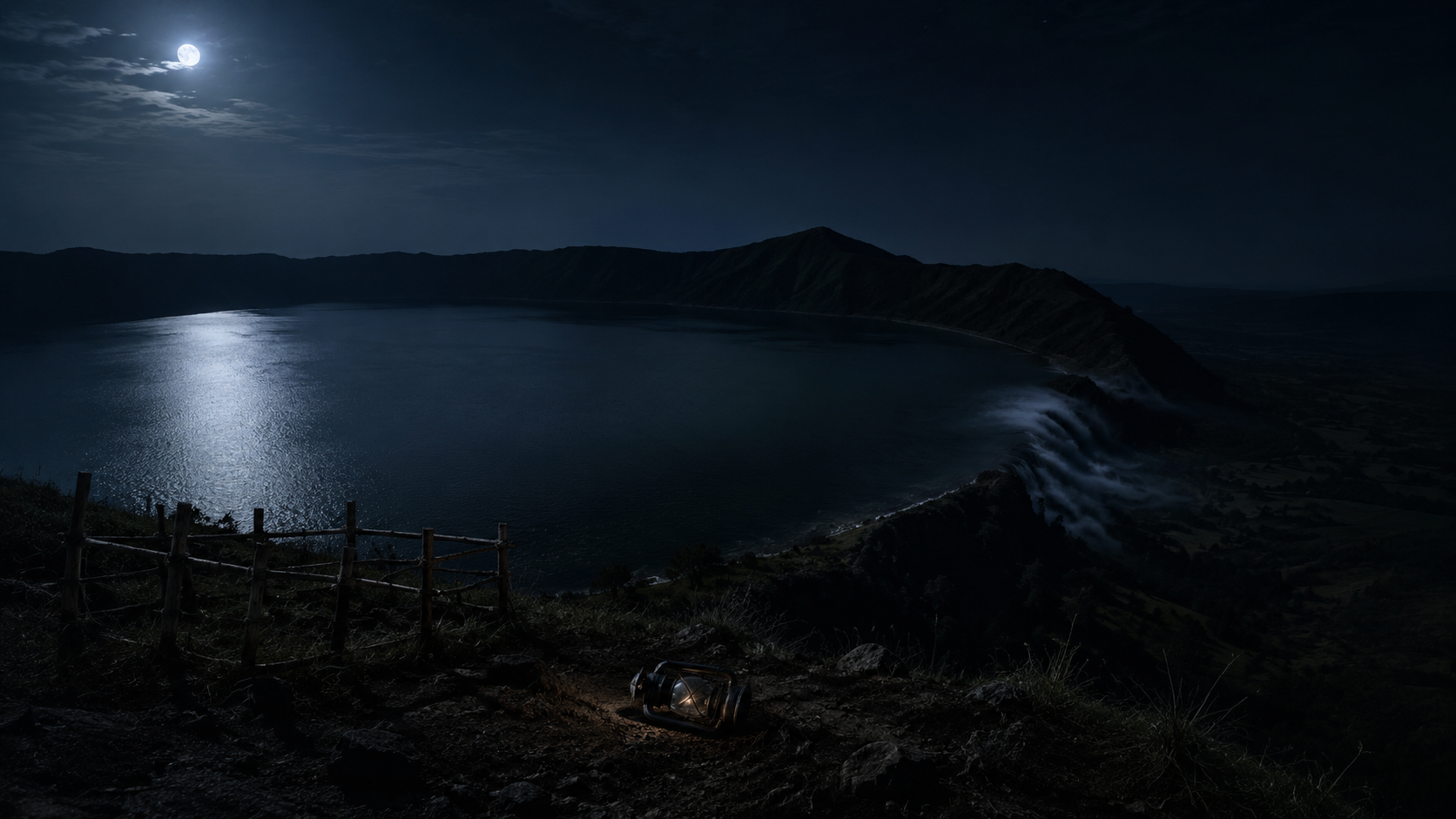
The Invisible Disaster That Wiped Out Entire Villages
How A Beautiful African Lake Became A Silent Killer
On the evening of 21 August 1986, something almost unimaginable happened in a remote part of north-western Cameroon. There was no huge volcanic explosion, no advancing wall of fire and no violent earthquake announcing what was coming. Instead, an enormous quantity of invisible carbon dioxide escaped from the depths of Lake Nyos and began flowing silently into the surrounding valleys.
By the time it was over, at least 1,700 people were dead. Thousands of cattle and other animals had also been killed, while entire settlements had been devastated. Many victims apparently had almost no opportunity to understand what was happening before they lost consciousness.
The catastrophe became known as the Lake Nyos disaster, and it exposed a natural hazard that few people outside specialist scientific circles had even considered possible. A lake had effectively stored an enormous quantity of gas beneath its surface and then released it catastrophically into the atmosphere.
Even four decades later, Lake Nyos remains one of the strangest natural disasters ever documented. It was a disaster in which the water itself did not sweep through villages. The volcano beneath the landscape did not erupt in the conventional sense. The real killer was something nobody could see.
A Disaster With Almost No Warning
Lake Nyos lies within the Cameroon Volcanic Line, a chain of volcanic features extending across the region. It occupies a deep volcanic crater and, before 1986, would have looked to most observers like an isolated mountain lake rather than a potential mass-casualty hazard.
That appearance concealed an unusual geological process taking place far below the surface. Carbon dioxide originating from deep within the Earth was entering groundwater and ultimately accumulating in the deeper layers of the lake.
This mattered because deep lake water was under considerable pressure. Just as carbon dioxide can remain dissolved in a sealed bottle of fizzy drink while it is pressurised, large quantities of CO₂ could remain dissolved in the cold, pressurised water near the bottom of Lake Nyos.
Normally, the different layers of the lake remained relatively stable. The deep, gas-rich water did not continually mix with the surface.
That allowed the carbon dioxide concentration below to rise over time.
Lake Nyos was therefore not simply a crater filled with water. It had gradually become an enormous natural reservoir of dissolved gas.
The danger existed long before anyone living around the lake could see it.
The Night The Lake Released Its Gas
On 21 August 1986, that stability catastrophically failed.
A huge amount of carbon dioxide suddenly came out of solution and erupted through the lake. Estimates vary depending on how the event is reconstructed, but scientific investigations concluded that an extraordinary quantity of CO₂ was released.
The physical process is often compared with opening a carbonated drink after it has been shaken, although the scale at Lake Nyos was vastly greater.
Once some deep water began rising, the pressure on it decreased. Lower pressure allowed dissolved carbon dioxide to form bubbles. Those bubbles made the water more buoyant, encouraging it to rise even faster.
That exposed the water to still lower pressure.
More carbon dioxide then escaped.
The process could therefore reinforce itself. Rising gas-rich water released bubbles, the bubbles accelerated the upward movement, and increasingly large volumes of deep water could become involved.
At the surface, the result was violent enough to disturb the lake dramatically. Evidence examined after the disaster showed wave damage around parts of the shore and vegetation stripped from areas close to the water.
Yet the most lethal part of the disaster was only beginning.
The carbon dioxide did not simply rise harmlessly into the upper atmosphere.
It moved across the surrounding landscape.
Why The Gas Stayed Close To The Ground
Carbon dioxide is denser than ordinary air. Under the conditions surrounding Lake Nyos, the enormous gas cloud remained concentrated near the ground and flowed downhill through depressions and valleys.
That turned the geography around the lake into part of the disaster.
The gas moved out through low points surrounding the crater and travelled along valleys towards populated areas including Nyos and Cha. Investigators later used the distribution of human and animal deaths, damaged vegetation and survivor accounts to reconstruct its path.
In places, the lethal cloud appears to have been tens of metres deep.
The effect would have been profoundly deceptive.
There was no towering wall announcing the arrival of the danger. Carbon dioxide is colourless. At concentrations capable of killing, someone might be surrounded by an atmosphere that looked completely normal.
The cloud simply displaced breathable air while simultaneously exposing victims to extremely high concentrations of carbon dioxide.
People and animals in low-lying areas were especially vulnerable because that was where the dense gas tended to collect.
For anyone caught deeply inside the cloud, escape could become impossible within a very short period.
How Carbon Dioxide Killed So Many People
Carbon dioxide is a normal component of the atmosphere and is constantly produced by the human body. That can make it sound far less threatening than gases commonly associated with poisoning.
Concentration changes everything.
At sufficiently high levels, carbon dioxide produces severe physiological effects. Breathing becomes difficult, consciousness can be impaired and extreme exposure can cause convulsions, coma and death.
At Lake Nyos, victims were exposed not merely to an atmosphere with slightly elevated CO₂ but to an enormous concentrated release capable of creating conditions incompatible with survival.
Many apparently lost consciousness rapidly.
Medical investigations of hundreds of survivors found symptoms consistent with exposure to an asphyxiant gas. People reported headaches, coughing, breathing difficulties, weakness, confusion and loss of consciousness.
Some survivors had collapsed for prolonged periods before eventually waking.
This created one of the most disturbing features of the disaster.
People could wake hours later to discover that family members, neighbours and livestock around them had died.
The Villages In The Path Of The Cloud
The communities around Lake Nyos were predominantly rural. Families lived close to their livestock, farmland and neighbouring settlements.
When the gas flowed into these inhabited valleys, it did not distinguish between houses, roads, farmland or sleeping areas.
People died inside homes and outside them. Livestock collapsed. Wild animals were also killed.
Some settlements suffered catastrophic losses.
The pattern of deaths showed why the behaviour of the gas mattered so much. Higher ground could mean survival while lower terrain nearby could become lethal.
Investigators examining the landscape found that the cloud had followed natural channels away from Lake Nyos. One portion travelled northwards and towards the village of Nyos, while another moved westward through the Cha valley for many kilometres.
In some places, the movement of the gas and water associated with the initial release was energetic enough to damage crops and vegetation.
But beyond the immediate vicinity of the lake, the defining characteristic remained silence.
The killer was atmospheric.
What Survivors Experienced
Accounts gathered after the catastrophe helped scientists understand just how rapidly the event unfolded.
Some people remembered unusual noises from the direction of the lake. Others recalled smells described in terms such as rotten eggs or gunpowder, although carbon dioxide itself is odourless and investigators found no evidence that gases such as carbon monoxide or hydrogen cyanide were responsible for the mass deaths.
Many victims simply collapsed.
One of the initial mysteries involved unusual skin lesions found on some survivors and bodies. Early suspicions included chemical or acidic burns.
Later medical investigation suggested that many of the injuries were instead associated with prolonged unconsciousness and pressure on the skin while victims lay immobile.
A large clinical study examined 845 survivors who had received medical attention. The overall pattern was consistent with exposure to an asphyxiating atmosphere.
For doctors, geologists and disaster investigators arriving in the region, the scale of the event created a deeply unusual problem. They were examining the aftermath of a mass fatality incident without the obvious physical destruction normally associated with something capable of killing more than a thousand people.
Buildings could still be standing.
The landscape could appear recognisable.
Yet large numbers of the people and animals who had occupied it were dead.
Was Lake Nyos A Volcanic Eruption?
The answer requires an important distinction.
Lake Nyos is volcanic in origin, and the carbon dioxide responsible for the catastrophe ultimately had a magmatic source. But the evidence did not support the idea that a conventional volcanic eruption beneath the lake suddenly injected the entire deadly gas cloud directly into the atmosphere that night.
Instead, carbon dioxide had accumulated gradually in the deep lake water.
This transformed the understanding of the disaster.
The lake had essentially acted as a storage system.
The geological source supplied the gas over time. The unusual structure and depth of the lake allowed it to accumulate. Then a separate destabilising process caused the stored carbon dioxide to escape catastrophically.
This phenomenon became widely known as a limnic eruption or lake overturn gas disaster.
It is extraordinarily rare.
But Lake Nyos proved that rarity does not mean insignificance.
What Actually Triggered The Disaster?
This remains one of the most interesting unresolved parts of the Lake Nyos story.
Scientists became increasingly confident about where the carbon dioxide came from, how it accumulated and why the resulting cloud killed people.
Determining exactly what initiated the catastrophic release on 21 August proved more difficult.
Various mechanisms have been considered, including a landslide entering the lake, cooling or rainfall affecting its stratification, internal overturn, seismic disturbance or a spontaneous instability caused by deep water approaching gas saturation.
The important distinction is between the trigger and the underlying cause.
Even if a relatively modest event initiated the overturn, it could only produce such an extraordinary catastrophe because vast amounts of carbon dioxide were already stored in the deep water.
The lake was primed.
The trigger merely had to start the chain reaction.
That helps explain why the disaster remains scientifically fascinating. Researchers can reconstruct much of what happened once gas began escaping without being able to identify with equal confidence the precise event that started it.
The Warning At Lake Monoun
Perhaps the most haunting part of the Lake Nyos disaster is that Cameroon had experienced something disturbingly similar only two years earlier.
On 15 August 1984, Lake Monoun released a lethal gas cloud that killed dozens of people.
The event was unusual enough to attract scientific attention, but the full implications of gas-charged crater lakes had not yet been translated into a system capable of preventing what happened at Nyos.
After 1986, the connection became impossible to ignore.
Two lakes in the same country had produced catastrophic carbon dioxide releases within two years.
Lake Monoun demonstrated that Nyos was not simply an inexplicable one-off accident. Together, the disasters revealed an entirely new category of natural hazard requiring monitoring, geochemistry, lake science and engineering rather than conventional eruption forecasting alone.
Scientists began examining other crater lakes to determine whether they could also accumulate dangerous quantities of dissolved gas.
The search extended well beyond Cameroon.
Why Lake Nyos Was So Dangerous
Several conditions came together at Nyos.
The lake is deep enough for high pressures to exist at the bottom. It is strongly stratified, limiting regular mixing between deep and surface water. Carbon dioxide continuously enters the deep lake from geological sources below.
Its surrounding topography then made the consequences of a release worse.
A vast CO₂ cloud escaping over flat, open ground would gradually mix with the atmosphere. Around Lake Nyos, valleys instead channelled dense gas towards settlements.
The disaster therefore required a rare combination of geology, limnology and geography.
Remove the carbon dioxide source and the lake does not become dangerously charged.
Remove the stable deep water and the gas cannot accumulate in the same way.
Remove the surrounding valleys and a released cloud behaves differently.
At Nyos, all of those conditions existed together.
The Other Danger Hidden At Lake Nyos
Post-disaster investigations discovered another major hazard.
Part of Lake Nyos is held in place by a natural dam composed of volcanic material. Scientists and engineers became concerned that this barrier was vulnerable to failure.
A major collapse could potentially release an enormous quantity of lake water into valleys downstream.
This meant the authorities faced two separate problems.
One involved invisible carbon dioxide accumulating beneath the surface.
The other involved the physical structure retaining the lake.
Both required long-term intervention rather than simply evacuating the immediate area and assuming the 1986 catastrophe had exhausted the danger.
The natural dam was subsequently reinforced as part of efforts to make the surrounding region safer.
The Problem After 1986
The Lake Nyos disaster did not empty the lake of carbon dioxide permanently.
Gas continued entering the deep water.
Measurements conducted during subsequent years showed that dangerous quantities were accumulating again.
That produced an uncomfortable reality.
Without intervention, the conditions responsible for the original disaster could gradually return.
The survivors displaced from the surrounding area could therefore not simply be told that the danger had passed.
Scientists needed a way to remove carbon dioxide deliberately without destabilising the lake and accidentally causing precisely the catastrophe they were trying to prevent.
The answer was remarkably elegant.
They would make the lake release its gas slowly.
How Scientists Began Defusing Lake Nyos
The eventual solution involved installing pipes reaching into the gas-rich deep water.
Once water was brought upwards through a pipe, pressure decreased. Dissolved carbon dioxide began forming bubbles, lowering the density of the water inside the pipe and helping pull more water upwards.
After being initiated, the process could become largely self-sustaining.
At the surface, a dramatic fountain of gas-rich water emerged from the pipe.
It looked violent, but it represented almost the opposite of the 1986 disaster.
Instead of allowing an enormous quantity of carbon dioxide to accumulate before being released unpredictably, engineers could steadily remove gas in controlled amounts.
Full-scale degassing began at Lake Nyos in 2001.
Early monitoring showed that the procedure could reduce the amount of dissolved CO₂ without catastrophically destabilising the water column.
But one pipe was not considered enough to make the lake safe quickly.
Additional pipes were eventually installed in 2011, greatly accelerating the removal process.
Turning A Natural Disaster Into An Engineering Problem
The degassing programme transformed Lake Nyos into one of the clearest examples of humans deliberately reducing an unusual geological hazard.
Natural carbon dioxide continues entering the lake. It cannot simply be switched off.
The objective therefore became managing the balance.
Enough gas must be released deliberately to prevent dangerous quantities from accumulating again.
By 2020, researchers involved in the long-running programme concluded that the main objective had effectively been achieved: most of the dangerous gas inventory had been removed and continued operation of a properly configured pipe could broadly balance the natural CO₂ recharge.
That does not make monitoring irrelevant.
It makes monitoring part of the solution.
Lake Nyos remains connected to the geological system that produced the original danger.
Could A Lake Nyos Disaster Happen Somewhere Else?
Yes, although the necessary conditions are rare.
The Lake Nyos and Lake Monoun disasters forced scientists to examine gas-bearing lakes elsewhere in the world.
One of the most closely studied is Lake Kivu on the border between Rwanda and the Democratic Republic of Congo.
Kivu is vastly larger and contains enormous quantities of dissolved carbon dioxide and methane. Its chemistry, structure and gas dynamics are not identical to Lake Nyos, so it should not simply be described as a gigantic version of the same ticking bomb.
But Nyos fundamentally changed how scientists think about such lakes.
The 1986 disaster demonstrated that dissolved gas stored beneath a stable water column can become a direct threat to entire communities.
That is why identifying, measuring and monitoring gas concentrations matters.
A hazard that was barely recognised before the Cameroon disasters became something that could be actively studied.
Why So Many People Had No Chance
The most frightening part of Lake Nyos was the mismatch between the size of the danger and the warning available to ordinary people.
A hurricane can be seen approaching.
A wildfire produces smoke.
A major flood visibly transforms rivers.
Many volcanic eruptions provide earthquakes, ash, explosions or deformation as warning signs.
The Lake Nyos gas cloud could move through darkness while remaining effectively invisible.
Someone waking to breathing difficulty or confusion might have had no way of knowing whether to run, where to go or even what was happening.
And because carbon dioxide collected in low ground, the safest direction was generally uphill — information almost nobody living around the lake had reason to know before 1986.
The disaster therefore became lethal not simply because carbon dioxide escaped, but because communities had virtually no meaningful warning system for a hazard that had barely been understood.
The Disaster Changed Science
Lake Nyos occupies an unusual place in the history of natural disasters because its aftermath produced much more than an explanation of a single catastrophe.
Researchers needed to understand the geological source of the gas.
They needed to determine how it dissolved and accumulated.
They needed to understand the lake's stratification.
Doctors had to establish what happened physiologically to the victims.
Engineers then had to design a system capable of removing the gas without destabilising the lake.
Authorities also had to deal with evacuations, resettlement, monitoring and the separate danger posed by the natural dam.
The result was a multidisciplinary response to a phenomenon that few people had recognised as a major natural hazard before the 1980s.
Lake Nyos became a natural laboratory.
What We Still Do Not Know
The broad explanation for Lake Nyos is now well established.
Carbon dioxide of deep geological origin accumulated in the lower water. A catastrophic overturn allowed that gas to escape. The dense CO₂ cloud travelled through surrounding valleys and caused mass asphyxiation.
But the exact initiating trigger on 21 August 1986 remains uncertain.
That uncertainty matters because popular descriptions sometimes portray Lake Nyos as though scientists know precisely what happened second by second.
They do not.
Evidence supports the overall mechanism far more strongly than any single proposed trigger.
In some ways, that makes the disaster more unsettling rather than less.
The catastrophe did not require an enormous volcanic explosion.
It may have required only enough disturbance to destabilise a lake that was already storing an extraordinary amount of gas.
The Legacy Of The Killer Lake
Lake Nyos today is not the untouched lake that existed before August 1986. Degassing infrastructure, monitoring and engineering work have turned an obscure geological danger into a managed hazard.
The disaster nevertheless remains extraordinary because of how little visible destruction was required to cause so much death. More than 1,700 people could be killed by a cloud they could not see, released from a lake that had appeared calm only hours earlier.
It is tempting to describe Lake Nyos as a freak accident of nature. That misses the more important lesson. The catastrophe was produced by understandable physical processes operating silently for years beneath the surface until the system crossed a threshold.
That is what makes Lake Nyos so compelling decades later. The danger was real long before the disaster became visible — trapped beneath seemingly peaceful water, accumulating molecule by molecule, until one night the lake could hold it no longer.
