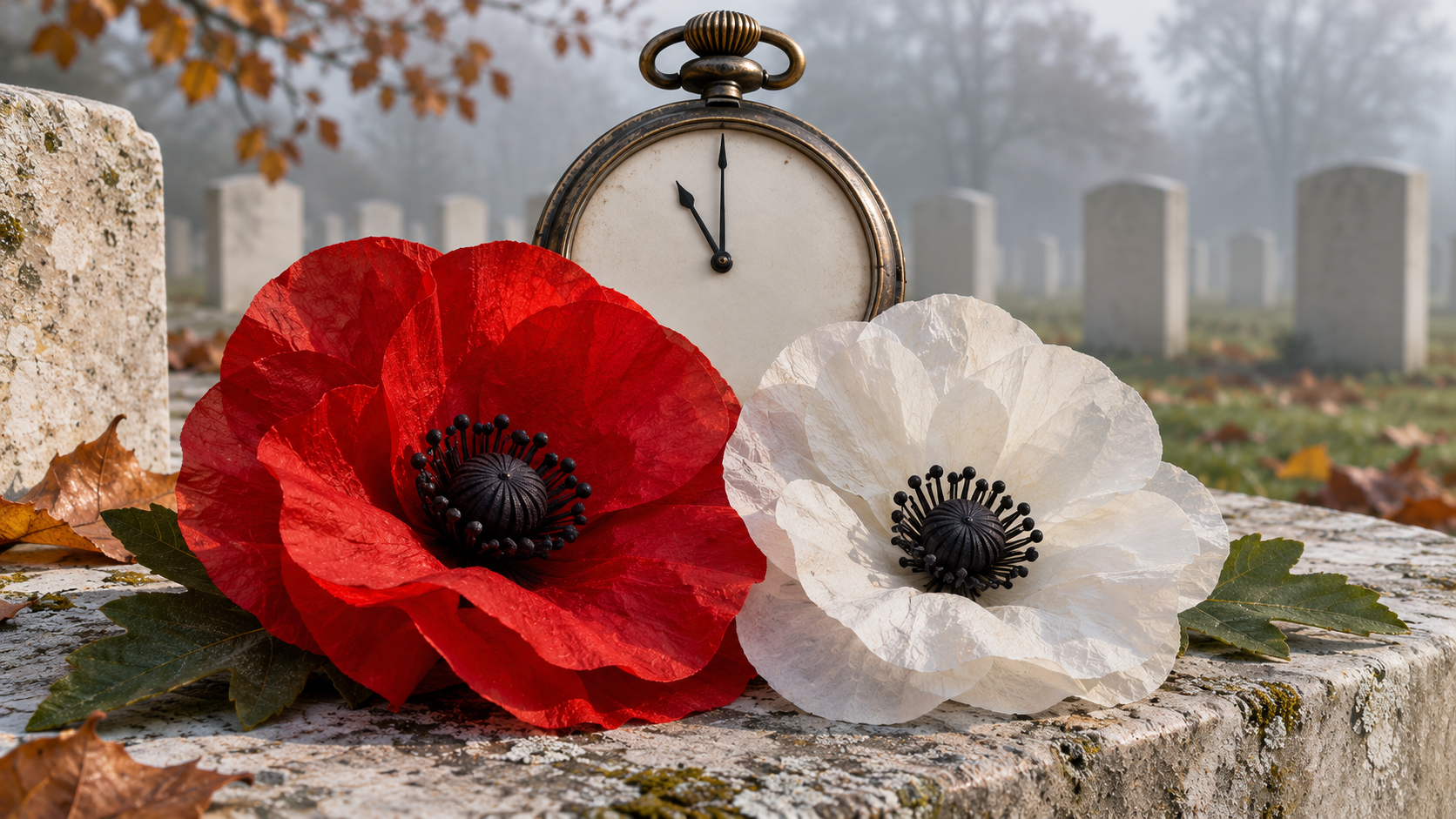
wo Minutes, a Red Poppy and a Century of Remembrance
Remembrance, Peace and the Argument Over a Flower
A ceasefire in 1918 gave Britain its hour of remembrance, but the meaning of the flower worn beside it remains a matter of conscience.
At eleven o’clock, an ordinary morning acquires a different purpose. Conversations pause, attention shifts and two minutes are set aside for people whose lives were changed or ended by war. The timing is precise because the armistice with Germany took effect at 11am on 11 November 1918, bringing the fighting on the Western Front to an end.
The poppy carries a less settled public meaning. For many, it expresses remembrance and support for the Armed Forces community. For others, its association with military institutions raises questions about which deaths are acknowledged and whether mourning can become approval of war. The Royal British Legion says wearing one is a personal choice.
That distinction is essential. People can share a moment of silence without sharing a judgement about every conflict. They can also disagree about a symbol without disagreeing that the dead deserve to be remembered.
Why the Silence Starts at Eleven
The familiar formula—the eleventh hour of the eleventh day of the eleventh month—comes from a military agreement, not an ancient religious observance.
The armistice was signed early on 11 November 1918 in a railway carriage at Compiègne in France. The ceasefire took effect later that morning. The gap allowed time for instructions to reach the forces expected to obey them; signing an agreement and stopping a vast war were separate operations.
An armistice suspends fighting. It is not the same thing as a comprehensive peace settlement. Remembering that distinction prevents the memorable date from flattening the complicated history around it.
Nor did every front become peaceful at the same moment. In East Africa, communication with German forces was difficult and fighting continued after 11 November. The war’s consequences also outlasted its campaigns: bereavement, injury and the practical work of returning soldiers to civilian life could not be ended by a clock.
Eleven o’clock therefore marks a decisive cessation of hostilities on the Western Front, rather than a magical instant when suffering everywhere stopped. Its power as a commemorative hour comes from that historical turning point. The silence asks later generations to stop at a moment when so many people had desperately wanted the fighting to stop.
How Two Minutes Became a National Ritual
The commemorative silence followed in 1919, on the first anniversary of the armistice. King George V called for ordinary activity to pause so that people could concentrate on remembering the dead.
Its origins involve more than one proposal. Edward George Honey, an Australian journalist and veteran living in London, had advocated a period of silence. Percy FitzPatrick promoted an anniversary observance informed by wartime pauses in Cape Town. Accounts differ in the details of how proposals converged, so assigning the entire tradition to one isolated moment of inspiration oversimplifies it.
What endured was the form: a short, shared interval that required no elaborate equipment and could be observed far beyond a ceremonial centre. Two minutes could belong to a village, a workplace or an individual as readily as to a national gathering.
There is a useful distinction between coordinating behaviour and prescribing thought. A service can establish when people pause. It cannot determine whether a participant remembers a relative, reflects on civilian suffering, gives thanks for survival or questions the decisions that sent people into danger.
That openness helps explain the ritual’s strength. Speeches supply an interpretation; silence leaves room for several. Someone with strong religious convictions and someone with none can participate together without pretending that their understanding of death is identical.
The absence of words also creates a responsibility for the words around it. An introduction that names only military achievement will frame the pause differently from one that describes loss, displacement or the burden on families. Silence permits private reflection, but ceremonies still make public choices about what receives attention.
Remembrance Day and Remembrance Sunday Are Different
Armistice Day, also commonly called Remembrance Day, falls on 11 November. Remembrance Sunday takes place on the second Sunday in November. In 2026, Remembrance Sunday is 8 November and Armistice Day is Wednesday 11 November. The customary two-minute silence begins at 11am on both occasions.
The anniversary preserves the exact historical date. The Sunday observance provides the setting for the principal national ceremony and many local services. They serve connected purposes rather than competing for the status of the “real” day.
The distinction also explains why a person might attend a Sunday parade and then pause again during the following working week. One observance places remembrance within a community gathering; the other brings it into the ordinary day on the anniversary itself.
For anyone planning to attend a local event, the silence time should not be mistaken for the arrival time. Processions and services may begin earlier. The local organiser’s arrangements are the useful guide to the practical details.
Why an Empty Tomb Became the Centre of Remembrance
The Cenotaph in Whitehall is an unusual national monument because absence is central to its design. Its name means “empty tomb”. It has no individual names carved into it.
Designed by Edwin Lutyens, the first version was a temporary structure for the 1919 peace celebrations. Public attachment helped secure a permanent replacement. The stone Cenotaph was unveiled on 11 November 1920, when the Unknown Warrior was also brought to Westminster Abbey for burial.
These memorials addressed a practical problem as well as an emotional one. Many bereaved families could not easily visit overseas graves. Others had no identified grave to visit. Local memorials provided places where loss could be acknowledged close to home.
A name on a village monument does something different from a casualty total. It connects a war to the street where someone lived, the workplace they left or the family that waited for them. A visitor does not need to understand an entire campaign to understand that a household was changed.
The national and local forms complement one another. The Cenotaph can stand for losses too numerous to list in one place. A local memorial can restore particular identities to that vast collective absence.
This is also why treating remembrance solely as a military spectacle misses part of its purpose. The monument is useful to people who never wore a uniform. It gives bereaved communities somewhere to bring a relationship that war interrupted.
The distinction between a grave and an empty tomb matters here. The Cenotaph does not resolve uncertainty about a missing person. It acknowledges that uncertainty in a shared space. Its restraint allows visitors to supply the person, the story and the grief that the stone itself cannot contain.
How the Red Poppy Became a Symbol
The poppy’s connection with remembrance grew from the landscapes of the Western Front and the poetry associated with them. Disturbed ground allowed poppies to flourish, creating a striking contrast between flowers and devastated battlefields.
Canadian doctor John McCrae wrote In Flanders Fields in 1915. Its poppies helped establish an image that could travel beyond the battlefield. American campaigner Moina Michael and French organiser Anna Guérin subsequently helped turn that association into an emblem people could wear.
The British Legion adopted the poppy for fundraising in 1921. From the beginning, the flower connected commemoration with practical support for people living with war’s consequences. It was both a sign of remembrance and a means of raising money.
That combination helps explain why arguments about the emblem can become so personal. A criticism intended to address national ceremony may be heard by a donor as criticism of the people receiving assistance. Conversely, a defence centred on charitable help may fail to answer someone’s objection to the symbol’s public military associations.
Those are different questions. What does a donation support? What does the wearer mean? What does an observer understand? The answers may overlap, but one cannot safely substitute for all the others.
A person remembering a grandparent may not intend any statement about present foreign policy. Someone uncomfortable with the emblem may be responding to experiences that the wearer has never encountered. Understanding the disagreement begins by identifying which meaning is being discussed.
What the Royal British Legion Says the Poppy Means
The Royal British Legion presents the red poppy as remembrance, support for the Armed Forces community and hope for a peaceful future. Its published position is that the emblem has no political or religious meaning and that wearing it is voluntary.
Its guidance also acknowledges civilians and the wider effects of conflict. It would therefore be inaccurate to claim that its stated understanding of remembrance excludes civilians altogether. The organisation respects people’s choice to use other emblems alongside the red poppy.
These statements clarify the Legion’s intention. They do not establish that every observer experiences the symbol in the same way. An organisation can define its purpose; it cannot erase the histories people bring to it.
A useful comparison is a family photograph displayed in public. The family may see affection and continuity. An outsider may recognise an institution, a uniform or a historical period carrying different associations. Neither response can be understood properly by looking only at the object’s physical appearance.
This does not mean that any interpretation is equally well supported. Claims about what the Legion officially advocates should be checked against what it actually says. Claims about someone’s personal motives require evidence about that person. The existence of a political dispute is not proof that every participant intended a political statement.
Why White Poppies Have Their Own History
White poppies were first produced in 1933 by members of the Co-operative Women’s Guild. Their history reaches back to people living with the aftermath of the First World War, rather than originating as a recent objection to remembrance.
The Peace Pledge Union describes three connected meanings: remembering all victims of war, challenging militarism and working for peace through nonviolent approaches. Its scope includes civilians and military personnel of every nationality, as well as people affected by current conflicts.
The difference is therefore more substantial than a change of colour. The white poppy makes an explicit argument about how remembrance should relate to preventing war. That argument can be debated without treating its wearers as indifferent to the dead.
Equally, the phrase “peace symbol” should not be used to imply that red-poppy wearers favour war. A person may believe that armed defence can sometimes be necessary and still regard every death as a tragedy. Another may believe that the institutions used to prepare for war make future conflict more likely. Both positions need arguments beyond a flower.
The hardest disagreement concerns means. A shared desire for peace does not settle when force is justified, whether deterrence works or how civilians can best be protected. Remembrance can bring those disagreements into view without being capable of resolving them.
Wearing red and white together can express an individual combination of support and concern. It need not reconcile the organisations’ entire philosophies. Personal symbols often communicate a limited commitment rather than a complete political programme.
Why History Changes How a Poppy Is Read
The poppy’s meaning has been particularly contested in Ireland and Northern Ireland, where remembrance intersects with different experiences of British military power and national identity. A single explanation based on gratitude for service cannot capture all those histories.
The important point is not that a background automatically determines a person’s view. People from the same city, religion or family can disagree profoundly. It is that the context needed to understand a refusal may differ from the context that makes wearing a poppy feel natural to somebody else.
Consider the difference between remembering a relative who served and remembering a community harmed during a conflict. Either experience may shape what a military-associated emblem evokes. Asking both people to treat the symbol as emotionally identical would require one or both to set aside part of their history.
That does not make respectful public remembrance impossible. It makes curiosity more useful than assumption. A person can explain why they participate without requiring another person to adopt the same account of the past.
There is also a distinction between the morality of an individual’s service and the legitimacy of a campaign. Service can involve courage, coercion, duty, fear, professional commitment or some combination of them. Assessing the policy that placed people in danger is a separate historical task.
The separation becomes especially important when discussing wars whose political objectives were not achieved. Failure does not erase bereavement. Equally, bereavement cannot prove that the decisions leading to a war were sound. Respect for people and scrutiny of policy have different evidential requirements.
When Remembrance Becomes a Test of Loyalty
The problem with making poppy-wearing a moral test is that a visible badge provides very little evidence about the person behind it.
Someone may wear a poppy thoughtfully, casually or because it is expected in the setting. Someone without one may have donated privately, forgotten it, lost it, chosen another emblem or decided against wearing any symbol. Appearance alone cannot distinguish among those explanations.
This creates an easy route to unfair judgement. The observer supplies a motive, treats it as established and then condemns the person for it. The argument has moved from something visible to something unknowable without admitting the gap.
There is a reasonable concern on the other side: shared rituals can lose their public character if nobody feels any responsibility to maintain them. Schools, employers and community groups may want to explain the occasion and make participation possible. An invitation to remember can be valuable, especially for people unfamiliar with the history.
The boundary is between explaining a practice and demanding a display of conviction. A clear invitation tells people what the silence commemorates and when it will happen. A loyalty test claims that declining the associated emblem reveals defective character.
These approaches produce different kinds of participation. One leaves room for an honest choice; the other rewards visible compliance. If remembrance is meant to encourage reflection, compulsory-looking conformity is a poor substitute for it.
Respect also runs in both directions. Choosing not to participate does not require interrupting another person’s grief. Choosing to participate does not provide access to somebody else’s private conscience.
Can We Honour Service and Still Question War?
Yes, provided the questions remain precise. Honouring a person’s courage is not the same as endorsing a government’s strategy. Caring for veterans does not require agreeing with every use of military force. Remembering civilian victims does not require treating every party to a conflict as equally responsible.
These distinctions protect remembrance from two opposite simplifications. One turns the suffering of service personnel into proof that a campaign must have been justified. The other treats criticism of a campaign as a reason to discount the humanity of those who served in it.
Neither conclusion follows. A policy needs to be assessed through its aims, alternatives, conduct and consequences. A person’s needs after service require attention whether or not that assessment is favourable.
Historical judgement also benefits from keeping achievement and responsibility distinct. The controversies surrounding the recruitment of former Nazi scientists after the Second World War illustrate why a useful result cannot settle every moral question about how it was obtained. Remembering history well means retaining difficult evidence alongside the parts a nation finds reassuring.
A commemorative service cannot carry the full burden of that analysis. It is neither a history seminar nor a foreign-policy inquiry. But it can avoid implying that gratitude requires silence about mistakes, wrongdoing or preventable harm.
The most useful relationship between remembrance and history is therefore a continuing one. A ceremony directs attention towards lives that matter. Historical investigation asks what happened to those lives, what choices were available and who exercised power. The first can motivate the second without determining its conclusions.
What to Do During the Silence
For someone observing the two minutes, the practical act is straightforward: pause ordinary conversation and activity where it is safe and possible to do so. At an organised service, follow the event’s cues. The purpose is reflection, not demonstrating that you know a complicated set of rules.
Participation need not involve a personal connection to the Armed Forces. Thinking about a name on a local memorial, the effect of bereavement on a family or the civilian consequences of conflict can make an abstract anniversary more concrete.
There is no need to judge the depth of that reflection by outward appearance. A person sitting down, working in an essential role or unable to join a public gathering may still be observing the occasion in a meaningful way.
Nor does a poppy need to function as a certificate of understanding. Learning about one life can reveal more than repeating a familiar slogan. Who was the person? Where did they come from? What happened to those left behind? Such questions turn commemoration into attention.
At eleven o’clock, the clock supplies a common starting point. What gives the pause substance is the willingness to remember actual people, including those whose stories complicate the history we thought we knew.
Sources
House of Commons Library — Remembrance Day and Remembrance Sunday in the UK: FAQs — The distinction between the commemorations, the 2026 dates and the contested history of poppy-wearing.
House of Commons Library — Centenary of the Armistice — The signing at Compiègne and the ceasefire taking effect at 11am.
History of Government — The War That Did Not End at 11am on 11 November — Why the armistice did not immediately stop fighting everywhere, including East Africa.
Australian War Memorial — A Period of Silence — Proposals associated with Honey and FitzPatrick and the 1919 royal request.
English Heritage — History of the Cenotaph — Lutyens’s memorial, its temporary predecessor and the permanent monument unveiled in 1920.
National Army Museum — Honouring the Fallen — Bereavement, overseas graves, local memorials and the Unknown Warrior.
Royal British Legion — The Poppy and Remembrance — The flower’s origins, McCrae, Michael, Guérin and the 1921 appeal.
Royal British Legion — Remembrance Key Points — The Legion’s stated meaning, civilian recognition, voluntary participation and other emblems.
Peace Pledge Union — Remembrance & White Poppies — The 1933 origins and the organisation’s explanation of white-poppy symbolism.
Next Reads
Why America Lost the Vietnam War: The 10 Biggest Reasons, Ranked — How to distinguish military sacrifice from the political and strategic outcomes of war.
Why America Hired Nazi Scientists After Defeating Hitler — The difficult relationship between national achievement, historical evidence and responsibility.
