

Strait of Hormuz Disruptions: The Long History of the World’s Most Dangerous Oil Chokepoint
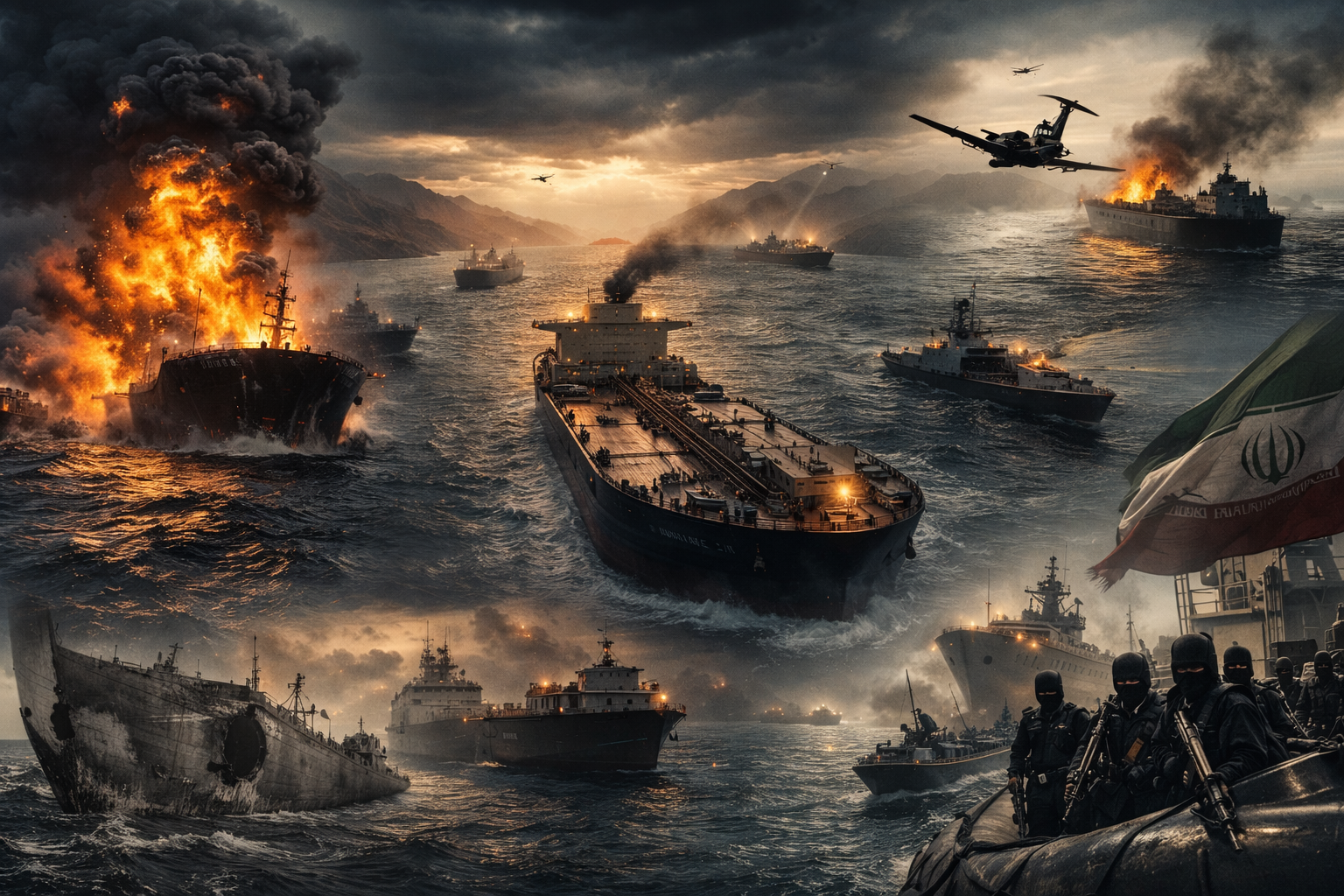
Why the Strait of Hormuz Keeps Threatening the World Economy
The Strait of Hormuz is no longer just a familiar flashpoint in market commentary. It is once again the hinge between a regional conflict and a global economic shock. That matters because this narrow waterway, lying between Iran and Oman, has spent decades proving that a few miles of sea can move energy prices, naval strategy, and great-power politics far beyond the Gulf.
The usual framing is simple: if Hormuz is threatened, oil jumps. That is true, but it is incomplete. The deeper story is that the strait’s history is not really a series of neat closure attempts. It is a history of coercion, signaling, mine warfare, tanker intimidation, and calibrated disruption designed to make free passage feel unsafe even when the route remains technically open.
This is why every new crisis in Hormuz instantly feels larger than the map suggests. The passage is narrow, but the real contest has always been overconfidence: confidence from shipowners, insurers, governments, and energy markets.
The story turns on whether disruption is enough to break commercial confidence before it becomes a full military blockade.
Where This Story Really Begins
The Strait of Hormuz became globally decisive because Gulf energy exports became globally decisive. The waterway is the only sea outlet for much of the oil and gas shipped from the Persian Gulf. Its geography is brutally simple: a narrow funnel through which enormous volumes of energy pass.
That made Hormuz a strategic pressure point long before today’s war. But its modern history as a disruption zone took shape in the 1980s, when the Iran-Iraq War spread from land to shipping.
The lesson from that period still defines the strait. Once a regional war moves onto merchant shipping, the line between commercial risk and military escalation becomes dangerously thin.
The Tanker War Changed the Rules
During the later phase of the Iran-Iraq War, both sides attacked tankers and merchant shipping in what became known as the Tanker War. Iraq targeted Iranian exports. Iran, unable to match Iraq symmetrically in all areas, increasingly threatened broader Gulf shipping and tried to impose costs on states seen as helping Baghdad.
This was the turning point because it transformed commercial traffic into a battlefield. Ships were no longer just carrying cargo. They became political signals, pressure points, and proxies.
The United States and other outside powers were eventually pulled in. In 1987, Washington agreed to reflag and escort Kuwaiti tankers under Operation Earnest Will. That did not eliminate risk. Iran adapted with mines, small-boat harassment, and deniable tactics. In 1988, the USS Samuel B. Roberts struck an Iranian mine, triggering Operation Praying Mantis, one of the largest U.S. naval actions since World War II.
That episode established the core strategic truth of Hormuz. A weaker regional power does not need to dominate the sea. It only needs to make transit dangerous enough that stronger powers must absorb the burden of keeping it open.
Why the Strait Kept Returning in the Sanctions Era
After the Iran-Iraq War ended, Hormuz did not disappear as a threat. It became a recurring lever in standoffs over sanctions, oil exports, and Iran’s nuclear program.
In 2011 and 2012, as U.S. and European pressure on Iran intensified, Tehran threatened to close the strait in retaliation. Those threats rattled markets because they revived an old fear: that sanctions on Iranian exports might be answered by attempts to endanger everyone else’s exports too.
Yet this period also showed another pattern. Tehran’s threats were severe, but full closure remained an escalatory last resort. The point was often deterrence through uncertainty. If the market believed Hormuz could become unpassable, Iran gained leverage without necessarily firing the first shot.
That distinction matters. The economic effect of Hormuz risk often begins before any formal blockade exists.
What Most Coverage Misses
The central mistake in much Hormuz coverage is the idea that the only question is whether Iran can literally shut the strait.
History suggests the more important question is whether it can make normal commercial passage feel abnormal. Mines, drone strikes, commandos, selective seizures, and attacks near the shipping lanes can all achieve strategic effect without a permanent wall across the water.
That is why Hormuz crises are not best understood as on-or-off events. They are insurance crises, confidence crises, and threshold crises. Traffic can fall sharply long before lawyers, diplomats, or navies agree that the strait is officially closed.
This changes how the history reads. The most effective disruptions were often not the loudest threats but the moments when risk became hard to price and harder to manage.
2019 Showed the Power of Gray-Zone Disruption
The 2019 crisis brought Hormuz back into sharp focus. After the United States withdrew from the Iran nuclear deal and pressure on Tehran increased, a series of attacks on tankers and maritime seizures shook the region. Four vessels were attacked off the UAE coast in May 2019. Later that summer, Iran seized the British-flagged Stena Impero near the Strait of Hormuz.
This was not the Tanker War repeated in full. It was something more modern and, in some ways, more unnerving: gray-zone maritime coercion. The acts were limited, calibrated, and politically loaded. They were enough to raise premiums, disrupt routing, and warn that commerce could be held hostage to wider geopolitical disputes.
The significance of 2019 was that it updated the Hormuz playbook for a new era. Instead of mass strikes on shipping, the model shifted toward selective action with strategic visibility. One seized tanker could do diplomatic work far beyond its tonnage.
Seizures, Retaliation, and the New Maritime Pattern
That pattern continued into the 2020s. Iran and outside powers increasingly used shipping seizures and counter-seizures as part of a wider sanctions and retaliation struggle. Tankers linked to contested oil trades became bargaining chips. Commercial vessels became legal, political, and military symbols all at once.
In 2023 and 2024, more ships were seized near or in the strait. In April 2024, Iran seized the MSC Aries, tying the move to a broader confrontation with Israel. By then, the message was unmistakable: the Strait of Hormuz was no longer just an oil chokepoint. It was a theater for coercive signaling in a region where every convoy, cargo, and flag could become part of a larger conflict.
That expanded the stakes. Container shipping, crew safety, insurance, sanctions enforcement, and naval deterrence all became entangled in the same stretch of water.
Why the Real-World Stakes Are Always Global
The reason Hormuz disruptions matter so much is not only that oil passes through the strait. It is that alternatives are limited, slower, and politically exposed. Some Gulf exporters can reroute part of their supply through pipelines, but not enough to neutralize a severe Hormuz crisis.
That means every serious disruption sends stress through multiple layers at once: crude prices, LNG trade, freight costs, marine insurance, refinery planning, inflation expectations, and diplomatic signaling.
For households, that can mean higher fuel and transport costs. For governments, it can mean emergency stockpile decisions, naval deployments, and pressure to intervene. For companies, it means a brutal question: is the route still commercially rational, even if it remains physically possible?
That last point is often the one that bites first.
The Pattern That Binds the History Together
Across four decades, the pattern is remarkably consistent. Hormuz crises are usually not simple attempts to stop all shipping forever. They are contests over leverage.
Iran has repeatedly used the threat of disruption to offset conventional disadvantages, answer sanctions, punish adversaries, and remind the world that pressure on Tehran can impose costs far beyond Iran itself. Outside powers, especially the United States, have repeatedly tried to preserve freedom of navigation without sliding into a wider war.
This creates a chronic instability. If outside navies do too little, deterrence weakens. If they do too much, the confrontation can widen. That is why Hormuz has remained one of the most dangerous places on earth for miscalculation.
What History Says to Watch Next
The history of Strait of Hormuz disruptions does not offer comfort, but it does offer clues. The first is that commercial paralysis can arrive before formal closure. The second is that convoying and naval escorts can restore some confidence, but they also raise the risk of direct state-to-state clashes. The third is that mines, drones, and selective attacks remain the most efficient tools for prolonged intimidation.
So the key signposts are concrete. Watch whether insurers begin treating transit as uneconomic even under naval protection. Watch whether Gulf exporters can move enough supply through bypass pipelines to steady markets. Watch whether attacks stay selective or shift toward sustained, overt attempts to deny passage. And watch whether outside powers define the problem as a shipping-security mission or a broader war aim.
That is the fork in the road. Hormuz history shows that the world rarely faces a clean binary between open and closed. More often, it faces a murkier and more dangerous zone in between, where trade still moves, but only under fear, force, and rising cost. In strategic terms, that gray zone has shaped the Gulf for decades, and it may prove more consequential than any single battle.
