Thailand’s 2,000-Year-Old Gold Rings Could Rewrite An Ancient Trade Story
Ancient Gold Rings Reveal Thailand’s Lost Indian Ocean Links
Thailand’s Ancient Gold Ring Discovery Points To Elite Burial Mystery
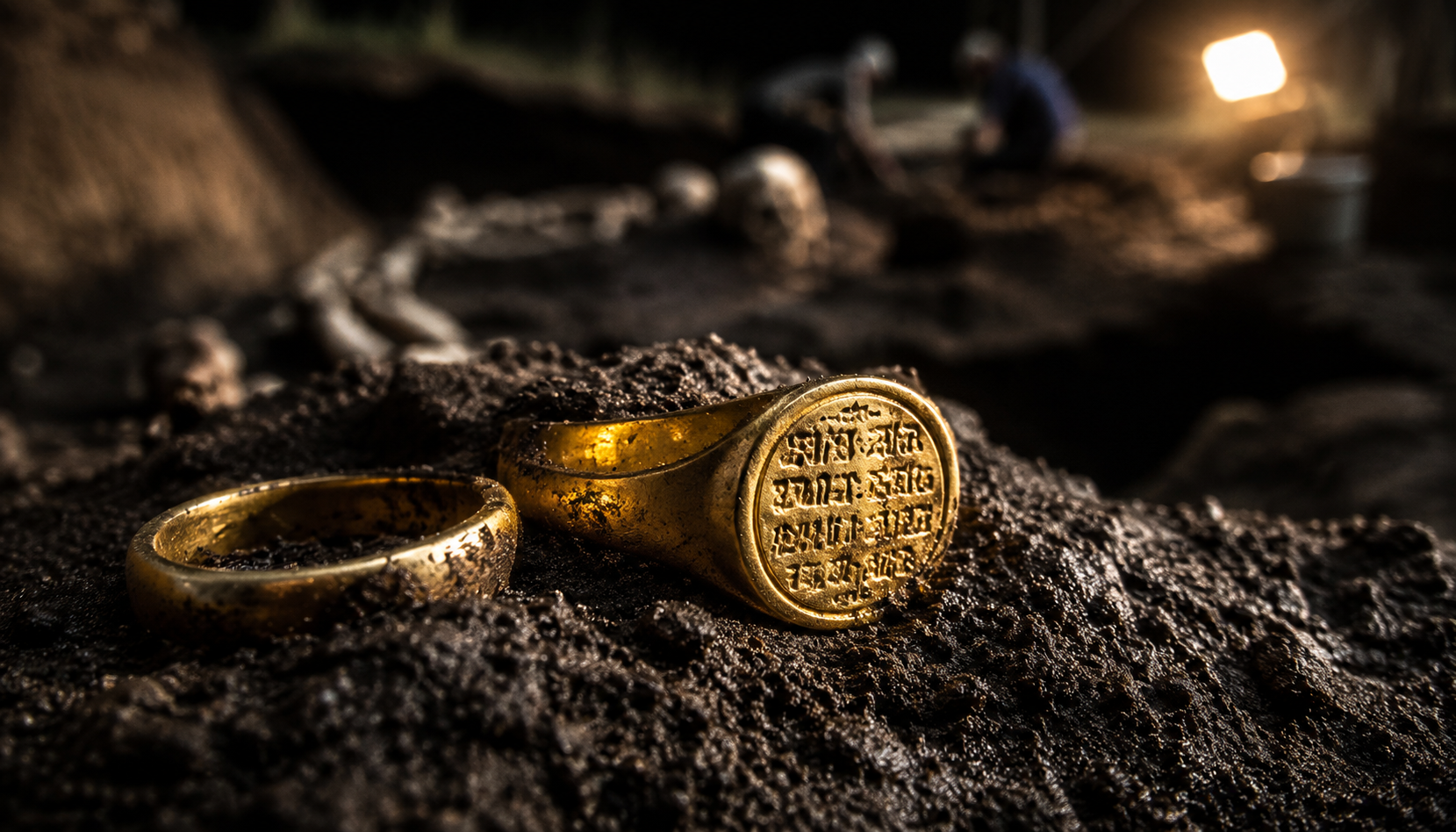
Two gold rings found beside human remains in western Thailand have turned a local excavation into a much bigger historical question. The discovery at the Don Yai Thong archaeological site in Phetchaburi province is not just about jewellery; it is about trade, status, migration, belief and the reach of Indian cultural influence across ancient Southeast Asia.
Thai officials say the rings are roughly 1,900 to 2,100 years old, placing them in a period when parts of mainland Southeast Asia were becoming increasingly connected to Indian Ocean trade networks. One ring is plain, but the other is far more important: a gold signet ring bearing an inscription in ancient Brahmi script. That inscription has been read as “pusarakhitasa” or similar transliteration, interpreted as meaning “the one protected by Pushya,” a reference linked to an auspicious star or zodiac sign in Indian astrology.
What Was Found In Thailand
The rings were found during excavation work at Don Yai Thong in Ban Lat district, Phetchaburi, about 130 kilometres southwest of Bangkok. The site was reportedly identified earlier this year after local residents found fragments of ancient bronze drums in a rice field, prompting archaeological investigation. Since excavation began, the site has yielded human skeletons, gold and bronze jewellery, pottery and other objects that point to ceremonial burials rather than ordinary disposal of the dead.
The two rings were reportedly discovered with skeletal remains labelled as skeleton number four. Thai heritage officials said the finds had to be recovered carefully because groundwater, salinity and wet conditions from the rainy season were accelerating the deterioration of bones and bronze objects. That environmental pressure matters because archaeological value is often destroyed not by dramatic looting, but by water, salt, exposure and delay.
The most important object is the inscribed gold signet ring. A signet ring is not merely decorative; historically, such objects could be connected with identity, ownership, authority, trade or sealing goods and documents. If the reading of the inscription is confirmed, the ring may preserve a personal name or protective formula, making it far more valuable to historians than a plain gold band of the same weight.
Why The Discovery Matters
The find matters because it places an Indian-script object inside a Thai burial context from around two millennia ago. That is powerful evidence of cultural contact, whether through migration, trade, elite exchange, intermarriage, religious influence or imported prestige goods. It does not prove a single simple story, but it does show that people in this region were linked to wider systems of movement and meaning.
The Brahmi inscription is the key. Brahmi was used across ancient South Asia and became one of the great parent scripts of Asia. Finding it on a gold ring in Thailand strengthens the picture of early contact between the Indian subcontinent and mainland Southeast Asia before the later, more visible spread of Indianised kingdoms, Sanskrit inscriptions and Buddhist-Hindu state culture.
Thai experts have suggested the owner may have been connected with the Vaishya, or merchant, caste in ancient Indian society. That interpretation should be treated carefully, because grave goods do not always identify a person’s full life story. Still, the possibility is striking: a merchant or merchant-linked elite buried in western Thailand with gold, script and symbols of Indian cultural vocabulary.
This is why the rings are more than treasure. They are evidence of a world in motion: traders crossing seas, goods moving inland, symbols travelling with people, and local communities adopting, adapting or displaying foreign prestige objects. The burial context gives the discovery its force because it shows the object was not just passing through a market; it was placed with the dead, meaning it carried personal or social significance.
What Is The Value Of The Rings
The market value of the gold itself is the least important part of the story. The rings’ weight and purity have not been publicly confirmed in the available reports, so any exact cash valuation would be guesswork. For context, gold was trading at roughly $4,143 per troy ounce on 6 July 2026, which works out at around $133 per gram before any purity adjustment.
That means a small ancient gold ring weighing, for example, 5 to 10 grams might contain a bullion value somewhere in the rough range of hundreds to a little over a thousand dollars, depending on purity and current market price. But that is not its real value. A 2,000-year-old inscribed ring from a controlled excavation is not priced like scrap jewellery.
Its archaeological value is much higher because it carries information: script, date range, burial context, trade implications, craftsmanship, social status and cultural contact. A plain modern gold ring is valuable because of metal. An ancient inscribed ring is valuable because it can answer questions metal alone cannot answer.
There is also a legal and ethical point. These are cultural heritage objects, not ordinary private collectibles. Reports say the rings were transferred for museum custody, conservation and further study, with plans for public display after conservation work. That makes their practical value public and scholarly, not commercial.
If the inscription is confirmed and studied in detail, the signet ring could become one of the more important early-contact objects from the site. Its value would then sit in the same category as rare seals, inscribed beads, elite burial goods and early trade objects: small in size, large in historical consequence.
Similar Finds In Thailand And Southeast Asia
The Don Yai Thong rings fit into a wider pattern of discoveries showing early links between Thailand and the Indian Ocean world. Thai reports note that Brahmi inscriptions on seals and ornaments have previously been found at sites including Khlong Thom in Krabi and Khao Sam Kaeo in Chumphon. Those places are important because they sit within southern Thailand’s long history as a corridor between the Indian Ocean and the South China Sea.
Khao Sam Kaeo is especially significant because archaeological research has treated it as an early port-city connected to exchange across the Thai-Malay Peninsula. Finds from such sites help explain how ideas, technologies and prestige goods moved through Southeast Asia before the rise of later historic kingdoms. The comparison makes the Phetchaburi ring more interesting, not less, because it may extend that evidence into a burial landscape in western Thailand.
Thailand has also produced other major gold-related discoveries from later periods. At Wat Thammachak Sema Ram in Nakhon Ratchasima, workers and archaeologists uncovered gold, silver and bronze objects associated with a 1,300-year-old reclining Buddha and Dvaravati-period religious activity. That find is younger than the Don Yai Thong rings, but it shows how gold continued to hold sacred, symbolic and elite value in Thailand across different periods.
Another famous comparison is Ayutthaya’s Wat Ratchaburana, where a royal crypt discovery in the twentieth century revealed a huge quantity of gold objects and votive material. That was a very different context, much later and tied to royal Buddhist culture, but it shows the recurring role of gold in Thai elite and ritual life. The Don Yai Thong rings are rarer in a different way: they are earlier, smaller and potentially more useful for understanding the first deep layers of cross-cultural contact.
The closest comparisons, therefore, are not simply “gold treasure” finds. They are inscribed, portable, identity-bearing objects: seals, rings, beads and ornaments that reveal how people marked status, belief and economic role. A gold statue fragment can show religious devotion. A gold signet ring can suggest a person, a name, a network and a social function.
How Rare Is This Discovery
Ancient gold objects are rare because they are fragile in context, attractive to looters, easy to melt down and often removed from sites long before archaeologists arrive. Gold survives chemically better than iron or bronze, but that does not mean ancient gold survives historically. Its very value makes it vulnerable.
An inscribed gold ring from a controlled burial excavation is rarer still. The combination matters: gold, inscription, human remains, probable elite burial context, and an early date of around 2,000 years. Each element adds significance; together they make the find exceptional.
The rarity is also regional. Southeast Asia has many ancient trade sites, but objects that directly connect personal identity, Indian script and burial practice are not everyday discoveries. Even when similar Brahmi inscriptions have been found elsewhere in southern Thailand, each new object helps refine the map of early cultural exchange.
The Don Yai Thong site has reportedly produced eight human skeletons and multiple categories of grave goods, suggesting that archaeologists are not dealing with an isolated loose object. That makes the discovery more valuable because the rings can be studied alongside bones, burial position, associated artefacts, soil conditions, pottery and metalwork. Context is what turns a beautiful object into evidence.
What Happens Next
The next stage is conservation, documentation and analysis. Researchers will need to stabilise the rings, confirm the reading of the inscription, examine the gold composition, compare the ring form with known examples, and study the human remains and surrounding objects. Any future scientific testing could sharpen the date range and possibly reveal more about diet, origin, health or burial practice.
The public may eventually see the rings in a museum display, but the more important story will unfold in specialist study. If the inscription, date and burial interpretation hold, Don Yai Thong could become a key site for understanding how western Thailand fitted into early trade and cultural networks between South Asia and Southeast Asia.
The most exciting part is also the most cautious: the rings do not prove a fully formed ancient trade colony, nor do they alone identify the deceased with certainty. What they do prove is that a small gold object can carry a much larger historical signal. In this case, two rings buried with the dead may have reopened a 2,000-year-old story about wealth, belief and the movement of people across one of Asia’s most important ancient crossroads.
