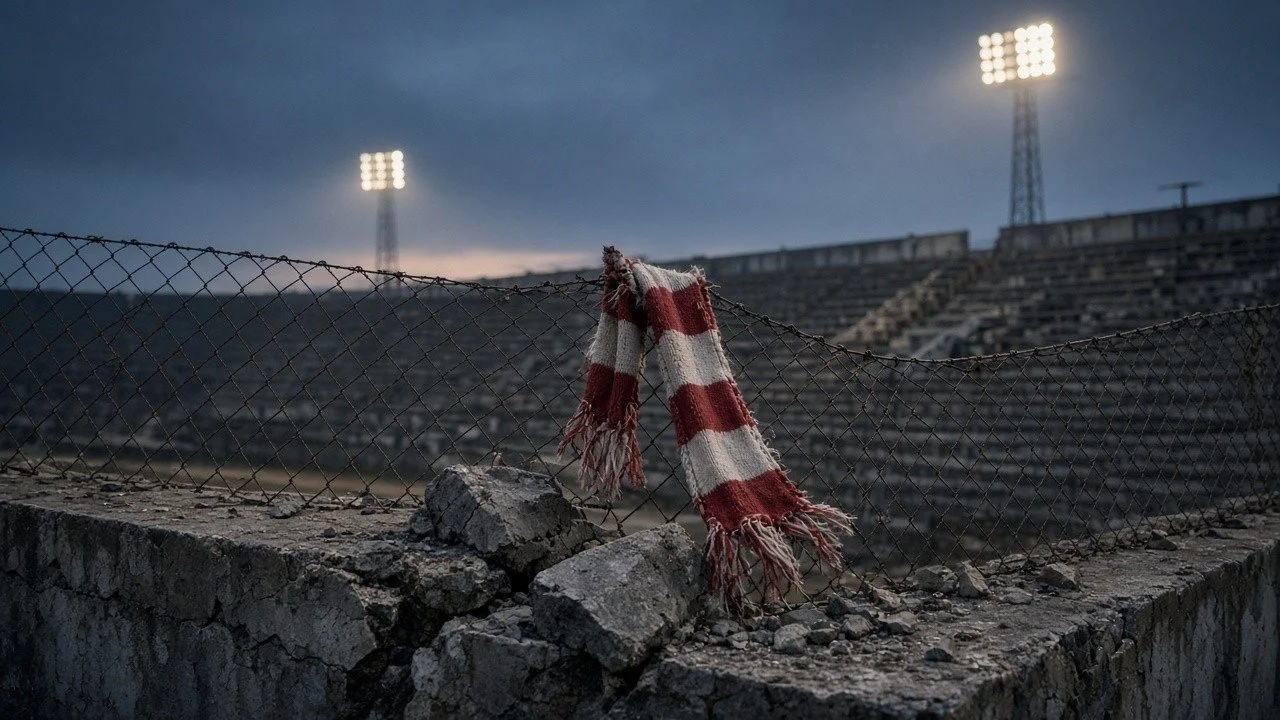
Thirty-nine people died at the Heysel Stadium in Brussels on 29 May 1985.
Thirty-Nine People Went To A Football Final In Brussels And Never Came Home: What Really Happened At Heysel?
On the evening of 29 May 1985, Liverpool and Juventus were due to play the European Cup final at the Heysel Stadium in Brussels. It should have been the biggest night of the club football season, the holders from England against the champions of Italy. Instead, about an hour before kick-off, a charge across the terraces, a collapsing wall and a crush against concrete left 39 people dead and hundreds injured. Most of the dead were Italian supporters of Juventus.
More than four decades later, Heysel still shapes how English football is remembered abroad, how stadiums are policed and how two clubs talk to each other. On 20 November 2026 a new film, Heysel 85, opens in UK cinemas, telling the story of that evening through the eyes of the people who had to decide what to do while it was unfolding.
If you are planning to see it, or simply want to understand why the name still carries such weight, this is what happened, why it happened, who was held responsible and how the dead are remembered today.
A Final In A Stadium That Was Not Fit For It
The Heysel Stadium was an ageing ground, and by 1985 parts of it were in poor condition. Contemporary agency reports described a flimsy fence and crumbling terraces, with chunks of concrete broken from the decaying stands. Roughly 58,000 to 60,000 people were inside on the night of the final.
The organisers' plan relied on separation. Liverpool fans were allocated one end of the ground. Next to them was an area known as Section Z, which was meant to be a neutral zone sold to the Belgian public as a buffer between the two sets of supporters. That buffer failed before a ball was kicked. Many Italians obtained tickets for the block beside the Liverpool section. When the time came, the "neutral" zone was largely full of Juventus supporters, separated from Liverpool fans by little more than a thin line of fencing and a small number of police.
That combination, a weak stadium, an unworkable ticketing plan and light policing, later became central to the court case.
What Happened Before Kick-Off
Trouble began at around 7pm local time, about an hour before the scheduled start. Missiles were thrown between the two sections. Some Liverpool supporters later claimed that Juventus fans had thrown objects first. What is not disputed is what followed: groups of Liverpool supporters charged across the terrace, breaking through the fencing and the thin police line towards Section Z.
As the charge came, the people in Section Z tried to get away from it, moving en masse towards the far side of the section. There was nowhere for them to go. They were pressed against a perimeter wall, and under the weight of the crowd the wall collapsed. People were crushed and trampled as they fell or tried to climb out.
Thirty-nine people died. One widely cited count puts the number of Italian dead at 32; other sources give slightly different breakdowns of nationality, but every account agrees that most of those who died were Italian. The number of injured is reported anywhere from about 350 to 600, depending on the source and the date of the count. Either way, this was a mass-casualty event, played out in front of live television cameras across Europe.
Why The Match Was Still Played
One of the most disturbing facts about Heysel is that the final went ahead. Both managers protested. The decision to play was taken by the authorities on public-order grounds: the fear was that abandoning the match, with tens of thousands of angry and frightened supporters inside and many outside, would lead to even worse violence in the streets of Brussels.
The game kicked off late. Juventus won 1-0 with a second-half penalty. Juventus players have since said that they were made to play for reasons of public order, and that many of them only understood the full extent of what had happened once they were back at their hotel. The images of celebration at the end of that night have remained painful for everyone connected with it, and for the families of those who died.
This tension, between the instinct to stop everything and the fear of what stopping might cause, is the territory Heysel 85 explores.
What Caused The Heysel Disaster?
There is no single cause, and it is important to be careful about how responsibility is described. The courts eventually spread it across several people and organisations.
The violence itself. The immediate trigger was the charge by Liverpool supporters into Section Z. That is why English fans were later prosecuted, and why the English game carried the shame of Heysel for years.
The stadium. The terraces and walls were in poor condition. A wall that gave way under the pressure of a fleeing crowd turned a violent incident into a deadly one.
Ticketing. The plan for a neutral buffer zone depended on tickets reaching neutral Belgian buyers. In practice many went to Italians, which put rival fans side by side with almost nothing between them.
Policing and crowd control. Belgian authorities were widely criticised for the small number of officers at the crucial point and for poor crowd management on the night.
The organisers. UEFA chose the venue and was responsible for the final. A Belgian appeal court later found it jointly responsible.
Those strands were tested in a long legal process in Belgium.
The Investigation, The Trial And The Convictions
The Belgian authorities pursued criminal charges against Liverpool supporters identified from photographs and television footage. In September 1987, after extradition proceedings, a group of British men were sent to Belgium to face trial. The trial began in Brussels on 17 October 1988 and lasted around five months.
On 28 April 1989, a three-judge panel led by Judge Pierre Verlynde delivered its verdicts. Fourteen Liverpool supporters were convicted of involuntary manslaughter. Each was sentenced to three years in prison, half of it suspended, and fined. Eleven other defendants were acquitted.
The court also looked at the officials. Albert Roosens, the former secretary-general of the Belgian football federation, received a six-month suspended sentence for his handling of ticket sales. Johan Mahieu, a captain in the Belgian gendarmerie, received a nine-month suspended sentence. A more senior gendarmerie officer was acquitted.
The verdicts came less than two weeks after the Hillsborough disaster in Sheffield on 15 April 1989, in which 97 Liverpool supporters ultimately lost their lives. The two disasters had very different causes, and the long fight for the truth about Hillsborough is a separate story, but the timing meant English football faced two catastrophes in the same weeks.
UEFA Found Jointly Responsible
The case did not end there. On appeal in June 1990, a Belgian court found UEFA jointly responsible for the disaster. Its general secretary at the time, Hans Bangerter, received a three-month suspended sentence and a fine. In October 1991 Belgium's highest court confirmed the convictions, a ruling that cleared the way for compensation claims by the families and the injured to move forward.
For many of the families, that ruling mattered. It meant the official record no longer described Heysel only as an act of hooliganism, but also as a failure by the people who chose the venue, sold the tickets and policed the ground.
The Ban That Changed English Football
The political response in Britain was immediate. Two days after the disaster, the Football Association, backed by the Prime Minister, Margaret Thatcher, banned English clubs from European competition, and UEFA then imposed an indefinite ban of its own. Thatcher made clear the problem had to be fixed at home first: "We have to get the game cleaned up from this hooliganism at home and then perhaps we shall be able to go overseas again."
The ban eventually ran for five years for English clubs in general, and six years for Liverpool. English clubs returned in 1990. Liverpool's first European fixture after Heysel came in September 1991, against the Finnish side Kuusysi Lahti in the UEFA Cup.
The ban kept a generation of English teams, including several league champions, out of Europe's biggest competitions. It also became part of a wider political story about football, policing and public order in 1980s Britain, a period explored in our guide to Thatcherism and the ideas that changed Britain.
The stadium itself did not survive in its old form. It was rebuilt and reopened in 1995 as the King Baudouin Stadium.
What Heysel Changed, And What It Did Not
Heysel is often remembered as a turning point, but it is worth being precise about what changed because of it.
It led directly to the European ban, to criminal prosecutions across borders, and to a ruling that an international football body could share legal responsibility for a disaster at one of its matches. It also forced a reckoning with violence connected to English supporters abroad.
The biggest physical change to British grounds, the move to all-seater stadiums at the top level, came after Hillsborough and the Taylor Report, not Heysel. Crowd crushes, as later disasters around the world have shown, can happen wherever too many people are pushed into too little space with no safe way out. Our report on the deadly crowd crush at Haiti's Citadelle shows how quickly a gathering can turn fatal.
For the families in Italy, Belgium and elsewhere, the long-term change was less abstract. For years, many felt that Heysel was treated as a footnote in English football's story, overshadowed by the ban and by Hillsborough. Much of the memorial work of the past 20 years has been an attempt to correct that.
How The 39 Are Remembered
Brussels, 2005. On the 20th anniversary, 29 May 2005, a memorial was unveiled at the stadium site in Brussels. Designed by the French artist Patrick Rimoux, it is a stainless-steel sundial with 39 lights, one for each victim, set with Italian and Belgian stone and lines from W. H. Auden's poem "Funeral Blues". The Brussels mayor, Freddy Thielemans, unveiled it alongside the mayors of Turin and Liverpool, and said: "It is this day that the most terrible page of soccer history was written."
Anfield, 2005. In April 2005, when Liverpool met Juventus again in the Champions League, Liverpool fans on the Kop held up a mosaic spelling "Amicizia", Italian for friendship. Some Juventus supporters applauded. Others turned their backs, a reminder that reconciliation could not be organised from one side alone.
Turin, 2025. For the 40th anniversary, on 29 May 2025, Juventus opened "Verso Altrove" ("Towards Elsewhere"), a permanent memorial by the artist Luca Vitone in the Continassa area near the club's stadium: a spiral path of about 66 metres among ginkgo trees. Liverpool sent representatives, including the former striker Ian Rush. Juventus described the tragedy as "a wound that, even 40 years later, has no way of healing".
Anfield, 2026. On 29 May 2026, the 41st anniversary, Liverpool unveiled a new memorial called "Forever Bound" beside the Anfield Road Stand. Carved in Carrara marble, it shows two knotted scarves, one Liverpool and one Juventus, and carries the names of the 39 people who died. It replaced the earlier plaque at the stadium. Ian Rush, who played in the 1985 final, said "the memory of that day never fades."
What To Know Before You Watch Heysel 85
Heysel 85 is directed by Teodora Ana Mihai, whose previous film La Civil was about a mother searching for her kidnapped daughter in Mexico. It is a Belgian, Dutch and German co-production, written by Lode Desmet, Isabelle Darras and Mihai, and runs for just over 90 minutes, with dialogue in Dutch, English, Italian and French.
The film had its world premiere in the Berlinale Special Gala section of the Berlin International Film Festival in February 2026, and its UK premiere at the BFI London Film Festival in October. It is released in UK cinemas by Icon Film Distribution on 20 November 2026.
A few things are worth knowing before you go:
It is a drama, not a documentary. Its central characters, including the Brussels mayor Dumont (played by Josse De Pauw), his daughter and press attaché Marie (Violet Braeckman) and an Italian journalist, Luca (Matteo Simoni), are fictionalised figures built around the real events.
It focuses on decision-making. Much of the drama concerns what officials knew, what they feared and why they let the match go ahead.
It uses real footage. The film blends archive television coverage from the night with dramatised material shot to match it.
It is distressing. The British Board of Film Classification's content advice for the film lists "images of real dead bodies", moderate violence, injury detail and language.
Early critical reaction from the festival circuit has been mixed, with some reviewers praising its craft and immediacy and others finding the drama heavy-handed. Whatever you make of it as a film, it is one of the few major screen treatments of Heysel, and it is likely to bring the disaster to many viewers who were not born in 1985.
Why Heysel Still Matters
Heysel is not just a chapter in Liverpool's history or Juventus's. It is a story about how ordinary people going to a football match were failed by a crumbling stadium, a broken ticketing plan, thin policing and, at the decisive moment, by the violence of other supporters. The courts found that responsibility was shared. The families have spent four decades making sure the 39 are remembered as people, not a statistic.
If you see Heysel 85, it may help to remember the simplest facts: 39 people went to watch a game, and they did not come home.
For another look at how warnings, decisions and institutional failures combine in a disaster, read our explainer on what NASA knew before the Challenger shuttle broke apart.
Next Reads
The Challenger Disaster Explained: What NASA Knew Before The Shuttle Broke Apart
30 Dead At Haiti's Citadel: A Celebration Turns To Chaos As A Crowd Crush Exposes A Deeper Crisis
Sources
The Telegraph: Anniversary monument honours Heysel dead (2005)
UPI Archives: Belgian court sentences British fans in stadium deaths (28 April 1989)
Los Angeles Times: 14 Britons get 3 years each in soccer riot fatal to 39
El País: La UEFA, confirmada como responsable 'caso Heysel' (18 October 1991)
Liverpool FC: 'Forever Bound' memorial unveiled to mark Heysel anniversary
Prolific North: Acclaimed Heysel disaster biopic lands UK cinema release date
