The Making of a Modern Monster Festival
From Ghostly Traditions to a Billion-Dollar Spooky Season
Seasonal gatherings, Christian remembrance and immigrant customs helped shape Halloween. Now commerce and technology are changing who celebrates it, how long it lasts and what it means.
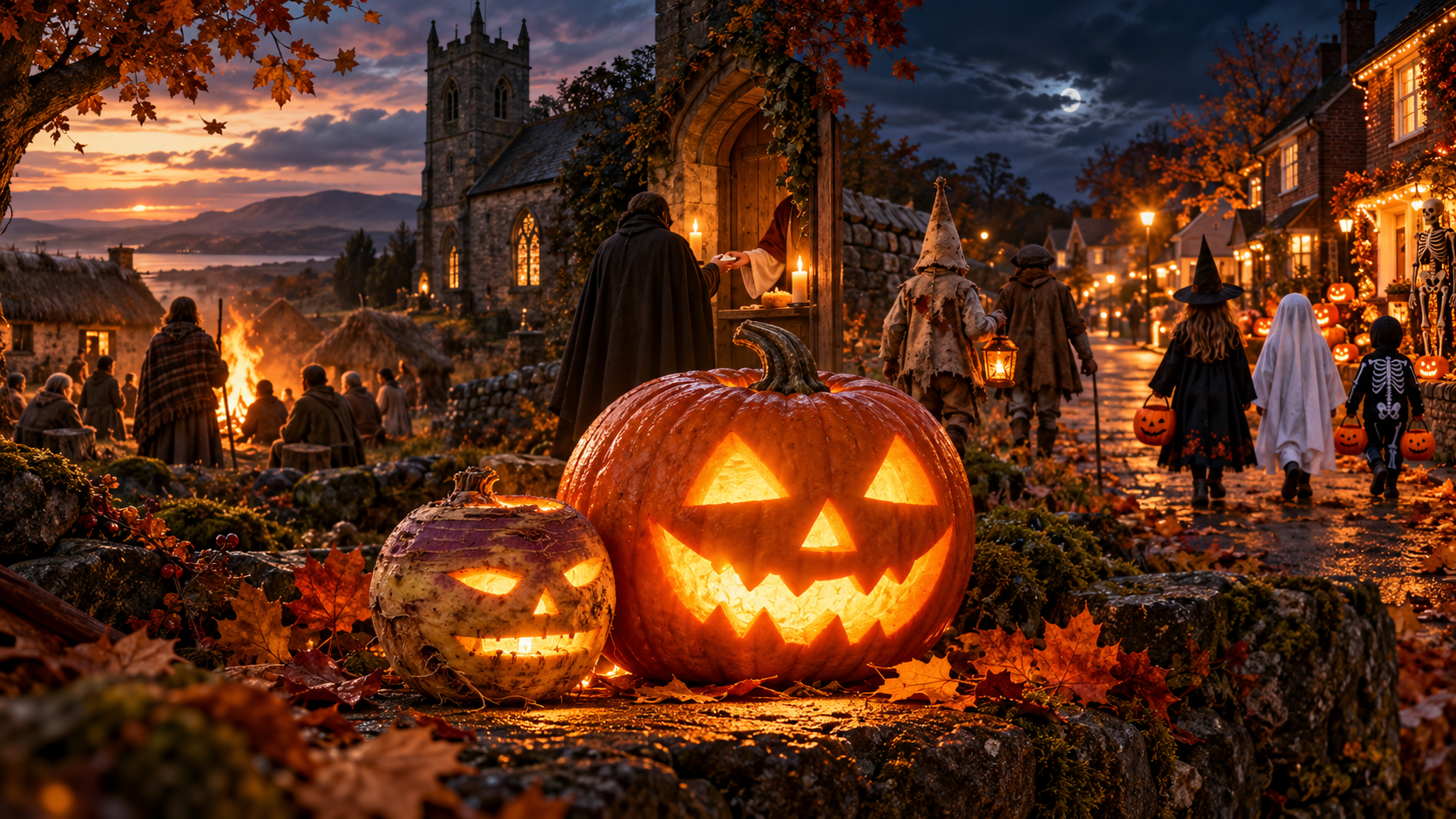
A carved turnip can look much more disturbing than a pumpkin. Its narrow face resembles a shrunken head. The light catches the uneven flesh, leaving the eyes and mouth dark. Before orange pumpkins became Halloween’s best-known decoration, people in parts of Ireland and Britain carried lanterns made from root vegetables.
That small change captures something larger about the history of Halloween. The festival we recognise today developed through seasonal customs, Christian holy days, migration, neighbourhood celebrations and commercial entertainment. There was no single moment when an ancient ceremony became an evening of plastic skeletons and bags of sweets.
Nor is its development finished. Halloween has expanded into a season of shopping, horror films and attractions. Artificial intelligence is entering the planning process, while concerns about cost, waste and access may change what people expect from celebrations.
To understand where it could go next, it helps to separate the evidence from the stories we enjoy telling about its past.
What Samhain Can Tell Us — And What It Cannot
Halloween is often introduced as a Celtic festival that survived for two thousand years. That explanation contains an important connection, but it gives a misleading impression of uninterrupted continuity.
Samhain was a significant seasonal turning point in Gaelic tradition, associated with the beginning of winter. Related traditions developed in Ireland, Scotland and the Isle of Man. Later stories and folklore connect this period with supernatural encounters, returning dead and dangerous beings.
The difficulty is establishing precisely what people believed and did before Christianity. Much of the written evidence comes from a later Christian world. Accounts recorded centuries afterwards cannot automatically be treated as eyewitness descriptions of ancient rituals.
English Heritage historian Michael Carter cautions against confidently projecting later beliefs about witches, demons and ghosts into a distant pre-Christian festival. Heritage organisations sometimes present different interpretations of this relationship. That disagreement matters: a confident origin story can hide how uneven the surviving evidence is.
It is reasonable to recognise an older seasonal setting. Communities whose work depended on crops, animals and daylight had powerful reasons to mark the approach of winter. It is much harder to demonstrate that every familiar Halloween activity descends directly from a particular ancient ceremony.
A child dressed as a vampire is participating in a custom with a complicated history. We cannot draw a straight, fully documented line from that doorstep to an Iron Age ritual.
Why Halloween Falls on 31 October
The clearest explanation for Halloween’s name comes from Christianity.
All Saints’ Day, on 1 November, honours the saints. An older English word for saints is hallows. The preceding evening therefore became All Hallows’ Eve, eventually shortened to Halloween.
All Souls’ Day follows on 2 November and commemorates the faithful departed. These observances developed through church history; they were not one event established at a single stroke. Together, they gave the period a strong connection with remembrance and the relationship between the living and the dead.
The distinction between saints and other departed souls mattered in medieval Christianity. Saints were understood to be in heaven. Other souls might require spiritual assistance. The living could express that concern through worship and charitable giving.
This helps explain why the season could carry both solemn and social meanings. Religious observance took place within communities that also ate, gathered and entertained one another. A holy day did not require the complete suspension of ordinary human pleasures.
The familiar claim that the Church simply stole Samhain and renamed it is too certain. A shared time of year does not, by itself, prove the intention behind a religious calendar. Halloween’s Christian name is well established; the precise relationship between the observances and earlier seasonal festivals remains more contested.
When Knocking on Doors Meant Praying for the Dead
One important predecessor of trick-or-treating involved charity rather than confectionery.
In parts of England, people went souling around All Saints’ and All Souls’ Days. Poorer members of the community visited better-off households and received food, including soul cakes. In return, they offered prayers for departed relatives and friends.
The arrangement made sense within belief in purgatory, where souls underwent purification before entering heaven. Gifts to the poor and prayers for the dead connected material help with spiritual obligation.
Souling was therefore more than an early version of asking for sweets. It joined neighbours through an exchange that involved the absent as well as the living. A household’s generosity could be understood as benefiting people it had lost.
The Reformation disrupted the religious framework supporting these customs. Protestant reformers rejected purgatory and the effectiveness of prayers offered to release souls from it. Practices changed or declined, although souling survived in some places well into later centuries.
Its survival was uneven, with documented traditions in counties including Shropshire, Cheshire and Staffordshire. There was no uniform national Halloween that everyone celebrated in the same way.
The resemblance to modern doorstep visiting is clear. The meaning of the exchange, however, has changed profoundly.
Guising, Jokes and the Work of Earning a Treat
Scottish guising provides another important part of the story.
Guisers dressed in disguise and visited houses, traditionally offering a song, joke, poem or other performance in return for something to eat or another small reward. The visitor contributed entertainment; the household supplied hospitality.
That differs from the modern expectation that a costume and a knock should be enough. In guising, the performance formed part of the bargain.
Disguise also gave people room to behave differently. A familiar child or neighbour could temporarily become an unfamiliar figure. The costume created a little distance from ordinary identity, allowing play, teasing and surprise.
Folklore connected disguises with supernatural protection or imitation, although those explanations should not all be assigned the same age. A later explanation for a custom is evidence of how people understood it at that time, rather than proof of its original purpose.
Modern trick-or-treating belongs to a wider family of visiting customs. Souling, guising and other seasonal practices help explain its shape. Deciding that one alone was its inventor oversimplifies a process that involved several regions and generations.
What endured was a useful social arrangement: people could cross a household threshold under rules that made an unusual encounter welcome.
Halloween Once Had a Romantic Side
Modern Halloween shops favour monsters. Older celebrations also concerned themselves with marriage.
Scottish traditions included burning nuts to interpret a couple’s prospects and pulling kale stalks to predict the appearance or wealth of a future partner. Robert Burns’s 1785 poem Halloween records a world in which seasonal games and romantic speculation belong together.
In Ireland, barmbrack, a fruit bread associated with Halloween, could contain objects interpreted as signs of the future. A ring indicated marriage, while other tokens suggested different fortunes. Customs varied between households and places.
These games reveal a concern that disappears from many accounts of the holiday. Participants were curious about the course their lives would take. Marriage, money and the household ahead of them could be as compelling as anything frightening outside.
Fortune-telling also made uncertainty social. Rather than worrying alone, people turned it into something a group could laugh about, discuss or use as an excuse for flirtation.
Much of that romantic emphasis has receded from mainstream commercial Halloween. Its disappearance shows why surviving customs need context. Keeping a date on the calendar does not mean keeping everything that date once meant.
How the Turnip Became a Pumpkin
The National Museum of Ireland preserves a particularly useful object: a painted plaster model of a turnip lantern. It was made after the museum received a lantern from a teacher near Fintown, County Donegal, in 1943. She described it as the kind made locally around 1900.
That provenance makes it valuable. It documents a particular custom in a particular place, rather than serving as a mysterious relic from an unspecified ancient past.
Carved root vegetables could be illuminated and used to frighten people. Irish folklore also associated the jack-o’-lantern with a wandering figure named Jack, excluded from both heaven and hell and left with a light for his journey.
The story belongs to folklore, not to a verifiable biography. Different tellings help explain the image without establishing one universal origin for every lantern.
In North America, pumpkins became the defining material. Their broad surfaces and hollow interiors offered different possibilities from a dense root vegetable. The resulting orange face became easy to recognise and reproduce.
Once reduced to a familiar outline, the lantern could appear almost anywhere: on a costume, a biscuit, a shop window or a screen. A local object had become a portable symbol.
How Migration Changed the Celebration
Irish and Scottish migrants carried Halloween customs across the Atlantic. Large-scale migration in the nineteenth century helped establish practices that could be adapted within new communities.
Migration rarely preserves a tradition exactly. Families arrive with different memories, available materials change, and neighbours contribute customs of their own. Children growing up elsewhere may keep the enjoyable parts while losing some of the explanation.
Halloween was well suited to that process. A person could join a party, wear a disguise or play a game without sharing a precise religious belief. Participation could spread beyond the community that introduced it.
The United States did not receive an already complete modern Halloween. Its neighbourhoods, businesses and entertainment industries helped produce that version over time.
This is why describing the holiday as either wholly Irish or wholly American misses something. Irish and Scottish traditions were essential to its development. North American reinvention was also essential to the celebration that later travelled internationally.
The journey continued when American-style Halloween became more familiar in Britain. Some customs were returning in altered form; others had remained locally throughout. Different generations could therefore experience the same activity as either familiar tradition or foreign novelty.
The Uneasy Bargain Behind Trick-or-Treating
Halloween mischief was not always charming.
In North America, pranks could involve damage, disruption and intimidation. Efforts to redirect the occasion towards organised parties and children’s activities helped make the festival more acceptable to adults responsible for streets, homes and schools.
Trick-or-treating offered one workable compromise. Children gained an evening of excitement and permission to visit neighbours. Householders could participate in a predictable exchange rather than wondering what less welcome behaviour might follow.
The custom grew through the twentieth century. Popular entertainment helped make it familiar: Disney’s 1952 Donald Duck cartoon Trick or Treat presented the doorstep exchange to a mass audience. Post-war suburban neighbourhoods and commercially supplied treats helped it become routine.
That development was social as well as commercial. A successful trick-or-treating street requires shared expectations about where to go, how to ask and when the exchange ends. The costume does not abolish manners. It creates an occasion for learning a special set of them.
Halloween could also direct the encounter towards a wider purpose. Trick-or-Treat for UNICEF began in 1950, encouraging children to collect donations for other children. The visit to a neighbour’s door could carry an obligation beyond the visitor’s own bag of sweets.
Why Britain Has Two Autumn Nights of Fire and Mischief
In Britain, Halloween developed alongside another powerful autumn observance: Bonfire Night.
The failed Gunpowder Plot of 1605 led to an annual commemoration on 5 November. Church services, bells, bonfires and fireworks became part of its history. Its earlier meanings included religious and political divisions that a modern family attending a display may barely consider.
The proximity of the two dates helps explain why British childhood memories differ. For some families, November fireworks provided the main autumn excitement. Others maintained strong Halloween traditions, including guising and lanterns.
It would be too simple to say that one festival replaced the other everywhere. They served different purposes and developed differently across communities.
Their changing meanings do make an instructive comparison. Many people enjoy Bonfire Night without intending a statement about seventeenth-century politics. Many enjoy Halloween without making a declaration about religion or the supernatural.
A celebration can outlive the beliefs that first gave it force. Later participants inherit the occasion and decide, often without much conscious debate, which parts still feel worth doing.
How Horror Films Supplied New Monsters
Cinema gave Halloween a growing collection of recognisable characters.
Older supernatural figures could be redesigned through performances, make-up, sound and memorable costumes. Later films introduced threats that belonged to suburban streets, bedrooms and ordinary family homes. The seasonal monster no longer needed a distant castle.
John Carpenter’s Halloween, released in 1978, made the festival itself central to a story of danger invading an American neighbourhood. Michael Myers could move through a setting already full of masks, dark streets and distracted adults.
Among the horror films that changed what audiences fear, it offers a particularly direct example of a holiday helping to organise suspense.
The relationship works both ways. Films supply costumes and decorations; the calendar supplies an annual reason to watch frightening films. A character can remain commercially useful long after the original cinema release because another October will arrive.
Stories about real events and alleged curses behind horror films add another kind of appeal. They bring uncertainty outside the fictional story, although documented events and supernatural claims require very different standards of evidence.
For viewers, the pleasure often lies in controlling the encounter. The frightening figure appears on a screen, and the evening has a known ending. Fear becomes something people can arrange together.
The Making of a Billion-Dollar Spooky Season
Modern Halloween offers businesses several kinds of purchase at once: costumes, sweets, decorations, tickets and entertainment. Adults can take part without having children, and a household can celebrate without leaving home.
The National Retail Federation’s September 2026 survey forecast American Halloween spending of 13.5 billion dollars. It found that 74 per cent of consumers planned to celebrate and 49 per cent planned to begin shopping in September or earlier.
Those figures describe surveyed intentions and projected spending, rather than a final total of purchases. They concern the United States and should not be presented as worldwide participation.
Even with that qualification, they show why the expression spooky season makes commercial sense. A longer period gives shoppers time to plan, compare prices and buy across several paydays. Businesses gain more opportunities than one evening could provide.
Retail has also separated Halloween into different moods. One household can choose cheerful ghosts and autumn colours. Another can construct a scene of elaborate horror. The same festival accommodates children’s parties, adult nightlife and people who mainly enjoy decorating.
That flexibility helps it grow. It also creates pressure to keep adding something new. When celebrations become visible online, an ordinary front window can start to feel modest beside a professionally staged display encountered on a phone.
A Global Festival Does Not Mean a Single Tradition
As Halloween travels, it meets communities with their own festivals, beliefs and boundaries.
Its appeal can be straightforward: dressing up, sharing food and attending a party are activities that travel easily. Adopting a costume night does not require adopting every part of its history.
There is a cost when distinct traditions are flattened into one marketable image, however. Mexico’s Día de los Muertos should not be treated as another name for Halloween. It has its own histories and practices of remembrance, including family offerings and attention to deceased loved ones.
UNESCO’s account of the Indigenous festivity dedicated to the dead describes the anticipated temporary return of departed relatives and the preparations that welcome them. Its emphasis cannot be explained adequately by calling it a Mexican horror party.
Similar care is needed when discussing contemporary Pagan observance of Samhain. A religious celebration, a school costume day and a nightclub event can share a date without being the same activity.
The practical question for a global Halloween is how much difference it can accommodate. A festival becomes poorer when every local practice must fit the same set of purchasable decorations.
What AI Could Change About Halloween
Artificial intelligence is already entering Halloween planning. The National Retail Federation’s 2026 survey reported that 47 per cent of consumers were using AI platforms and tools to support their Halloween shopping, including brainstorming and product research.
That finding concerns shopping support. It does not establish that almost half of people are attending AI-run attractions or wearing technologically advanced costumes.
The more immediate uses are ordinary ones. A person can ask for a costume idea within a budget, develop a decorating theme or adapt party suggestions for a small room. Such assistance may be most useful when it turns a vague plan into something manageable.
More ambitious possibilities remain predictions. An attraction could combine speech systems, sensors and theatrical effects to make a character respond differently to each group. A digital ghost might refer to an earlier encounter rather than delivering the same recorded line every few minutes.
Whether that improves the experience depends on execution. A convincing pause, a capable performer or a well-placed shadow may work better than a conversational system that interrupts the atmosphere.
Personalisation also creates a question the old paper mask did not: what information is being collected? If a future attraction remembers a visitor’s face, voice or reactions, the experience should make that clear. Being startled by a performance and discovering unexpected data collection are different kinds of surprise.
Will Halloween Become More Expensive — Or More Resourceful?
There is no guarantee that growth in total spending means everyone will buy more.
Higher prices can increase a market’s value without improving the experience of the people paying. A family may spend more and still leave a shop with fewer decorations or a smaller supply of treats.
Two possible directions could develop together. Premium attractions may compete through elaborate effects and distinctive settings. Household celebrations may place greater value on borrowing, reusing and making things.
Neither outcome is inevitable. They are plausible responses to the same pressure: people want an occasion to feel special while remaining within a budget.
The do-it-yourself version has advantages beyond price. Making a costume gives children decisions to make and problems to solve. A decoration built with friends carries a memory that a purchased object does not automatically provide.
That does not make buying a costume a failure. Time, skill and energy are unevenly distributed. It does suggest that a satisfying Halloween need not be measured by how much somebody brings home from a shop.
The most resilient version may allow several levels of participation, so that a family can join the occasion without feeling obliged to compete with the most expensive display nearby.
The Future of Halloween Also Depends on Its Waste
A festival built around novelty has an obvious material problem. A costume may be worn once, a decoration may break quickly, and a carved pumpkin may be discarded after a few evenings.
There is no need to pretend that all Halloween products have the same impact. Materials, manufacturing, transport, reuse and disposal affect the outcome. A precise comparison would require evidence about the items concerned.
The basic choices are easier to recognise. A borrowed outfit avoids another purchase. A robust decoration can return for several years. Where suitable, the edible parts of a pumpkin can become food rather than being treated entirely as a disposable prop.
Future businesses could compete by making repair, rental and reuse convenient. Schools and neighbourhood groups could organise costume exchanges. Those are practical possibilities, not a forecast that throwaway products will disappear.
There may also be a cultural advantage. If a whole street passes costumes between households, the preparation creates contact before Halloween itself. The effort that would otherwise go into individual shopping becomes an excuse to cooperate.
That is a different kind of growth: more participation from the same collection of objects.
Who Gets to Take Part Will Shape What Comes Next
The most significant improvement may be less spectacular than an intelligent monster.
A noisy event can offer a quieter session. A doorstep can be made easier to approach. An organiser can explain in advance whether visitors should expect darkness, sudden sounds or live performers. A household can offer a non-food alternative alongside sweets.
These choices matter because the standard celebration makes assumptions. It assumes that everyone can move easily between houses, tolerate surprise, speak to unfamiliar adults or eat the same treats.
Changing those assumptions would broaden participation without requiring a complete redesign of the festival. A child should not have to perform confidence to be welcomed.
There is another decision for adults. Halloween can become an evening spent mainly documenting the celebration, or it can provide permission to pay attention to the people taking part. Photographs can preserve a memory; organising every moment around a photograph can also interrupt it.
The final encounter remains a useful test of whatever comes next. Someone approaches in disguise. Someone else opens a door. A successful Halloween gives both a clear reason to enjoy the meeting.
Sources
English Heritage — A Brief History of Halloween, All Saints’ Day and All Souls’ Day — Historian Michael Carter explains the Christian calendar, souling and the limits of claims about pagan continuity.
National Museum of Ireland — Ghost Turnips, the Púca, Fortune-Telling and Evil Abductions — Irish lanterns, masks, food traditions, divination and seasonal beliefs.
National Retail Federation — Halloween Survey Shows Consumer Spending Expected to Reach 13.5 Billion Dollars — September 2026 survey projections, early shopping and reported AI use; these are intentions and estimates rather than final sales.
Next Reads
The 10 Greatest Horror Films Ranked: The Masterpieces That Changed What We Fear — How influential films, including Halloween, built the visual language of modern horror.
10 Horror Films With Disturbing Real Origins — And The ‘Curses’ That Followed Their Casts — The documented events and disputed supernatural stories behind familiar screen terrors.
The 10 Biggest Plot Holes in Famous Horror Films, Ranked — A lighter look at the questions that remain after a seasonal horror-film marathon.
