Children, Gods and Disaster
Were sacrifices made specifically to the Sun?
One of Succession’s coldest scenes begins not with a corporate threat but with ancient history. Logan Roy tells Kendall that during terrible crises the Inca would sacrifice a child, before recalling Marcia’s question: “What could you possibly kill that you love so much… it would make the sun rise again?” It is a devastating metaphor because Logan is preparing to sacrifice his own son to save his empire.
The disturbing part is that the writers did not invent the historical core. The Inca Empire really did sacrifice children in an elaborate state ritual known as capacocha, or capac hucha. Archaeology has uncovered children deliberately taken to sacred locations across the Andes, while modern analysis of their remains has reconstructed remarkable details about their journeys, diets, drug consumption and deaths. A major study published in 2026 has even overturned a long-standing explanation for the death of one famous Inca child, finding evidence consistent with deliberate cranial trauma rather than simple death from exposure.
But Succession compresses a complicated religious system into one brilliant sentence. There is no evidence of a standard Inca doctrine stating that a beloved child had to die specifically so that the physical Sun would rise the next morning. What existed was arguably more interesting: a civilisation in which political authority, sacred geography, natural catastrophe and divine order could become bound together so tightly that a child's life could become one of the most prestigious offerings the state could make.
The Succession Line That Sounds Too Horrific to Be True
The scene occurs near the end of Succession’s second season. Waystar Royco needs a senior figure to absorb responsibility for the cruises scandal. Logan concludes that Kendall is the person who must be sacrificed.
Before telling him, Logan remembers discussing history with Marcia. He describes the Inca sacrificing a child during a terrible crisis and initially dismissing them as savages. Marcia’s interpretation changes the meaning: the sacrifice matters precisely because the victim is precious. Logan then does essentially the same thing symbolically, offering Kendall to preserve Waystar.
Historically, the comparison is imperfect. Inca child sacrifice was not simply an emergency mechanism deployed whenever people feared that sunrise might fail. Capacocha could mark the death or accession of an emperor, imperial expansion and major ceremonial occasions, while historical accounts also connect it with catastrophes including droughts, earthquakes and volcanic eruptions.
The Sun nevertheless occupied an enormously important position in Inca religion. Inti, the solar deity, was intimately connected with imperial kingship, while sacred mountains, ancestral powers and places known as huacas formed part of a much larger supernatural landscape. The same fear of celestial disorder can be seen across the history of how ancient societies understood eclipses, although Inca religion cannot be reduced simply to sun worship.
What Capacocha Really Was
Capacocha was one of the Inca state's most prestigious ritual programmes. Children could be selected from different regions of the empire, brought towards Cusco for ceremonies and then sent out again towards sacred destinations. Archaeological sites connected with the ritual stretch across territories now divided between Peru, Argentina, Chile, Bolivia and Ecuador.
This was not an improvised killing. The movement of the children itself appears to have been part of the ritual.
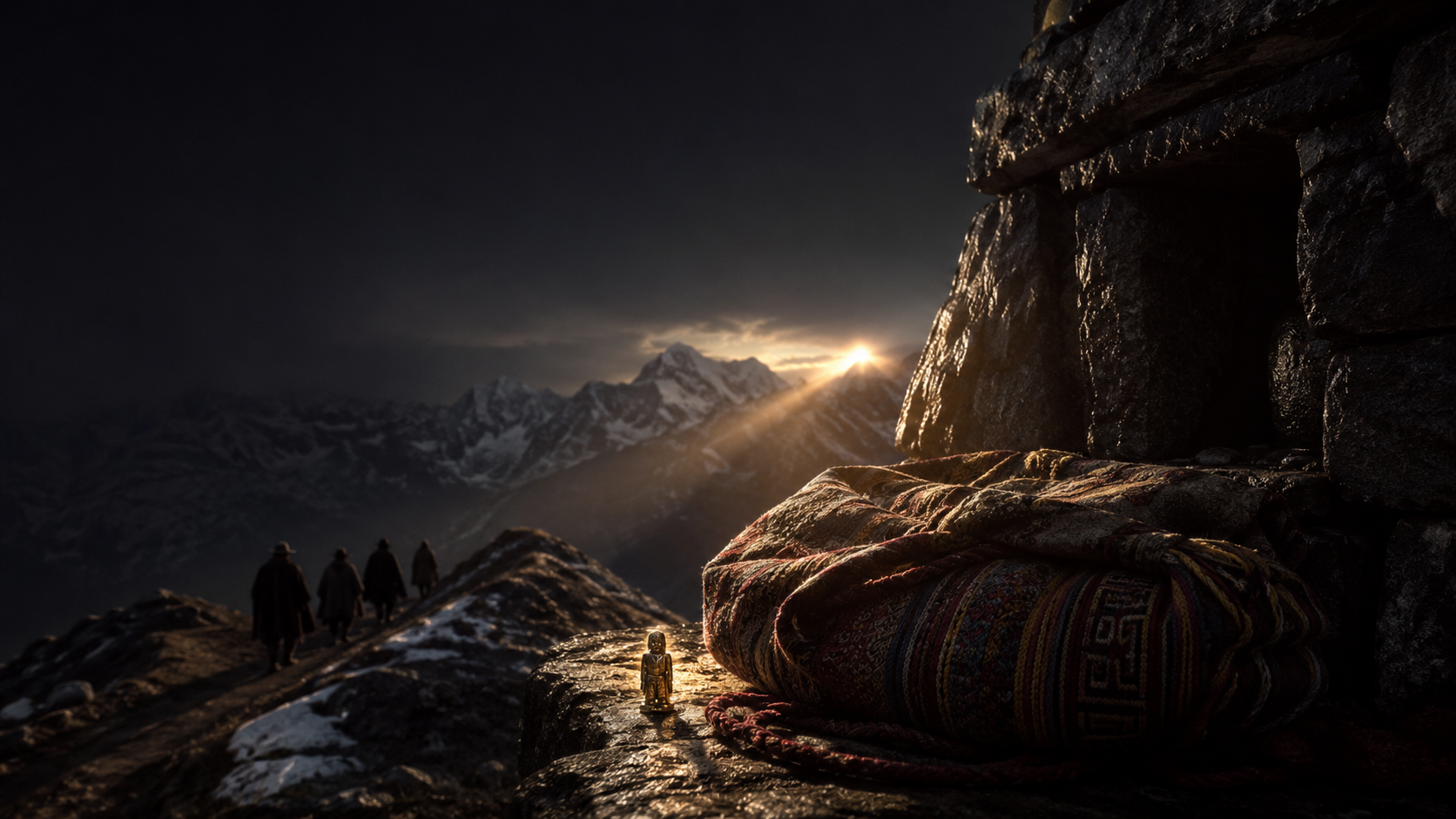
They could be dressed in extremely fine clothing and accompanied by miniature human and animal figurines made from precious materials. Objects deposited alongside sacrificed children connected local communities, imperial authority and sacred landscapes. The ceremony therefore operated simultaneously as religion and statecraft.
That distinction matters. The Inca Empire expanded with extraordinary speed during the century before the Spanish conquest. Controlling a vast territory across mountains, deserts and valleys required more than soldiers. Political authority had to become spiritually meaningful to communities that had previously possessed their own rulers, shrines and traditions.
Capacocha helped achieve that. Sacred ceremonies radiating out from Cusco could connect distant communities with the emperor while physically inscribing imperial ritual onto mountains and shrines across the conquered world. Researchers have consequently argued that the practice had political as well as religious functions, reinforcing hierarchy and integrating territory into the Inca state.
Why Children Became the Ultimate Offering
This is the point at which Marcia’s interpretation in Succession comes closest to the historical reality.
An offering becomes meaningful because it has value.
Inca sources and archaeological interpretation indicate that children selected for capacocha could be treated as prestigious sacrificial offerings. Some historical descriptions emphasise beauty, physical perfection or purity. These were not necessarily people whom society considered worthless. Their perceived special status appears to have been part of what made the offering powerful.
That does not mean every parent willingly regarded the death of a child as an honour, nor can archaeological evidence tell us exactly what individual children or families thought. Concepts such as consent become particularly difficult when dealing with children inside a highly stratified imperial society.
Researchers studying the Llullaillaco victims have explicitly raised questions of coercion, compliance and political legitimation. Whatever religious explanations surrounded the ceremony, an empire capable of demanding children from communities and transporting them across enormous distances was also demonstrating extraordinary power.
The ritual therefore contained a brutal contradiction. The child could be represented simultaneously as honoured and powerless, sacred and condemned.
That is precisely why the Succession metaphor works so well. Logan does not tell Kendall that society sacrifices rubbish. He tells him that during existential crisis, the thing sacrificed can be valuable precisely because losing it hurts.
The Journey to the Mountains
Some capacocha ceremonies ended in places that remain physically extraordinary today.
Three exceptionally preserved children were discovered in 1999 near the summit of Llullaillaco, a volcano rising 6,739 metres above sea level on the modern Argentina-Chile border. They included a girl of around 13 and two younger children approximately four or five years old.
The extreme cold and dry conditions preserved their bodies to an unusual degree. Their hair became a biological timeline.
Chemical analysis showed changing patterns of coca and alcohol consumption during the months before death. In the oldest girl, alcohol and coca use increased significantly towards the end of her life. Researchers have argued that these substances had ceremonial significance while also potentially reducing fear, awareness and physical resistance during the final stages of the ritual.
Other research has found evidence of coca and psychoactive substances among sacrifices associated with Ampato in Peru. This reinforces the wider picture of intoxicants playing an important ritual role, although different capacocha victims should not automatically be assumed to have received identical treatment.
The journey itself could take weeks or months. Historical accounts describe children travelling from Cusco towards distant provincial shrines, while physical evidence from some victims indicates substantial travel through punishing high-altitude terrain.
Imagine the scale of the undertaking. Priests, officials, attendants, animals, food, clothing and ceremonial objects moving across the Andes towards a mountain regarded as sacred, with the entire procession centred on children who would not return.
This was not hidden murder. It was state ritual.
How the Inca Children Died
There was no single universal method.
For years, some high-altitude victims were thought to have died largely through exposure after sedation, particularly because freezing temperatures could kill rapidly at extreme elevation while preserving the body.
The evidence is now more complicated.
Research on different victims has identified traumatic injuries, while other individuals show fewer obvious signs of lethal violence. The circumstances appear to have varied according to place, ritual and victim.
A particularly important development arrived in 2026.
The famous Boy of Cerro El Plomo, discovered in Chile in 1954 at more than 5,400 metres, had long been interpreted as having died from hypothermia. New CT imaging and forensic analysis instead identified evidence consistent with cranial trauma during the capacocha ceremony, substantially changing the reconstruction of his death.
The study examined Cerro El Plomo alongside the Cerro Esmeralda sacrifices and concluded that violent acts formed part of those deaths. It is an important reminder that even exceptionally preserved archaeological remains can continue surrendering new evidence decades after discovery.
The romantic image of a sedated child simply falling asleep peacefully on a mountain therefore cannot be applied universally.
The Chimú Did Something Even Larger
The most astonishing child-sacrifice discovery in ancient Peru was not Inca at all.
It belonged to the Chimú, whose state dominated much of Peru's northern coast before eventually being conquered by the Inca.
At Huanchaquito-Las Llamas, close to the enormous Chimú capital of Chan Chan, archaeologists uncovered evidence for the sacrifice of more than 140 children and over 200 young camelids, principally llamas, in a single event around the fifteenth century. Boys and girls were among the children, generally ranging from approximately five to 14 years old.
This was not an interpretation based simply upon unusual burials.
The skeletons carried physical evidence of deliberate killing.
Cut marks crossed the sternum in numerous children, while displaced ribs indicated that their chest cavities had been opened. Comparable injuries appeared on sacrificed camelids. Researchers concluded that the thoracic cavities had deliberately been cut open; heart removal is a plausible explanation for the procedure, but the surviving skeletal evidence cannot prove that every heart was actually removed.
The consistency is chilling.
There were few signs of alternative lethal injuries among the children. Archaeologists concluded that the killings followed an organised and remarkably consistent ritual programme rather than an uncontrolled massacre.
Human and animal footprints preserved in ancient wet mud provide another extraordinary fragment of the event. Children and llamas apparently moved through the area while the ground was still wet before being killed and buried nearby.
More than five centuries later, those footprints preserve movement towards a ritual whose final destination is visible in the graves.
Did El Niño Trigger a Mass Sacrifice?
Why would a civilisation kill more than 140 children?
No surviving Chimú explanation answers that question directly.
But the ground itself contains a possible clue.
Huanchaquito lies in an exceptionally dry coastal environment. Archaeologists found evidence that the sacrificial event followed unusual heavy rainfall and flooding. The wet mud that preserved human and camelid footprints may have resulted from an extreme climatic episode associated with El Niño or a similar coastal event.
For the Chimú, such disruption could have been catastrophic. Their political and economic power depended on sophisticated irrigation, agriculture and coastal resources. Torrential rainfall in a desert landscape could destroy fields and infrastructure, while changing ocean temperatures could disrupt marine food supplies.
Researchers therefore proposed a haunting possibility: the mass offering may have been an attempt to appease supernatural powers during an environmental disaster.
But this distinction is essential.
The flooding is archaeological evidence. The claim that the sacrifice was intended specifically to stop the flooding remains a hypothesis.
The researchers themselves caution that the association could theoretically be coincidental. Archaeology can demonstrate that extreme rain occurred and that a huge sacrifice followed in the same context. It cannot recover the exact words spoken by Chimú priests before the killings.
That uncertainty makes the evidence more powerful, not less. Something extraordinary happened near Chan Chan, and the Chimú state responded with an expenditure of human and animal life on a scale almost unparalleled in the ancient Americas.
Where These Beliefs Came From
Neither the Inca nor the Chimú invented Andean religion from nothing.
Long before either empire existed, societies across the Andes had developed religious traditions involving sacred landscapes, ancestors, mountains, water, celestial forces, ritual offerings and political authority. Human sacrifice also has a much deeper history in the region.
The Moche, who flourished centuries before the height of Chimú power on Peru's northern coast, left both visual and skeletal evidence of ritual killing. Archaeological research at sites including Huaca de la Luna has identified sacrificed individuals, while Moche imagery depicts prisoners and ceremonial violence.
It would be too simple to draw a straight line saying “Moche religion became Chimú religion.” Political systems changed, populations moved and religious traditions evolved.
Yet the Chimú developed inside a north-coastal cultural landscape already possessing a long history of ritual violence and sacred political authority.
The same applies more broadly to the Inca. They inherited and reorganised beliefs from many societies incorporated into their empire. Mountains could possess sacred agency. Shrines could embody local identities. Ancestors remained politically powerful after death. The Inca state did not erase all of this; it frequently incorporated local sacred traditions into an imperial hierarchy.
Religion therefore helped an empire perform a difficult trick: conquest could be presented not simply as military domination but as participation in a larger sacred order.
Capacocha fitted that system remarkably well.
A child selected in one province could travel to the imperial centre, participate in ceremonies associated with Inca authority and ultimately become an offering at a sacred location. Religion, geography and empire became physically joined by the victim's journey.
What Succession Gets Right — And What It Changes
Logan Roy's history lesson is therefore both true and false.
It is true that the Inca sacrificed children.
It is true that such sacrifices could occur in response to severe crises.
It is true that the Sun occupied a crucial place within Inca religious and political ideology.
And it is true that sacrificing something regarded as unusually valuable was fundamental to the logic of offering.
What is not established is Marcia's beautifully phrased idea that the Inca literally asked what they loved enough to kill in order to “make the sun rise again.”
That is the drama doing its work.
Capacocha involved Inti, mountains, huacas, imperial ceremonies, royal deaths, political expansion, natural catastrophe and the relationship between conquered communities and the Inca state. Turning all of that into a single terrified civilisation sacrificing its most beloved possession so daylight returns is an elegant simplification.
But Marcia's interpretation captures something deeper.
A sacrifice that costs nothing is hardly a sacrifice.
The horrifying power of these ceremonies came partly from offering lives and resources of exceptional value when rulers believed the stakes were exceptional.
The Real Meaning of Logan Roy’s Metaphor
That is why the line fits Logan and Kendall almost perfectly.
Waystar is Logan's cosmology. It is his empire, his monument, his source of authority and the structure through which he understands the world. When it appears to face existential danger, somebody valuable has to absorb the damage.
Kendall is valuable enough.
Logan's cruelty is therefore more complicated than simply throwing away a son he hates. The metaphor allows him to imply affection at exactly the moment he destroys Kendall. The sacrifice has meaning because Kendall matters.
Ancient Peru gives that fictional exchange an uncomfortable historical echo. Across the Andes, powerful states really did bring children into ceremonies connecting catastrophe, political authority and the supernatural. Some travelled for months. Some were intoxicated. Some were buried on mountains. At Huanchaquito, more than 140 children appear to have been killed in one organised Chimú ceremony after extraordinary rainfall.
We cannot know whether a Chimú priest or Inca ruler ever expressed the logic as Marcia does. There is no surviving ancient quotation asking what must die for the Sun to return.
But archaeology has uncovered something unsettlingly close to the idea beneath it: when the natural, political or sacred order appeared to demand an extraordinary offering, ancient Andean rulers were sometimes prepared to give up human lives they considered precious.
That is what makes the Succession line so effective. Logan thinks he is describing savagery from another world. Seconds later, he reproduces its logic himself.
