The Missing Centuries of the True Cross
A Pilgrim In Jerusalem Described The Hands That Guarded A Piece Of Wood.
On Good Friday in late fourth-century Jerusalem, worshippers could approach a piece of wood believed to have come from the cross on which Jesus died. They could bow over it, touch it with their foreheads and kiss it. There was one firm restriction. They had to keep their hands to themselves.
A visiting Christian named Egeria recorded the reason she had been given. On an earlier occasion, somebody had leant down, bitten off a piece of the wood and taken it away. Now the bishop kept hold of the relic and deacons watched the people coming forward. A pilgrim hoping to carry home a fragment would have to get past them.
For anyone asking what happened to Jesus’ cross, Egeria brings a frustrating part of the story into focus. We know how a church in Jerusalem guarded the wood on a particular morning more than three centuries after the crucifixion. We have no comparable account of anyone taking charge of the timber on the afternoon Jesus died. The earliest clear references to pieces of the cross come from Jerusalem around the middle of the fourth century. By then, some of those pieces had already left the city.
What Do the Gospels Say Happened to Jesus’ Cross?
In John’s Gospel, the Roman soldiers attend to the bodies because the Sabbath is approaching. Joseph of Arimathea asks Pilate for permission to take Jesus’ body. Nicodemus brings myrrh and aloes. The two men wrap the body in linen and lay it in a nearby tomb. John even explains why they chose that particular tomb. It was close enough to use before the day ended.
Earlier in the same chapter, John takes an interest in something physically attached to the cross. Pilate has a notice placed above Jesus identifying him as King of the Jews. Jerusalem’s chief priests object to its wording. Pilate refuses to change it. The notice will become important in one later account of the discovery of the cross, but John gives it no further history. Nobody is described taking it down or keeping it.
The other Gospels likewise direct attention towards Jesus’ death, the witnesses and the burial. None identifies a custodian for the cross. Joseph’s permission to remove the body is sometimes easy to read past, as though he had received everything associated with the execution. The request concerns Jesus’ body. Extending it to the timber gives Joseph a role the accounts never assign him.
That leaves several imaginable fates for the wood. Someone might have removed it, reused it or discarded it. Someone might have kept part of it. Without a witness, a record or a securely identified find, there is no sound historical reason to select one of those possibilities and tell it as the next episode in the Gospel story.
Who First Mentioned Pieces of the True Cross?
Around the middle of the fourth century, Cyril of Jerusalem was teaching people preparing for baptism. When he spoke about the crucifixion, he could appeal to the geography his listeners knew. Golgotha was there in Jerusalem. He also referred to wood associated with the cross and to pieces that people had carried away from the city.
Cyril is especially valuable because he had little interest in the question a modern investigator would most like him to answer. He was preaching to people for whom the relic could serve as evidence. He had no occasion to set down the name of its finder, identify the first person to examine it or explain where it had been kept. His passing references tell us how familiar the claim had become in his community. They cannot tell us how it began.
There is a geographical surprise here. It is tempting to picture an intact cross kept in Jerusalem for centuries, with fragments appearing elsewhere only much later. In one of our earliest clear accounts, distribution is already under way. A Christian living far from Jerusalem could conceivably encounter a piece said to come from the cross before ever seeing the place where Jesus died.
Did Helena Really Find Jesus’ Cross?
Helena was the mother of the Roman emperor Constantine. Her journey to the Holy Land in the fourth century is well founded, as is her association with churches at Bethlehem and the Mount of Olives. Constantine also sponsored building work at the site revered as Jesus’ tomb in Jerusalem. These events put an imperial family, substantial resources and an interest in identifying sacred places in the right region at the right time.
One witness worth reading closely is Eusebius of Caesarea. In his Life of Constantine, he describes Helena’s journey and praises her patronage. He also devotes considerable attention to the emperor’s work at the tomb. A discovery as extraordinary as the cross might seem an obvious inclusion. Yet Eusebius gives no account of Helena finding and identifying it.
An omission cannot establish what Helena did on every day of her visit. Eusebius chose incidents to suit a particular account of the emperor and his reign. The difficulty arises when a later story is told as though Eusebius had witnessed it. He supplies evidence for the pilgrimage and the building programme. A reader who wants the familiar discovery scene has to turn to later authors.
If There Were Three Crosses, How Did Anyone Recognise the Right One?
In 395, Ambrose, bishop of Milan, delivered a funeral oration for the emperor Theodosius. Looking back to Constantine’s family, he told of Helena finding three crosses. This created an identification problem already familiar to anyone who knew the Gospel account. Jesus had been crucified with two other men. Finding execution timbers, even in the expected place, would leave the finder with a choice.
In Ambrose’s telling, the inscription identifying Jesus as King of the Jews supplies the answer. A detail preserved in John’s account of the execution acquires a second purpose. What Pilate had ordered people to read becomes the means by which Helena recognises the cross generations later.
Rufinus, writing an ecclesiastical history in the early fifth century, relates a different test. A gravely ill woman is brought into contact with the crosses. Her recovery identifies the one associated with Jesus. Here the decisive evidence is a healing. A reader could accept the same broad tradition about Helena while inheriting a quite different account of how she reached her conclusion.
The setting of each account matters. Ambrose was speaking at an imperial funeral in Milan. Rufinus was recounting the history of the Church. Neither presents a set of observations made at the excavation. Their accounts show that Christians around the turn of the fifth century were already asking how Helena could have recognised the right cross. The survival of two answers gives us good reason to resist combining them into a single eyewitness report.
What Did Egeria Actually See on Good Friday?
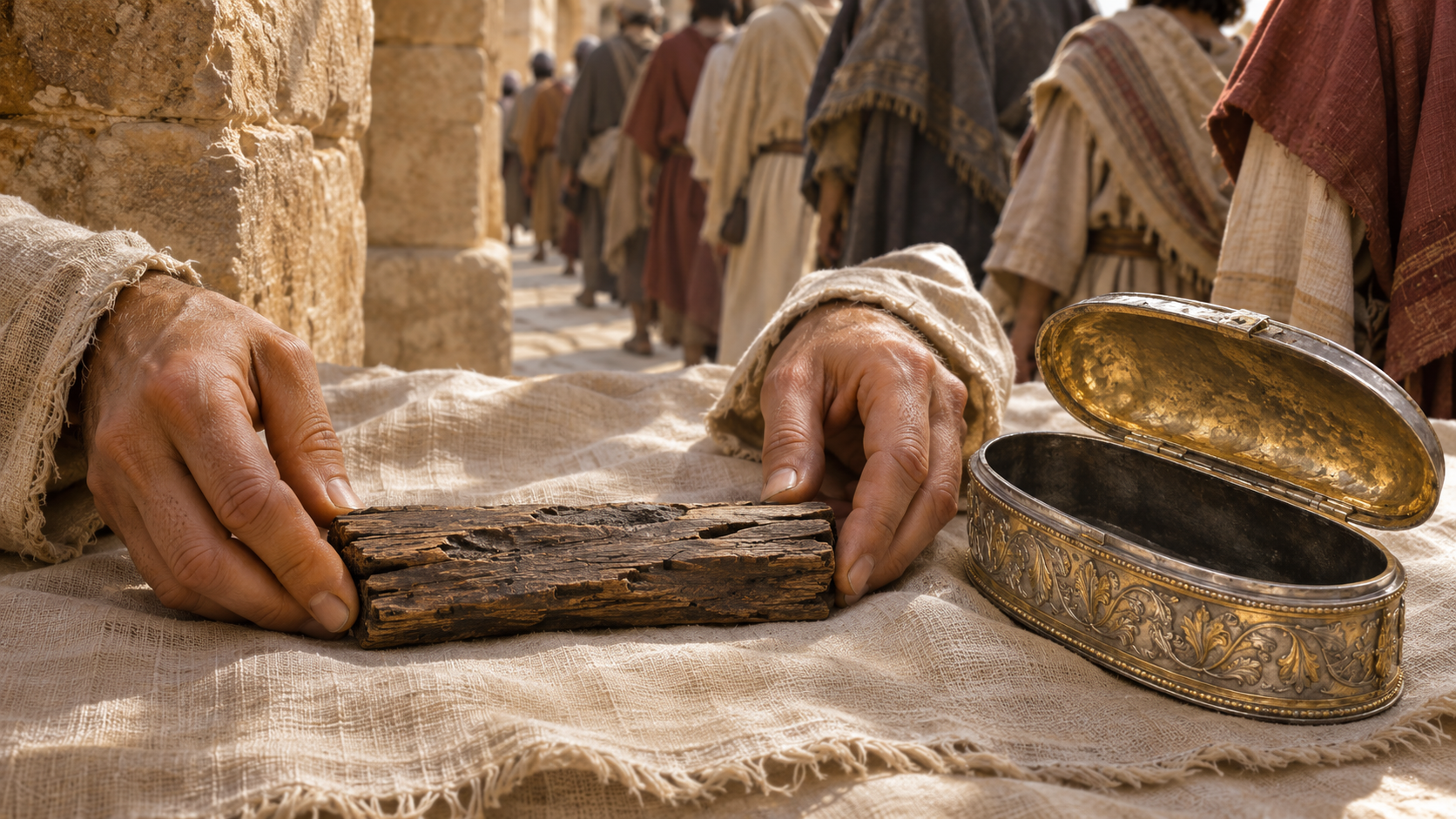
Egeria’s account takes us back to Jerusalem and closer to an event the writer could observe. The bishop sat in a chair. A table covered with linen stood before him. A silver-gilt casket was brought out and opened. The wood and an inscription were placed on the table. The bishop held the ends of the wood while deacons stood around him.
The worshippers came forward one at a time. Egeria describes a sequence of movements involving the forehead, eyes and lips. For a reader accustomed to seeing precious objects behind museum glass, it is worth pausing over the physical closeness. The purpose of opening the casket was to let people approach. The bishop’s hands made that encounter possible while keeping the wood in place.
Then comes the bite. Egeria is careful about how she knows of it. Someone told her the story. She could describe the arrangements in front of her in detail, but the loss of a fragment belonged to an earlier occasion. Reporting that a pilgrim heard this explanation is more accurate, and more interesting, than treating her as a witness to a theft. We are overhearing the kind of story a visitor to Jerusalem might be told while learning the local customs.
It also explains why a small piece of missing wood could matter so much. A pilgrim could take home memories of the service or describe it to friends. A fragment offered the prospect of carrying something of Golgotha itself across the threshold of a distant church or home. The same conviction that brought people to the table gave the deacons a reason to guard it.
Where Did Fragments of the True Cross Come From?
Once pieces were circulating, each acquired a history of its own. One might pass as a gift between churches. Another might be enclosed in a reliquary whose maker, donor or date could be identified. An inscription might record who gave a fragment to a monastery. Such evidence can establish that a particular community possessed and honoured an object at a particular time.
Consider what a dated gift inscription could actually prove. If it records that a donor gave wood of the cross to a church, it may be excellent evidence for the gift. It may also establish what both parties believed they were exchanging. To trace the wood another century backwards, a historian needs something more. The donor’s confidence cannot supply the name of a previous owner whom nobody recorded.
There are therefore two histories worth recovering when a church preserves a fragment. One follows the surviving wood, its container and the people who handled it. The other follows the claim made for it. Sometimes both can be traced through the same documents for hundreds of years. The point at which those documents run out is different for every relic. A beautifully documented medieval gift can still leave the centuries between Jerusalem under Pilate and Jerusalem under Constantine entirely open.
Can Science Authenticate Wood From Jesus’ Cross?
Imagine that a church allowed a laboratory to sample a fragment. The most revealing result might be one that placed the growth of the wood well after the first century. Provided the sample belonged to the claimed relic itself, and the analysis accounted for contamination, that result could rule it out as timber used at Jesus’ execution.
A date compatible with the first century would be harder to interpret. Radiocarbon analysis estimates when the sampled material grew. A tree can live for many years. Timber can be stored or reused. Even if a laboratory could establish exactly when the tree was felled, a date would still leave unanswered what a carpenter made from it, where it was taken and whose execution it served.
There are narrower questions that physical examination might answer particularly well. Two churches might hold pieces said to have been divided from the same larger fragment. If their broken surfaces fitted together, that would provide striking evidence of a shared object. It could help reconstruct an episode in the relic’s travels. The next question would concern that larger piece and how its custodians came to identify it.
What would most change the history is evidence connecting one stage to the next. An early, securely dated account naming a custodian and describing a transfer would do something a laboratory date alone cannot. Even then, historians would want to know how the writer obtained that information and whether the object in the account could be connected to one that survived.
The last person we can picture holding the wood with any confidence is therefore also one of the earliest. A bishop sits at a linen-covered table in Jerusalem. He steadies the ends while a pilgrim bends to kiss it. Egeria lets us recover the position of his hands. The name of the person who first lifted the timber after Jesus’ death is lost to us.
Sources
The Gospel of John, Chapter 19 — The Crucifixion and Burial
Eusebius, Life of Constantine, Book III — Jerusalem, Helena and the Imperial Churches
Cyril of Jerusalem, Catechetical Lecture IV — The Wood of the Cross
Egeria, The Pilgrimage of Etheria — The Good Friday Service at Jerusalem
Next Reads
Which Parts of the Bible Has Archaeology Confirmed? The Kings, Sieges and Relics Behind the Stories
What a Crucifixion Nail Found in Britain Reveals About Roman Executions
