

What If Britain Made Peace With Hitler And Helped Rewrite The World In Darkness?
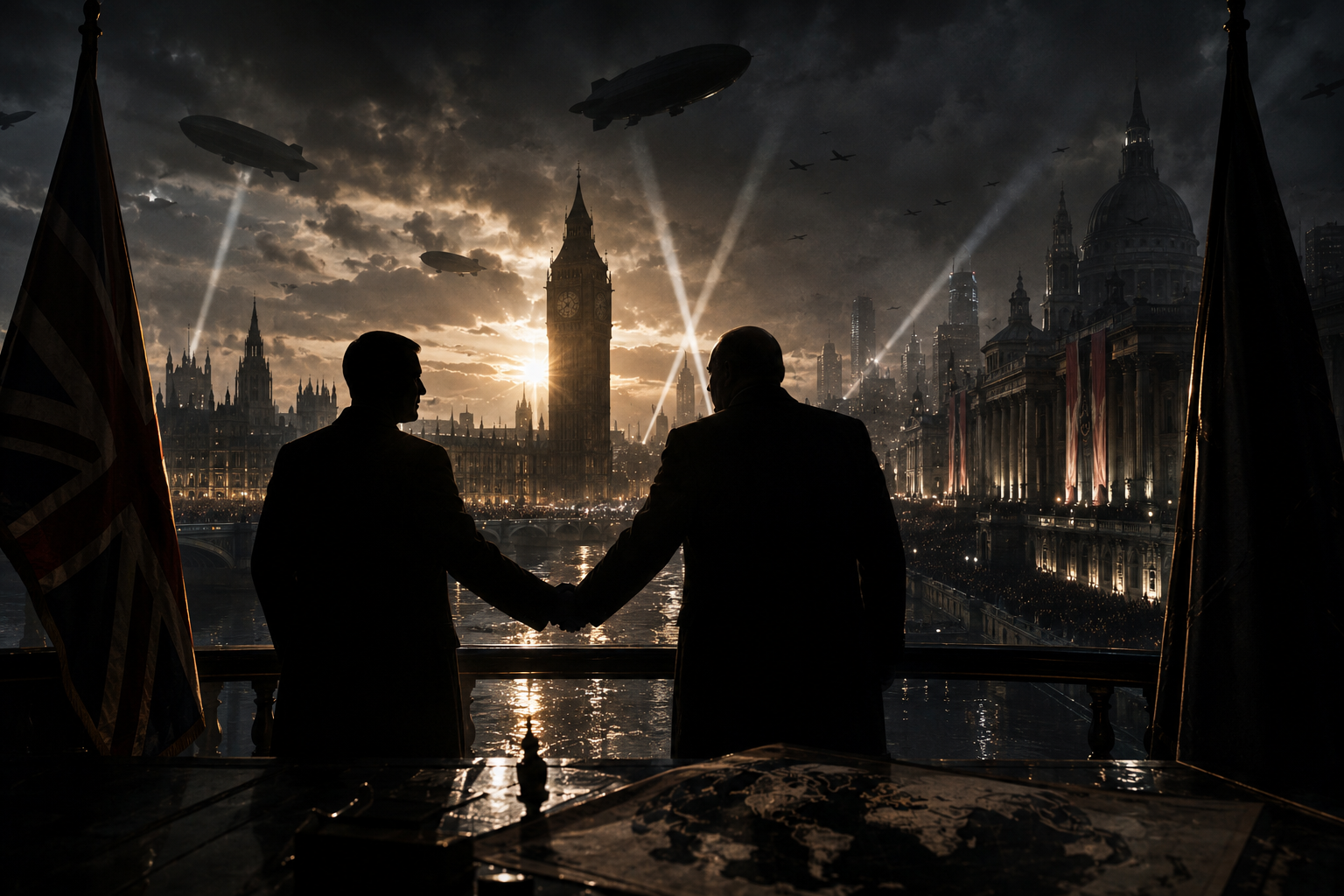
What If Britain And Nazi Germany Became Allies During World War II?
The British-German Pact That Could Have Saved The Empire And Shattered Britain’s Soul
The Week Britain Nearly Changed History
In May 1940, Britain was not standing on a marble pedestal of destiny. It was cornered, frightened, underarmed, and watching the map of Europe collapse at a speed that made every previous strategic assumption look childish. Germany had broken through France. The British Expeditionary Force was trapped around Dunkirk. The continent was falling into Hitler’s hands.
The familiar version of the story remembers Winston Churchill as the man who saw clearly while others blinked. That is broadly true, but it can also become too comforting. Britain’s decision to fight on was not automatic. It was fought for inside government, under military disaster, political pressure, and the terrible knowledge that Britain might soon be alone.
The darkest realistic alternate history does not begin with Britain becoming Nazi. It begins with something colder and more plausible: respectable British statesmen deciding that the empire, the fleet, and the island’s independence mattered more than the liberation of Europe. It begins with Britain choosing survival over defiance.
That is the hinge. Not a fantasy coup. Not a natural alliance. Not a clean peace. A negotiated settlement between Britain and Nazi Germany would have been morally contaminated from the first hour because it would have saved Britain by abandoning the people Hitler had already conquered and the people he was still preparing to destroy.
The Impossible Choice
Britain’s position in late May 1940 was catastrophic. France was collapsing. German armor had split the Allied front. British troops were being driven toward the Channel. The evacuation from Dunkirk had begun, but nobody yet knew whether it would become a miracle or the prelude to national ruin.
The British Army might be rescued, but much of its equipment would be lost. The Royal Navy still ruled the seas, but it could not retake Europe by itself. The RAF might defend British skies, but if Germany gained air superiority, invasion no longer looked like propaganda. America was sympathetic, but not yet committed. The Soviet Union was bound to Germany by the Nazi-Soviet Pact. Britain was staring at the possibility of fighting a continental empire alone.
This is where the logic of peace becomes dangerous. Halifax and other cautious establishment figures did not need to admire Hitler to argue that Britain should test his terms. They only needed to say that a government had a duty to know whether the country could survive without gambling everything on future American intervention, imperial endurance, and aerial defense.
The choice was not between courage and cowardice as clean moral categories. It was between two types of risk. Fight on, and Britain might preserve its honor but lose its army, cities, empire, and independence. Negotiate, and Britain might preserve its physical power while poisoning the moral basis on which that power rested.
Halifax Wins
The most plausible point of divergence is the War Cabinet crisis of 27–28 May 1940. In the real timeline, Churchill held the line. In this alternate one, he fails to command enough support before the wider Cabinet and party machinery settle behind him. Neville Chamberlain remains more cautious. Halifax presses harder. The language of “exploring terms” becomes harder to reject while the army is trapped in France.
Halifax does not present negotiation as surrender. That would fail instantly. He presents it as reconnaissance. Britain, he argues, is not accepting Hitler’s terms by discovering them. Britain is not dishonoring itself by using Mussolini as a mediator. Britain is not abandoning Europe by preserving the one power still capable of resisting Germany at some later date.
Churchill sees the trap. He understands that asking for terms changes the psychology of the conflict. Once Britain signals that survival is negotiable, Hitler gains leverage before offering a single concession. Churchill warns that peace with Hitler would not be a shield, but a cage. Yet in this timeline, his argument is judged too dependent on miracles: American entry, successful air defense, imperial stamina, and German restraint elsewhere.
Churchill resigns after losing the decisive argument, or is forced into a position where resignation becomes inevitable. Halifax becomes prime minister directly despite the complications of being in the House of Lords, or more plausibly becomes the controlling figure behind a Commons-based national government. The public is told that Britain is exploring whether honorable terms exist. The word “peace” is used cautiously. The word “surrender” is denounced angrily.
That is how the door opens. Not with a fascist takeover. Not with cheering crowds. With frightened men in dark rooms calling catastrophe management realism.
Hitler’s Offer
Hitler’s offer is designed to split British morality from British interest. He does not need Britain to become Nazi. He needs Britain out of the European war. His deeper obsession lies east: land, food, racial empire, and the destruction of Bolshevism. If Britain can be neutralized while keeping its empire, Germany can dominate the continent and prepare for the Soviet war under far stronger conditions.
The German terms would likely be brutal in Europe and generous at sea. Britain recognizes German dominance on the continent. Britain ends the blockade. Britain stops supporting governments-in-exile and resistance activity. Britain accepts the new order in western and central Europe. Britain ceases offensive operations against Germany and restricts anti-German propaganda.
In return, Germany recognizes the British Empire. It does not demand the Royal Navy. It does not occupy British territory. It does not require German bases in Britain. It does not force Britain into the Axis. It offers assurances over France that sound stabilizing while leaving Germany in practical control. It promises that the conflict between Britain and Germany was unnecessary, artificial, and now over.
Britain refuses to concede the essentials of sovereign power. No surrender of the fleet. No German troops on British soil. No German bases in Ireland or the British Isles. No handover of Gibraltar, Malta, Suez, Singapore, or India. No formal ideological alignment with Nazism. No dissolution of Parliament. No domestic Nazi movement under German protection.
Germany accepts because it receives the central prize: strategic freedom. Britain’s blockade ends. The western air war does not develop in its familiar form. The British Isles do not become the future platform for American armies. No D-Day is built from southern England. No long bombing campaign grows into a sustained industrial threat. Hitler buys the silence of the one enemy he most wanted to remove before turning east.
Britain survives. Europe is abandoned.
Peace Without Honour
The settlement is sold to the public as an act of grim national preservation. Halifax tells Britain that the government has saved the island, the empire, the fleet, and the lives of another generation. The alternative, he says, was possible invasion, starvation, aerial destruction, and imperial collapse. The country has not surrendered. It has secured time.
Many Britons are disgusted. Many are relieved. Most are exhausted. That is why the scenario is plausible. A nation still haunted by the First World War, watching France collapse in weeks, might tolerate a settlement if it believed the alternative was national destruction. Public morality often sounds absolute after the danger has passed. Inside the danger, survival has a powerful voice.
There is no Battle of Britain in the way Britain remembers it. There is no Blitz as national baptism. There is no “finest hour” as the foundational myth of modern Britain. Churchill becomes not the victorious embodiment of defiance, but the leader of a wounded patriotic opposition. His speeches circulate as warnings from the path not taken.
The deal is not peace in the deeper sense. It is armed suspicion. Britain remains sovereign, armed, imperial, and humiliated. Germany remains ideological, expansionist, and contemptuous. The Channel becomes not a battlefield, but a cold diplomatic frontier between an island empire and a continental tyranny.
The British state survives physically. Its moral authority begins to bleed.
Europe Abandoned
The first victims of the settlement are the countries Britain can no longer pretend to defend. Poland is betrayed most brutally. Britain entered the war after Germany invaded Poland, but a 1940 settlement leaves Poland partitioned, occupied, and doomed to a deeper darkness. Polish pilots, soldiers, diplomats, and exiles who expected Britain to continue the fight find themselves stranded in a country that has made survival its policy.
France becomes a diminished state under German control. Vichy France may still emerge, but in this timeline it operates in a Europe where Britain has stopped being the offshore counterweight. There is less hope of Allied return. French resistance develops more slowly, under harsher conditions, with fewer external channels of support. Germany can extract more from France with less fear of a western front reopening.
Czechoslovakia remains erased as an independent strategic actor. Its industrial capacity, already absorbed into the German war machine, becomes even more secure. Belgium and the Netherlands are reorganized under German pressure. Norway and Denmark remain within Germany’s security system. Across Europe, the message is unmistakable: Britain has chosen the sea over the continent.
This is where the moral distinction becomes severe. Britain does not become Nazi. It does not need to. Its decision still gives Nazi Germany strategic permission to deepen continental domination. The crime is not ideological conversion. It is calculated abandonment.
The British defense would be simple: Britain could not save everyone. The historical verdict would be harsher: Britain saved itself by making everyone else easier to destroy.
Germany Turns East
Germany now turns east under stronger conditions. In the real war, Operation Barbarossa opened in June 1941 and became the central military catastrophe of Hitler’s empire. Germany achieved enormous early victories, captured millions, and drove deep into Soviet territory, but failed to destroy the Soviet state before logistics, distance, Soviet manpower, industrial relocation, winter, and ideological brutality turned the campaign into a war of exhaustion.
In this alternate timeline, Germany may invade the Soviet Union earlier, but not dramatically so. The idea that peace with Britain automatically enables a clean 1940 eastern war is too neat. Germany still needs to digest France, reposition forces, secure supply, prepare rail and road systems, and organize a campaign on an almost unimaginable scale. The more plausible outcome is a 1941 invasion launched under better conditions, perhaps earlier in the season and with greater confidence.
The German advantages are real. More aircraft are available. Fewer pilots have been lost over Britain. The western coastline is less pressured. German industry faces less immediate bombing. Resources are less divided. Diplomatically, Berlin can present the eastern war as a crusade against Bolshevism rather than one front in a global war of aggression.
But the structural problems remain. The Soviet Union is vast. German logistics are brittle. Roads are poor. Rail systems require conversion. Oil remains a constraint. The Wehrmacht is still less mechanized than its image suggests. Nazi racial ideology still produces terror, starvation policy, and mass murder, which harden resistance and make stable occupation almost impossible.
Peace with Britain makes Barbarossa more dangerous for Moscow. It does not make Nazi victory inevitable. Germany can win more territory and still fail to build a durable empire from it.
Britain And The Anti-Soviet Bargain
Britain does not instantly join the Axis. That would be politically impossible and strategically unnecessary. The early alignment is quieter and more British: formal neutrality, diplomatic cover, restricted intelligence sharing, commercial channels, and an official language that increasingly presents the Soviet Union as the greater long-term danger.
This is how the relationship shifts from settlement into collaboration without a formal alliance. Britain does not send divisions to fight under German command. It does not put the Union Jack beside the swastika in a crusade against Moscow. But it may reduce pressure on Germany’s western empire. It may allow trade routes that ease German shortages. It may limit exile activity. It may share selective intelligence on Soviet capabilities. It may treat Germany’s eastern war as a brutal but useful containment of communism.
The ideological glue is anti-communism, not Nazism. British imperial elites fear Bolshevism, revolution, and anti-colonial agitation. Germany frames its eastern campaign as the destruction of Soviet tyranny. Some British conservatives persuade themselves that Hitler, however vile, is bleeding the more durable threat. In India, the Middle East, and Asia, British officials worry less about German tanks than about nationalist uprisings and Soviet-backed subversion.
This is the coldest bargain in the scenario. Britain keeps its hands technically clean while Germany does the killing. The language is balance of power. The reality is complicity by strategic convenience.
The empire survives another day, but its moral accounts begin to rot.
America’s Betrayal Shock
Roosevelt’s problem becomes almost impossible. In the real war, Britain’s survival gave the United States a forward partner, a moral cause, and eventually an unsinkable aircraft carrier for the liberation of Europe. Lend-Lease was built around supporting nations already resisting Germany and Japan. The Anglo-American relationship became the core of the wartime order and then the postwar order.
In this alternate timeline, Roosevelt faces a Britain that has made terms with Hitler. He condemns the settlement, publicly or with carefully controlled diplomatic fury. American opinion fractures. Isolationists argue that Britain has proved Europe is not America’s war. Interventionists argue that Britain has betrayed democracy and left the United States facing a German-dominated continent alone.
Lend-Lease changes shape. Britain receives far less, or receives aid tied only to imperial defense against Japan rather than European war. The Soviet Union becomes a more awkward recipient. Roosevelt can still support Moscow after Germany invades it, but selling aid to Stalin without Britain as a fighting democratic ally is politically harder. The American public may accept anti-Japanese rearmament and hemispheric defense more easily than a massive commitment to save the Soviet Union from Germany.
America’s route into Europe becomes far less clear. Without Britain fighting, there is no natural staging ground for American air power, no buildup toward Normandy, no combined Anglo-American command structure, and no easy way to turn American industrial power into a continental campaign. The United States can become the arsenal of anti-German forces, but the arsenal needs a front.
Roosevelt’s fury would be real. His options would be narrower.
Japan’s Calculation
Japan’s decision becomes more complex, not simpler. In the real war, Japan attacked Pearl Harbor while also striking across Allied possessions in the Pacific and Southeast Asia. That attack brought the United States formally into the war, and the European and Pacific conflicts became fused into a single global struggle.
If Britain has made peace with Germany, Japan sees both opportunity and danger. The opportunity is obvious: Britain may be less willing to fight a major Asian war while protecting a morally compromised European settlement. The danger is that Britain, no longer fighting Germany, can concentrate more naval and imperial resources on Singapore, India, Malaya, Burma, and the Indian Ocean.
Japan still wants resources. The Dutch East Indies still matter. American sanctions still matter. China still bleeds Japanese power. The United States Pacific Fleet still matters. Pearl Harbor may still happen if Tokyo concludes that war with America is unavoidable. But Britain’s position changes the sequence and psychology of Japanese planning.
One plausible outcome is that Japan attacks Dutch and American positions while trying to avoid immediate war with Britain. Another is that Japan attacks British possessions anyway, gambling that London will not risk the empire in a full Pacific struggle. A third is that Britain, desperate to preserve imperial credibility after abandoning Europe, responds harder in Asia than it did historically.
Singapore becomes the test. If Britain has preserved more resources, Singapore may be better defended. But better defended does not mean invulnerable. Japanese operational skill, British complacency, regional nationalism, and the weakness of imperial assumptions remain serious. Britain may hold Singapore longer. It may still lose it.
A Britain that made peace with Hitler to save the empire might discover that the empire’s real executioner was not Germany. It was the exposure of imperial weakness.
The Holocaust Becomes Harder To Stop
This scenario must be morally blunt. A British-German settlement would almost certainly make the Holocaust harder to obstruct, harder to expose, and harder to answer. Nazi antisemitic policy had already escalated through persecution, forced emigration, occupation, and ghettoization. With the invasion of the Soviet Union and the later machinery of extermination, genocide became systematic mass murder across German-controlled Europe.
Britain’s continued war did not stop the Holocaust quickly in real history. That must be admitted. But British resistance mattered because it kept alive a coalition, an intelligence system, a propaganda counterweight, a refuge network, and eventually the military possibility of destroying Nazi Germany. In this alternate world, those pressure points weaken.
Refugee routes shrink. Governments-in-exile lose leverage. German control over western Europe becomes more secure. Resistance movements receive less support. The British press, constrained by the settlement, speaks more cautiously. Reports of mass killing emerge, but the government treats them as strategically inconvenient. The moral stain becomes permanent: Britain knows enough to suspect horror, but not enough, it tells itself, to reopen war.
This does not mean the Holocaust unfolds identically. A less pressured Germany may initially move with different timing. A stronger eastern campaign could produce even larger killing zones in Soviet territory. If Germany penetrates deeper into the Soviet Union, Jewish communities that historically survived behind Soviet lines may be trapped. If the Soviet state collapses in parts, the scale of murder could expand.
The most likely outcome is not a cleaner Holocaust. It is a more secure one. Britain’s silence would become one of the great indictments of modern history.
The Alliance Begins To Rot
The British-German alignment is unstable from the beginning because its foundations are lies. Germany does not truly respect British sovereignty. Britain does not truly trust German restraint. Hitler may admire aspects of empire, but Nazi ideology sees compromise as temporary and weakness as an invitation. A Britain that negotiated once can be pressured again.
The first cracks appear over occupied Europe. German brutality produces refugees, underground networks, and moral revulsion inside Britain. Churchillite opposition grows. Labour radicals, liberal intellectuals, parts of the Church, military figures, and imperial officers begin to argue that Britain has bought time at the price of national corruption. The government responds by calling them reckless. That only deepens the wound.
The second crack is naval. Germany cannot dominate Europe permanently while accepting indefinite British command of the seas. A continental empire eventually needs oceanic reach, colonial leverage, and trade security. Britain’s fleet is both a shield and a threat. The settlement preserved it, but Germany will increasingly seek limitations, port access, intelligence restrictions, or colonial concessions.
The third crack is America. Washington cannot tolerate a Europe permanently organized by Nazi Germany and quietly accommodated by Britain. Economic pressure increases. Diplomatic pressure grows. American rearmament accelerates. Canada, Australia, New Zealand, and South Africa face agonizing choices between imperial loyalty, democratic instinct, and American power.
The fourth crack is the Soviet war. If Germany struggles, Britain is pressured to help more openly. If Germany wins too much, Britain faces a continent dominated by a militarized racial empire with no eastern counterweight. Either outcome is dangerous. The settlement’s core promise — that Germany can be contained by giving it Europe — begins to look insane.
The Second War
The most realistic long-term outcome is that Britain eventually turns against Germany again. The question is not whether the settlement is stable. It is what finally breaks it.
One path is German overreach in the Middle East. Germany, seeking oil and leverage, pushes through the Balkans, the Caucasus, or pro-German Arab nationalist movements toward British imperial lifelines. Egypt, Iraq, Palestine, and the Gulf become flashpoints. Britain can tolerate German domination of Poland more easily than German pressure on Suez. That hypocrisy becomes strategically decisive.
Another path is genocide exposure. As evidence of mass murder becomes undeniable, domestic pressure inside Britain intensifies. The government that made peace in 1940 becomes morally radioactive. Churchill or a successor movement returns, promising to restore Britain’s honor. The second war begins not as noble prevention, but as delayed reckoning.
A third path is American coercion. If the United States enters war against Japan and then confronts German power indirectly, it may force Britain to choose. Access to American finance, oil, technology, and naval cooperation becomes too important. Britain’s empire cannot survive against American hostility. London begins drifting back toward Washington, and Berlin sees betrayal.
The second British-German war likely comes in the late 1940s or early 1950s. It is uglier than the real one in some ways because Germany has had longer to fortify Europe, exploit industry, develop rockets, and murder opposition. But Germany has also accumulated enemies, occupation costs, resistance movements, and ideological dysfunction. Nazi rule is good at conquest and terror. It is much worse at building legitimate, durable order.
The second war does not produce a clean D-Day myth. It produces blockade, air war, proxy uprisings, Mediterranean crises, colonial revolts, covert operations, and possibly early nuclear brinkmanship. Britain enters it with less moral authority and more strategic desperation.
The victory, if it comes, is colder. Nobody calls it Britain’s finest hour.
The Twentieth Century Rewritten
The missing Allied victory changes everything. There is no normal 1945 settlement. No familiar liberation of western Europe. No Marshall Plan as remembered. No NATO in its known form. No European Union emerging from Franco-German reconciliation under American protection. No United Nations with the same legitimacy. No clean American century built on the combined defeat of fascism and later containment of communism.
Instead, the twentieth century becomes a darker multipolar struggle. America rises, but later and with more suspicion toward Britain. Germany dominates Europe for a period, but pays for it through permanent militarization, occupation, insurgency, and strategic overstretch. The Soviet Union either survives in a battered reduced form east of the Urals, collapses into fragments, or endures as a militarized revenge state after losing vast western territories.
Britain’s empire survives longer in form, but worse in legitimacy. The argument for imperial rule after making peace with Hitler becomes grotesque. Colonized peoples do not forget that Britain abandoned Europe while demanding loyalty from India, Africa, the Caribbean, and Asia. Anti-colonial leaders use the settlement as proof that empire was never about liberty. It was about British interest wrapped in moral language.
India is the decisive case. Britain may try to delay independence by arguing that global instability requires imperial unity. But the moral authority of British rule is weaker, not stronger. If Britain cracks down harder, it radicalizes opposition. If it negotiates, it does so from a position of shame. Indian independence may be delayed, but it likely arrives angrier, more anti-British, and perhaps more geopolitically aligned against the old empire.
The British Empire surviving into the modern age becomes less a story of continuity than contamination. It lasts longer on paper, but the moral basis beneath it decays faster.
Britain Today
Britain in this timeline is not a defeated country. That is the unsettling part. It may still be wealthy, nuclear-armed, diplomatically experienced, and globally connected. London may remain a financial capital. The Royal Navy may still carry symbolic weight. The monarchy may survive. The English language may remain globally powerful.
But Britain’s identity is different. The national myth is not Dunkirk, the Blitz, Churchill, D-Day, and standing against tyranny. It is the Settlement: the decision that saved Britain and abandoned Europe. Every schoolchild learns it. Every election reopens it. Every foreign crisis triggers comparison. Britain becomes a country physically preserved but morally divided by its own survival strategy.
Churchill’s reputation becomes volcanic. To some, he is the prophet Britain ignored. To others, he is the reckless romantic who would have sacrificed the island for Europe. His speeches circulate underground during the settlement years and later become sacred texts for the restoration movement. If Britain eventually fights Germany again, Churchill becomes larger after failure than he was in real history after victory.
Germany depends on whether Nazi rule collapses in the second war. If it does, Germany is not rebuilt through the same postwar democratic miracle. It is occupied later, punished differently, and trusted less. European integration is weaker. Franco-German reconciliation is delayed by deeper collaboration, harsher occupation memories, and a longer Nazi shadow.
Russia is either broken or more militarized. If the Soviet Union survives, it does so with a memory of British betrayal and German extermination. If it collapses, Eurasia becomes a fractured zone of successor states, German client regimes, insurgencies, and American strategic experiments. Either way, the clean Cold War binary never forms.
America is powerful, but less romantically attached to Britain. China’s rise may come earlier or later depending on Japan’s war path, Soviet survival, and American Pacific strategy. India emerges with a harder anti-imperial tradition. The Middle East becomes more volatile because Britain’s imperial management is longer, more cynical, and more openly linked to oil and great-power rivalry.
Human rights law exists, but with weaker moral foundations. The Holocaust, exposed late and answered late, produces horror but also accusation. The question is not only how Germany did it. It is why Britain made the deal that helped Germany consolidate the space in which it happened.
Winners And Losers
The short-term winners are clear. Nazi Germany gains time, legitimacy, and freedom to turn east. British imperial elites preserve the fleet, the island, and the empire. Vichy France gains more room to survive as a German-managed state. Anti-communist factions across Europe and the British establishment gain influence. Japan may gain opportunity if Britain appears morally and strategically weakened.
The losers are even clearer. Poland is abandoned. France is diminished. Czechoslovakia remains swallowed. European Jews face a more secure Nazi order with fewer external pressures. The Soviet Union faces Germany without Britain as a full fighting ally. Liberal democracy loses its cleanest wartime story. America loses its direct European partner. Colonized peoples lose the illusion that British rhetoric about freedom applies universally.
The deepest loser is British moral authority. That sounds abstract, but it is not. Moral authority shapes alliances, legitimacy, postwar settlements, imperial decline, national memory, and the stories countries tell about why they deserve influence. Britain’s real twentieth-century identity was not built only on victory. It was built on the claim that when the central test came, Britain did not make the easy bargain.
In this alternate history, Britain makes the bargain. It survives the immediate crisis. It preserves the empire for a while. It avoids invasion, avoids the Blitz as remembered, and keeps the Royal Navy intact. On a narrow strategic ledger, Halifax can claim success.
But history is not a narrow ledger. Nations survive as stories as well as states.
Final Verdict
A British-German alignment during World War II could have saved Britain in the short term. It could have prevented invasion, preserved the fleet, protected the empire, and allowed London to avoid the worst immediate consequences of standing alone. It would not have required Britain to become Nazi. It would only have required Britain to accept German domination of Europe as the price of British survival.
In the medium term, Germany would have turned east under stronger conditions. The Soviet Union would have faced a more concentrated German war machine, fewer western distractions, and less British material and diplomatic support. But Nazi Germany’s deeper weaknesses would remain: logistics, racial ideology, occupation brutality, economic distortion, strategic arrogance, and Hitler’s inability to turn conquest into stable order.
In the long term, the alliance would rot because Nazi Germany could not be safely contained. A regime built on domination would eventually pressure Britain, threaten imperial lifelines, collide with America, deepen genocide, and make neutrality morally and strategically impossible. Britain would probably fight Germany again, but later, from a worse position, with dirtier hands and a weaker claim to leadership.
The British Empire might survive longer, but not better. It would become more morally compromised, more resented, and more obviously self-interested. The postwar world would be darker, colder, less liberal, and less institutionally coherent. NATO and the EU would either not exist or emerge in distorted, delayed forms from a more traumatic second European reckoning.
The final answer is therefore brutal. A British-German settlement may have saved Britain as a state, but it would have damaged the moral foundation of modern Britain. It may have given Germany a stronger chance against the Soviet Union, but not a stable path to permanent victory. It may have extended the British Empire, but only by making its eventual collapse more bitter.
Britain may have survived by making peace with Hitler. But it would have spent the rest of history asking what, exactly, had survived.
