What If China Discovered the Americas First? How a Different First Contact Could Have Rewritten World History
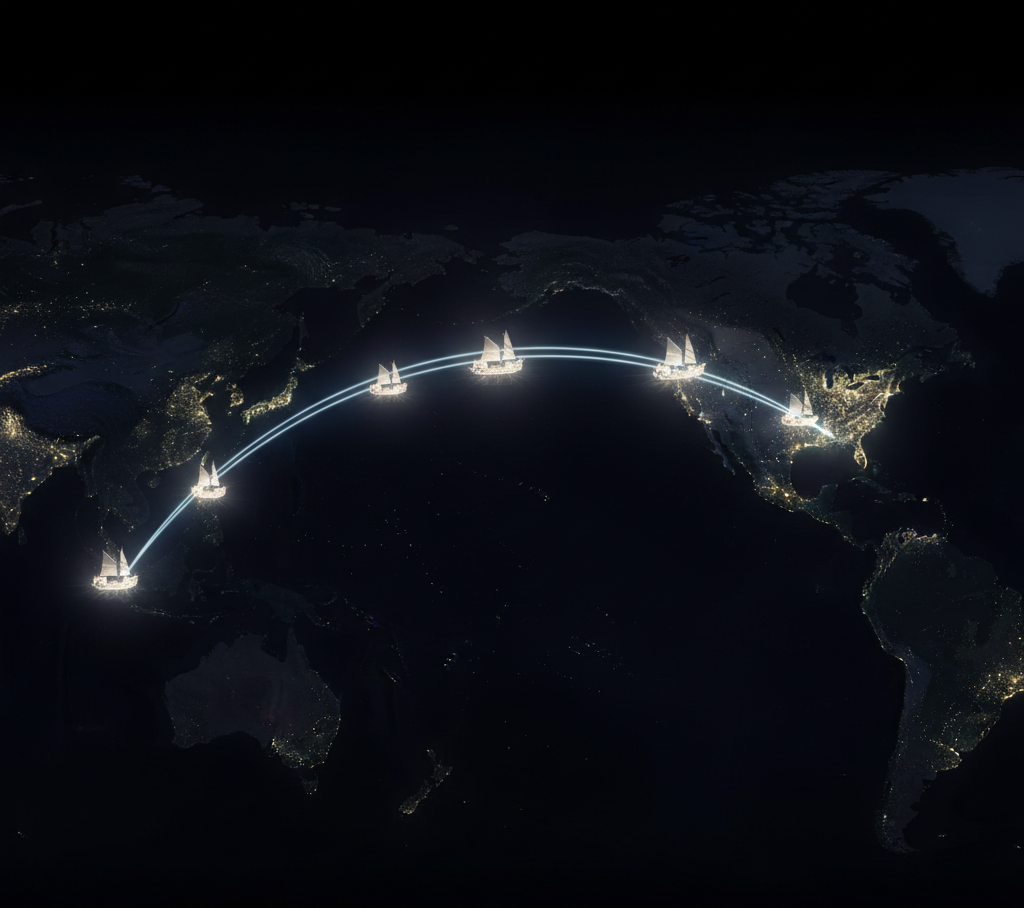
For a brief moment in the early fifteenth century, China had the largest, most advanced oceangoing fleet on Earth. Massive treasure ships sailed across the Indian Ocean, carrying porcelain, silk, and soldiers to ports from East Africa to Arabia. Then, almost as quickly as it had begun, this outward push stopped.
This “what if” asks a simple but explosive question: what if it had not stopped? What if Chinese explorers had crossed the Pacific and reached the Americas decades before Columbus? The answer reshapes everything from European empires and Christianity to the modern map of the Pacific and the balance of global power.
Thinking through this alternate timeline is not just a parlor game. It highlights how fragile real history was, and how much depended on a few court decisions in Beijing, a few storms on the open ocean, and a few judgments by officials who never imagined a whole new continent lay to their east.
By the end of this piece, you will have a clear picture of how an early Chinese presence in the Americas might have changed trade, technology, religion, and empire, and why those choices in the fifteenth century still echo in arguments about power in the Pacific today.
The story turns on whether China kept sailing long enough to meet the Americas before Europe did.
Key Points
A sustained Chinese blue-water program in the fifteenth century could plausibly have reached the Pacific coast of the Americas before Columbus sailed.
Early contact would likely have taken the form of tribute and trade outposts, not mass settler colonies, at least at first.
European powers arriving later might have faced stronger, better-armed American polities linked to Chinese trade and technology.
Christianity’s spread in the Americas could have been slower and more contested, with Buddhist, Confucian, and local traditions holding greater ground.
The Atlantic might have remained a secondary arena for longer, with the main axis of world trade running from East Asia to the American Pacific coast.
In the modern era, the Pacific could be an almost “Chinese lake,” with deep historical roots for Chinese influence from California to Chile.
Background
In the early 1400s, the Ming dynasty sponsored a series of vast maritime expeditions under the admiral Zheng He. His treasure fleets carried tens of thousands of men and hundreds of ships on each voyage. They reached as far as the Swahili Coast of Africa and the Red Sea.
These missions had several goals. They projected imperial prestige, secured tribute from foreign rulers, and controlled trade routes. But they were not designed as colonizing ventures. The court in Beijing saw the world in terms of a tributary system: distant states sent gifts and respect to China; China responded with titles, trade, and protection.
After a few decades, court politics shifted. Confucian officials argued that the expeditions were expensive, unnecessary, and morally suspect. The fleets were recalled. Shipyards were closed. Records were lost or destroyed. Chinese policy turned inward, focusing on defending land borders and managing internal affairs.
In Europe, the opposite pattern took shape. Smaller, more competitive states on the Atlantic coast poured resources into long-distance voyages. By the late fifteenth century, Columbus reached the Caribbean under the Spanish flag. Portuguese and Spanish empires spread across the Atlantic and into the Americas.
This divergence in strategy is the hinge of the counterfactual. If the Ming court had backed its naval program for another fifty to a hundred years, it is at least plausible that Chinese fleets, already able to cross the Indian Ocean, could have pushed north and east across the Pacific and made landfall in the Americas.
Analysis
Political and Geopolitical Dimensions
In this alternate timeline, the Ming dynasty chooses continuity over retrenchment. Court factions favor maritime strength, perhaps due to a stronger emperor, more supportive advisers, or greater perceived threats at sea. Shipyards keep working. Navigators push beyond known routes.
Chinese fleets probing the central and northern Pacific might first encounter island chains, then the west coast of the Americas. Likely landfalls include what is now Mexico, Central America, or the Pacific Northwest, depending on currents and winds. Early contact would be framed as a meeting between the Son of Heaven’s envoys and distant “barbarian” rulers.
Chinese envoys would seek tribute relationships, not direct rule. They might leave behind interpreters, craftsmen, and small garrisons to protect warehouses. In return, local leaders would receive silk, metal tools, gunpowder weapons, and recognition in Chinese records as loyal tributaries.
When European powers arrive later on the Atlantic side, they find a more complex scene. Some American polities now have access to ironworking techniques, better shipbuilding, and gunpowder. They may also be familiar with distant empires that expect tribute but not immediate cultural conversion.
Spain and Portugal would still seek gold, land, and souls. But they would now be competing with an established great power that has its own world order and its own view of legitimacy. Negotiations, proxy wars, and shifting alliances would follow. The Americas become the front line of a Eurasian rivalry centuries before the Cold War.
Economic and Market Impact
One of the biggest shifts in this scenario is the direction of world trade. In our timeline, silver from the Americas flowed first to Europe, then on to Asia in exchange for tea, porcelain, and silk. That gave European states leverage and capital to build global empires.
If China links directly to American mines and markets first, that flow changes. Chinese merchants and state agents could move silver, copper, and new crops directly across the Pacific to East Asia. The main artery of global commerce runs west–east across the Pacific rather than east–west across the Atlantic.
European powers arriving later would find that some of the most profitable ports are already oriented toward Chinese trade. They might still seize Caribbean islands and parts of the Atlantic coast, but their ability to dominate global bullion flows would be weaker. That could slow the rise of European financial hubs and naval supremacy.
For Indigenous societies, the economic impact cuts both ways. Early access to iron tools, textiles, and gunpowder could strengthen their states and agriculture. At the same time, it could intensify warfare, social stratification, and resource extraction. Some elites might lean into the new trade, consolidating power through control of Chinese goods and advisors.
Social and Cultural Fallout
Culture does not move as quickly as metal and gunpowder, but over generations the effects would be profound.
Chinese envoys and settlers would bring Confucian ideas about hierarchy and statecraft, as well as Buddhist and folk religious practices. Temples, shrines, and administrative compounds might rise in coastal American cities, blending with local architecture and beliefs.
Instead of the sharp religious conquest carried out by Spanish missionaries, there could be a slower, more layered fusion. Indigenous deities might be mapped onto Buddhist bodhisattvas or local spirits honored in Chinese folk practice. Written characters could be adopted for record-keeping by some American elites, creating hybrid literate cultures along the Pacific coast.
Christianity would still arrive with European ships. But it would no longer be the first world religion to make a sustained claim on American souls. Missionaries would face competition not only from resilient Indigenous beliefs but also from established Asian traditions that already have imperial backing.
Social hierarchies could also look different. Intermarriage between Chinese settlers and local populations might produce new mixed communities with their own identities. Racial categories familiar from later European empires might be weaker or at least more varied in regions where Chinese influence came first.
Technological and Security Implications
Technological exchange would start centuries earlier and on different terms. Indigenous American societies were already sophisticated in agriculture, astronomy, and urban planning. Add Chinese metallurgy, gunpowder, and navigation, and you get a faster fusion of capabilities.
By the time European fleets press harder into the Pacific and Atlantic coasts, they might face American states that can build oceangoing ships, cast cannon, and organize armies with drilled musket lines. The era of one-sided conquest could be shorter or fragmented into a patchwork of failed invasions, negotiated enclaves, and stalemates.
In the long term, the Pacific rim might host several industrializing centers earlier than in our world. Coastal cities in what is now Mexico, Peru, or California could become major shipbuilding and trade hubs under mixed Indigenous–Chinese leadership.
Security alliances would follow. Ming or later Chinese dynasties might sign defense pacts with American polities against European encroachment. The idea of an “Atlantic alliance” might never take the same shape. Instead, the defining security system of the modern world could be a Pacific-centered network dominated by China and its American partners.
What Most Coverage Misses
Most surface-level “China discovers America first” scenarios focus on flags and maps: whose banner flies over which harbor, which empire gets credit for first contact. That misses two quieter but crucial forces: disease and demography.
In our timeline, European contact unleashed catastrophic epidemics in the Americas. Smallpox, measles, and other diseases killed huge percentages of Indigenous populations who had no prior exposure. Military conquest became easier in societies hollowed out by loss and grief.
If contact came first via China, the disease pattern might be different, but it would not vanish. Eurasian diseases would still arrive, carried by sailors and settlers. The timing, route, and intensity of outbreaks might change, but American societies would still face a biological shock.
The key question is whether staggered contact from both sides of Eurasia spreads that shock over a longer period instead of concentrating it in a few brutal waves. If so, some states might adapt more effectively, maintaining more population and institutional continuity. That, in turn, makes it harder for any outside power, Chinese or European, to impose simple domination.
Another overlooked factor is language. If Chinese characters or adapted phonetic scripts become tools for Indigenous elites before widespread European arrival, they anchor a literate tradition that does not depend on European schooling. That could give later independence movements, constitutions, and national narratives a very different flavor.
Why This Matters
This alternate history speaks to the present because it touches on long-running debates about who gets to set the rules in the Pacific and the Americas.
If China had discovered and integrated parts of the Americas early, its claim to be a Pacific power would rest on centuries of direct engagement, not just modern trade and naval build-up. Arguments today about spheres of influence, maritime rights, and historical presence would play out on a very different record.
For Europe and its settler states, the story is also unsettling. Many modern institutions, from global finance to international law, grew out of a period when Atlantic empires held most of the leverage. A Pacific-first world would have produced different norms, boundaries, and precedents.
For the Americas themselves, the biggest change lies in agency. Instead of being the primary stage for European expansion, they become a crossroads between two great Eurasian centers of power. That could mean more room for local states to play powers off against each other, but also more complexity and more pressure.
Thinking through this scenario helps illuminate today’s real struggles over trade routes, digital infrastructure, and military bases across the Pacific. It reminds us that geography is fixed, but the stories great powers tell about their place in that geography are not.
Real-World Impact
Imagine a coastal city in what is now Mexico where a local ruler hosts both Chinese envoys and later Spanish captains. The ruler’s scribes keep dual records: one in a local script adapted from Chinese characters, another in an alphabet learned from European priests. Every treaty becomes a three-way negotiation.
Picture a farmer in the Andean highlands whose ancestors adopted Chinese metal tools generations before European arrival. Her community grows both traditional crops and new varieties brought from Asia. When European traders arrive with their own goods and demands, she engages from a position of relative strength rather than shock.
Think of a merchant in a Pacific port that has stood for centuries at the junction of American, Asian, and later European trade. His family speaks three or four languages, worships at shrines that blend traditions, and reads newspapers printed with a mix of characters and alphabetic scripts. His sense of what “global” means is very different from ours.
Or consider a sailor from a European power who signs on to a voyage around Cape Horn, only to find that the richest markets on the other side already use Chinese silver standards, Chinese measurements, and Chinese-style commercial codes. He is the outsider, learning the rules rather than writing them.
What If?
A world in which China discovered the Americas first does not erase Europe, nor does it create a simple Chinese colonial replacement. Instead, it produces a more crowded, contested early modern era in which American societies sit between rival centers of power rather than beneath a single dominant empire.
The core tension is clear. Does early Chinese contact give Indigenous states enough tools and time to shape their own paths, or does it simply substitute one external hierarchy for another? At the same time, does a weaker Atlantic system slow the rise of European global dominance, or does it only delay it?
The fork in the road lies in a few choices made in Ming palaces and shipyards: fund the fleets or scrap them, look inward or outward, cross one more horizon or turn back. The signs that would show which way this alternate story was breaking are familiar ones even today: budget lines for exploration, elite arguments over priorities, and a willingness to risk short-term cost for long-term reach.
History took one path. Thinking seriously about this other one helps clarify how narrow that path was—and how much power still lies in decisions about where to sail next.
