What If Julius Caesar Wasn’t Assassinated?
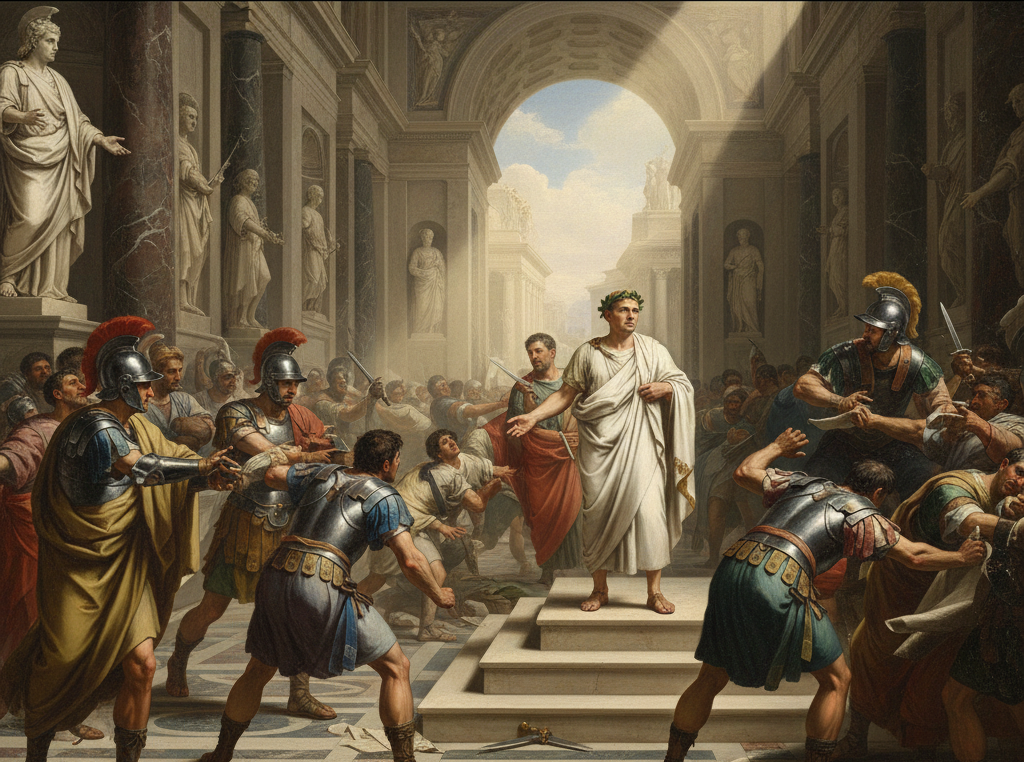
In this alternate timeline, Julius Caesar wasn’t assassinated on the Ides of March. The knives never found him, or the plot failed. And one of history’s most famous “turning points” becomes something else: a near miss that forces Rome to choose between reform, repression, and another round of civil war.
Why does that matter right now? Because Caesar’s death didn’t restore the Republic. It accelerated its collapse, unleashed a new cycle of violence, and cleared the stage for an emperor. If Julius Caesar wasn’t assassinated, the question is not whether Rome avoids empire. It’s which kind of empire arrives, how quickly, and at what cost.
This piece maps the most plausible paths if Caesar lives: what he likely does next, what his enemies and allies do in response, and how the wider Mediterranean world shifts. It also lays out the risks that remain even with Caesar alive, especially the one problem no strongman can dodge forever.
The story turns on whether Caesar could solve succession without restarting civil war.
Key Points
If Julius Caesar wasn’t assassinated, Rome likely sees a faster move toward one-man rule, not a return to the old Republic.
Caesar’s next steps probably include tightening personal security, reshaping the Senate further, and managing rivals like Mark Antony with less tolerance than before.
A major wildcard is Caesar’s planned eastern war, which could have made him untouchable through victory, or exposed him to defeat, mutiny, or assassination on campaign.
The biggest structural problem remains succession: who inherits authority, and whether the army accepts that choice without splitting.
The famous post-assassination bloodletting and mass purges might be reduced or delayed, but elite resistance would not vanish; it would adapt.
The long-term result could still be an empire, but with different founding myths, different borders, and a different first “emperor” figure.
Background
By early 44 BC, Caesar had won a brutal series of civil wars and stood at the center of Roman politics. He held extraordinary powers, had expanded and reshaped the Senate, and pushed reforms across finance, colonization, and administration. He also accumulated symbols that alarmed many elites, who feared monarchy in all but name.
The assassination in March 44 BC removed the man but not the system that produced him: a Republic hollowed out by factional violence, patronage, and armies loyal to commanders more than institutions. In actual history, the result was more civil war, the rise of the Second Triumvirate, and eventually the ascent of Octavian as Augustus.
Remove the assassination, and Rome still faces the same reality: Caesar has concentrated power, his opponents fear permanent loss, and the legions remain the ultimate political fact on the ground. The difference is that Rome has to negotiate that reality with Caesar alive, present, and able to act.
Analysis
Political and Geopolitical Dimensions
If Julius Caesar wasn’t assassinated, the immediate political temperature rises, not falls. A failed plot is proof that elite opposition is real, organized, and willing to kill. Caesar’s likely response is a mix of intimidation and theater: arrests, public trials, and a hard lesson delivered to deter copycats. His earlier reputation for clemency might survive in rhetoric, but his incentives change. Mercy looks like weakness when the next blade could come tomorrow.
That shift matters because it would reshape the internal balance among Caesar’s allies. Mark Antony, already powerful, becomes either a trusted enforcer or an obvious threat. If Caesar feels secure, he might clip Antony’s wings by moving him to a military command away from Rome. If he feels vulnerable, he might rely on Antony more, which risks creating a second center of gravity.
Beyond Rome, a living Caesar likely presses outward. He had reasons to seek a major eastern campaign: prestige, security for Rome’s provinces, and the lure of finishing what earlier Roman generals failed to do. A successful campaign would strengthen his claim that stability requires him. A stalled or bloody campaign would do the opposite, giving rivals a narrative: Caesar is reckless, aging, and gambling Rome’s future for personal glory.
Economic and Market Impact
Rome’s economy in this era is not a modern market, but it does have confidence, credit, supply lines, and investor-like behavior among elites. Caesar’s survival could reduce one kind of volatility: sudden leadership vacuum. Grain shipments still need to arrive, tax systems still need to function, and veterans still expect land and pay.
If Caesar remains in control, he can keep pushing administrative reforms that improve predictability: clearer provincial governance, standardized timekeeping, and a more orderly settlement of veterans. That tends to calm the most destabilizing economic pressure points, especially around land distribution and debt disputes.
But there is a second kind of volatility that could intensify: elite capital flight into political conspiracy. Senators and equestrians who feel threatened will protect themselves. They will hoard, shift assets, and build private networks of protection. In practical terms, that means more money spent on influence and security, and less on civic stability. Caesar alive does not remove Rome’s deep inequality. It changes who feels unsafe, and when.
Social and Cultural Fallout
Caesar living past the Ides of March changes the emotional story Rome tells itself. In actual history, his death becomes a rallying symbol and a justification for revenge. In this timeline, Caesar’s survival becomes a warning and a mandate: the state cannot rely on norms, because norms failed to protect its leader.
That cultural shift could speed up the normalization of personal rule. Public life becomes less about offices and more about proximity to one man. Honors, festivals, statues, and public messaging would likely intensify, because survival feeds myth. A leader who escapes death looks favored by fate, and Rome was highly fluent in reading politics through omens and symbolism.
At the same time, the opposition’s identity changes. Instead of being “liberators” who struck a final blow, they become “failed conspirators,” forced underground. That pushes resistance into quieter forms: patronage wars, whisper campaigns, and attempts to split the army’s loyalty rather than win open votes in the Senate.
Technological and Security Implications
“Technology” here is administrative and military capacity: logistics, intelligence, communications, and the tools of control. If Caesar isn’t assassinated, the most likely institutional innovation is earlier, more formal personal protection. Rome eventually develops elite guard structures around imperial power. A Caesar who survives an attempt on his life has every reason to accelerate that development.
Security tightening does not only mean guards. It means surveillance of networks: who meets whom, who funds whom, who can mobilize crowds, who can sway legions. The Republic’s old political style depends on public speech and bargaining among peers. A threatened Caesar shifts Rome toward a more managed politics, where private fear replaces public persuasion.
What Most Coverage Misses
Most counterfactuals fixate on whether Caesar becomes “king.” That’s the surface drama. The deeper issue is that Rome’s old system was already breaking because it could not manage scale: too many provinces, too much money, too many armies, and too many careers built on conquest.
Caesar’s survival does not solve the contradiction between a city-state constitution and a Mediterranean empire. It simply postpones the moment when someone has to rewrite the rules openly.
And that returns the whole question to succession. The real danger is not Caesar ruling. It is Caesar dying later, without a clear, widely accepted transfer of authority. That is when Rome is most likely to tear itself apart.
Why This Matters
In the short term, if Julius Caesar wasn’t assassinated, Rome could see less immediate chaos in Italy and fewer rapid-fire shifts in leadership. That likely means steadier grain supply, fewer street clashes in the capital, and a more controlled political environment.
In the long term, the stakes are larger: what kind of imperial system takes root, and what its founding violence looks like. Rome’s later empire shapes law, governance, language spread, urban development, and the basic mental map of Europe and the Mediterranean. Change the founding sequence, and you can change which families dominate, which provinces gain favor, and which frontiers harden first.
Concrete events to watch in this scenario are simple and ruthless: whether Caesar leaves Italy on campaign, whether he names a clear heir while alive, and whether the legions swear loyalty to that choice as a matter of routine rather than fear.
Real-World Impact
A grain merchant in Ostia notices the change first. Fewer rumors of imminent collapse means fewer panic price spikes. But tighter security also means tighter control of docks and permits, and profits shift toward those closest to Caesar’s administrators.
A veteran settler in southern Italy benefits from continuity. Land grants arrive with less delay, and disputes are settled by officials who know Caesar expects results. Yet that same speed breeds resentment among locals pushed off land they once worked.
A provincial tax contractor in Asia Minor sees a different risk. Stability in Rome makes revenue collection easier, but it also makes oversight sharper. The old gray zones shrink, and fortunes depend more on being in favor than being clever.
A junior senator in Rome feels the new ceiling. Career advancement becomes less about public debate and more about personal alignment. He learns to watch his words, choose his dinners carefully, and keep his clients from looking too enthusiastic about “the old days.”
What If?
If Julius Caesar wasn’t assassinated, the Republic is not magically saved. The more plausible outcome is a smoother, earlier slide into personal rule, with fewer sudden lurches and a colder, more controlled politics.
The fork in the road is not “Republic versus empire.” It is whether Caesar can turn a violent, personality-driven system into something that transfers power predictably, or whether he merely delays the inevitable explosion until his eventual exit.
The signs that reveal the direction are practical: a named successor with real authority, an army that treats that succession as normal, and a Senate that becomes an administrative body rather than a battlefield. If those pieces do not lock into place, Caesar surviving the Ides only changes the timing of the storm, not its arrival.
