What Made Joseph Goebbels So Dangerous
Why Joseph Goebbels Was So Good at Propaganda
Why Joseph Goebbels Was So Effective at Propaganda — and So Loyal to Hitler
The name is Joseph Goebbels, not “Gorbels,” and the reason he still matters is simple: he was not just a liar with a microphone. He was one of history’s most effective political communicators because he understood something deeper. Propaganda works best when it does not feel like propaganda. It feels like belonging, grievance, identity, emotion, rhythm, repetition, and moral permission. Goebbels did not invent those forces, but he weaponized them with unusual discipline inside one of the most murderous regimes in modern history.
He was effective because he operated at the junction of message, medium, and state power. He had Hitler’s trust, control over huge parts of Germany’s cultural machinery, and a fanatical belief in the Nazi worldview. That combination matters. Plenty of people can write slogans. Far fewer can align newspapers, radio, film, rallies, schools, censorship, and political terror into one emotional system. Goebbels helped do exactly that.
He was loyal for a related reason. His loyalty was not merely careerism, though ambition mattered. It was ideological devotion, personal dependence, and near-religious attachment to Hitler as leader, symbol, and destiny. He remained what the Holocaust Museum calls an unconditional follower of Hitler to the end, including in Berlin in 1945, when collapse was obvious.
The story turns on whether Goebbels was mainly a master manipulator or something more dangerous: a true believer who turned modern media into an engine of emotional capture.
Key Points
Goebbels was powerful because he fused persuasion with censorship, state control, and mass spectacle rather than relying on words alone.
He understood that propaganda is strongest when it simplifies reality into a few emotional binaries: victim and enemy, humiliation and restoration, chaos and order.
His success depended on media control, especially radio, the press, film, and public ritual, all coordinated through Nazi institutions after 1933.
He was loyal because he was both ideologically committed and personally bound to Hitler, whom he treated as the center of political meaning.
Goebbels was not omnipotent. His propaganda worked best when backed by fear, censorship, conformity, and military momentum. It was never just “effective messaging.”
Since Goebbels, other regimes have built propaganda systems as strong or stronger in scale, but few individual propagandists have matched his combination of theatrical instinct, media fluency, and direct access to a totalitarian state.
He Knew That Politics Is Theater Before Many Rivals Did
Goebbels was born in 1897, was highly educated, earned a doctorate, and moved into politics during the instability of Weimar Germany. That matters because he did not come into the Nazi movement as a simple street thug. He came as a frustrated intellectual, a gifted polemicist, and someone who understood modern urban mass politics. Britannica notes that he became one of Hitler’s key lieutenants and that he was central to shaping Nazi myths, rituals, and public support.
His real strength was not that he told lies better than everyone else. It was that he understood audiences. He grasped resentment, spectacle, repetition, simplification, and timing. Germany was politically fragmented, economically scarred, and psychologically bruised during the late Weimar years. Goebbels saw that people were not waiting for long policy white papers. They were waiting for certainty, identity, and someone to blame. Nazi propaganda gave them all three.
That is why he was so dangerous. He treated politics as a stage-managed emotional experience. He made the Nazi movement feel energetic, modern, disciplined, and inevitable. The party newspaper he led in Berlin was called Der Angriff, or The Attack, which tells you a lot about the style: aggressive, relentless, polarizing, and always on the front foot.
Why His Propaganda Worked
The simplest answer is that Goebbels reduced complexity into emotionally satisfying stories. Germany had not lost World War I because of military failure, in this telling, but because it had been betrayed. Economic pain was not the result of a web of structural causes but the work of enemies. Political pluralism was not a normal democratic argument but weakness and decay. Hitler was not one politician among many but the embodiment of national recovery.
That style works because it gives people cognitive relief. Complex reality is exhausting. Moral theater is easier. Goebbels understood that modern propaganda does not need to prove everything. It needs to create a framework in which facts are filtered before they even arrive. Once people accept the emotional script, new events are interpreted through it. Economic hardship becomes sabotage. Criticism becomes treason. Violence becomes self-defense.
He also knew that propaganda cannot live on one note. It has to shift between hope and fear. The Nazis glorified Hitler, promised rebirth, staged enormous rallies, and sold a vision of community and restored power. At the same time, they constantly defined enemies: Jews, Communists, dissidents, avant-garde artists, independent journalists, and anyone labeled “un-German.” Propaganda was not just about inspiration. It was about permission to exclude, humiliate, and eventually destroy.
The Media Machine He Helped Build
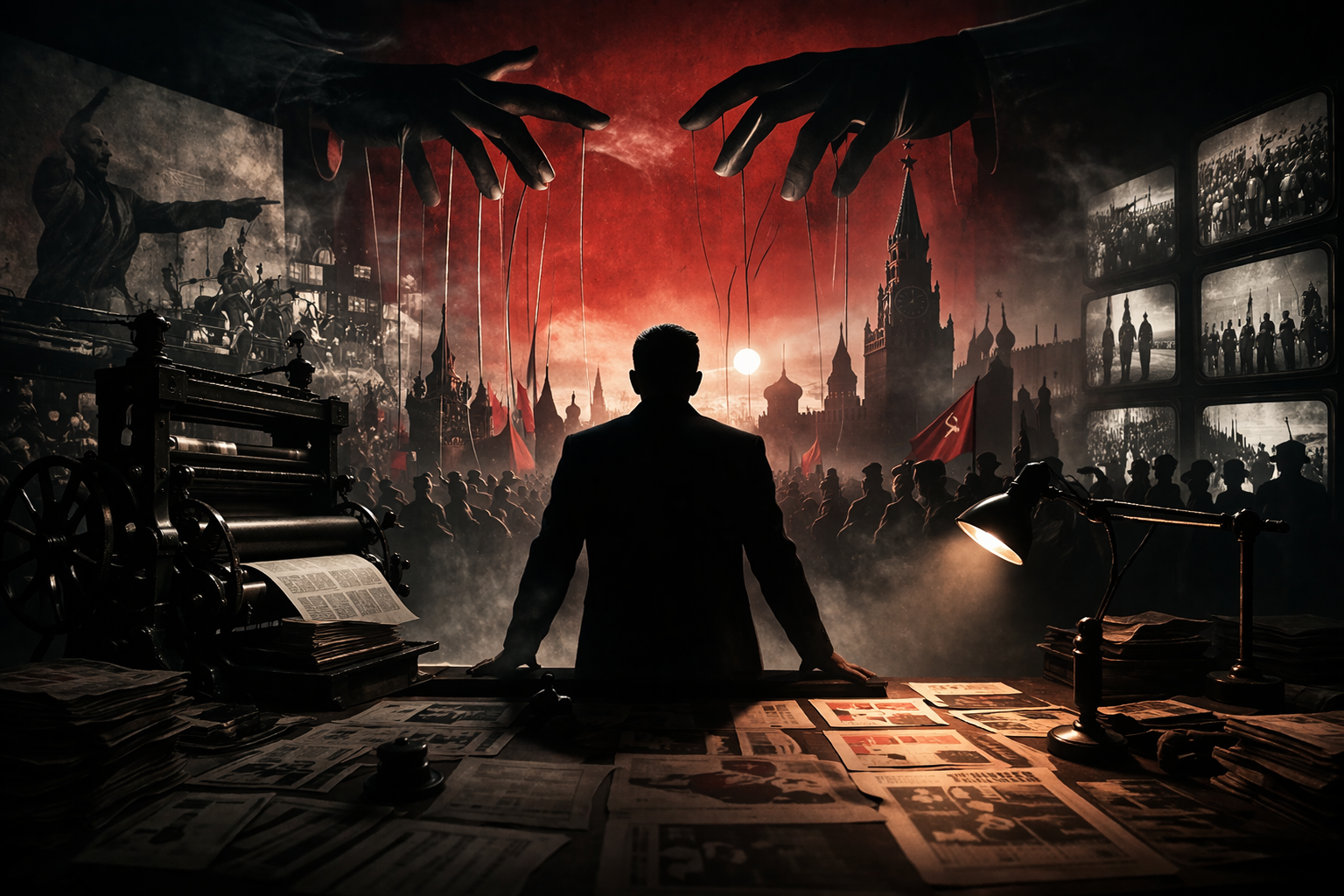
Goebbels became Reich Minister for Public Enlightenment and Propaganda in 1933. From there, he operated inside a regime that did not merely compete in the marketplace of ideas. It crushed the marketplace. The Propaganda Ministry aimed to coordinate art, music, theater, film, books, radio, educational materials, and the press. The breadth of Nazi propaganda was its main objective. Nazi propaganda was not a poster campaign. It was an attempt to shape the entire information environment.
Radio was especially important. The regime promoted cheap receivers so broadcasts could reach ordinary homes, making the leader’s voice and the state narrative harder to escape. The United States Holocaust Memorial Museum describes how the “People’s Receiver” helped carry Nazi propaganda directly into German households.
The press was brought into line as well. The Nazis destroyed Germany’s diverse newspaper culture, seized political opponents’ printing infrastructure, and issued daily instructions on how news should be reported. That is a crucial detail. Goebbels did not simply flood the zone with content. He narrowed the range of what could be said, then repeated the official frame until it felt normal.
Culture mattered too. The Reich Chamber of Culture oversaw artistic life, while campaigns against so-called degenerate art helped stigmatize dissenting aesthetics and force conformity. In 1937, Goebbels helped organize the confiscation and exhibition of art the regime deemed unacceptable. This shows how seriously the Nazis took culture. They understood that control of taste, beauty, and status could reinforce political control.
Film and spectacle completed the circuit. Nazi rallies, newsreels, and cinema did not just distribute information. They created awe. Such events mattered because awe weakens skepticism. When politics becomes pageantry, criticism can start to feel lonely, small, even absurd. Goebbels was adept at creating that atmosphere.
What Most Coverage Misses
What most coverage misses is that Goebbels was not merely adept at persuasion. He was adept at environment design. That is the sharper way to understand him. He helped build a system in which competing voices were suppressed, official cues were repeated across platforms, and social pressure did the rest.
That changes the question. Asking why he was “so adept at propaganda” can make it sound as if he won by rhetoric alone. He did not. He won because rhetoric, censorship, intimidation, institutional capture, and spectacle reinforced one another. His genius, if that word is used at all, was organizational and psychological as much as verbal.
The second missed point is that some of his wartime propaganda did not depend on obvious fantasy. Britannica notes that after major German defeats, he sometimes avoided outright denial and instead tried to maintain morale through hope, historical parallels, and emotional reframing. That is a more sophisticated model than simple lying. It is a selective truth arranged to serve false meaning.
Why He Was So Loyal to Hitler
Goebbels’ loyalty came from several layers working together. The first was ideology. He was a radical antisemite and a committed Nazi long before the end. This was not a case of a basically normal official getting trapped in a dangerous job. He believed in the movement’s core hatreds and ambitions.
The second layer was personal identification with Hitler. Hitler offered Goebbels something he craved: political meaning, status, proximity to power, and a grand stage for his talents. In return, Goebbels helped construct the Führer cult, making Hitler appear superhuman, indispensable, and above ordinary politics. That sort of relationship becomes circular. The propagandist glorifies the leader, then becomes emotionally dependent on the myth he helped build.
The third layer was career fusion. Goebbels did not merely work for Hitler. His identity, legacy, family position, and public purpose all became bound up with Hitler’s fate. By 1945, there was no clean exit. Britannica notes that Hitler named him chancellor in his political testament, and Goebbels stayed in Berlin to the end. One day after Hitler’s suicide, Joseph and Magda Goebbels killed their six children and then themselves. Loyalty in that final phase was fanatical and nihilistic.
There is also a colder explanation. People who help create totalizing myths often become prisoners of them. If Hitler was Germany, if Germany was destiny, and if defeat meant civilizational ruin, then loyalty could be framed as moral necessity even amid obvious disaster. Goebbels was not just serving a leader. He was living inside an apocalyptic story he had spent years helping to write.
Was He Really Better Than Everyone Else?
Among individual propagandists, he belongs near the top tier of the modern age. Not because he was more original than every rival, but because he combined several rare qualities at once: ideological conviction, verbal aggression, media instinct, administrative reach, and direct access to a totalitarian state. That is a potent mix.
But it is worth being careful. Goebbels worked under unusually favorable conditions for propaganda. He had censorship, terror, a charismatic leader, a mass party, and later a wartime emergency. Those conditions amplified his effectiveness. A brilliant propagandist in an open pluralist system has more resistance to overcome than a very good propagandist inside a dictatorship.
So the right answer is this: yes, he was exceptionally effective, but not in isolation. He was effective because his talents were embedded in a regime built to reward emotional simplification, destroy rivals, and saturate daily life with one worldview.
Are there any as good since?
If the question is whether any later regime built propaganda systems as formidable, the answer is yes. Stalin’s Soviet Union built a vast leader cult, and Mao’s China drove a personality cult to extraordinary intensity during the Cultural Revolution. Britannica describes the Stalin cult and Mao’s personality cult in stark terms, including the near-religious proportions of Mao’s.
If the question is whether any single propagandist has matched Goebbels as an individual operator, the answer is murkier. Later systems were often more bureaucratic, more diffuse, or more collective. Goebbels stands out because he was both chief ideologue of presentation and hands-on media strategist. He did not just approve slogans from a distance. He shaped the atmosphere.
In the digital age, the comparison gets harder because propaganda is less centralized. Today the most powerful systems often rely on networks, algorithms, influencers, state media, selective leaks, outrage cycles, and audience self-sorting. That means no single modern figure may look quite like Goebbels, even when the effects can be comparably corrosive. The machinery has become more distributed. The emotional logic has not. This last point is an inference from the historical pattern rather than a direct statement from one source, but it fits the evidence of how earlier personality cults and mass propaganda systems worked.
The Lessons to Learn
The first lesson is brutal and simple: propaganda is rarely just about falsehood. It is about framing, repetition, emotional capture, and control of the environment in which people interpret facts. That is why fact-checking alone is never enough. When people want belonging more than accuracy, correction struggles.
The second lesson is that propaganda thrives when institutions weaken. Independent media, pluralism, legal protections, cultural autonomy, and civic trust are not luxuries. They are defensive structures. Once they collapse, charismatic messaging becomes much more dangerous.
The third lesson is that the most effective propaganda often mixes truth, grievance, and myth. That is what makes it sticky. Crude lies can be rejected. Half-truths organized into a moral story are harder to dislodge.
The fourth lesson is about loyalty. Fanatical loyalty is often less about personal virtue than identity fusion. When a leader becomes the vessel for nation, destiny, humiliation, revenge, and hope, followers can remain loyal far past reason. Goebbels shows how an intelligent man can become more dangerous, not less, because he is articulate enough to rationalize his devotion.
And the final lesson is the one that matters most now. Do not imagine propaganda only as old posters, marching crowds, and authoritarian speeches. The core techniques are portable: simplify, polarize, repeat, flatter the audience, isolate enemies, and make belonging feel moral. The tools change. The human vulnerabilities do not. That is why Goebbels remains worth studying, not to admire the man, but to recognize the method before it hardens into power.
What to Watch in the Bigger Historical Argument
The debate is not really about whether Goebbels was evil. That part is settled. The deeper question is whether modern societies have learned enough from how he operated. He showed that propaganda becomes most effective when it fuses media skill, emotional grievance, institutional capture, and a sacred leader image into one system.
So yes, there have been propaganda systems as powerful since. But as a single operator, Goebbels still sits near the summit because he was not just selling a regime. He was helping build the mental world in which millions could live inside it. The lesson is not that history repeats in costume. It is that whenever politics becomes theater, enemies become abstractions, and one narrative tries to swallow every institution, the old machinery is starting up again.
