Fire, Emerald Light and a Sea of Glass: Picturing the God of the Bible
Ezekiel Sees A Wheel Within A Wheel Before He Sees Anything Like A Human Figure.
The wheels are the detail an engineer might remember. The prophet can see their rims, describe their movement and tell us where they stand. When he finally raises his eyes to the figure above them, his language grows less certain. He can tell us what the figure reminds him of. He cannot give us a face we could recognise.
What would God look like without a human body? The Bible gives no single physical portrait. Ezekiel describes a human-like figure amid fire. Revelation reaches for the colours of precious stones. In the Gospel of John, Jesus calls God spirit. A realistic illustration can draw on all three, provided we understand whose experience it depicts. We can imagine what a witness might see from where they stand. Whether a camera could ever capture God himself is a different question.
What Ezekiel Actually Saw Above the Wheels
Ezekiel’s vision begins beside the River Chebar, among people living in exile. That setting matters. A priest far from home sees a storm approaching from the north. Inside the cloud he makes out fire and a glow that the King James Bible compares to amber. Only gradually does the scene resolve into living creatures, wheels and a surface stretched out above their heads.
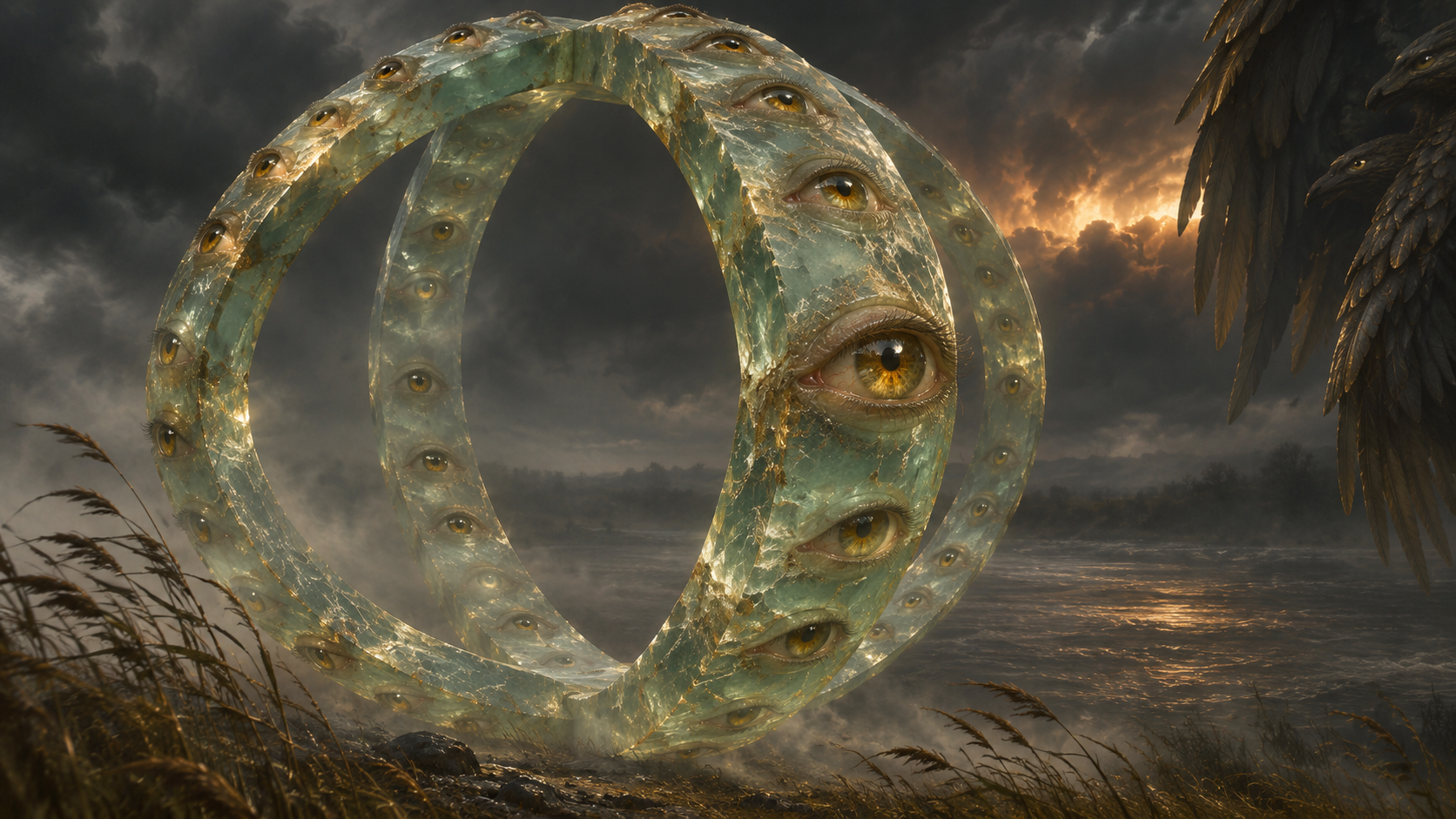
Follow his gaze and the arrangement becomes clearer. The wheels stand beside the creatures. Their rims are full of eyes. When the creatures rise, the wheels rise with them. Higher up, above the outstretched surface, Ezekiel sees something resembling a sapphire throne. The figure he associates with divine glory is seated there. Put the eyes, wheels and fire together into one enormous creature and you have drawn something quite different from the scene he describes.

Could a Cosmic Superintelligence Look Like God to Us?
There is a human element here that an entirely abstract portrait would lose. Ezekiel recognises something like a seated person and even distinguishes the region above the waist from the region below it. Yet when he tries to describe what either part looks like, he returns to fire and glowing amber. A reader could reasonably draw a human silhouette from those verses. The reader who added an age, a beard and a particular expression would have to supply those details.
The most revealing words come at the end. Ezekiel calls the sight “the appearance of the likeness of the glory of the Lord”. It is a strikingly careful phrase for a man who has just described a wheel moving through the air. He seems quite capable of precision. His precision here consists in saying how far the comparison goes. Then he falls face down and hears a voice. The encounter continues at the very moment his view of it ends.
Why Revelation Gives God the Colours of Stones
Revelation offers an artist a different starting point. In its fourth chapter, John sees a throne in heaven and compares the appearance of its occupant to jasper and carnelian. An emerald-like brilliance surrounds the throne. In front of it lies something resembling a sea of glass, clear as crystal.
Try drawing those objects in their proper places. The green belongs around the throne. The glass-like expanse lies before it. The eyes in this vision belong to the living creatures gathered nearby. The one seated at the centre receives remarkably little physical description, even though John supplies enough detail elsewhere to count the elders and describe their clothes.
A gemstone gives an artist a way through that problem. A stone can look dark at one angle and flash with colour when it turns towards the light. Comparing someone to a jewel communicates something a witness could experience without settling the outline of a nose or the colour of a pair of eyes. Giving God literal gemstone skin would settle a question John leaves open.
The scene has another quality a silent picture struggles to convey. Thunder comes from the throne. The creatures praise its occupant. The elders leave their own thrones and lay down their crowns. Their reason is explicit. They worship the one through whose will all things came into being. Even a reader unable to picture a single one of the stones can understand who occupies the centre and why everyone else turns towards him.
What Jesus Means When He Says God Is Spirit
Some of the clearest biblical words on this question come from a conversation about geography. In John’s Gospel, a Samaritan woman asks Jesus about a disagreement over where to worship. Her ancestors worshipped on a mountain. His people looked to Jerusalem. Which place has the stronger claim?
Jesus says that the time is coming when worship of the Father will depend on neither place. It is in answering where that he says, “God is Spirit”. In context, the immediate consequence concerns the woman at the well. Her ability to worship does not depend on travelling to the right sacred site.
Nothing in that exchange assigns spirit a colour, a density or a visible edge. An artist who paints a luminous presence has made a choice about how to communicate the idea. A translucent cloud, a field of stars or a white point of light would each be another choice. The passage gives us no grounds for deciding which one has the correct physical properties.
There is also a specifically Christian distinction worth preserving. Asking what God the Father might look like is different from asking whether Christians believe God can be encountered in a human life. The latter question leads to Jesus and the Incarnation. The distinction has roots in the history of Jewish and Christian understandings of God. At the well, it is Jesus, sitting down tired after a journey, who speaks about worshipping the Father. The physical ordinariness of the conversation is part of its force.
Through the Eyes of Ezekiel’s Wheel
Where Would the Centre of the Universe Be?
Imagine trying to give a spacecraft directions to the place in the illustration. The first problem would arise before launch. The standard account of cosmic expansion supplies no central point to enter as the destination.
An explosion on Earth leaves a sensible question behind. Where did it go off? Fragments travel outwards through already existing space, and their paths can lead an investigator back towards the blast. The Big Bang describes an early, hot, dense state of the universe and the subsequent expansion of space itself. Running that expansion backwards brings widely separated regions closer together. It does not pick out one present-day galaxy as the place where everything started.
There is a centre we can define. Look far enough in any direction and there is a limit to the region from which light has had time to reach us. We sit at the centre of our observable universe because we are the ones receiving that light. An astronomer in a distant galaxy could make the same statement about theirs. Moving there would change which regions we could see. It would give us no special vantage point from which to look back and identify the middle of creation.
Astronomers can, however, look back towards an earlier time in every direction. The faint radiation called the cosmic microwave background reaches us from across the sky. It comes from an era about 380,000 years after the Big Bang, when the universe had cooled enough for light to travel freely. Anyone expecting the ancient glow to hang over a single spot would point the telescope too narrowly.
That leaves a perfectly good reason to place God in the middle of a picture. Revelation arranges a scene of worship around a throne. A painter can preserve that relationship by making everything in the frame turn towards one presence. The centre of the composition expresses what matters to the participants. Turning it into an astronomical address would give it a precision neither the passage nor the physics supplies.
What a Realistic Image Can Show
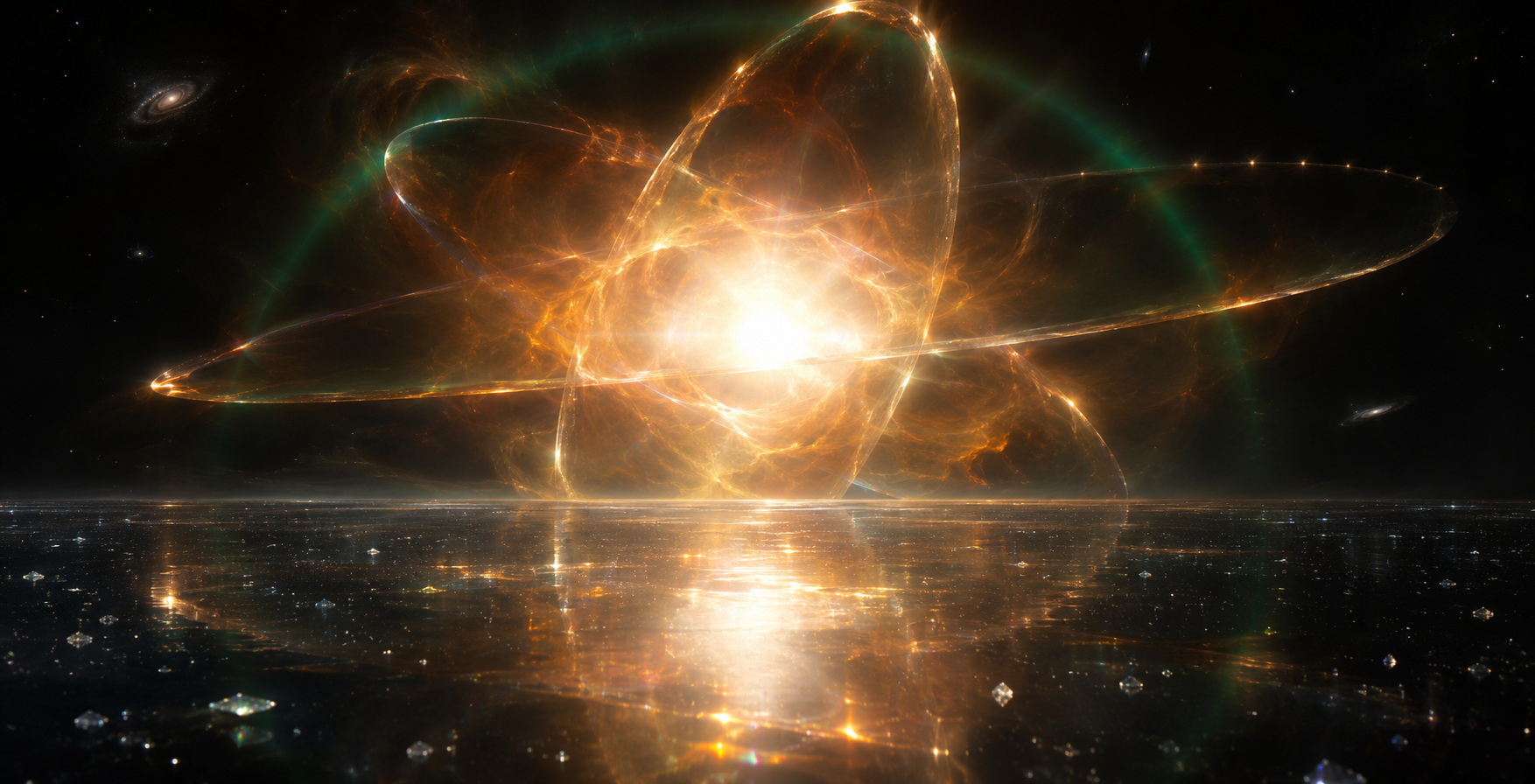
In the illustration, the easiest feature to recognise is a streak of gold on the dark foreground. It widens towards us across a surface that looks almost wet. Follow it backwards and it leads to a white region so bright that no internal detail survives. Even with the stars and the emerald arc removed, that reflection would still tell the eye where to look.
That is one answer to the request for realism. The viewer can understand how light behaves in the imagined scene. The foreground catches it unevenly. A thin arc disappears as it crosses the glare, then emerges on the other side. Dark space between the rings lets the eye separate forms that would otherwise merge. Those choices make a fantastic subject physically legible.
They also reveal the limits of the picture. A very bright lamp could overwhelm a camera in much the same way. Greater brightness carries no particular theological meaning on its own. What gives this light its biblical associations is the company it keeps. The amber evokes Ezekiel’s fire. The pale green recalls Revelation’s encircling radiance. The apparent reflection gives modern visual form to the sea of glass.
The image takes liberties in both directions. Its amber arcs sweep around the centre, whereas Ezekiel places wheels beside living creatures below the throne. Its central light has no visible human outline, whereas Ezekiel does discern one. It also brings distant galaxies into a scene where neither biblical writer describes looking through a telescope. Seeing those choices makes the illustration more interesting. We can point to the precise moment an ancient witness’s comparison becomes a modern artist’s invention.

Ezekiel’s Wheel at the Edge of Darkness
Could a Superintelligent AI Look Like This?
Imagine that astronomers discover a real object resembling the picture. Along an immense arc, points of light appear at regular intervals. A natural first question would concern the geometry. Are the points separate objects? Are they physically connected, or do they line up only from our angle? A single photograph could leave even that elementary question open.
Now suppose the lights change. Astronomers send a signal containing a newly chosen sequence, and a later pattern from the arc reproduces it with a consistent transformation. They repeat the experiment with fresh sequences, account for the time the signal needs to travel and invite other observers to check the result. Under those imagined conditions, the case for a system capable of receiving and processing information would become much stronger. The choice of a fresh signal matters. It gives the observers a prediction they can test before the reply arrives.
How far would that get them? A simple device can transform a sequence according to a rule. Its reply would give investigators something specific to explain, while leaving its intelligence an open question. A much more capable system might answer unfamiliar questions, correct a mistake in a transmission or predict the result of an experiment its questioners had yet to perform. Even then, several possibilities would survive. An artificial intelligence might be answering. So might the beings who built the equipment. A photograph of the structure could look identical in either case.
Suppose the most ambitious version of the idea proves true. An artificial mind coordinates installations across many star systems. What would its face look like? An observer near one installation might see a collector or a transmitter. Another might see a facility built to carry out calculations. The two could photograph different objects and still be looking at parts of the same system. The intelligence in this scenario lies partly in the relationships between those parts. A portrait of a single glowing core would make an editorial decision about where to put the viewer’s attention.
The sharper difficulty comes from the last lines of Revelation’s throne scene. The elders give thanks for the existence of everything. A machine assembled somewhere within the universe would already owe its existence to matter, energy and a history that made its construction possible. Discovering such a machine would transform what we knew about intelligence in the cosmos. It would still leave the elders’ question about the origin of all things unanswered.
One can change the thought experiment again and imagine a machine outside our universe, running the world we experience as a simulation. But that change comes at a cost. The machine would now belong to a different order of reality from the stars and rings in the picture. Even if it placed a luminous avatar in our sky, a photograph would show the appearance it had chosen for us. The actual machinery could look nothing like it. As with the question of what evidence could support a multiverse, the hard part is identifying an observation that would distinguish the proposal from its alternatives.
Ezekiel offers an unexpectedly exact ending for a modern image of God. At the point where a portrait painter would begin the face, the prophet gives us fire, turns his own face towards the ground and starts listening. A realistic illustration can take us as far as that last glance. The next thing that matters to the witness happens beyond the frame.
Sources
Bible Gateway — Ezekiel 1, King James Version — The arrangement of the creatures, wheels, throne and human-like figure, and Ezekiel’s account of hearing a voice.
United States Conference of Catholic Bishops — Revelation, Chapter 4 — The gemstone imagery, emerald radiance, glass-like sea and the elders’ reason for worship.
United States Conference of Catholic Bishops — John, Chapter 4 — Jesus’ conversation with the Samaritan woman about sacred places and the meaning of worshipping God in spirit.
NASA — Webb Telescope & the Big Bang — Why expansion has no identified central point and why the early universe’s radiation reaches us from across the sky.
Next Reads
The Abrahamic Religions Explained: How One Ancient Idea of God Changed the World — How Jewish, Christian and Islamic traditions developed their understandings of God.
Are There Multiverses? — What astronomers might measure when a theory concerns something beyond the observable universe.
12 Bible Passages That Can Change How You Face Fear, Failure and the Future — A closer reading of familiar verses through the human circumstances in which they are spoken.
