UPDATE: Bondi Beach shootings: more guns and explosive devices recovered as terror probe widens
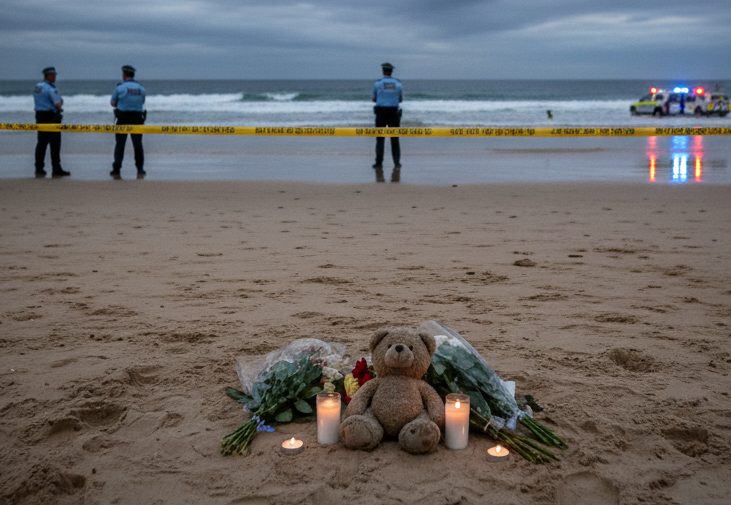
The Bondi Beach shootings are now being handled as a terror-related case, with investigators confirming a larger cache of weapons and explosive devices than was initially known. Police say they have recovered six firearms and three improvised explosive devices so far, including items found at the beach and during overnight searches at two Sydney addresses.
This matters right now because it changes the shape of the threat. A shooting is one kind of emergency. A shooting paired with explosives is a different operational picture, with bigger questions about planning, capability, and how close the attack came to being even worse.
This update lays out what officials have confirmed in the past 24–48 hours, what remains unresolved, and what the fast-moving political response is likely to change in Australia’s security and gun oversight system.
The story turns on whether the investigation can map the planning chain clearly enough to close the gaps that allowed a public holiday gathering to become a mass-casualty target.
Key Points
Police say 16 people have died in total, including one of the attackers. Authorities say 15 victims were killed, with a 10-year-old girl and a 40-year-old man among those who later died in hospital.
The shootings happened around 6:40 p.m. on Sunday, December 14, 2025, when two men with long guns fired into crowds at Bondi Beach. Two police officers were wounded.
The incident has been deemed terror-related by the state police commissioner, and the Joint Counter Terrorism Team is leading the main investigation under a named operation.
Investigators say they have now recovered six firearms and three improvised explosive devices, including additional items located on Monday, December 15.
Detectives have searched two addresses in Bonnyrigg and Campsie and seized more firearms and other items now undergoing forensic examination.
National leaders have agreed to pursue stronger gun-law measures, including accelerating a national firearms register and considering tighter licensing conditions.
Background: Bondi Beach shootings
The attack unfolded on a warm Sunday evening near one of Australia’s most recognizable public spaces. Police say officers arrived to reports of shots fired, located two men using long guns to fire into crowds, and exchanged fire. One attacker, a 50-year-old man, was shot by police and died at the scene. The other, a 24-year-old man, was critically injured and remains in hospital under police guard.
Authorities say 42 people were taken to hospitals across Sydney, including four children. As of Monday, police said six people remained in critical condition, with others in serious but stable condition. The two wounded officers were also described as serious but stable.
Officials have framed the attack as targeted at the Jewish community on the first day of Hanukkah, turning what should have been a public celebration into an act of mass violence.
Analysis
Political and Geopolitical Dimensions
The political response has moved quickly because the target was not only a crowd, but a community. Leaders have described the attack as antisemitic and terror-related, and that framing drives policy in two directions at once: security measures for vulnerable groups, and system reforms designed to prevent recurrence.
A national meeting of leaders has already put gun-law tightening back on the agenda, with public pressure for action amplified by the scale of casualties and the symbolism of the location. The debate is not only about access to weapons, but whether licensing systems can integrate enough intelligence and enforcement to identify escalating risk before it becomes lethal.
There is also an unavoidable international dimension. Attacks against Jewish gatherings draw global scrutiny and diplomatic attention. That can speed up domestic decision-making, but it can also harden narratives and invite opportunistic blame. The practical challenge is to respond forcefully without letting the public conversation collapse into suspicion-by-association.
Economic and Market Impact
Bondi is a neighborhood economy as well as a landmark. The immediate impact is visible: closures, cordons, canceled events, and fewer visitors. Small businesses near the beachfront feel that shock first, because even a short disruption hits staffing, stock, and cash flow.
The second-order impact is insurance and liability. When an event is treated as terror-related, insurers and government-backed risk pools start assessing exposure, but payouts can hinge on specific legal triggers and policy terms. That uncertainty matters for cafés, retailers, and venues trying to reopen quickly while absorbing lost trading days and extra security costs.
Longer term, public-event organizers may face a new baseline of security expectations—more screening, more private guards, and higher compliance costs—especially for religious and community gatherings that were previously low-friction and open.
Social and Cultural Fallout
The social harm extends beyond the casualty count. For Jewish Australians, the attack is personal and immediate: it targets identity, faith, and public belonging. For the broader public, it strikes at a shared assumption that open spaces are safe by default.
There is also a tension between grief and suspicion. Moments like this can produce solidarity, but they can also fuel polarization if fear is channeled into scapegoating. That is why public language matters. Clear condemnation of antisemitism and terror can coexist with discipline about evidence and motive. Losing that discipline is how social cohesion frays.
The recovery arc will likely include visible memorials, increased security in Jewish areas, and a mental-health tail that lasts far longer than the news cycle. The people least equipped to process it—children and adolescents—often carry the longest shadow.
Technological and Security Implications
The newest operational detail is the most stark: investigators say they recovered not only firearms, but improvised explosive devices. That shifts the security interpretation from a single method of violence to a broader intent to maximize harm, panic, or disruption.
Police say the Joint Counter Terrorism Team has taken the lead, supported by federal and state agencies, while a separate critical incident process is examining police actions during the shooting. This dual-track structure matters for trust. The public needs both outcomes: an aggressive terrorism investigation, and transparent oversight of the police use of force.
On prevention, the policy focus is tilting toward systems rather than slogans: a faster national firearms register, tighter licensing conditions, and the use of criminal intelligence in licensing decisions. Governments are also looking at customs settings and emerging risks like 3D printing and novel firearms technology, which can outpace older regulatory assumptions.
What Most Coverage Misses
Two different “terror” labels are now in play, and they do not do the same job.
One is the policing classification: a commissioner’s declaration that the incident is terror-related, which shapes investigative powers, agency involvement, and operational priorities. The other is the insurance and compensation reality: terrorism-related insurance provisions may depend on a separate federal declaration under national law before certain eligible losses can be treated as terrorism losses for insurance purposes.
That distinction is not academic. It can influence how quickly businesses recover, how insurers process claims, and how governments communicate “support” in practical, check-writing terms. It is one of the clearest examples of how legal definitions shape real life after a mass attack.
Why This Matters
In the short term, the people most affected are the injured and bereaved, the Jewish community in Sydney, first responders, and the local economy around Bondi. The immediate needs are medical care, trauma support, and stability—alongside a fast, credible investigation.
In the long term, the Bondi Beach shootings will likely accelerate changes in gun oversight and public-event security across Australia. That includes licensing rules, the speed and coverage of firearms tracking, and how authorities share intelligence across jurisdictions.
What to watch next is concrete:
the filing of charges tied to the surviving attacker’s hospital status; formal victim identification and funerals; the next steps from police ministers and attorneys-general on gun-law proposals; and any federal declaration that affects how terrorism-related insurance mechanisms apply.
Impact
A café manager near Campbell Parade reopens to half the usual foot traffic. Staff shifts are shortened, not because demand disappeared forever, but because uncertainty kills routine before it kills appetite.
A Jewish parent in Sydney weighs whether future holiday events should be public at all. The choice becomes a trade-off between community visibility and perceived risk, made under emotional strain.
An events coordinator in another Australian city rewrites a summer calendar overnight. Insurance questions, security quotes, and venue requirements become the gatekeepers of community life.
A small-business insurer triages calls from clients asking the same thing in different words: “Will this be treated as terrorism for my policy?” The answer is often technical, and the delay feels personal.
Road Ahead
The latest confirmed findings in the Bondi Beach shootings sharpen the stakes. This was not only a shooting in an open space. Investigators say it involved multiple firearms and improvised explosive devices, and it has now been pulled fully into a counterterrorism framework with parallel oversight of police actions.
The fork in the road is clear. Australia can treat this as a terrible exception, make narrow fixes, and move on. Or it can use the forensic facts—how weapons were held, tracked, and deployed—to tighten systems that are only “strict” when they are continuously enforced.
The signposts that will show which way the story breaks are not rhetorical. They are procedural: charges, policy drafts, licensing reforms with teeth, and the speed at which governments translate public vows into rules that actually change risk.
Meta description: Bondi Beach shootings update: police recover more guns and explosive devices, expand the terror probe, and leaders push fast gun-law reforms.
