

Kyiv air attack after peace talks ends highlights the “talks vs tempo” gap in Ukraine
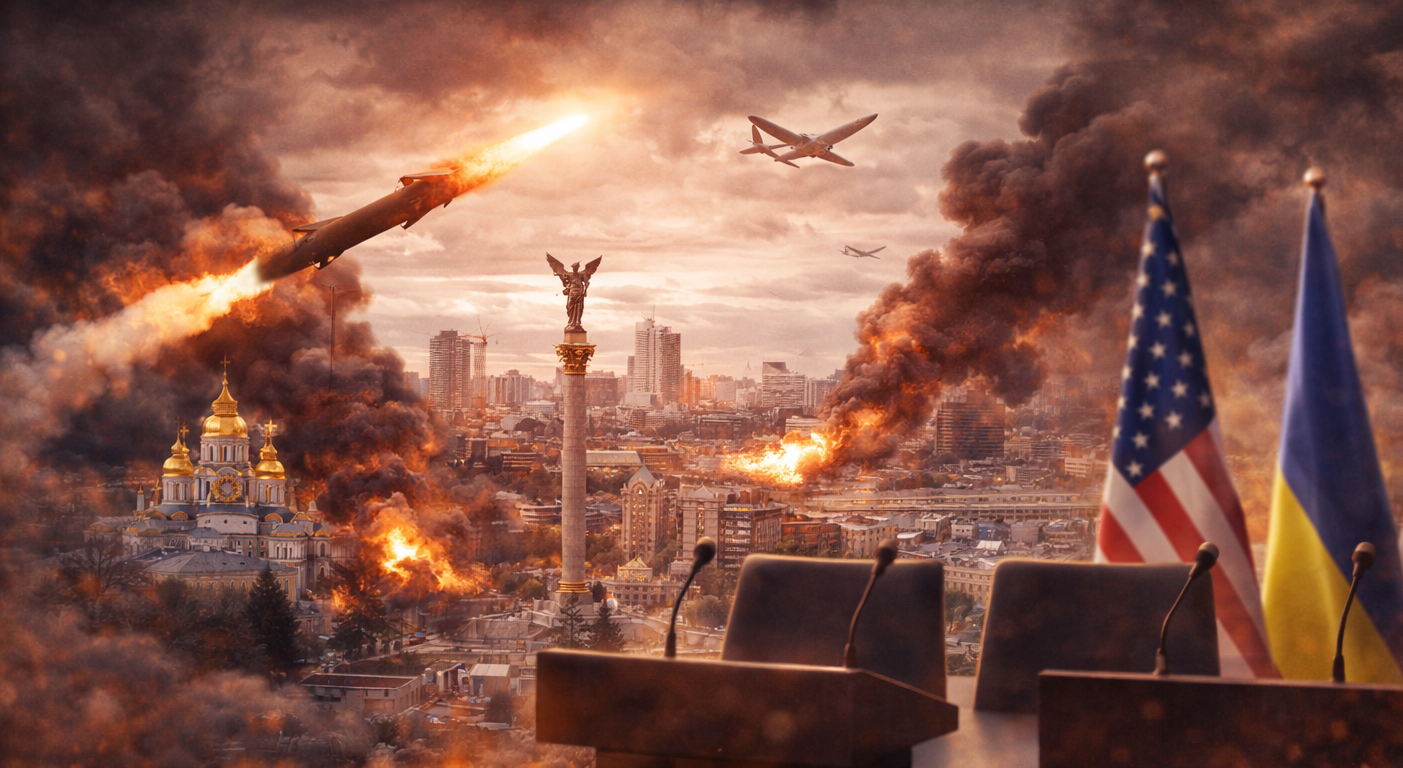
As of Dec. 23, 2025, Ukrainian officials reported a renewed Russian air attack on Kyiv within days of U.S.-led peace meetings ending in Miami. The timing is the point. Diplomacy is trying to build a track toward de-escalation, while the air war keeps running at full speed.
This is the recurring clash at the heart of the conflict: negotiations move in slow, careful steps, but missiles and drones move in minutes. Each new strike becomes both a battlefield act and a political signal, shaping public mood, bargaining positions, and the room leaders have to compromise.
This piece explains what is known about the latest Kyiv air attack, what the Miami round did and did not change, and why the “talks vs tempo” gap is not a side detail but a core mechanism of the war. By the end, the reader will understand how air campaigns and negotiation calendars collide, what constraints matter most, and what to watch next.
The story hinges on whether diplomacy can slow the air war before the air war shapes the course of diplomacy.
Key Points
Ukraine reported an early-morning air attack on Kyiv on Dec. 23, with air defenses engaging and residents urged to remain in shelters; initial official updates did not immediately specify damage or casualties.
The attack followed U.S.-led meetings in Miami that tested whether a settlement framework can gain traction while the war continues.
Ukrainian leadership has signaled conditional openness to a U.S.-proposed, three-sided format involving the United States, Ukraine, and Russia, but only if it produces concrete steps like prisoner exchanges and a path to leader-level talks.
Russia has downplayed expectations of a near-term diplomatic breakthrough, framing the process as detailed, expert-level work with major issues still contested.
The “talks vs tempo” gap matters because ongoing air attacks can drain air-defense inventories, pressure civilian morale, and harden negotiating positions on both sides.
Near-term outcomes are likely to hinge less on dramatic announcements and more on whether a verifiable pause mechanism emerges, and whether external pressure tools are tightened or loosened.
Background
The latest reported Kyiv air attack lands in a familiar strategic pattern. When talks intensify, air operations often do not pause. Instead, they continue as a parallel campaign with its own objectives: disrupting logistics, targeting infrastructure, testing air defenses, and maintaining pressure on leadership and society.
The Miami meetings reflect a U.S.-led attempt to determine whether there is a workable settlement package that Ukraine, Russia, and key European stakeholders could accept, or at least use as a basis for further bargaining. Recent public signals suggest a multi-track structure: discussions involving U.S., Ukrainian, and European delegations, alongside separate contacts with Russian representatives.
In recent days, Ukrainian leadership has described negotiations as nearing something tangible in structure, even while acknowledging unresolved issues that neither side is ready to accept. At the same time, Russia has emphasized process over breakthrough, casting the talks as meticulous and technical, with core disputes still open.
A notable feature of the current diplomatic push is an emerging discussion about format. Ukraine has indicated it would back a three-sided framework involving the United States and Russia if it produces measurable results, especially on prisoner swaps and creating conditions for higher-level meetings. Ukraine’s publicly stated position has also stressed that any settlement discussion must grapple with the current line of contact and control on the ground, and with credible security guarantees after any ceasefire.
Analysis
Political and Geopolitical Dimensions
The Kyiv air attack highlights a crucial reality: negotiations are not conducted in a vacuum, but rather under intense pressure, and this reality shapes the incentives involved. For Ukraine, continued strikes on the capital sharpen the political cost of compromise. Leaders must show they can protect civilians and defend sovereignty while negotiating, or risk losing public trust and coalition cohesion.
For Russia, continuing air attacks can serve multiple political functions without requiring claims about intent. It can demonstrate operational reach, maintain pressure during diplomatic engagement, and reinforce the idea that time and escalation control remain contested. Even if talks produce a draft framework, Moscow can treat air operations as leverage, not as a contradiction.
For the United States and Europe, the tension is credibility. If the public perceives diplomacy as disconnected from the pace of violence, it may lead to a fracture in support. If it is seen as enabling a pause that simply resets the battlefield, it can become politically toxic. This is why “security guarantees” and verification mechanisms remain central: without them, any pause looks like a gamble.
Four near-term scenarios are now plausible. First, talks continue while strikes persist, producing incremental technical alignment but no immediate reduction in attacks. Second, a limited pause is tested around specific objectives, such as humanitarian corridors or a narrowly defined lull tied to prisoner exchanges. Third, the process stalls, and both sides harden positions, with the air campaign continuing as a pressure instrument. Fourth, an unexpected political decision forces a temporary halt, but only if enforcement and monitoring are credible enough to deter immediate violations.
Economic and Market Impact
Air attacks on Kyiv are not only a security story; they are an economic one. Capital-city risk affects insurance, investment confidence, supply-chain routing, and labor decisions. Repeated alerts and disruptions, even with limited physical damage, create a drag that leads to lost output and strained municipal services.
For Europe, war tempo intersects with energy strategy and sanctions endurance. Each extension of economic restrictions signals that the cost-imposing track remains active even as talks proceed. That matters because sanctions and export controls are among the few tools that can be adjusted quickly without putting troops on the ground. They also shape Russia’s fiscal room and import access over time.
For Ukraine, the economic stakes are about staying solvent and functioning while negotiating. A settlement framework that does not clearly address reconstruction finance, air-defense replenishment, and long-term stability can struggle to gain domestic support, especially if attacks keep landing near population centers.
A single Kyiv strike often has a muted immediate effect on global markets compared to earlier stages of the war. But the broader pattern—talks rising while attacks continue—keeps risk premia alive. It also reinforces uncertainty about shipping, grain corridors, and infrastructure resilience, which can ripple into food prices and regional inflation pressures.
Technological and Security Implications
The operational detail that most shapes the “talks vs tempo” gap is not the headline of an air attack, but the math behind air defense. Drones and missiles can be produced, adapted, and launched in waves. Interceptors and radar systems are expensive, finite, and constrained by manufacturing capacity, training pipelines, and spare parts.
That asymmetry creates a grinding pressure even when defenses perform well. Every night of alerts forces hard choices: what to intercept, what to conserve, where to reposition, and how to protect both the front and major cities. It also creates opportunities for adaptation—changes in flight profiles, decoys, mixed salvos—that can be iterated faster than some defensive procurement cycles.
This is why talks alone rarely change tempo. Unless a negotiated pause is paired with monitoring, enforcement, and clear consequences for violations, air campaigns can keep running with minimal immediate cost. The technological balance, not the rhetoric, often decides whether a lull holds.
What Most Coverage Misses
Most coverage treats “talks vs tempo” as a messaging contradiction: leaders talk peace while bombs fall. The deeper point is operational and institutional. A diplomacy track can be real and still fail to slow the air war because the air war has its own bureaucratic momentum, its own target cycles, and its own strategic logic.
The overlooked constraint is verification capacity. A ceasefire is not a sentence; it is an architecture. It requires agreed lines, monitoring systems, incident reporting, escalation management, and enforcement triggers that both sides believe will be effective. Without that, a pause becomes a brief political headline rather than a durable change in tempo.
There is also a second-order effect: continued attacks on a capital city compress decision time for leaders and publics. That can reduce the space for nuanced debate and increase the appeal of maximalist positions, even when private negotiators are exploring compromise language. In other words, the air tempo does not merely accompany diplomacy; it can actively reshape what diplomacy is allowed to achieve.
Why This Matters
The people most affected are civilians in and around Kyiv and other population centers who live with the nightly rhythm of alerts, shelters, and uncertainty. But the consequences spread outward: European policymakers managing sanctions and energy transitions, defense industries facing replenishment demands, insurers pricing risk, and households across the region absorbing the economic drag of a long war.
In the short term, the key question is whether diplomacy can generate a verifiable de-escalation mechanism that survives the next wave of strikes. In the long term, the question is whether any settlement can credibly prevent a return to aggression, especially if the war ends with contested control lines and unresolved security architecture.
Concrete events to watch include official announcements about the next negotiation format, any scheduled adviser-level meeting, and whether prisoner exchanges or limited humanitarian arrangements materialize as early “proof of life” for the talks. It also matters whether pressure tools tighten further or soften—sanctions timelines, enforcement actions, and energy policy decisions are not side stories; they are leverage signals.
Real-World Impact
A nurse in Kyiv plans hospital shifts around air-raid alerts, keeping a bag packed for shelter. Even when the city avoids direct damage, the disruption drains staff and reduces routine care capacity.
When risk perceptions spike, a logistics manager in southeastern Poland reroutes deliveries, not due to road closures, but because insurers and clients insist on lower-risk schedules. The cost shows up as delays and higher fees that customers ultimately pay.
A small manufacturer in central Germany watches input costs and export orders as political risk remains elevated. The firm does not trade on headlines, but it does respond to uncertainty that keeps energy and financing conditions jumpy.
A municipal engineer outside Kyiv faces a grim maintenance cycle: repair, reinforce, and restore, knowing that infrastructure is both essential and vulnerable. The war’s tempo turns long-term planning into triage.
What’s Next? The Kyiv air attack and the talks-tempo gap
The next phase will likely be decided less by grand statements than by whether the process produces small, verifiable steps that alter daily realities. If the Miami track can deliver concrete outcomes—prisoner exchanges, an agreed structure for adviser-level engagement, or a limited and monitored pause—then diplomacy gains credibility. If not, the air tempo will keep defining the political climate in which talks occur.
The fork in the road is clear. A settlement path requires mechanisms that reduce violence in practice, not just on paper, and security arrangements that make renewed attacks less likely or more costly. A failure path keeps negotiations alive but hollow, while the air war continues to drain defenses, strain society, and harden positions.
The signs to watch are straightforward: whether a follow-up meeting is scheduled with a clear mandate; whether any limited pause is announced with verification details; whether prisoner swaps happen quickly; and whether air-attack patterns change in frequency, scale, or targeting. Those indicators will show whether the gap between talks and tempo is narrowing—or simply being managed.
