

A Nation Hit at Once: Inside the Coordinated Attacks Shaking Mali
A Nation Hit at Once: Inside the Coordinated Attacks Shaking Mali
Mali Under Siege: Coordinated Terror Assault Engulfs Multiple Cities in Unprecedented Wave of Violence
Coordinated strikes across Bamako and beyond reveal a deeper shift in power, strategy, and control in the Sahel
Gunfire. Explosions. Military bases under attack.
Multiple cities across Mali experienced simultaneous attacks, targeting not only specific locations but also the very concept of control.
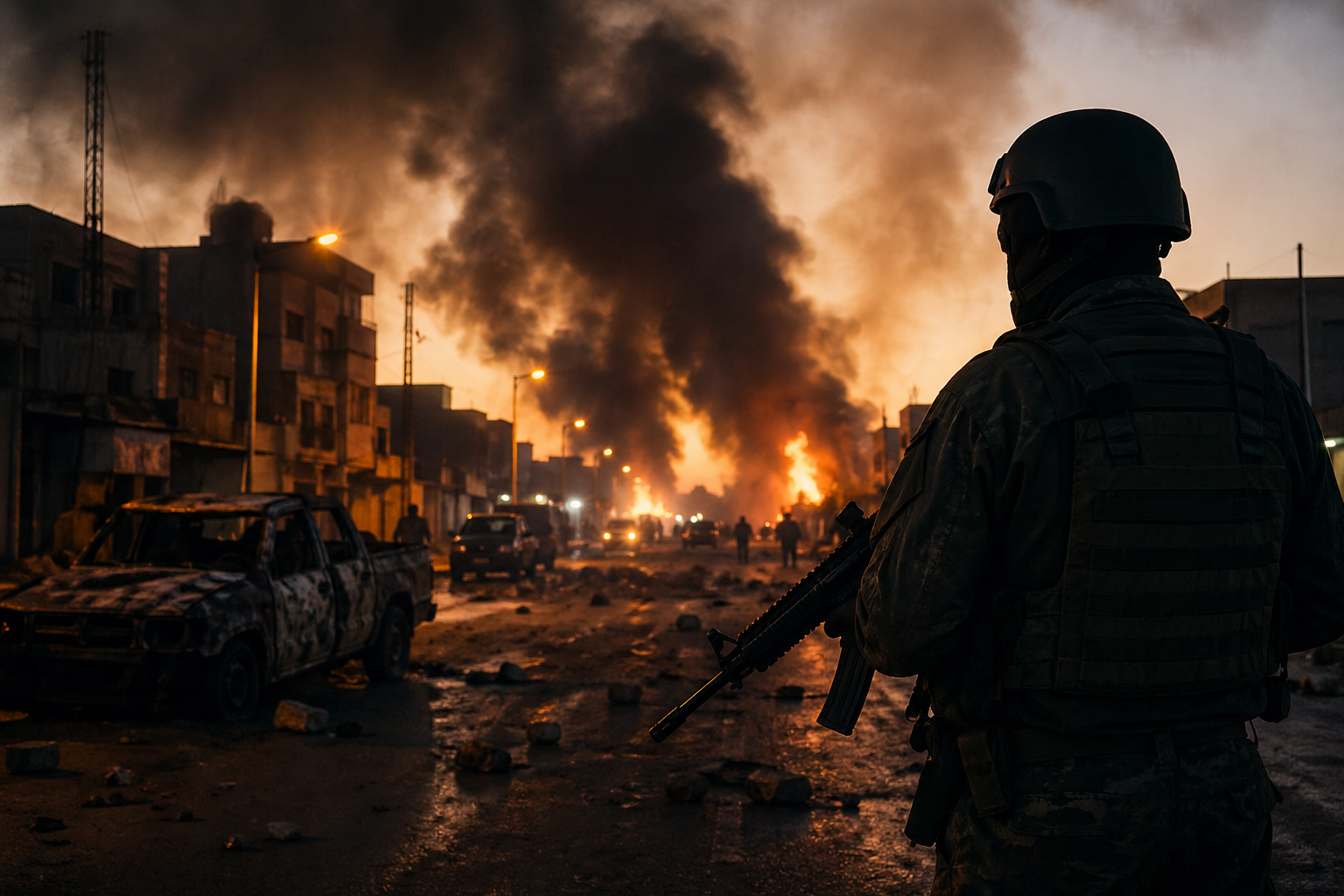
Early reports indicate coordinated attacks in the capital, Bamako, and key strategic areas, including Kati, Gao, and Kidal. Witnesses reported hearing loud explosions, armed fighters moving through city streets, and continuous automatic gunfire.
This was not a random act of terror. It was something far more deliberate—and far more dangerous.
What Happened
The attacks unfolded in waves.
Explosions and heavy gunfire were reported near Bamako’s main airport and military infrastructure
Key military sites, including the Kati base, came under direct assault
Armed groups launched simultaneous strikes across multiple regions
Urban movement of militants was observed in real time, including convoy activity
The Malian military confirmed that “terrorist groups” had targeted multiple positions and that active combat operations were underway.
During the fighting, armed factions reportedly contested or partially controlled at least some areas in the north, particularly Kidal.
This level of coordination marks one of the most complex and widespread attacks the country has faced in years.
Why This Is Different
Mali has faced violence for over a decade. But the current situation is not just another attack.
This is escalation.
Three factors make this moment distinct:
1. Simultaneity
Attacks were launched across multiple cities at the same time. That requires planning, communication, and operational confidence.
2. Urban Penetration
Fighters were not confined to remote areas. They operated inside major population centers, including the capital.
3. Coalition Signals
Available reporting suggests possible coordination between jihadist networks and separatist groups—actors who do not always share identical goals.
That matters. Because when different armed groups align, even temporarily, the threat multiplies.
The Real Story Beneath the Violence
On the surface, the incident is a terror attack.
Underneath, it is a test of the state.
Mali’s government has spent years trying to stabilize the country after coups, shifting alliances, and the withdrawal of foreign military support. That effort has always depended on one core assumption: that the state can maintain control of key territory.
This attack challenges that assumption directly.
The ability of armed groups to strike multiple strategic locations at once suggests the following:
Intelligence gaps inside the security apparatus
Freedom of movement for militant networks
Increasing operational confidence among insurgent groups
And most importantly:
It signals that the balance of power is not settled.
What Media Misses
The instinct is to treat the incident as a spike in violence.
It is more accurate to see it as a signal of convergence.
Different armed actors—jihadist groups, separatists, and local militias—have historically operated with different goals. But when pressure aligns, so can their actions.
What matters is not whether they formally merge.
What matters is that, in moments like these, they do not need to.
The coordination itself is enough to overwhelm fragmented state responses.
Why This Matters Now
The timing is not random.
The Sahel region has been undergoing a quiet but profound shift:
Western military support has reduced
Regional governments have restructured alliances
Security gaps have widened
Armed groups have adapted faster than state institutions
The result is a vacuum—one that violent organizations are increasingly capable of exploiting.
This attack is what that vacuum looks like when it becomes visible.
What Happens Next
Three scenarios now matter:
Most Likely
Security forces regain control of major urban areas, but insurgent capability remains intact, leading to further attacks.
Most Dangerous
Armed groups consolidate control in northern or strategic zones, creating semi-permanent strongholds.
Most Underestimated
The psychological impact spreads faster than the violence itself—undermining confidence in state control and accelerating instability.
Even if the immediate fighting subsides, the underlying trajectory has shifted.
The Bottom Line
This is not just an attack.
It is a demonstration.
A demonstration that multiple armed groups can strike together, move through cities, and challenge the state in real time.
That changes the equation.
Once proven, that capability remains.
And the next time it happens, it may not stop at disruption.
