America’s Founding Document Was Hiding In Britain’s War Files For 250 Years
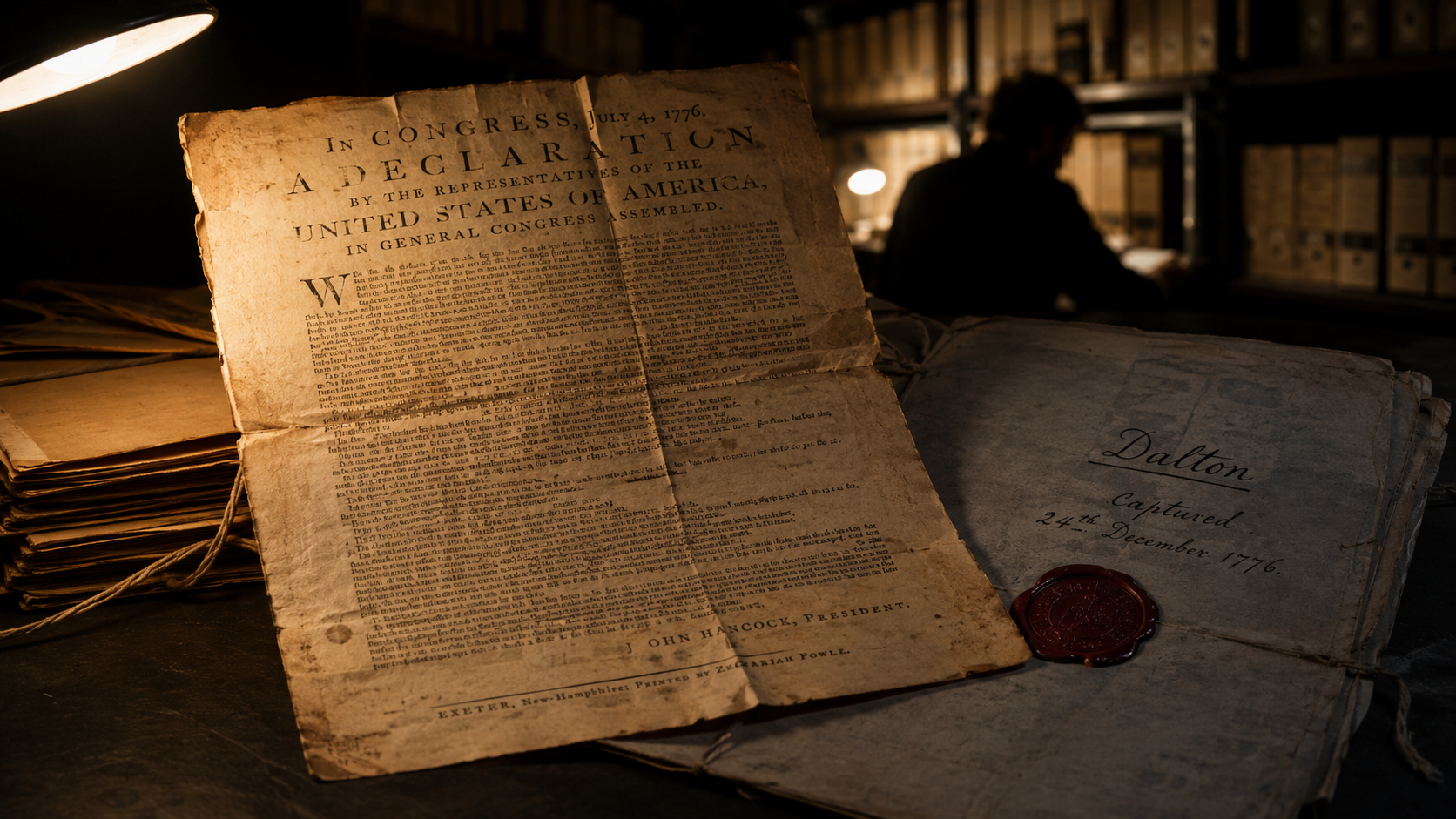
The Declaration Of Independence Copy Britain Captured And Forgot
Rare Declaration Copy Found In UK Archives Rewrites A Lost 1776 Sea Story
A rare 1776 copy of the Declaration of Independence has been found in the UK National Archives, and the discovery is more than a collector’s thrill. It is a lost wartime object from the moment America declared itself independent and Britain was still trying to stop that independence becoming real.
The copy is an Exeter printing, produced in New Hampshire in mid-July 1776 after the Declaration was first issued in Philadelphia. Only 11 surviving Exeter copies are now known, and this is the only one identified outside the United States.
What The Document Contains
The document contains the printed text of the Declaration of Independence. It was not the famous signed parchment version preserved in Washington, and it was not meant to be treated as a museum treasure.
It was a working revolutionary broadside. These copies were printed quickly, distributed widely, and used to spread the political claim that the colonies were no longer British colonies but independent states.
That makes this copy powerful in a different way. It shows the Declaration not as a settled national relic, but as an active message moving through war, ships, crews, ports, and enemies.
Why This Copy Matters
The significance is not only that the document is rare. It is that this copy appears to have been captured in war, taken from the American privateer Dalton after the Royal Navy seized the ship on Christmas Eve 1776.
That gives the paper a complete and dramatic chain of custody. It was printed in revolutionary America, carried by men fighting under the authority of the Continental Congress, seized by Britain, and then absorbed into the machinery of imperial paperwork.
For the crew, the Declaration was not just rhetoric. It explained what they were fighting for and why the conflict had become more than a dispute over taxes or trade.
How Many Copies Exist
This is now counted as one of 11 known surviving copies of the Exeter printing. Before this discovery, the known examples were held in the United States.
That makes the UK copy exceptional. It is not simply another early printing of the Declaration, but the only known Exeter copy outside America and reportedly the only known copy taken by military action.
The number also explains the intensity around the find. Early Declaration broadsides were fragile, practical documents, not objects designed for long-term preservation.
How It Stayed Hidden For So Long
The answer is bureaucracy. The Declaration was not sitting in a display case waiting to be recognised. It was folded into captured naval papers and described in dull archival language as another document or another paper.
That is how historically explosive material can disappear in plain sight. The British state preserved huge volumes of wartime records, but the meaning of a single printed sheet could vanish when filed under the paperwork of a captured ship.
The discovery came when Michael Scurr, a volunteer working through Royal Navy correspondence, opened the material and recognised the beginning of the text. In other words, it was not lost because it had been destroyed. It was lost because it had been classified as ordinary.
What Happens Next
The document has already moved from hidden record to public historical object. Conservation work has been carried out to stabilise it, and it is linked to the National Archives’ Revolution 250 programme marking 250 years since American independence.
The next stage is scholarly attention. Historians will study its printing, movement, capture, preservation, and the wider role of privateers in carrying revolutionary ideas across the Atlantic.
The deeper consequence is sharper. America’s founding text did not only travel through Congress, newspapers, and public squares. It travelled through war, seizure, paperwork, and empire, before reappearing in the archives of the power it had declared independence from.
