Brown University shooting: FBI posts $50,000 reward as manhunt intensifies
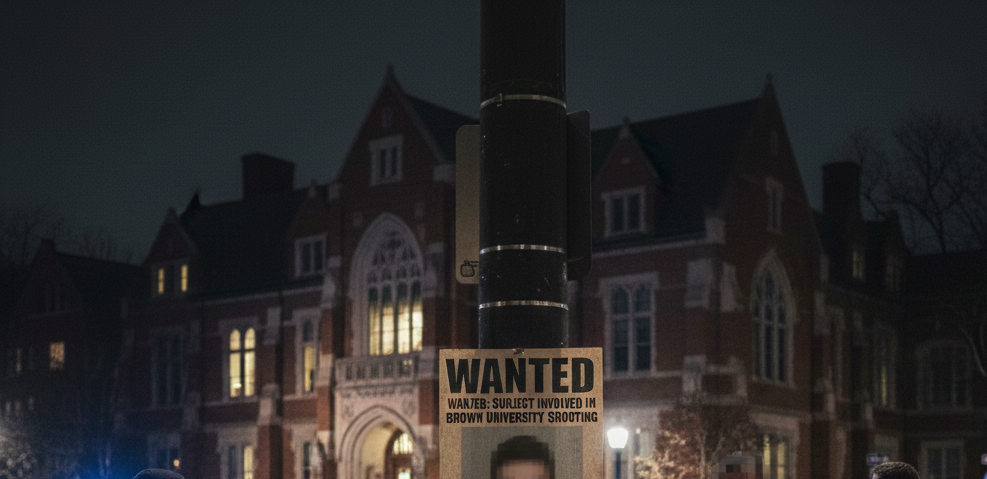
The Brown University shooting has entered a new, more urgent phase. Federal and local authorities are now offering a reward and pushing out clearer images of the person they believe carried out the attack.
This matters right now for one blunt reason: the suspect is still not publicly identified, and the wider community is trying to function without the basic reassurance that the threat is contained.
The central tension is simple but hard. Investigators need the public’s help to identify a masked figure. At the same time, the public is being asked not to spiral into rumor, vigilante “sleuthing,” or panic that can muddy the case and harm innocent people.
This piece explains what changed in the last few days, what is confirmed, what remains unclear, and what the reward-driven push says about where the investigation stands.
The story turns on whether the new images and public tips can produce a fast, reliable identification.
Key Points
The FBI is offering up to $50,000 for information leading to the identification, arrest, and conviction of the person responsible for the Brown University shooting.
Authorities have released additional images and video showing a masked person of interest near campus in the hours before the attack.
Two students were killed and nine others were injured. One person remained in critical condition in the days after the shooting, while others were described as stable or discharged.
A person previously detained and described as a “person of interest” was later cleared and released, resetting public expectations about an imminent arrest.
Brown moved quickly to suspend remaining classes and exams for the semester as the campus tried to shift from lockdown to recovery.
The investigation is now heavily dependent on community video, timestamps, and small pieces of routine data that can place the suspect before and after the shooting.
Background
The Brown University shooting occurred on Saturday, December 13, 2025, in Providence, Rhode Island, during final exam season. The initial emergency alert prompted students and staff to shelter in place, locking doors and staying hidden while police searched buildings and nearby streets.
In the immediate aftermath, officials confirmed two deaths and multiple injuries, with several victims initially described as critically injured. Over the next day, the university and authorities provided a clearer picture of the medical status: most of the injured were stable, with one person still in critical condition, and at least one person later discharged.
The early investigation appeared to move quickly, including the detention of an individual described publicly as a person of interest. But within roughly a day, officials said that individual had been cleared and released. That reversal did two things at once: it corrected the record, and it also widened the emotional blast radius, because it signaled the case was not as close to resolution as many hoped.
By Monday, the focus visibly shifted toward public assistance. Authorities released additional surveillance imagery and leaned on a standard tool in high-profile cases: a reward designed to generate high-quality tips, jog memories, and surface private video from doorbells, security cameras, and phones.
Analysis of the Brown University shooting
Political and Geopolitical Dimensions
Even when a case is local, the political stakes are national. A campus shooting lands immediately in the U.S. debate over guns, policing, and public safety. But a reward and a federal “seeking information” push also signals something more practical: the investigation needs scale, specialist support, and rapid triage of incoming tips.
There is also an international dimension, even if it is not the headline. Universities are global institutions. When violence hits a campus, it ripples through families and communities far beyond the United States, especially when victims, witnesses, or classmates have international ties. That can raise pressure on institutions to communicate clearly and avoid errors that travel fast online.
For officials, the constraint is credibility. Every public update has to balance speed with accuracy. The earlier detention-and-release sequence illustrates why: premature certainty can damage trust, invite false accusations, and create new victims in the form of wrongly targeted individuals.
Economic and Market Impact
The most immediate economic impact is operational. When a university suspends classes and exams, the cost is not just emotional. It affects travel plans, campus staffing, security spending, and the logistics of supporting students who may need temporary housing, transport, or crisis services.
Providence also feels it in small, concrete ways. College Hill is not a sealed-off campus bubble. It is a neighborhood with residents, shops, and routine foot traffic. A visible police presence, fear-driven staying indoors, and disrupted schedules can hit local businesses quickly, especially during a period when many rely on end-of-semester demand.
There is a longer-term cost question too: whether this event accelerates spending on surveillance coverage, controlled access, and emergency systems. Those investments can improve safety. They also raise difficult questions about privacy, campus openness, and the lived experience of students who chose a university expecting freedom of movement, not checkpoints.
Social and Cultural Fallout
The social damage of an unsolved shooting is different from the damage of a solved one. When the suspect is not publicly identified, fear becomes diffuse. People begin to scan ordinary details for threat, and normal interactions can feel charged.
That is why officials often repeat a careful message: be vigilant, but avoid speculation. Online rumor moves faster than fact, and campus communities are particularly vulnerable because students share information at speed, often in group chats where uncertainty gets flattened into certainty.
The detention-and-release episode adds another layer. It can breed cynicism in some people and anger in others. Both reactions can make it harder for communities to follow guidance calmly and for investigators to receive useful, uncluttered information.
Technological and Security Implications
The current push shows how modern manhunts work. Surveillance video is only as good as its coverage, its angles, and its timestamps. A masked face reduces the value of a single image, so investigators rely on patterns: gait, build, clothing layers, and the small habits that can distinguish one person from another.
That is where public tips become essential. A neighbor’s doorbell camera may capture a clearer side profile. A rideshare drop-off might create a digital trace. A receipt, a text message, or a timestamped photo can place the suspect in a way that narrows the search dramatically.
At the same time, there is a security dilemma. More camera coverage and more digital collection can help solve violent crimes. But it also expands the infrastructure of monitoring that communities will live with long after the crisis ends.
What Most Coverage Misses
The overlooked factor is not the reward amount. It is the quality of the information pipeline.
In cases like this, success depends less on one dramatic tip and more on thousands of mundane fragments being received, prioritized, verified, and connected without error. That process is labor-intensive and surprisingly fragile under public pressure, especially when social media generates noise that looks like signal.
The second missed point is campus access. Final exam periods change how buildings are used. Doors may be propped, traffic patterns shift, and students move in groups at unusual hours. The immediate question is not just how the suspect escaped, but which routine choices created opportunity, and which changes could reduce that risk without turning a campus into a fortress.
Why This Matters
In the short term, the people most affected are students, staff, and nearby residents living with uncertainty while the investigation continues. The emotional cost is compounded by the practical disruption: altered classes, delayed assessments, and the need for support services that extend beyond a weekend.
In the longer term, the Brown University shooting will likely shape policy decisions about campus security, building access, emergency alerts, and cooperation with local police. It may also influence how prospective students and parents weigh safety and institutional transparency.
Concrete things to watch next are straightforward. Additional briefings may clarify whether investigators have a confirmed identity, whether the suspect description changes, and whether authorities are seeking specific types of evidence (particular time windows, locations near campus, or certain camera footage). Hospital updates may also continue, especially regarding any victim in critical condition.
Real-World Impact
A graduate student in Providence checks the campus alert system every hour, not because classes are happening, but because daily life now feels tied to each update. Grocery runs become shorter. Routes home change. The sense of safety becomes conditional.
A parent overseas tries to reach their child between time zones. The biggest stress is not the headlines. It is the silence between messages, and the fear that a lack of information means something has gotten worse.
A small café owner near the university watches foot traffic drop sharply. Orders fall. Staff worry about late shifts. The owner also worries about saying the wrong thing to customers who are grieving or on edge.
A security director at another university quietly reviews building access rules during finals. The goal is not panic-driven change. It is identifying the one or two realistic adjustments that could make an incident less likely, or make response faster, without reshaping campus life into something unrecognizable.
Conclusion
The reward and the release of new imagery mark a pivot: the investigation needs identification power that only the public can provide at scale. But that same public attention can become a hazard if it turns into rumor, misidentification, or harassment.
The fork in the road is clear. One path is a fast, tip-driven identification that leads to an arrest and a more stable recovery period for the campus. The other is a longer manhunt that keeps anxiety high, invites misinformation, and forces broader security changes under pressure.
The signs that the story is breaking one way or the other will show up in concrete steps: whether officials announce a confirmed identity, whether they narrow the search parameters publicly, and whether the flow of usable video and tips starts producing verifiable leads rather than online speculation.
