Charlie Kirk Murder Case Takes Dramatic Turn As Prosecutors Reveal New Evidence
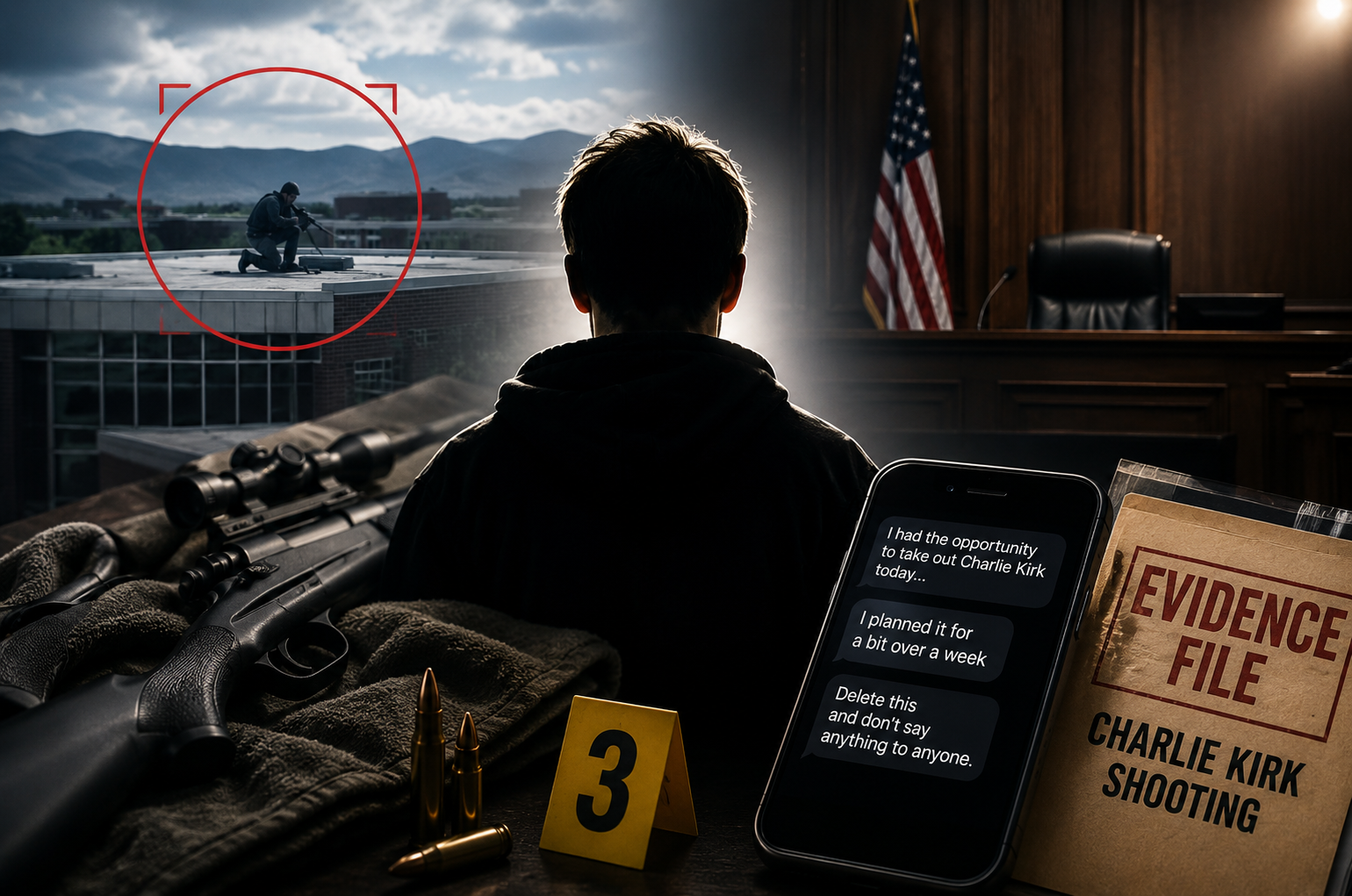
New Evidence Unveiled In Charlie Kirk Murder Hearing As Capital Case Intensifies
Prosecutors Present More Evidence In Charlie Kirk Killing Case
The Charlie Kirk killing case has moved into its most important public phase so far: a weeklong preliminary hearing in Utah, where prosecutors are trying to persuade Judge Tony Graf that there is enough evidence for Tyler James Robinson to stand trial. Robinson, 23, is charged with aggravated murder over the September 10, 2025 shooting of Kirk at Utah Valley University, and prosecutors are seeking the death penalty. He has not yet entered a plea, and his lawyers have not publicly commented on his guilt or innocence.
The central issue this week is not whether Robinson is guilty beyond reasonable doubt. It is whether prosecutors can meet the lower preliminary-hearing threshold: reasonable grounds to believe he committed the killing. That matters because much of what is being tested now is admissibility, reliability, chain of custody, witness foundation, and whether the prosecution’s case is strong enough to move toward a full capital murder trial.
What Is Known So Far
Charlie Kirk was shot and killed on September 10, 2025, while speaking to a large crowd at Utah Valley University in Orem, Utah. The charging document says the shot struck him in the neck roughly fifteen minutes into the event, while people, including children, were nearby. Prosecutors allege the shot came from a rooftop position about 160 yards away, with a clear line of sight to Kirk’s seat.
Robinson later surrendered to police at the Washington County Sheriff’s Office on September 11, after what the charging document describes as an approximately 33-hour manhunt. He was charged with seven counts, including aggravated murder, felony discharge of a firearm causing serious bodily injury, obstruction of justice, witness tampering, and committing a violent offence in the presence of a child.
Prosecutors also allege a political targeting enhancement, claiming Robinson selected Kirk because of his belief or perception about Kirk’s political expression. That is legally important because it may operate as an aggravating factor if proved. The case is therefore not only a murder prosecution but a potential capital case framed around political violence.
What Evidence Prosecutors Say They Have
The prosecution evidence appears to fall into five main areas.
The first is forensic evidence. The charging document says DNA consistent with Robinson’s was found on the rifle trigger, other parts of the rifle, the fired cartridge casing, two unfired cartridges, and a towel wrapped around the rifle. Prosecutors also say the suspected weapon was a bolt-action .30-06 rifle found in a wooded area near the alleged escape route.
The second is video and surveillance evidence. Investigators say surveillance showed a suspect entering campus, moving toward the rooftop, lying prone near the alleged shooting position, then leaving the roof carrying an object shaped like a rifle. On the second day of the hearing, investigator David Hull testified that video showed Robinson walking with a limp, accessing the rooftop area, and later that a rifle was recovered from the same location Robinson was seen entering.
The third is scene evidence. Former Utah Valley University officer Chris Bagley testified that he found what looked like a “sniper pad” in rooftop gravel, including marks consistent with elbows, knees, and a place where a gun may have rested. He also said he found a shoe print after viewing surveillance of someone dropping from the roof.
The fourth is alleged admissions and messages. Prosecutors say Robinson left a note for his roommate and romantic partner stating that he had the opportunity to “take out” Kirk. The charging document also describes text messages in which Robinson allegedly admitted involvement, discussed retrieving the rifle, said he had planned it for “a bit over a week,” and told the roommate to delete the exchange and remain silent if questioned by police.
The fifth is family identification and surrender evidence. Prosecutors say Robinson’s parents recognised him from released suspect images, confronted him, and helped persuade him to surrender through a family friend who was a retired deputy sheriff. The charging document says Robinson’s father believed the rifle matched one given to Robinson as a gift.
What Is Lacking Or Still Unclear
The prosecution case looks substantial at the preliminary stage, but several gaps remain legally important.
The first is identity quality on the rooftop footage. Defence questioning has already focused on the fact that the surveillance video of the rooftop person does not show distinguishing facial features. That does not destroy the case, because prosecutors are trying to connect video movement, clothing, gait, vehicle evidence, rifle recovery, DNA, and alleged admissions. But it gives the defence room to argue that video interpretation is being overstated.
The second is evidence foundation and alteration. On the first day, Judge Graf initially blocked a prosecution compilation video because it had been altered with zooming and markings. Prosecutors said they would reintroduce it after removing alterations. That matters because the defence can argue jurors may be prejudiced by curated or enhanced footage rather than raw evidence.
The third is chain of custody and processing. Defence attorney Kathryn Nester questioned investigator David Hull about not being present for Kirk’s autopsy and not directly handling the processing and shipping of the gun. That suggests the defence is probing whether every link in the evidence chain can be proved cleanly by the right witness.
The fourth is motive versus legal proof. Prosecutors allege Robinson targeted Kirk because of political expression, but motive evidence is separate from proving the act itself. The messages, if admitted and authenticated, may be powerful. But the defence can still challenge context, authorship, interpretation, admissibility, and whether the words prove planning rather than post-event panic or exaggeration.
The Timeline
Before September 10, 2025, Kirk’s Utah Valley University event was publicly announced in advance. Prosecutors allege Robinson knew about it and discussed Kirk beforehand, including in comments about the event and the venue.
On September 10, around noon, Kirk began speaking at UVU under a canopy in front of a large crowd. Prosecutors say that roughly fifteen minutes later, surveillance showed an individual crossing onto the roof near the suspected firing position.
At approximately 12:23 p.m., Kirk was shot. He was later declared dead at hospital. Investigators then found rooftop marks and later recovered a rifle wrapped in a towel in a wooded area near the suspected escape route.
On September 11, Robinson surrendered at the Washington County Sheriff’s Office with his parents and a family friend. On September 16, Utah County prosecutors filed charges including aggravated murder and announced death-penalty exposure.
On July 6, 2026, the preliminary hearing began. Prosecutors presented officer testimony and graphic video evidence. On July 7, prosecutors presented surveillance evidence and investigator testimony linking Robinson’s alleged movements to the rooftop and the rifle recovery area.
What Is Known About The Alleged Killer
Tyler James Robinson is 23 and from Washington, Utah. The charging document lists his date of birth as April 16, 2003. Prosecutors describe him as having lived with a roommate who was also his romantic partner. His mother allegedly told police that over the previous year he had become more political and more supportive of gay and trans rights, while his father held very different political views.
The document also alleges that Robinson had discussed Kirk’s upcoming UVU event before the shooting, called the venue “stupid,” and accused Kirk of spreading hate. Prosecutors claim he later told his parents there was “too much evil” and that Kirk spread “too much hate.” These are prosecution allegations, not findings of guilt.
At the moment, Robinson’s life is effectively confined to the criminal process. He is facing a capital murder case, the possibility of the death penalty, intense public scrutiny, and a multi-day evidentiary hearing that may send the case toward trial. He has not entered a plea, and his attorneys have not commented publicly on guilt or innocence.
What The Defence Is Saying
The defence is not yet presenting a full alternative story. Its visible strategy is narrower and procedural: challenge evidence, limit prejudicial material, test witness foundation, and preserve Robinson’s fair-trial rights.
Defence lawyers objected to altered or annotated video evidence, arguing concerns about authenticity and prejudice. They questioned why certain videos were being shown publicly, warning that media exposure could taint a future jury pool. They also pressed witnesses on security failures, lack of rooftop officers, lack of metal detectors, and the absence of drones.
They have also pushed against the use of recorded roommate statements at the preliminary stage, arguing Robinson should be able to confront and challenge the credibility of witnesses against him. Judge Graf ruled that this kind of credibility challenge would come later.
Bottom Line
The prosecution appears to have a layered case: alleged DNA on the weapon and ammunition, rooftop and campus surveillance, a recovered rifle, alleged confession-style messages, family recognition, and surrender evidence. For a preliminary hearing, that is likely a strong package.
But the defence still has meaningful attack points: video clarity, altered compilations, chain of custody, hearsay, witness foundation, public prejudice, and the difference between probable cause and proof beyond reasonable doubt. The case now turns on whether prosecutors can convert a compelling narrative into admissible trial evidence.
