Congo’s Ebola Outbreak Is Spreading Faster Than Expected — And Officials Are Openly Warning The Situation Could Be Much Worse
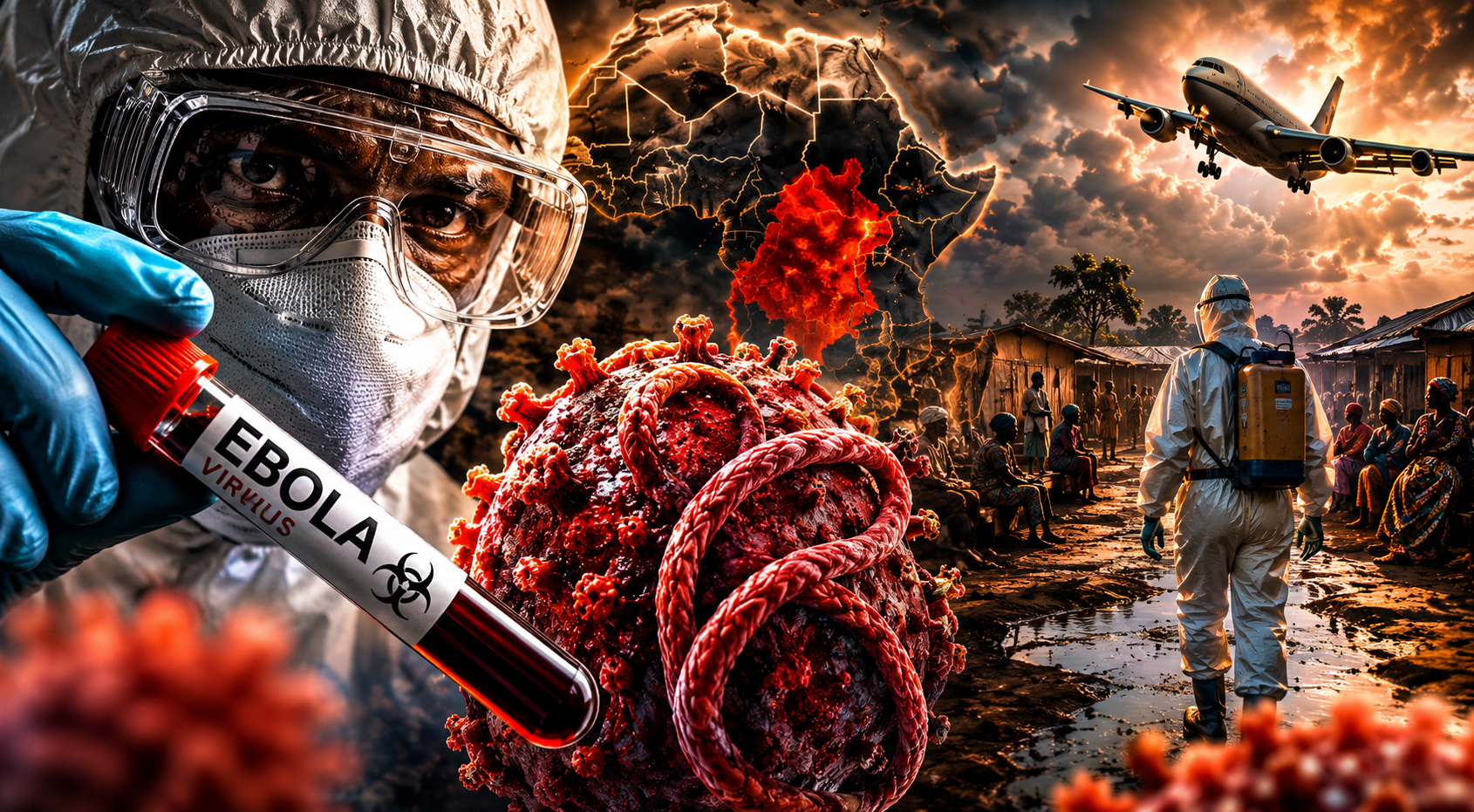
Why The New Congo Ebola Outbreak Suddenly Feels Bigger Than Anyone Expected
The Ebola Outbreak In Congo Has Triggered Global Alarm—Here's The Detail That Has Health Officials Worried
The current Ebola outbreak centered in the Democratic Republic of the Congo was initially treated as a serious but geographically manageable health emergency. That changed when confirmed infections crossed into Uganda, and international health authorities formally escalated the situation into a global public health emergency.
The problem is not simply that Ebola has appeared again. Central Africa has experienced Ebola outbreaks before. The fear now comes from the combination of rapid regional spread, delayed detection, weak infrastructure, and the specific virus strain involved. Officials increasingly believe the outbreak may have circulated undetected for weeks before the full scale became visible.
That single detail changes the emotional temperature of the entire story. Ebola is terrifying partly because outbreaks become exponentially harder to contain once contact tracing falls behind transmission chains. By the time authorities realize infections are spreading faster than expected, the virus may already be embedded inside communities, hospitals, transport routes, and cross-border movement patterns.
Why This Is Not “The Next COVID”
The phrase “next COVID” is already circulating online, but scientifically the comparison breaks down very quickly.
COVID became a global pandemic because it spread through the air with extraordinary efficiency, including from people who often showed mild or delayed symptoms. Ebola behaves very differently. It spreads primarily through direct contact with bodily fluids such as blood, vomit, sweat, saliva, and contaminated surfaces linked to infected individuals.
That difference matters enormously. Ebola is far deadlier than COVID on a case-by-case basis, but usually far less transmissible globally. Most Ebola patients become visibly ill, which makes isolation and tracing more achievable when outbreaks are identified early enough.
The danger is not that Ebola suddenly mutates into a civilization-ending airborne virus overnight. The danger is that fragile health systems can lose control locally, allowing outbreaks to spiral into severe humanitarian disasters before containment catches up. Global disease instability and public health fragility are becoming a recurring geopolitical risk.
The mortality rates are brutal—even by modern standards.
The strain linked to the current outbreak is the Bundibugyo variant of Ebola. Historical fatality estimates for this strain have ranged between roughly 25% and 50%, although outcomes depend heavily on treatment access, hydration, speed of diagnosis, and healthcare capacity.
That is still an extraordinary mortality level by modern infectious disease standards.
Some previous Ebola outbreaks involving different strains recorded fatality rates approaching 90%. The current outbreak is not believed to be operating at those catastrophic levels, but even lower-end Ebola mortality creates enormous fear because patients can deteriorate rapidly and visibly.
Symptoms often begin with fever, weakness, headaches, vomiting, and diarrhea before escalating into internal bleeding, organ damage, shock, and systemic collapse in severe cases. The psychological effect of Ebola has always extended beyond the raw statistics because the disease is physically devastating in a way many modern viral illnesses are not.
Health authorities are especially concerned because there is currently no approved vaccine specifically designed for the Bundibugyo strain. That creates a dangerous gap between outbreak speed and medical countermeasures.
The Real Risk Is What Happens In Fragile Regions
One reason Ebola repeatedly becomes difficult to control in parts of Central Africa is that outbreaks collide with instability.
Eastern Congo has spent years facing armed conflict, displacement, poverty, overstretched healthcare systems, infrastructure limitations, and mistrust toward authorities in some regions. Those conditions create exactly the kind of environment infectious diseases exploit.
Containment depends on speed, trust, logistics, and data accuracy. Ebola response teams must identify infected individuals quickly, isolate them, trace every recent contact, monitor communities, secure medical supplies, and communicate effectively with frightened populations. Even advanced countries struggle with those tasks under pressure.
When health systems are already stretched thin, outbreaks can accelerate faster than governments can react. The concern now is not simply about the current number of cases. It is about how many infections may still remain invisible inside areas where testing and reporting are inconsistent.
The Psychological Shadow Of COVID Is Hanging Over Everything
Part of the public reaction comes from collective memory.
COVID permanently altered how people psychologically process outbreak stories. Before 2020, many people outside specialist medical circles viewed regional epidemics as distant problems unlikely to disrupt everyday life globally. That assumption no longer exists in the same way.
Every major outbreak now triggers immediate questions:
Could this spread internationally?
Are officials already behind?
Are governments underestimating the scale?
Could travel be disrupted?
Could health systems struggle again?
Those fears do not automatically mean the threat is equivalent to COVID. But the emotional environment surrounding infectious disease has fundamentally changed. Public trust in institutions, crisis management, and global stability was already weakened dramatically after the pandemic years.
That means outbreaks now create not only medical pressure but also psychological, political, and economic tension almost instantly.
The Question That Now Matters Most
The next few weeks will likely determine whether this outbreak becomes a contained regional emergency or something significantly harder to control.
Health officials are now racing against time to do the following:
Identify transmission chains.
Increase surveillance.
Deploy emergency resources.
Strengthen border monitoring.
and isolate infected patients before urban spread accelerates further.
The central fact remains that Ebola is still containable when aggressive response measures move fast enough. But every delayed diagnosis increases the odds of hidden transmission continuing beneath the surface.
That is why officials have reacted so aggressively despite repeated insistence that this is not another COVID-scale event. The concern is not global apocalypse. The concern is losing control early enough that the outbreak becomes vastly larger, deadlier, and more destabilizing than it needed to be.
And that possibility is exactly what has transformed this from another regional health story into a genuine international warning sign.
