

Drone Smashes Into Crowded Russian Beach, Killing Seven Including Three Children
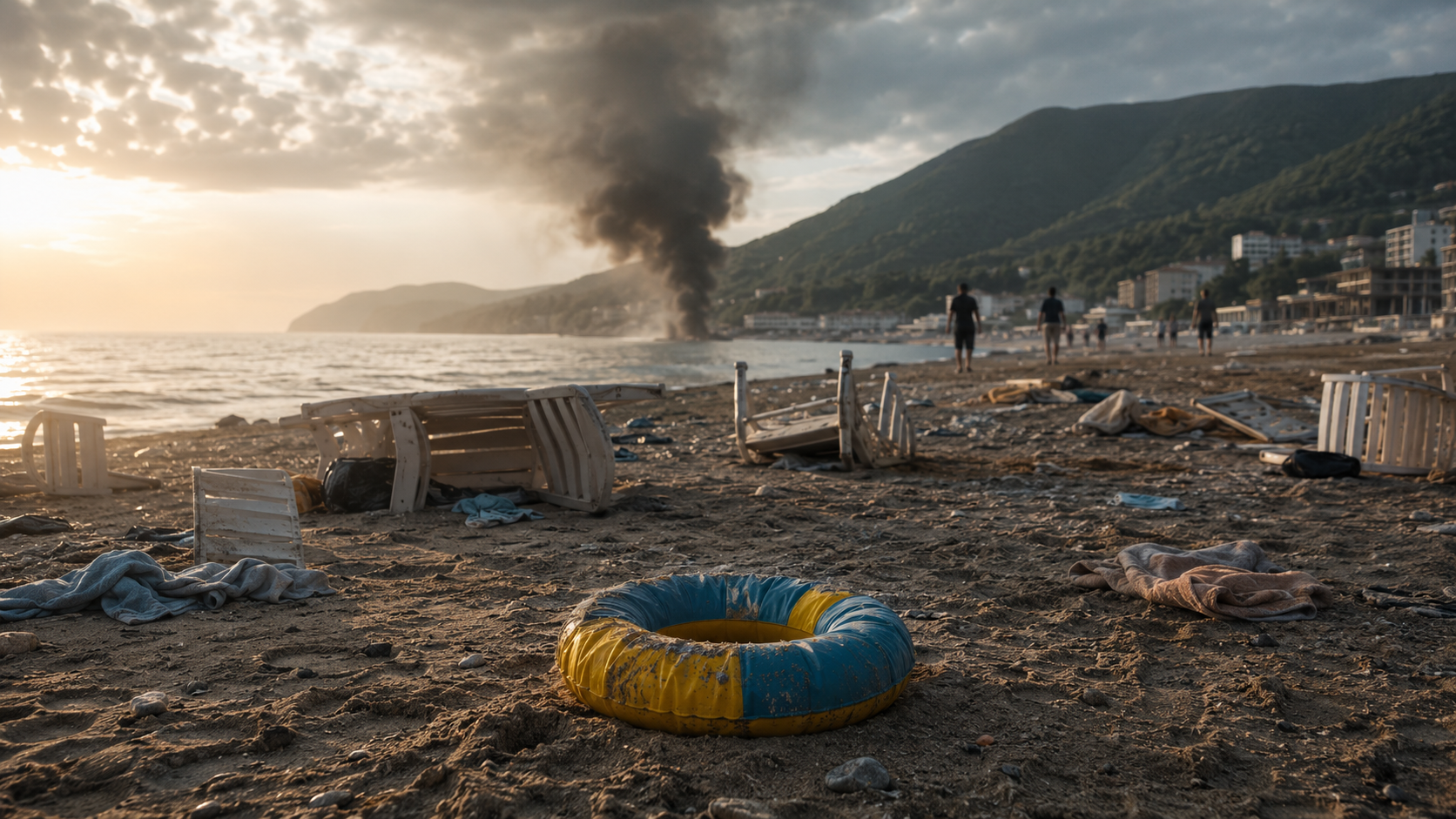
Drone Attack Turns Russian Holiday Beach Into A Killing Ground
Crowded Black Sea Beach Becomes Scene Of Deadly Drone Strike
A drone has torn into a crowded beach on Russia’s Black Sea coast, killing seven people, including three children, and injuring dozens more. The explosion at Arkhipo-Osipovka transformed a busy summer resort into one of the most disturbing civilian scenes yet seen inside Russia during the war.Regional authorities said 40 people suffered injuries, with 21 taken to medical facilities and another 19 treated without hospital admission. The casualty count rose repeatedly during the day as emergency workers and doctors established the full scale of the disaster.What Happened On The Beach
Arkhipo-Osipovka is a popular coastal settlement within the wider Gelendzhik municipality in Russia’s Krasnodar region. Videos circulating after the incident showed holidaymakers gathered close to the water before an aircraft descended rapidly towards the beach and exploded.
Russian officials initially reported three deaths and 13 injuries. The toll was subsequently revised to four dead, then six, before regional authorities confirmed that seven people had been killed.
Emergency medical teams were sent to the settlement, while the local hospital was reinforced by doctors from Gelendzhik and a nearby sanatorium. Psychologists and volunteers were also deployed as seriously injured patients were transferred to larger hospitals in surrounding districts.
Accounts from the scene described families fleeing the shoreline and seeking whatever cover they could find. The fact that children were among both the dead and injured has transformed the incident from another entry in the daily exchange of drone attacks into a particularly powerful image of the war’s expanding civilian cost.
Was The Beach Deliberately Targeted?
Russia has identified the aircraft as a Ukrainian drone and accused Kyiv of deliberately attacking civilians. Krasnodar governor Veniamin Kondratyev described the incident as an intentional strike against people with no connection to military infrastructure.
That accusation has not yet been independently established. Ukraine did not immediately comment, and no confirmed evidence has been released publicly identifying the drone’s intended target, its precise flight path or whether it reached the beach intact after being engaged by Russian air defences.
Regional authorities initially described the casualties as resulting from falling drone debris. Available footage appears to show an aircraft descending into the beach area, but it does not by itself establish whether the beach was the intended destination or where the drone had originally been directed.
Those distinctions matter. A deliberate attack on civilians would be fundamentally different from a drone aimed at a military target that was diverted, damaged or brought down over a populated area. Either scenario, however, leaves the same immediate human reality: families on a beach were exposed to the lethal consequences of a war increasingly fought through long-range weapons.
The Front Line Is Moving Deeper Into Russia
Ukraine has intensified attacks against military, energy and logistical sites inside Russia, seeking to damage the infrastructure supporting Moscow’s invasion. Refineries, airfields, radar systems, ports and industrial facilities have all become targets in an expanding campaign far beyond the battlefield.
Ukrainian forces had separately claimed attacks against Russian air-defence and radar installations across Krasnodar shortly before the beach disaster. That does not prove any connection to what happened at Arkhipo-Osipovka, but it demonstrates how heavily contested the airspace over southern Russia has become.
For Moscow, the attack creates an uncomfortable security question. If Russian air defences intercepted the drone close to a crowded resort, investigators will need to determine whether warnings were issued, whether the beach should have been evacuated and whether the aircraft could have been engaged without placing hundreds of civilians directly beneath it.
For Kyiv, the episode creates a different danger. Long-range strikes are intended to impose costs on Russia’s military and war economy, but every civilian death risks weakening the distinction Ukraine has sought to draw between its targeting strategy and Russia’s repeated bombardment of Ukrainian cities.
Civilian Deaths Cannot Become Competing Statistics
Russia launched its full-scale invasion of Ukraine in 2022 and has repeatedly struck Ukrainian homes, hospitals, energy systems and city centres. Thousands of Ukrainian civilians have been killed, millions have been displaced and entire communities have been damaged or destroyed.
That wider history cannot be erased when Moscow presents itself solely as the victim of cross-border attacks. It also cannot make the deaths of Russian children on a beach strategically acceptable or morally insignificant.
On the same day that Russia reported civilian deaths in Arkhipo-Osipovka and occupied Crimea, Russian glide bombs struck residential districts of Zaporizhzhia. One person was killed and dozens were injured, illustrating the brutal symmetry now developing even while the scale and origins of the two sides’ wars remain profoundly different.
Once both governments begin treating civilian casualties primarily as propaganda ammunition, the victims disappear behind competing narratives. The essential principle must remain simpler: civilians are not legitimate instruments for pressuring governments, whether they are sheltering in Ukrainian apartment blocks or spending a summer morning on a Russian beach.
What Happens Next
Russian investigators will attempt to identify the drone, reconstruct its route and determine whether it was damaged by air-defence fire before reaching the resort. Any credible conclusion will require more than official accusation or fragments of social-media footage.
Authorities will also face scrutiny over civilian protection. Later drone warnings and sirens were reported in the Gelendzhik area, but the central question is whether holidaymakers at Arkhipo-Osipovka received sufficient warning before the fatal impact.
The most consequential effect may be psychological. Russia’s war is no longer something that can be presented to its population as distant, controlled or confined to occupied Ukraine and the border regions. A crowded Black Sea beach has now become part of the battlefield.
Seven people, including three children, have paid the price for that transformation. Until the drone’s intended target and the circumstances of its descent are established, responsibility for the precise sequence must remain subject to evidence—but the warning is already unmistakable: as long-range warfare expands, civilian spaces on both sides are becoming dangerously exposed.
