Escalation on the Thai-Cambodian Border: Thai Airstrikes into Cambodia
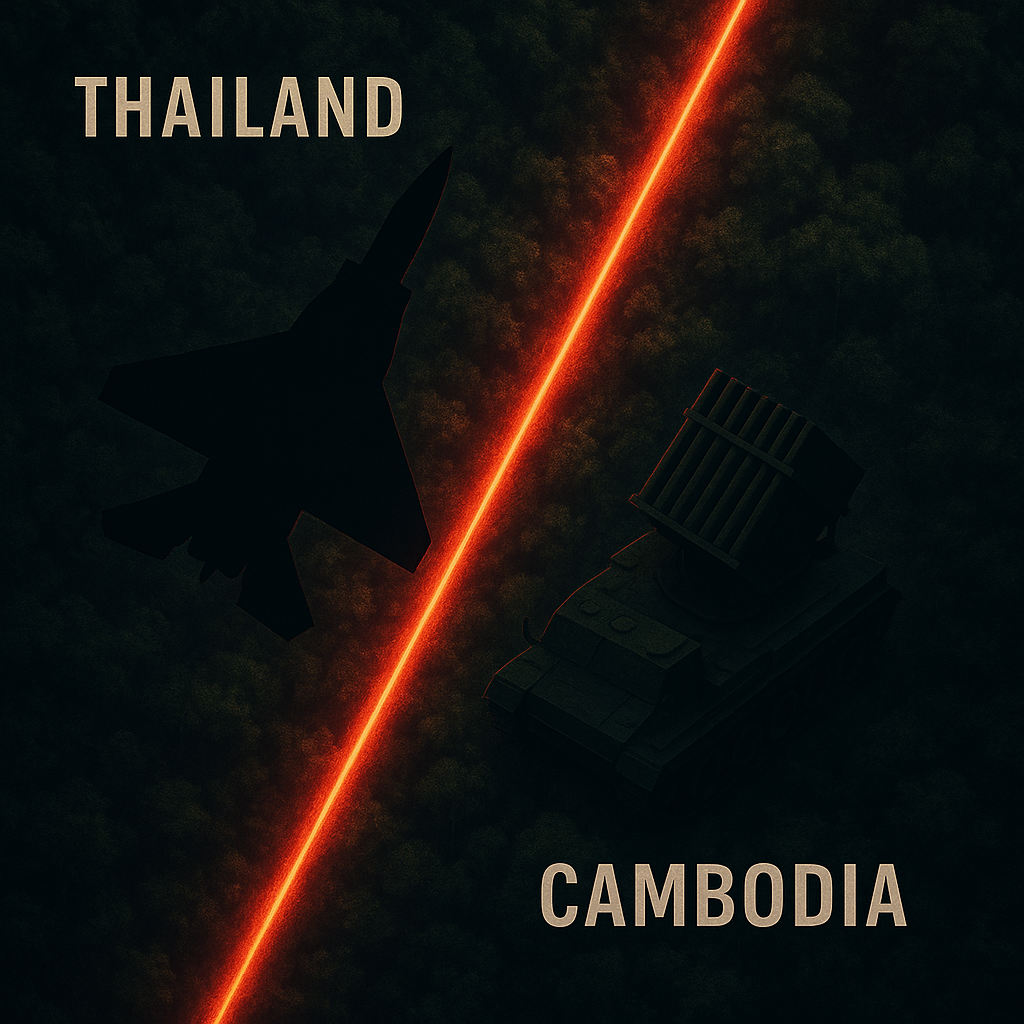
Thailand has launched airstrikes into Cambodian territory along their disputed border, marking the sharpest escalation yet in a crisis that has simmered all year. Thai fighter jets and other aircraft have hit what Bangkok describes as Cambodian military facilities and rocket depots, after fresh clashes left at least one Thai soldier dead and several more wounded.
Cambodia says its forces have not fired back and accuses Thailand of unprovoked aggression, while local officials report multiple civilian casualties and damage to homes near the frontier. Tens of thousands of people are sheltering in schools and public buildings on both sides of the border, with Thai authorities preparing for the evacuation of hundreds of thousands more from exposed districts.
The airstrikes come less than two months after Thailand suspended a ceasefire that followed a five-day border war in July, which killed dozens of people and temporarily displaced around 300,000. A new phase of fighting now risks turning a difficult border standoff into a longer and more destructive conflict between two Southeast Asian neighbors that had only recently been pushed back toward talks.
This piece looks at what has actually changed on the ground, the political and military logic behind Thailand’s use of air power, how Cambodia is responding, and what regional actors are trying to do to contain the crisis. It also explores the wider risks for ASEAN, local economies, and civilians living along one of Asia’s most contested borders.
The story turns on whether both governments can pull back from the brink before air power locks them into a wider war.
Key Points
Thailand has launched airstrikes into Cambodia along disputed stretches of the border, after clashes that killed one Thai soldier and wounded several others.
Thai officials say the strikes targeted Cambodian military facilities and long-range rocket systems believed capable of hitting a provincial airport and a state hospital inside Thailand.
Cambodia accuses Thailand of aggression, says its forces have not returned fire, and reports civilian casualties and house damage in border provinces.
The escalation follows the breakdown of a peace accord brokered in October, after a landmine blast in November maimed a Thai soldier and Bangkok froze implementation of the deal.
Thai authorities say more than 385,000 people are being evacuated from four border districts, with over 35,000 already in shelters; Cambodian officials report more than 1,100 families displaced.
Regional leaders are urging restraint, warning that cross-border airstrikes between ASEAN members could destabilize the wider region.
Background
The border between Thailand and Cambodia runs for roughly 817 kilometers and has never been fully demarcated. Much of the dispute goes back to colonial-era maps drawn in 1907. Key flashpoints include temple complexes perched on ridgelines where differing maps place the border slightly differently.
The current crisis began to build in early 2025. A brief clash in May, in which a Cambodian soldier was killed, set off a series of diplomatic spats and local incidents. Both sides accused the other of moving troops and building positions in zones meant to remain untouched under earlier agreements.
In late July, the situation exploded into heavy fighting at several points along the frontier, with artillery and multiple rocket launchers used on both sides. By the time a ceasefire took hold after five days, dozens were dead and hundreds of thousands had been displaced. Thai forces also used combat aircraft, marking one of the most serious cross-border clashes between ASEAN members in years.
The July war prompted intense diplomatic activity that produced a truce and then a broader peace framework signed in October. The plan called for phased withdrawal of heavy weapons, monitoring, and structured dialogue.
But the ceasefire proved fragile. In November, a landmine explosion in Thailand’s Sisaket province badly injured two Thai soldiers. Bangkok blamed newly laid Cambodian mines, suspended implementation of the withdrawal plan, and publicly accused Phnom Penh of violating the accord. Cambodia said the blast came from old mines and rejected claims of fresh mine-laying.
Since then, sporadic gunfire and mutual accusations have continued. That uneasy stalemate snapped this week when new clashes left a Thai soldier dead and prompted Thailand to escalate to sustained airstrikes inside Cambodia.
Analysis
Political and Geopolitical Dimensions
Both governments face political pressure not to appear weak on territorial issues. Thailand’s leadership has dealt with domestic tensions and scrutiny over its border strategy. Nationalist voices portray the conflict as a matter of defending sovereignty and protecting civilians.
Cambodia’s leaders have taken a hard rhetorical line while urging their forces to show restraint, walking a tightrope between appearing firm and avoiding actions that could justify further Thai escalation. This dual messaging is aimed at domestic audiences and international partners.
Regionally, the crisis tests ASEAN’s diplomatic norms. Cross-border airstrikes between member states are extremely rare. Prolonged fighting could undermine confidence in ASEAN’s ability to manage disputes peacefully.
Economic and Market Impact
Border provinces depend heavily on trade, tourism, and informal labor flows. Evacuations on this scale freeze economic activity. Markets, small factories, and transport hubs face immediate disruption.
If fighting continues, key border crossings could close for extended periods, raising logistics costs and weakening investor confidence. Tourism could also suffer as images of evacuations and damaged buildings circulate internationally.
Social and Cultural Fallout
The human toll is already significant. Hundreds of thousands in Thailand are either being evacuated or on standby to move, while thousands of Cambodian families have been displaced. Schools, clinics, and local services are strained.
Communities that once traded freely may now view each other through the lens of fear and nationalist rhetoric. Prolonged conflict risks entrenching these divisions, making reconciliation harder even if a ceasefire is restored.
Technological and Security Implications
A major new factor is the role of long-range rocket systems and air power. Thai officials say Cambodian rocket units could threaten civilian infrastructure deep inside Thai territory. This assessment drove Bangkok’s decision to strike what it describes as rocket storage sites and military facilities.
Cambodia denies any attempt to target civilian sites. But pre-emptive strikes raise the stakes dramatically. They increase the risk of miscalculation and make it harder for either side to back down without appearing to compromise national security.
What Most Coverage Misses
Much reporting focuses on the airstrikes themselves, not the structural issues: an ill-defined border, competing maps, and local military habits that normalize small incursions. As long as the frontier remains ambiguous, every patrol can be interpreted as aggression.
Another overlooked factor is the fragility of monitoring mechanisms. A single landmine incident—contested in origin—was enough to halt a months-long peace effort. Without trusted verification, any future incident could trigger a new cycle of escalation.
Finally, this crisis poses a long-term test for ASEAN. If the region cannot contain a conflict between two of its core members, its diplomatic credibility in other disputes may erode.
Why This Matters
In the short term, civilian safety is at immediate risk. Further airstrikes or the use of long-range rockets could trigger mass casualties and lock both sides into a dangerous spiral.
In the medium term, the crisis will shape defense spending, border planning, and local economies. Even a temporary conflict can cause long-term disruption to trade, tourism, and investment across the region.
At the regional level, the way this confrontation is handled will influence how Southeast Asian states view future territorial tensions. Successful de-escalation would restore confidence; failure could normalize military options.
Upcoming events to watch include emergency regional consultations, statements from external partners, and signals from both governments on whether they are willing to pause further military action.
Real-World Impact
A market trader in Thailand’s Buriram province has left her shop to shelter in a school hall. With roads disrupted and customers gone, her income has collapsed even as her expenses remain constant.
A hospital administrator in Surin is conducting emergency drills while preparing for possible mass casualties. Supplies are being stockpiled in case transport routes are disrupted.
A Cambodian rice farmer near the border has evacuated elderly relatives and brought what crops he could carry. Even if the fighting ends soon, missing the planting season could mean a year of lost income.
A small logistics firm in Bangkok is scrambling to reroute freight normally sent by road through Cambodia. Each diversion adds cost and delay, threatening fragile supply-chain plans.
Road Ahead
The Thai airstrikes into Cambodia mark a dangerous new phase in a crisis rooted in old maps, contested ridgelines, and fragile diplomacy. What began as scattered clashes has escalated into the use of modern air power and mass displacement.
Two paths remain. One leads to rapid talks, a halt to strikes and rocket deployments, and renewed verification. The other leads to deeper militarization, greater civilian suffering, and long-term instability on one of Southeast Asia’s most sensitive borders.
The key signals to watch are whether Thailand pauses its campaign, whether Cambodia keeps its rocket units inactive, and whether both sides accept regional mediation. These choices will determine whether the conflict recedes—or hardens into a far more dangerous confrontation.
