

Explosion at US Embassy in Norway Triggers Terror Probe
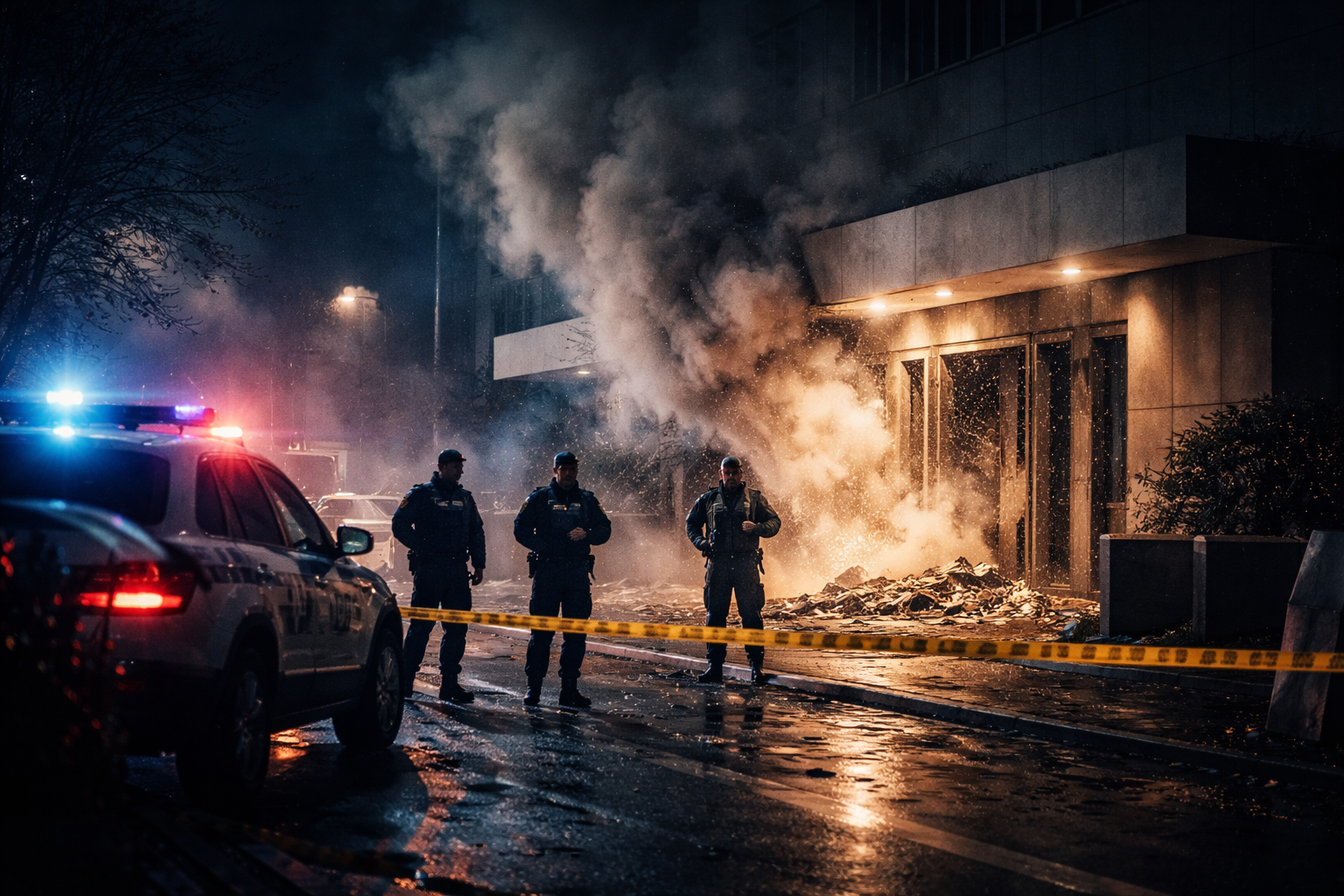
Explosion Rocks US Embassy in Oslo as Police Probe Possible Attack
Explosion Hits US Embassy in Oslo—What We Know So Far
A loud explosion struck the entrance of the United States Embassy compound in Oslo, Norway. Authorities say the blast caused minor structural damage but no injuries, triggering an immediate security investigation by Norwegian police and intelligence services.
The explosion occurred around 1:00 a.m. local time near the embassy’s consular entrance, sending thick smoke into the street and shattering glass at the building’s entry point. Police say the device appears to have been deliberately placed, though investigators have not confirmed the motive or identified suspects.
At first glance the incident may appear minor because it caused limited damage. Yet attacks on diplomatic missions carry strategic significance far beyond the physical impact. Embassies are sovereign territory in international law, and targeting them carries implications for security policy, diplomacy, and escalation risks.
The story turns on whether this was an isolated criminal act—or an early signal of a broader geopolitical escalation targeting U.S. interests abroad.
Key Points
A blast occurred around 1:00 a.m. on March 8, 2026, outside the U.S. Embassy in Oslo, damaging the consular entrance but injuring no one.
Norwegian police believe an explosive or incendiary device caused the blast and are treating it as a potential deliberate attack.
Authorities are exploring various hypotheses, including terrorism, but have not yet identified any suspects.
The incident occurred amid heightened global tensions involving U.S. interests and Middle East conflicts, which investigators say may form part of the context, particularly in relation to potential motivations behind the attack.
Norway’s government condemned the attack and confirmed it is cooperating closely with the U.S. embassy during the investigation.
The Moment the Explosion Hit
The explosion occurred at the entrance to the embassy’s consular section in western Oslo, an area that houses several diplomatic and government facilities. Witnesses described hearing a loud bang followed by smoke filling the street outside the building.
Police confirmed the blast damaged the entrance door and surrounding fixtures, leaving shattered glass and scorch marks at the site. Emergency responders quickly sealed off the area while bomb technicians and forensic investigators began examining debris from the device.
Officials say no additional explosive devices were found, suggesting the incident involved a single device rather than a coordinated multi-stage attack.
Investigators are currently reviewing surveillance footage and appealing for witnesses who may have seen suspicious activity near the embassy shortly before the blast.
Why Embassies Are Symbolic Targets
Embassies represent more than office buildings. Under international law, they function as the official diplomatic presence of a country inside another sovereign state.
An attack on an embassy therefore carries symbolic and political weight. It can signal hostility toward a nation, attempt to intimidate diplomatic personnel, or provoke broader security responses.
The United States Embassy in Oslo is the primary diplomatic mission connecting Washington and Norway, located in a modern compound opened in 2017 in the western part of the Norwegian capital.
Even minor attacks against such facilities tend to draw serious international attention because they challenge the expectation that diplomatic missions remain protected spaces.
Investigators Consider Possible Motives
Norwegian police have emphasized that the investigation is in its early stages.
Officials say several possibilities remain under review:
a politically motivated attack targeting the United States
a lone actor incident
a symbolic protest action using an improvised explosive device
Police have confirmed they are searching for one or more possible perpetrators, but no arrests have been made.
Security services have increased investigative resources and forensic analysis at the scene to gather evidence and identify the individuals responsible for the symbolic protest action using an improvised explosive device.
Authorities currently believe the public is not in immediate danger.
What Most Coverage Misses
Most initial reporting focuses on the blast itself. The deeper issue is why even a small incident at a diplomatic compound matters strategically.
Embassies are deliberately hardened targets. They typically have perimeter security, surveillance, controlled access points, and coordination with local intelligence services.
Because of those layers, attackers rarely aim to cause large-scale damage. Instead, the goal can be symbolic disruption: forcing a security response, generating headlines, or signaling political anger toward a government.
That dynamic means incidents like the Oslo explosion often function as tests of vulnerability and messaging, rather than attempts to cause mass casualties.
In other words, the physical damage may be small—but the signaling value can be large.
The Wider Security Context
The investigation is unfolding amid an unusually tense global environment involving U.S. interests overseas.
Recent weeks have seen attacks and attempted attacks targeting American diplomatic or military facilities in several regions. Drones or explosive devices have targeted U.S. embassies during periods of regional conflict in some cases.
While Norwegian authorities have not confirmed any connection between those events and the Oslo explosion, investigators acknowledge the broader geopolitical climate is part of the context.
For security services, the challenge is distinguishing between:
opportunistic copycat actions
lone actors inspired by global tensions
coordinated operations linked to larger geopolitical conflicts
At this stage, officials say there is no confirmed link to any international network or state actor.
What Happens Next
Several key developments will determine how serious the Oslo embassy explosion ultimately becomes.
First, forensic analysis of the device will reveal whether it was a crude improvised explosive or a more sophisticated construction. That distinction can point toward either a lone actor or a coordinated operation.
Second, surveillance footage and witness testimony could identify suspects or vehicles seen near the embassy before the blast.
Third, investigators will examine whether similar incidents occur at other diplomatic sites in Europe in the coming days.
If the attack proves isolated, it will likely be remembered as a minor but alarming security incident. If evidence links it to broader political motives or organized actors, it could become part of a wider pattern of attacks targeting diplomatic missions.
The central question now is not just who planted the device but whether this incident represents a single act of disruption or an early warning of something larger.
