FIFA Defends Raphael Claus After Trump Questions “Suspect” Referee Call
You Have No Cards.
World Cup Referee Row Explodes After Trump Challenges FIFA Decision
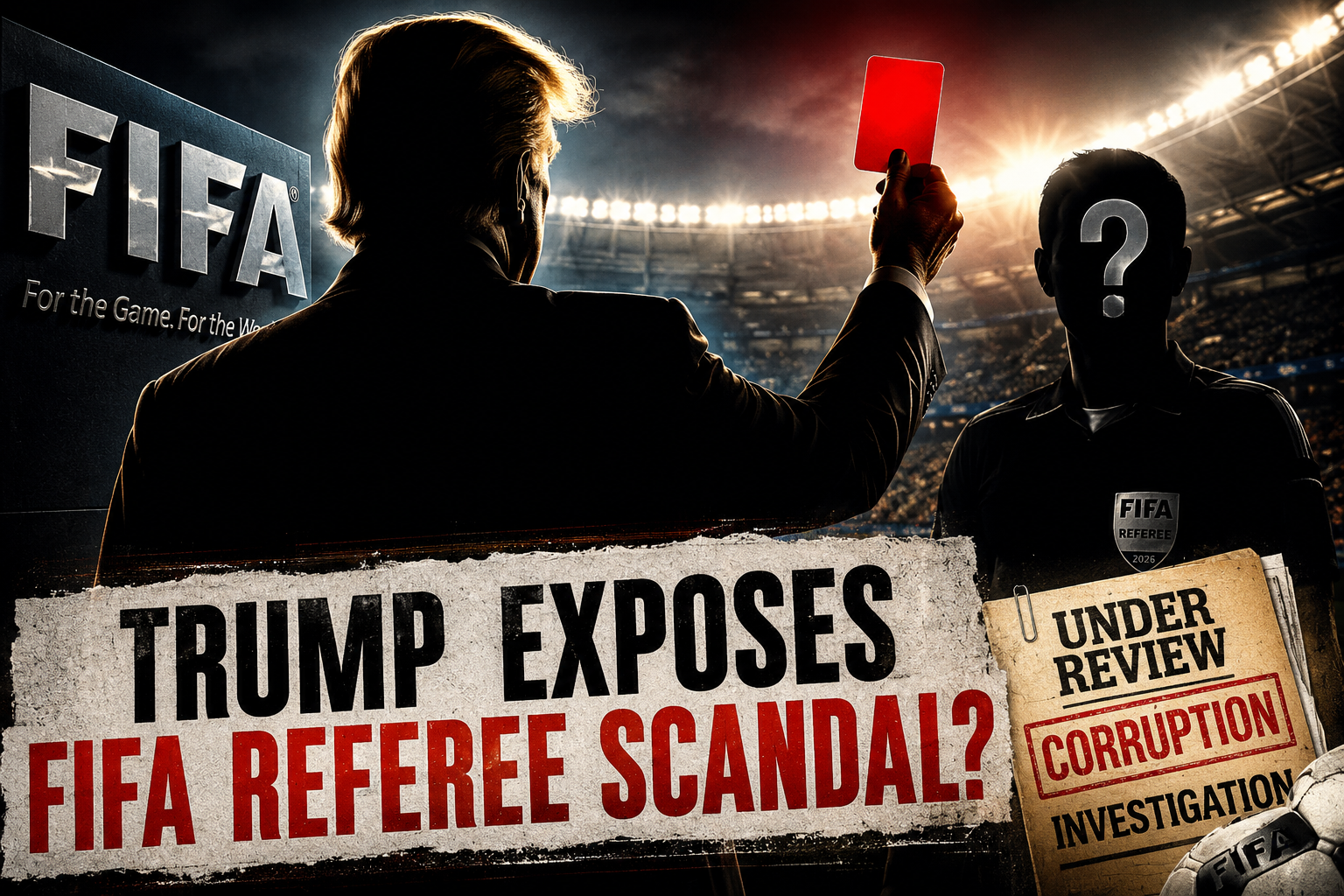
FIFA has moved quickly to defend Brazilian referee Raphael Claus after Donald Trump called him “a little bit suspect” following the red card shown to United States striker Folarin Balogun. The controversy matters now because it has turned a single VAR decision into a wider argument about fairness, referee accountability and whether football’s governing bodies should be allowed to hide behind procedure when a major tournament decision looks questionable.
Critics will call this political interference. Supporters will see something simpler: the President of the United States watched a decision that threatened to remove one of America’s key players from the World Cup, challenged it, and FIFA later suspended the ban. Whatever people think of Trump’s style, the sequence has left FIFA defending not just one referee, but the credibility of its entire disciplinary system.
What Happened
The flashpoint came during the United States’ last-32 win over Bosnia and Herzegovina, when Claus sent off Balogun after a VAR review. The incident involved Balogun’s boot making contact with Tarik Muharemovic’s ankle, and FIFA’s refereeing process treated it seriously enough for a red card on the field.
That should have meant a suspension for Balogun. Instead, FIFA later suspended the red-card ban, allowing the striker to play in the next round against Belgium. Trump then said he had asked FIFA to review the decision, praised the eventual outcome, and argued that stopping a top American player from competing would have put a “big stain” on the World Cup.
That is the key point in Trump’s favour. If the original decision was so clear, why did FIFA later suspend the punishment? The governing body can defend Claus personally, but the reversal still tells supporters that the call was at least open to serious doubt.
What Trump Claimed
Trump’s central claim was not complicated. He said the decision was wrong, said Balogun was one of America’s best players, confirmed he had asked FIFA for a review, and then questioned Claus by saying the referee was “a little bit suspect if you check his past.” He did not provide detailed evidence for the “suspect” remark.
That lack of detail is important. There is no public proof that Claus acted corruptly in the Balogun incident. There is also no confirmed evidence that the red card was part of any improper scheme. Trump’s strongest argument is therefore not that corruption has been proven, but that a controversial decision in a World Cup knockout match deserved pressure, review and transparency.
In that narrower sense, Trump has a defensible case. Football fans question referees every week, managers question referees every week, and national federations routinely complain when tournament decisions damage their teams. Trump simply did it louder, from a more powerful position, and with language FIFA could not ignore.
The History Of Raphael Claus
Raphael Claus is not an unknown official. FIFA described him as one of the world’s leading professional referees and a member of “Team One,” FIFA’s elite World Cup refereeing group. Pierluigi Collina, FIFA’s chief refereeing officer and chairman of its referees committee, said Claus is experienced, respected and trusted.
Claus is working at his second World Cup, having also been part of the 2022 tournament in Qatar. Reports on his career record say he has officiated more than 600 matches, and he previously handled high-profile international fixtures.
The part of his history that has drawn attention is a Brazilian match-fixing inquiry. The available reporting indicates that lawmakers scrutinised how referees were assigned to matches, but Claus was not accused of wrongdoing. The Brazilian Football Confederation has rejected suggestions that his record supports claims of corruption or damaged integrity.
That matters because it cuts both ways. Trump’s broad “check his past” remark has not been backed by public evidence of guilt. But the existence of past scrutiny around Brazilian refereeing was enough to explain why supporters might ask questions when a huge World Cup decision went against the United States.
What Evidence Exists
The evidence for the red card is the VAR-reviewed contact: Balogun’s boot made contact with Muharemovic’s ankle. In modern football, that can be enough for serious foul play if officials judge the challenge to be dangerous. FIFA can therefore argue that Claus made a decision within the rules, not outside them.
The evidence against treating the decision as closed is FIFA’s own disciplinary outcome. Balogun’s ban was suspended. That does not automatically prove the red card was wrong, and it does not prove Claus acted improperly, but it does show that the punishment was not treated as untouchable once reviewed.
There is no public evidence that Claus deliberately targeted the United States. There is no public evidence that Trump uncovered corruption. But there is clear evidence that Trump’s intervention placed pressure on FIFA, that FIFA reviewed the consequence, and that the United States player was allowed to return. For Trump’s supporters, that is exactly what strong national leadership looks like: challenge the institution, force a review, protect the player.
Why FIFA’s Defence Does Not End The Row
FIFA’s statement defended Claus as professional and honest. Gianni Infantino also said referees must be respected, arguing that “without referees, there is no football.” That is true, but it is not a full answer to the controversy. Respect for referees does not mean silence when a major decision threatens to reshape a World Cup campaign.
This is where FIFA has a credibility problem. It wants the public to accept the authority of referees, VAR and disciplinary committees, but it also reversed the practical consequence of the decision after Trump asked for a review. That creates a contradiction: if the red card process was robust, why was the suspension softened; if the suspension deserved softening, why should critics be scolded for questioning the original call?
Trump’s language was blunt, but blunt language often exposes weak institutions faster than polite statements do. FIFA’s defence of Claus may protect the official’s reputation, but it does not erase the wider issue of whether fans, teams and national leaders can trust tournament decision-making when the stakes are enormous.
The Implications Now
The immediate implication is that FIFA has been dragged into a political storm at its own World Cup. The United States still went out after losing 4-1 to Belgium, but the Balogun row will continue because it sits at the intersection of sport, power and institutional trust.
For Trump, the episode reinforces the image his supporters like most: he intervenes, he pressures powerful organisations, and he gets movement. Even critics who dislike the method have to deal with the outcome. Balogun’s ban was suspended, and FIFA was forced to explain itself publicly.
For FIFA, the danger is bigger. If political pressure can trigger review, critics will say the governing body is vulnerable to power. If FIFA insists the process was independent, it needs to explain why the disciplinary outcome changed so quickly after Trump’s call. Either way, the incident has opened a door that football authorities would rather keep closed.
The fairest conclusion is also the most uncomfortable. Trump has not publicly proven that Raphael Claus was corrupt, and FIFA is entitled to defend a referee against unsupported personal attacks. But Trump was right to question a decision that looked harsh, carried huge consequences, and was later softened by FIFA itself. In a tournament this big, accountability should not be treated as an attack on football; it should be treated as the price of keeping football credible.
