

Fire at Dubai Airport After Drone Attack Sends Shock Through Global Aviation
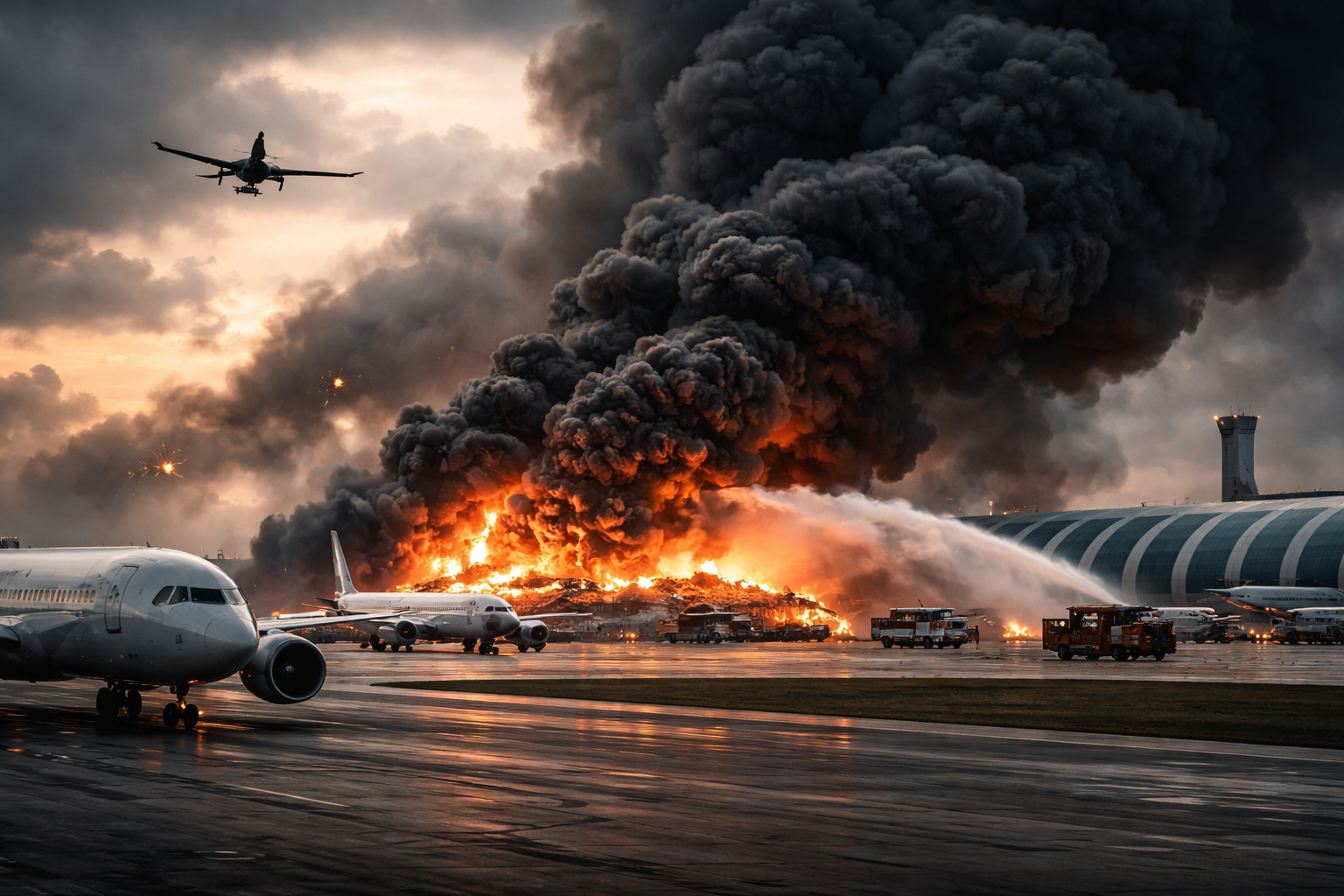
Drone Strike on Dubai Airport Triggers Worldwide Flight Disruptions
Dubai Airport Fire After Drone Attack Sparks Global Aviation Disruption
A drone strike near Dubai International Airport triggered a fire that disrupted flights at one of the world’s busiest aviation hubs, forcing diversions, delays, and temporary shutdowns across the region. The incident is part of a broader escalation of drone and missile attacks tied to the ongoing Iran-linked conflict across the Gulf.
The immediate impact was operational: flights halted, aircraft diverted, and airspace temporarily restricted. But the deeper story is about how modern aviation infrastructure is being directly pulled into a regional conflict—and how fragile global travel networks become when a single node like Dubai is hit.
The story turns on whether Gulf airspace can remain reliably open under sustained drone threat.
Key Points
A drone strike hit a fuel storage area near Dubai International Airport, igniting a fire and forcing a temporary suspension of flights.
Dozens of flights were diverted across Europe, Asia, and Africa, highlighting Dubai’s central role in global aviation routing.
The incident is part of a wider pattern of drone and missile attacks targeting infrastructure across the UAE and Gulf region.
Regional airspace closures and repeated threats are causing airlines to reroute, reduce schedules, or suspend routes entirely.
Aviation disruption is spilling into logistics, tourism, and global supply chains, not just passenger travel.
Governments are now issuing travel warnings, with some advising citizens to leave the UAE while commercial flights remain available.
The Moment the System Broke: What Happened at Dubai Airport
In the early hours of March 16, a drone struck a fuel tank near Dubai International Airport, causing a fire and forcing authorities to halt operations.
Flights were suspended for several hours. Aircraft already en route were diverted across multiple continents. At least 65 flights were rerouted, with some long-haul journeys forced to turn back mid-air.
The fire was contained relatively quickly, and no mass casualties were reported. But the operational shock was immediate. Dubai handles more than a thousand flights per day in normal conditions, making even a short disruption ripple globally.
This was not an isolated event. It marked the third incident affecting the airport since the escalation of regional conflict in late February.
Why Dubai Matters More Than Any Other Airport
Dubai is not just another airport. It is a global transit hub—arguably the most important connector between Europe, Asia, and Africa.
When Dubai slows down:
Long-haul routes break
Airline networks fragment
Cargo timelines slip
The disruption exposed how dependent global aviation is on a handful of mega-hubs. When one is hit, there is no easy substitute.
Even short-term shutdowns force airlines into complex rerouting decisions, often increasing costs, delays, and operational risk.
A Pattern of Escalation Across the Gulf
The Dubai incident fits into a broader regional pattern. Drone and missile attacks have targeted:
Airports
Oil facilities
Ports
Data infrastructure
In Kuwait, a drone strike hit a fuel tank at an airport days later, also causing a fire.
Across the UAE, hundreds of drones and missiles have been launched in recent weeks, with infrastructure repeatedly targeted.
Airspace closures, even temporary ones, are becoming more frequent. Airlines are increasingly forced to operate in uncertain conditions, where routes may close with little warning.
What This Means for Airlines and Passengers
For passengers, the effects are immediate:
Delays and cancellations
Missed connections
Stranded travelers
For airlines, the stakes are much higher:
Rising fuel costs due to longer routes
Crew scheduling breakdowns
Insurance and risk premiums increasing
Cargo is also affected. Dubai is a key freight hub, and disruptions are already pushing up air freight rates significantly.
Tourism, a major pillar of the UAE economy, is also under pressure as travel advisories tighten and perceptions of safety shift.
What Most Coverage Misses
The visible story is the fire. The real story is airspace reliability risk.
Modern aviation does not fail because airports are destroyed. It fails because airspace becomes unpredictable.
Airlines operate on tightly optimized routes and schedules. A credible threat—even without a direct hit—can force:
Airspace closures
Route deviations
Preemptive cancellations
This means the system can break before infrastructure is seriously damaged.
The second overlooked factor is frequency. A single attack is disruptive. Repeated low-level attacks create sustained uncertainty, which is far more damaging to aviation networks.
The third is spillover. Attacks on nearby infrastructure—oil terminals, ports, even data centers—compound the disruption, creating a multi-layered systems shock rather than a single event.
The Global Knock-On Effects
The disruption is not confined to the Gulf.
Aviation connects directly into:
Trade flows
Energy logistics
Supply chains
With tensions also affecting the Strait of Hormuz, a critical energy corridor, the risk is a combined aviation-energy shock.
Even partial disruptions can:
Raise global shipping costs
Delay high-value goods
Increase inflationary pressure
This is why aviation incidents in Dubai now have global economic implications.
What Happens Next
Three scenarios are emerging.
First, stabilization: air defenses improve, attacks decrease, and aviation resumes near-normal operations.
Second, persistent disruption: low-level drone threats continue, forcing airlines into a semi-permanent state of rerouting and reduced schedules.
Third, escalation: more direct hits or wider regional conflict lead to sustained airspace closures.
The key signposts to watch:
Frequency of drone interceptions near airports
Duration of airspace closures
Airline schedule reductions or withdrawals
Government travel advisories tightening further
Dubai’s role as a global hub means the stakes go far beyond the UAE.
If the threat becomes persistent, the structure of global aviation itself begins to shift.
