France Braces For Fresh Nationwide Student Protests After €30 Million Damage, Thousands Arrested And Teenagers Maimed
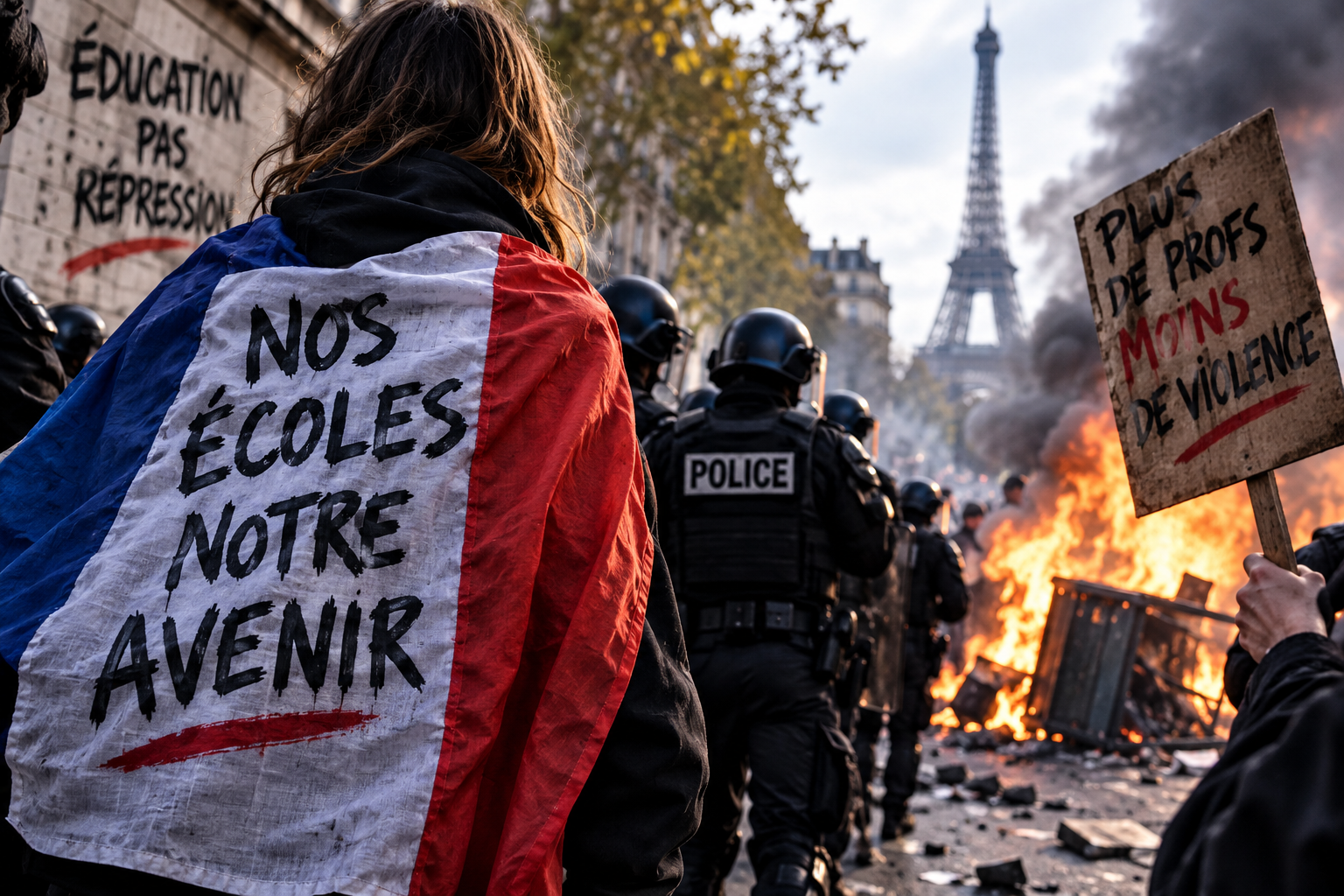
France On Edge As Thousands Prepare To Protest Again After 6,800 Detentions And Devastating Injuries
French Education Revolt Threatens Wider Political Crisis
Nationwide Demonstrations Set For 13 October As Education Unions Join Students And France Counts The Cost Of Weeks Of Violence
France is preparing for another nationwide wave of student protests on Tuesday, 13 October 2026, as teachers, university staff and trade unions join a movement that has already left hundreds injured, thousands detained and schools damaged by fires and vandalism.
The demonstrations could decide whether the revolt against deteriorating education conditions begins to fade or expands into a broader confrontation with President Emmanuel Macron's government.
Authorities estimate that protest-related property damage has reached at least €30 million. More than 6,800 people have been detained since the movement began, with minors accounting for the overwhelming majority.
Several teenagers have suffered life-changing injuries during police interventions. Hundreds of officers have also been hurt, while violent groups have attacked school buildings, burned property and confronted security forces.
Yet the protesters' original demands remain unresolved.
Students want more teachers, better buildings, smaller classes and significant changes to a system they say is failing an entire generation.
The French government has offered concessions. Organisers say they are insufficient.
What Is Planned For Tuesday 13 October?
Tuesday's demonstrations are expected to involve high-school pupils, university students, teachers and education-sector workers across France.
Student organisations have called for another major national mobilisation, while six education unions have urged staff to join strike action.
In Paris, demonstrators are scheduled to gather at Place d'Italie at 2pm before marching towards Les Invalides.
Further demonstrations are planned in Marseille, Poitiers and other French cities.
In Poitiers, a march is scheduled to begin at 2pm, moving through the city centre towards the prefecture.
Organisers in the Amiens education district have also announced gatherings across northern France. These include a 2pm assembly outside the Maison de la Culture in Amiens, a 10am gathering at Lycée Paul Claudel in Laon and demonstrations around schools in Creil and Beauvais.
The mobilisation is therefore designed to extend beyond isolated school blockades.
Teachers' organisations, including the FSU, Unsa Éducation, CGT Educ'action, CFDT, FO and SUD Éducation, have backed further industrial action.
Sophie Binet, leader of the CGT, has pledged support for the students, while university unions have encouraged their members to demonstrate alongside them.
The Union étudiante is seeking a nationwide turnout.
Its spokesperson, Sabrine Kharbach, has called for stronger mobilisation and demanded substantially greater investment in education.
The precise turnout remains unknown. Previous demonstrations attracted enormous crowds, but recent figures suggest participation has begun to decline.
That makes Tuesday particularly important.
How Serious Has The Violence Become?
The protests have developed into one of France's most disruptive education-related confrontations in recent years.
What began in September with demands for improved school conditions quickly spread from the Paris suburbs into cities across the country.
By the beginning of October, hundreds of high schools had experienced blockades, demonstrations or classroom disruption.
Some of the largest marches remained peaceful.
Others were accompanied by street violence, arson, attacks on police officers and severe injuries involving protesters.
The scale of the confrontation is reflected in the official figures.
By 10 October, authorities had reported more than 6,800 detentions since the demonstrations began. Around 86 per cent involved minors.
Reports of injuries included approximately 200 students and 700 police officers, although different official updates have covered different periods and categories of victims.
Earlier government figures also identified dozens of injured teachers and school employees.
The distinction matters because the violence has affected people on several sides of the confrontation.
Students have suffered serious harm during police operations. Police officers have been attacked with projectiles or assaulted. Teachers and school administrators have encountered threats and violence while attempting to maintain safety.
The authorities have argued that violent outsiders have exploited legitimate demonstrations.
Student organisations maintain that the great majority of participants are peaceful and that aggressive policing has made tensions worse.
Both issues are central to the coming demonstrations.
The Teenagers Who Suffered Life-Changing Injuries
One of the most serious incidents occurred in Lens, northern France, on 5 October.
A 15-year-old student lost a hand during an incident involving a police stun grenade outside the Auguste Béhal high school.
The circumstances surrounding the explosion remain subject to investigation.
The injury intensified demands for an examination of the weapons used by French riot police, particularly during demonstrations involving children.
A separate incident on 28 September left a 14-year-old boy, identified as Eden, with devastating facial injuries in Saint-Ouen-l'Aumône.
He was struck in the face by a tear-gas projectile fired by a police officer.
The teenager suffered a fractured jaw and extensive damage to his teeth.
His family pursued legal action, while the officer involved became the subject of criminal proceedings.
Further serious injuries have included permanent damage to young protesters.
France's internal police watchdog has been investigating multiple allegations of misconduct connected with the demonstrations.
The government has suspended the use of the type of stun grenade involved in the Lens incident in the relevant protest-policing context.
That decision represents an acknowledgment of the risks associated with certain crowd-control weapons.
However, the broader dispute over police tactics remains unresolved.
Police representatives argue that officers need effective equipment when confronting arson, thrown projectiles and violent assaults.
Human rights campaigners counter that weapons capable of causing irreversible injuries require particularly strict controls, especially when those facing officers are under 18.
Another severe injury during Tuesday's mobilisation could reignite this dispute even if the overall number of demonstrators declines.
Schools Burned And €30 Million In Damage
France is also confronting a substantial repair bill.
The government has estimated protest-related property damage at no less than €30 million.
The total is provisional and may change as inspections, repairs and insurance assessments continue.
Several schools have suffered fires or extensive vandalism.
Authorities previously identified 24 schools that had been burned or ransacked, while other buildings experienced broken windows, damaged entrances and attacks on surrounding property.
Protest-related arson has caused serious destruction in cities including Metz and Nantes.
In some locations, rubbish bins and street furniture were set alight, while clashes disrupted access to educational buildings and surrounding roads.
The physical damage has created a further problem for pupils already complaining about poor learning conditions.
Schools that needed repairs before the protests may now require additional emergency work.
Buildings damaged by arson can remain unusable long after a demonstration ends.
School closures also carry an educational cost.
Thousands of pupils have lost teaching time through blockades, precautionary closures and disrupted timetables.
The Education Ministry has warned that prolonged interruptions could harm the academic progress of between 10,000 and 20,000 students.
That estimate is not a confirmed count of students suffering permanent educational damage. It reflects the potential impact of missed lessons.
The contradiction is difficult to escape.
Students demanding better education are now attending fewer classes because the campaign has become so disruptive.
Why Are French Students So Angry?
The movement began with complaints about the everyday condition of French schools.
Students described classrooms that were overcrowded, poorly maintained or inadequately equipped.
Others complained about teachers being absent for extended periods without replacements.
In some poorer communities, the condition of school buildings has become a symbol of wider inequality.
The grievances are not limited to spending.
A government consultation involving approximately 67,000 contributions identified school timetables as one of the most prominent concerns.
Around 70 per cent of respondents raised problems connected with school hours, including long days, exhaustion and inadequate breaks.
Poor buildings, extreme classroom temperatures and insufficient ventilation were also prominent.
The results help explain why the movement has attracted support beyond politically active student groups.
Many teenagers are demanding changes that would affect their daily routines rather than an abstract ideological programme.
University admissions are another point of contention.
Parcoursup, France's centralised higher-education application system, has attracted criticism over its selection procedures, transparency and the stress associated with securing university places.
Student organisations have called for changes to the system and additional university capacity.
Some groups have demanded 250,000 more university places.
The different demands are related, but they are not identical.
Replacing absent teachers would address one problem. Repairing buildings would address another. Changing university admissions would require a separate reform.
That complexity makes a quick political settlement difficult.
Macron's Government Offers Concessions
Prime Minister Sébastien Lecornu and Education Minister Édouard Geffray have attempted to reduce tensions through a mixture of dialogue, spending commitments and measures intended to restore order.
Geffray has announced plans to deploy approximately 3,000 replacement teachers to 114 of the country's worst-affected high schools.
The aim is to tackle one of the most immediate complaints: pupils missing lessons because absent teachers are not replaced.
Lecornu has also promised to adjust elements of the proposed 2027 budget in response to student concerns.
Ministers have indicated that initial decisions on wider reforms should emerge towards the end of October.
The government has opened channels for students to describe their grievances and has continued discussions with representative organisations.
But student unions have questioned whether the measures go far enough.
The deployment of replacement teachers may improve conditions at targeted schools without solving nationwide staffing problems.
Repairing old buildings would require sustained investment.
Reducing class sizes could demand additional teachers and classrooms.
France's difficult public finances complicate every major spending commitment.
The government is under pressure to contain debt and borrowing at the same time as protesters demand more money for public services.
A limited package may fail to satisfy students.
A major spending increase may be difficult to deliver without altering other budget priorities.
This financial tension is one reason the protests could outlast the government's immediate concessions.
Could The Protests Escalate Into A Wider National Uprising?
There are several credible routes through which the current movement could become more disruptive.
The first is the involvement of organised labour.
A campaign led mainly by high-school pupils has different resources from one supported by teachers, university staff and national trade unions.
Tuesday's coordinated strike action could increase disruption even if the number of students demonstrating does not reach previous peaks.
The second risk is a renewed confrontation over policing.
The injuries sustained by teenagers have become a source of anger independent of the original education demands.
A further serious incident could bring additional people onto the streets, including parents and activists who were not previously involved.
The third risk is that the student protests become connected to wider economic grievances.
Campaigners have called for separate demonstrations on Saturday, 17 October, over the cost of living.
Those plans are distinct from the education mobilisation, but their proximity creates the possibility of overlapping campaigns.
France experienced a similar broadening of public anger during the Yellow Vest protests that began in 2018.
Those demonstrations started with opposition to fuel-tax increases before expanding into a much wider challenge involving living standards, political representation and the presidency.
The present education movement is not yet another Yellow Vest revolt.
Its demands, organisers and political circumstances are different.
Nevertheless, protest analysts have warned that the participation of public-sector workers, farmers and other dissatisfied groups could substantially broaden the confrontation.
Research organisation ACLED recorded more than 800 student-led demonstrations between 28 September and 2 October alone.
Its analysis identified the combination of education grievances, public spending pressures and wider economic dissatisfaction as an important escalation risk.
The danger is therefore not simply that the next march becomes violent.
It is that several separate disputes begin reinforcing one another.
Could France Experience Another Wave Of Riots?
Large-scale riots are a possibility, but they are not the most certain outcome.
The distinction between an organised demonstration and widespread disorder is important.
A peaceful march involving thousands of participants does not automatically lead to arson or attacks.
The worst incidents so far have often involved smaller groups acting within or around much larger gatherings.
Research into the unrest suggests that some violent participants have been outsiders rather than pupils directly involved in the education campaign.
That creates a security challenge.
An otherwise peaceful demonstration can be disrupted by people seeking confrontation with police or an opportunity to damage property.
Police deployments can also generate tension when students perceive the response as disproportionate.
The risk is particularly acute around school entrances, where blockades can bring large groups of teenagers into direct contact with riot-control units.
However, predictions of nationwide riots should be treated cautiously.
There is no verified evidence that a coordinated campaign of mass violence has been planned for 13 October.
What has been confirmed is a nationwide mobilisation involving demonstrations and strike action.
Any forecast of serious disorder remains an assessment of risk, not an established fact.
Why Tuesday Could Mark A Turning Point
There is evidence that the movement may already be losing some momentum.
On Tuesday, 6 October, government figures recorded nearly 256,000 demonstrators.
Two days later, on Thursday, 8 October, the reported turnout had fallen to approximately 71,500.
By Friday, the Education Ministry said more than 96 per cent of French high schools were opening.
That represents a notable change from the earlier period when hundreds of schools experienced blockades or disruption.
Several interpretations are possible.
Government concessions may be persuading some students to return to class.
Others may be concerned about missed lessons, examinations or the consequences of continued closures.
Sustaining repeated demonstrations also becomes more difficult as a movement continues.
But declining participation does not necessarily mean the underlying grievances have been resolved.
Tuesday's strike support could bring some participants back and attract new ones.
The next turnout will therefore offer an important indication of whether the movement has retained national strength.
A larger mobilisation involving teachers and universities would increase pressure on Lecornu's government.
A smaller turnout, combined with further school reopenings, would strengthen the argument that the unrest is beginning to subside.
Neither outcome can yet be assumed.
The Political Threat To Macron
France's education dispute is unfolding during an already sensitive political period.
The country faces difficult budget decisions and a presidential election in 2027.
Macron cannot seek another consecutive presidential term.
That makes the unrest part of a broader struggle over France's political direction after his presidency.
Jean-Luc Mélenchon and other figures on the left have expressed support for the student movement.
Mélenchon has praised the political engagement of young protesters and proposed lowering the voting age to 16.
Political opponents have accused elements of the radical left of attempting to exploit the unrest for electoral advantage.
Meanwhile, arguments over policing and public order could benefit parties promising a stronger security response.
For the government, the challenge is to avoid allowing the education dispute to become a broader referendum on its competence.
For student organisers, there is another danger.
As national political parties become increasingly involved, practical demands over buildings, teachers and timetables could be overshadowed by partisan competition.
A settlement that improves school conditions may then become harder to negotiate.
What Happens After 13 October?
Tuesday's demonstrations are the most immediate test.
The next confirmed political milestones include continued discussions between the government and student representatives, and the promised initial education measures expected towards the end of October.
Saturday's separately planned cost-of-living demonstrations will also provide an indication of whether public anger is spreading beyond education.
For now, three developments will be particularly significant: the turnout at Tuesday's marches, the extent of strike participation and whether police and demonstrators avoid further serious injuries.
The financial cost is already substantial.
The human cost is more difficult to repair.
France can replace damaged windows and rebuild burned classrooms. For teenagers who have lost a hand or suffered permanent injuries, the consequences may last for life.
The French government now faces a narrow opportunity to restore confidence through practical changes before the dispute becomes harder to contain.
Tuesday will not necessarily determine the future of the entire movement.
It will, however, reveal whether students and unions still have the strength to sustain national pressure despite weeks of disruption, injuries and mounting public concern.
Sources
AFP via Channels Television — France's High School Students Plan Fresh Protests, 12 October 2026 — Confirms the new protest date, detentions, damage estimates, government concessions, recent turnout and planned cost-of-living action.
Le Parisien — Grève Dans L'Éducation Nationale, Manifestations : À Quoi S'Attendre Le 13 Octobre?, 12 October 2026 — Confirms the Paris demonstration route, education-union strike calls, student demands and planned government consultations.
ACLED — Will France's Student Protests Spread Beyond The Schools? — Provides protest-event data, documented violence and analysis of the risks of broader mobilisation.
Next Reads
French School Revolt Inflicts “Heaviest Toll In Decades” As PM Confronts Violence, Injuries And Widespread Damage — Detailed examination of injuries, school damage and the government's response during the earlier protests.
Teenager Loses Hand As French School Protests Explode Across The Country — Examines the Lens grenade incident and its implications for French policing.
France Hit By Nationwide Strikes And Student Revolt As €54 Billion Budget Battle Explodes — Explains the budget pressures and wider labour unrest behind the confrontation.
