Gen-Z protests topple Bulgarian government as euro switch nears
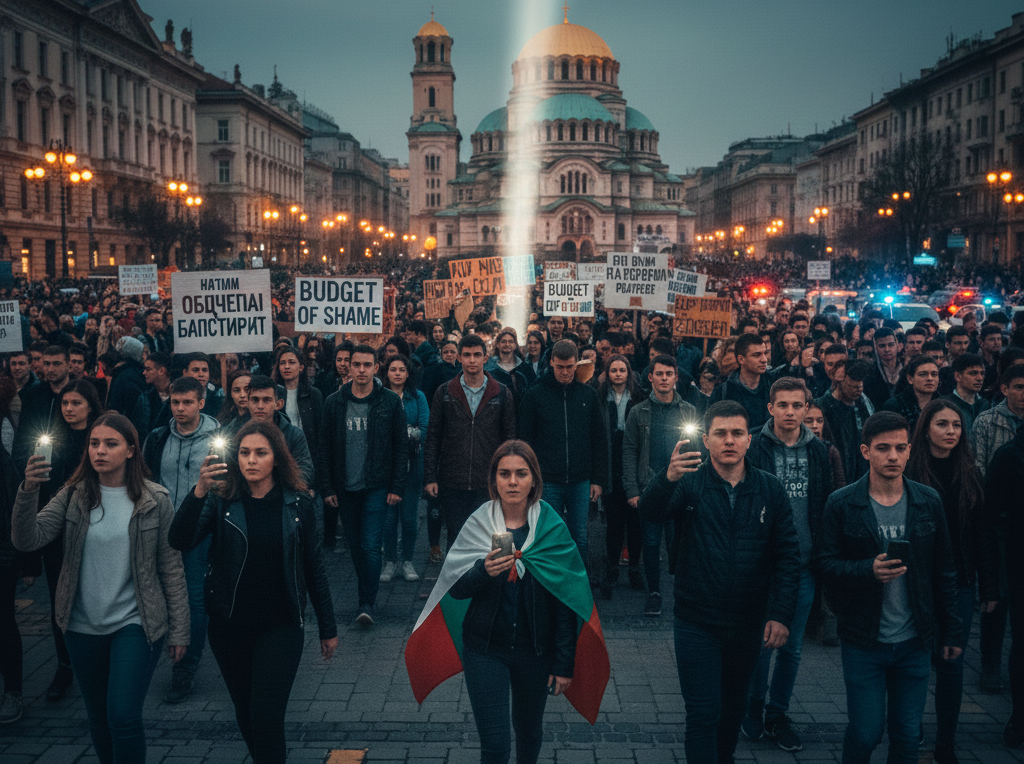
Bulgaria’s government has stepped down after weeks of street protests that swelled into the largest nationwide mobilisation in years, with younger Bulgarians playing an outsized role in driving momentum. The resignation, announced on December 11 and formally accepted by lawmakers on December 12, lands at an especially tense moment: Bulgaria is due to adopt the euro on January 1, 2026.
The immediate spark was a draft 2026 budget that many protesters viewed as the wrong mix of higher burdens and old habits. But the anger quickly widened into something deeper and harder to defuse: a long-running belief that power is captured, corruption goes unpunished, and elections do not fully deliver accountability.
This piece explains what changed in Sofia this week, what the protests were really demanding, and why the fallout will likely outlast the cabinet that just fell. It also maps the short list of plausible next steps, from an interim government to another snap election, and what each path means for ordinary people and the euro transition.
The story turns on whether Bulgaria can change how it is governed without derailing the stability it needs to pull off a currency switch.
Key Points
Bulgaria’s prime minister announced the government’s resignation on December 11, just before a scheduled no-confidence vote, and parliament accepted the resignation on December 12.
The protests began in late November around a controversial 2026 budget proposal, then expanded into broader anti-corruption and accountability demands.
Young people and students were highly visible in the demonstrations, but the movement drew a wider coalition across age groups and cities.
Bulgaria is scheduled to adopt the euro on January 1, 2026, raising the stakes for budget decisions, price oversight, and political continuity.
The president now starts the process of offering mandates to form a new government; failure would likely trigger an interim cabinet and snap elections.
The next government, elected or interim, will inherit the same constraints: a fragmented parliament, low institutional trust, and pressure to prove the euro switch will not become a price shock.
Background: Gen-Z protests topple Bulgarian government
The protests started in late November, after the government presented plans for a 2026 budget that included measures such as higher social security contributions and higher taxes on dividends to support increased state spending. The plan became a lightning rod. Some saw it as an unfair squeeze during a period when trust in institutions is already thin. Others saw something more structural: the idea that ordinary taxpayers are asked to pay more while entrenched networks remain untouched.
As rallies grew, the government moved to withdraw the contentious budget plan. That step did not end the demonstrations. Instead, it validated a belief among protesters that pressure works, and it shifted demands from “change the budget” to “change the government.”
Crowds gathered in Sofia and across other major cities. At peak moments, estimates ranged from tens of thousands to well over 100,000 participants nationwide, depending on how counts were made and which events were included. Organisers described the movement as civic and values-driven, while the government argued it could have survived another no-confidence vote in parliament.
A central theme in the protests was the perception of “shadow influence” in Bulgarian politics: the claim that formal coalitions matter less than informal leverage. Demonstrators targeted the idea of oligarchic control and pointed repeatedly to political figures they associate with captured institutions and compromised enforcement.
On December 11, the prime minister announced that the cabinet would resign ahead of a no-confidence vote. On December 12, lawmakers formally accepted the resignation, setting Bulgaria onto a familiar but unstable track: attempts to form a new coalition under tight deadlines, with the risk of yet another election.
Analysis
Political and Geopolitical Dimensions
Domestically, the resignation is less an endpoint than a reset. Bulgaria’s parliament has been fractured for years, and governments have struggled to last. The immediate political math is unforgiving: forming a stable majority requires coalitions among parties with competing red lines, mutual distrust, and reputations shaped by past alliances.
The president’s role now becomes pivotal. The process of handing mandates to form a government can produce a last-minute coalition, but it can also become a formal pathway to an interim administration and a snap vote. If the largest party refuses the mandate, or cannot assemble a majority, the window for a durable political solution narrows quickly.
Internationally, Bulgaria is an EU and NATO member on the edge of a major integration milestone: euro adoption. European partners will focus on continuity and technical readiness. They will also be watching how Bulgaria handles legitimacy questions—because a currency switch requires trust in price supervision, enforcement, and clear public communication. Political turmoil does not automatically stop a euro transition, but it raises the risk of mistakes, mixed messages, and opportunistic price behavior.
The geopolitical stakes are quieter than in a war-zone story, but they are real: Bulgaria sits on the Black Sea, is part of key regional logistics and energy routes, and is often a test case for how the EU deals with rule-of-law problems inside its own borders. A protest-driven resignation puts those issues back in the spotlight.
Economic and Market Impact
The core economic issue is not simply “budget versus protest,” but timing. A government falling weeks before a euro changeover is a stress test for state capacity. Even if the euro entry date holds, the machinery required—dual pricing, consumer protections, enforcement against price gouging, coordination with retailers, and public confidence—depends on competent administration.
A revised 2026 budget can still pass, but the political legitimacy to implement unpopular measures is weaker under a resigning cabinet. That matters for everything from public-sector wage commitments to investment planning and credit conditions for households.
For markets and businesses, the near-term concern is uncertainty rather than immediate collapse. Investors and employers can tolerate politics that is noisy if policy execution stays predictable. The worry is a cycle where repeated elections freeze decisions, weaken oversight, and leave the euro changeover exposed to rumors and resentment.
For ordinary people, the economic fear is simpler: prices. In many euro transitions, the public believes the changeover was used as cover for rounding up. Even if overall inflation does not spike, trust can. A government crisis amplifies that anxiety.
Social and Cultural Fallout
Calling this purely a “Gen-Z uprising” misses half the story. Younger people were clearly central in turnout, organizing energy, and the aesthetics of protest—fast mobilization, heavy social media presence, and a sharper intolerance for opaque power. But the crowds also included working-age voters and older citizens whose frustration is rooted in lived experience: stalled reforms, weak accountability, and a sense that the same people cycle through influence no matter who wins.
What is culturally striking is not only anger but confidence. The withdrawal of the budget plan, followed by the resignation, reinforces the idea that mass civic action can still force elite decisions in a system often described as captured or cynical. That can be empowering, but it can also raise expectations that politics will now deliver clean results quickly—an expectation Bulgaria’s institutions may not be able to meet.
If a snap election follows and produces another fragmented parliament, disappointment could set in fast. The next wave of pressure may not look like festive rallies. It could look like deeper disengagement, emigration, or radicalization of political identities.
Technological and Security Implications
The protests underscore how modern political movements are built now: online-first, leader-light, and fast. Mobilization through short-form video, messaging apps, and influencer-style networks can outpace traditional party structures. That can broaden participation, especially among younger citizens who distrust institutions, but it also creates vulnerabilities.
Authorities will face pressure to prevent violence, provocations, and disinformation while respecting the right to protest. Protest movements will face the mirror problem: keeping demonstrations open and large while limiting infiltration or escalation that can delegitimize the cause.
There is also a quieter security angle: state legitimacy. When large groups believe law enforcement, prosecutors, or the judiciary serve factions rather than rules, the state’s ability to manage any crisis—financial, cyber, or public order—degrades over time. The argument in the streets is ultimately about whether the system can be trusted to enforce its own standards.
What Most Coverage Misses
The overlooked factor is the euro switch as a political accelerant. The budget dispute mattered partly because it was tied to euro readiness and a first budget framed in the logic of the new currency era. That made the fight feel like a closing window: if institutions are captured, euro adoption becomes not just a technical change but a lock-in of a flawed system.
There is also a second-order effect: protests can topple governments faster than they can build replacements. Removing a cabinet is a clear outcome. Reforming the invisible webs of influence that protesters are angry about is slower, bureaucratic, and often boring. That gap—between dramatic street wins and slow institutional change—is where trust either consolidates or collapses.
Why This Matters
In the short term, Bulgaria’s biggest risk is not that it will suddenly stop functioning, but that it will drift into caretaker governance at the exact moment it needs sharp execution. Retailers, banks, employers, and regulators all need clear rules and consistent messaging ahead of January 1, 2026.
In the longer term, the resignation is another data point in a broader European pattern: younger voters pushing back against corruption, opacity, and perceived impunity, often outside traditional party structures. If Bulgaria cannot translate this civic moment into credible enforcement and cleaner elections, the likely outcome is not calm—it is repetition.
Concrete events to watch next include: the president’s mandate process to form a new government; parliamentary movement on a revised 2026 budget; and any formal announcement of an interim cabinet or a snap election timetable. The euro changeover date of January 1, 2026 is the hard deadline hanging over all of it.
Real-World Impact
A supermarket manager in Sofia is preparing for dual pricing and customer anger. Even if costs stay stable, shoppers will scrutinize every label. If there is no trusted government voice explaining the change, staff on the floor become the target for national frustration.
A young professional in Varna who supports euro adoption now faces a dilemma. The resignation feels like proof that protest works, but it also raises the risk of another election cycle that delays reforms. The question becomes whether to stay and push for change, or leave for a more predictable future elsewhere in the EU.
A small manufacturer outside Plovdiv is trying to price contracts for early 2026. Currency conversion should simplify trade on paper. But political uncertainty can slow permits, payments, and public procurement decisions—exactly the things that keep smaller firms alive.
A pensioner on a fixed income in a coastal town worries about “rounding up.” Even if official inflation stays modest, the fear is practical: bread, heating, and medication feeling more expensive after January. Trust in enforcement will shape whether that fear becomes reality.
Road Ahead
Bulgaria’s resignation drama is not only about a budget or a week of rallies. It is about whether a European state can rebuild trust in the basic idea that rules apply to the powerful as well as the ordinary.
The fork in the road is clear. One path is an interim government and another election that reproduces the same fragmentation, pushing the hard questions further down the line. The other is a coalition—however imperfect—that treats euro adoption as a responsibility to prove competence and fairness, while taking visible steps to reduce the perception of capture.
The early signals will be practical, not rhetorical: whether a functioning cabinet forms quickly; whether budget revisions are transparent and credible; whether price oversight for the euro transition is serious; and whether the next electoral process is seen as cleaner than the last. If those pieces fall into place, this could become a turning point. If they do not, it becomes another chapter in a cycle Bulgaria has struggled to break.
