Hantavirus Cruise Crisis Expands As Global Tracing Intensifies And Fears Grow Over Rare Human Transmission
The Deadly Cruise Ship Virus That Has Governments Scrambling Across Continents
The Cruise Ship Virus Panic Escalates Across The World As Authorities Race To Trace Passengers
A Remote Antarctic Expedition Has Turned Into A Multi-Country Health Emergency With Authorities Racing To Track Passengers Across The Globe
The images feel disturbingly familiar. Passengers confined to cabins. Emergency evacuations. International tracing operations. Governments quietly monitoring returning travelers. Health agencies are attempting to calm fears while simultaneously preparing for something that could be much bigger.
This time, the concern is not COVID-19.
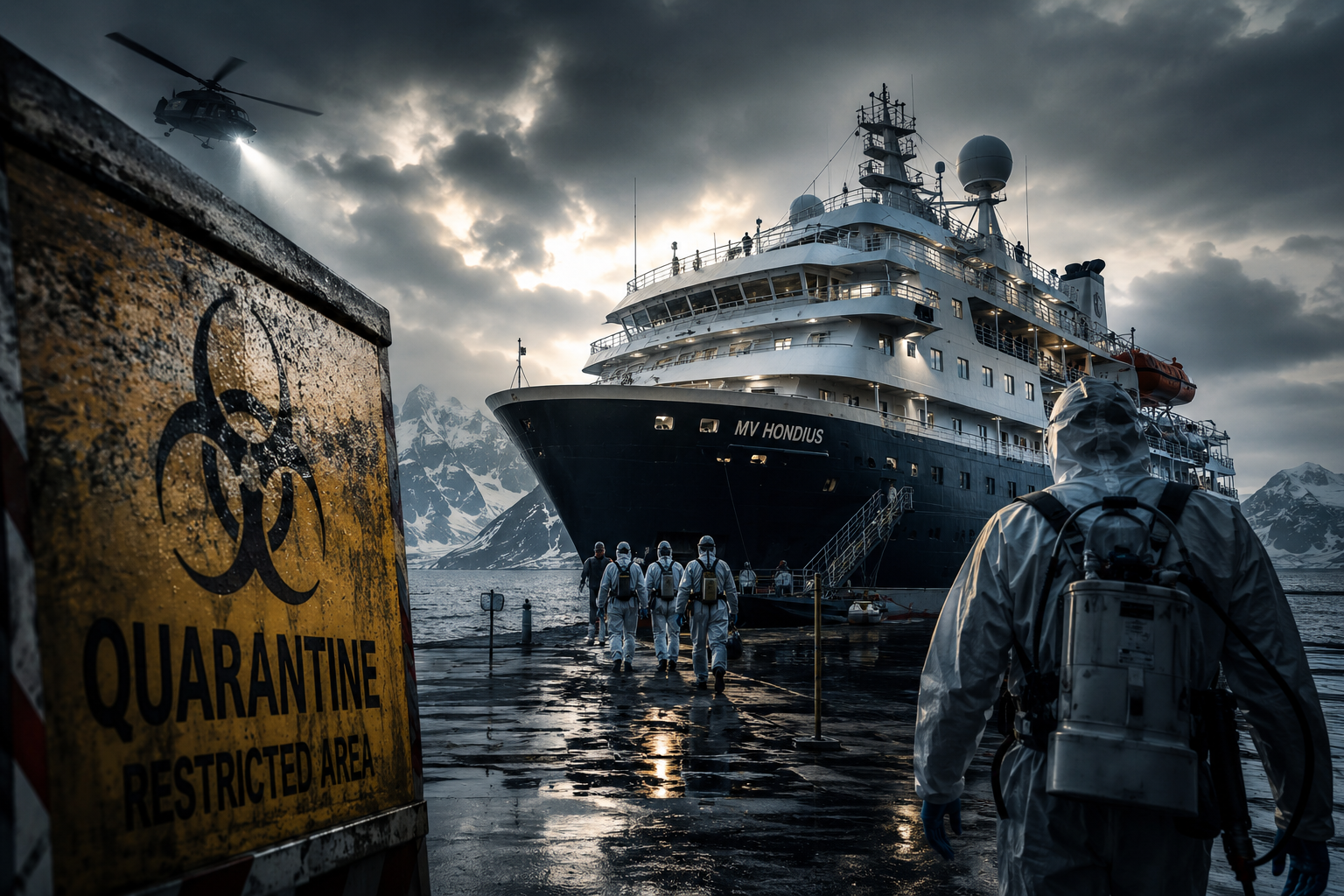
It is hantavirus—specifically the rare Andes strain linked to a growing outbreak aboard the expedition cruise ship MV Hondius. The situation has already resulted in multiple deaths, several confirmed and suspected infections, emergency medical evacuations, and a rapidly expanding international contact-tracing operation stretching across Europe, Africa, and beyond.
The outbreak has triggered particular concern because the Andes strain is the only known hantavirus variant capable of rare human-to-human transmission. That single detail has transformed what might otherwise have been viewed as an isolated infectious disease incident into a story now being watched closely by global health authorities.
For now, officials insist that the overall public risk remains low.
But the scale of the tracing effort tells a more complicated story.
The Cruise Ship At The Center Of The Crisis
The MV Hondius is not a typical holiday cruise liner packed with casinos and pool decks. It is a Dutch-operated polar expedition vessel designed for remote Antarctic voyages and scientific-style exploration trips. In early April, the ship departed Argentina carrying passengers and crew from more than 20 nationalities.
What began as a luxury expedition through isolated regions of the South Atlantic gradually turned into something far darker.
According to international health agencies, passengers aboard the ship began developing severe respiratory symptoms over several weeks. Some cases rapidly progressed into pneumonia, respiratory distress, and shock. Several people died. Others became critically ill and required evacuation.
The outbreak was eventually linked to hantavirus infections associated with the Andes strain, a variant primarily found in parts of South America.
Authorities now believe some passengers may have been exposed before boarding the vessel during land excursions in Argentina. Investigators are also examining whether limited onboard transmission occurred between close contacts.
That distinction matters enormously.
Most hantaviruses spread through contact with infected rodents or contaminated droppings. Human transmission is extremely unusual. The Andes strain is the major exception.
Why This Story Is Triggering Pandemic Anxiety
Scientifically, this outbreak is nowhere near another COVID-scale event.
Psychologically, however, it presses almost every modern public-health pressure point simultaneously.
A deadly respiratory illness. International travel. Cruise ships. Delayed identification. Passenger tracing across multiple countries. Isolation protocols. Quarantine fears. Uncertainty around transmission. Viral social media speculation.
The overlap with collective pandemic memory is obvious.
That does not mean the threat level is equivalent. Experts continue stressing that human-to-human transmission of Andes hantavirus is rare and generally linked to prolonged close contact.
Still, the numbers alone explain why authorities reacted aggressively.
Passengers reportedly disembarked in locations including St. Helena before anyone fully understood the outbreak. Travelers then boarded international flights to destinations across Europe and elsewhere. Health agencies from multiple countries have since begun monitoring exposed individuals and tracing potential contacts.
The Netherlands, Switzerland, South Africa, the United Kingdom, and the United States are among the countries involved in monitoring or tracing operations connected to the outbreak.
One flight attendant, who had been exposed to an infected passenger, was reportedly hospitalized for evaluation, which further intensified public attention around the case.
That is the kind of headline detail capable of spreading fear much faster than the virus itself.
What Hantavirus Actually Does To The Human Body
Hantavirus infections can begin deceptively mildly.
Early symptoms often resemble flu-like illness: fever, muscle pain, fatigue, headaches, and gastrointestinal problems. In severe cases, patients can rapidly deteriorate into hantavirus pulmonary syndrome, a life-threatening respiratory condition involving fluid buildup in the lungs and acute breathing failure.
There is currently no specific antiviral cure.
Treatment mainly focuses on intensive supportive care, oxygen support, and rapid hospitalization.
The high fatality rate for severe Andes strain infections partly explains why health authorities moved so aggressively once they recognized the outbreak.
At the same time, specialists continue emphasizing that the Andes strain is not a virus with the same transmission profile as influenza or COVID-19.
That nuance matters.
The danger is real, but the mechanics of spread appear far more limited based on current evidence.
The Cruise Industry’s Worst Nightmare Returning
Cruise ships became global symbols of pandemic vulnerability during the early COVID era. Few images defined that period more vividly than large vessels stranded offshore while infections spread inside sealed environments.
The MV Hondius outbreak has reopened that psychological scar almost instantly.
A confined vessel carrying international passengers through isolated regions creates ideal conditions for fear, rumor, and uncertainty. Even relatively small outbreaks become visually dramatic because the setting itself feels cinematic and vulnerable.
Passengers aboard the ship have reportedly faced cabin isolation measures while authorities coordinated testing, evacuations, and docking decisions. Spain ultimately agreed to allow the vessel toward the Canary Islands for controlled disembarkation and health procedures after earlier concerns about docking access intensified political tension around the case.
That sequence has reminded many observers how quickly infectious disease incidents can evolve into logistical and diplomatic crises once international travel becomes involved.
The Detail Most People Are Missing
The most significant lesson from this outbreak is not necessarily about hantavirus itself.
It is about how fragile global confidence remains after COVID-19.
Even a relatively limited outbreak involving a rare virus immediately triggered worldwide attention because governments, health agencies, and the public now react through the lens of recent pandemic trauma. Every unusual cluster is interpreted against memories of delayed responses, overwhelmed systems, and global disruption.
That changes the information environment around disease outbreaks permanently.
Health authorities are now forced to balance two competing risks simultaneously:
Underreacting to a potentially dangerous situation
Fueling panic through visible emergency measures
The MV Hondius outbreak demonstrates how difficult that balancing act has become.
Officials repeatedly stress that the broader public risk remains low. Yet the same officials are simultaneously conducting international tracing operations, coordinating cross-border monitoring and deploying emergency containment measures.
To many people, those two messages feel contradictory even when they are scientifically compatible.
Could This Become Something Bigger?
Currently, there is no evidence suggesting a large-scale global outbreak is developing.
That point is crucial.
The current concern centers on a specific cluster involving a rare strain capable of unusual transmission behavior under limited circumstances. Health agencies are actively investigating exposures, sequencing cases, and monitoring passengers precisely because containment appears achievable at this stage.
Still, the incident exposes uncomfortable realities about modern infectious disease risk.
Remote tourism, climate shifts affecting rodent populations, expanding human interaction with wildlife environments, and constant international travel all increase opportunities for rare pathogens to move rapidly across borders before detection.
The world may not be facing “the next COVID.”
But it is absolutely entering an era where unusual outbreaks can become international crises with astonishing speed.
The MV Hondius outbreak is a reminder that global health emergencies no longer begin only inside crowded cities or massive airports. Occasionally they begin quietly aboard a remote expedition vessel crossing cold water thousands of miles from public attention.
And by the time the world notices, the tracing operation has already begun
